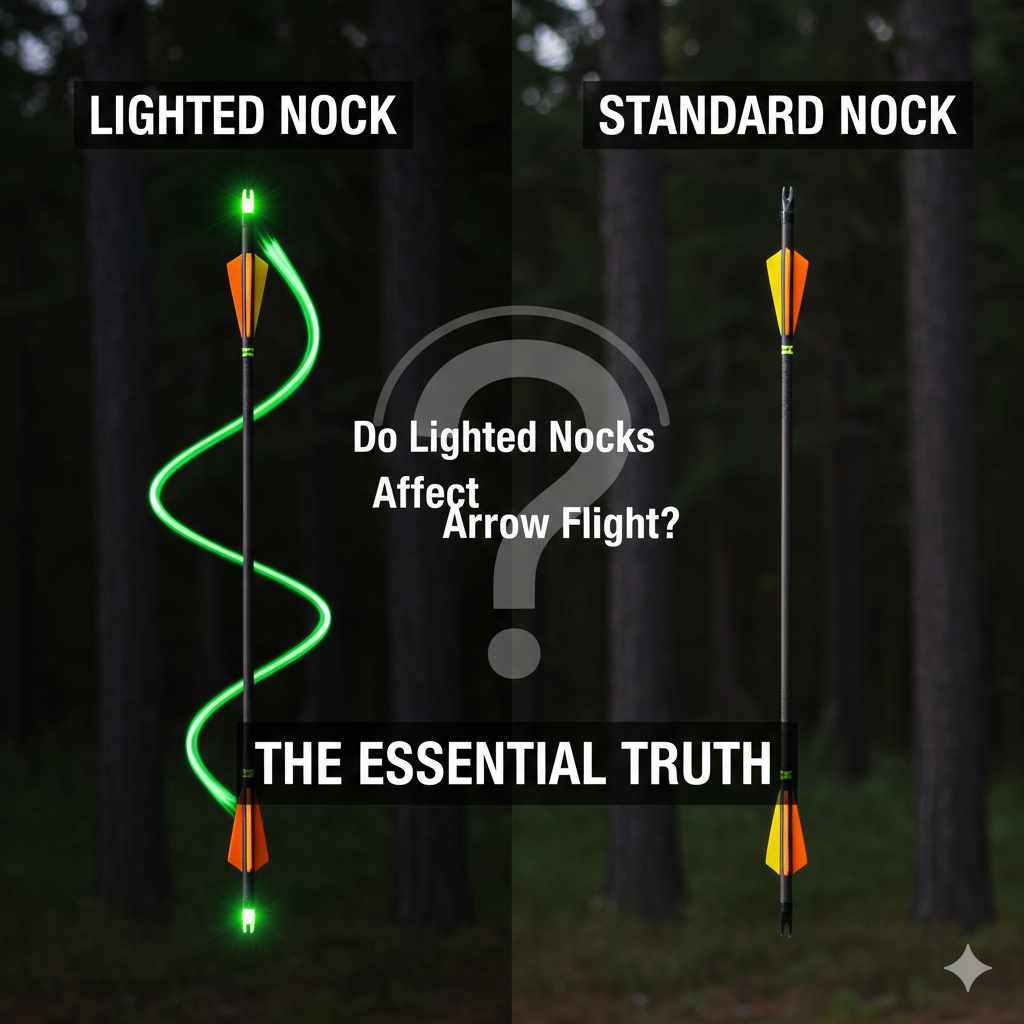
Yes, lighted nocks do affect arrow flight, but the change is usually small and easily corrected. Because they are heavier than standard nocks, they add weight to the back of your arrow. This can cause your arrow to hit slightly lower and may slightly change its balance. However, with a few simple sight adjustments, you can maintain excellent accuracy.
Have you ever watched your arrow disappear into the twilight, wondering exactly where it went? It’s a common feeling for archers, especially when hunting or shooting at long distances. That’s where lighted nocks come in. They look cool, but they also raise a big question: does adding a tiny light to your arrow mess up its flight?
It’s a great question, and you’re smart to ask it. The short answer is yes, but it’s not a deal-breaker. In fact, for many archers, the benefits far outweigh the tiny adjustments needed. This guide will walk you through everything you need to know. We’ll cover how lighted nocks work, how they affect your arrow, and a simple, step-by-step process to make sure you stay dead-on accurate. Let’s get you shooting with confidence!
What Are Lighted Nocks and Why Use Them?
Before we dive into the physics, let’s cover the basics. A lighted nock is a replacement for the standard plastic nock on the back of your arrow. It contains a tiny, battery-powered LED light. When you shoot your bow, the force from the bowstring activates the nock, causing it to light up. It creates a bright, visible streak in the air, much like a tracer round.
This simple piece of technology offers some amazing advantages, which is why they’ve become so popular with bowhunters and target archers alike.
The Big Benefits for Archers
- See Your Shot: The most obvious benefit is tracking your arrow’s path. In low light conditions, like early morning or late evening hunts, seeing a bright red or green light fly toward the target is incredibly helpful. It gives you instant feedback on your shot trajectory.
- Find Your Arrow: This is a huge one. Arrows are expensive, and losing them is frustrating. A glowing nock makes finding an arrow in tall grass, thick brush, or after dusk much, much easier. It can turn a 30-minute search into a 30-second recovery.
- Confirm Your Hit: For bowhunters, seeing the arrow’s flight path helps confirm the shot placement on an animal. This information is critical for making ethical and effective recovery decisions.
- Practice and Tuning Feedback: When you’re practicing, a lighted nock can reveal subtle flaws in your arrow flight that might be hard to see otherwise. If you see your arrow kicking sideways or porpoising (bouncing up and down), it’s a clear sign that your bow needs a tune-up.

The Million-Dollar Question: Do They Change How Your Arrow Flies?
Alright, let’s get straight to the heart of the matter. The simple, honest answer is yes, lighted nocks change how your arrow flies. But before you worry, let me add the most important part: the change is predictable, consistent, and very easy to fix.
Think of it like this: if you switch from wearing sneakers to wearing hiking boots, your feet feel a little heavier. You might walk a tiny bit differently at first, but your body quickly adjusts. It’s the same principle with your arrow. You’re adding a little weight, so it will behave a little differently. The key is knowing what to expect and how to adjust for it.
The change isn’t random or chaotic. It’s based on simple physics. Once you make a couple of small tweaks to your setup, your arrows with lighted nocks will fly just as accurately as your old arrows did. For thousands of archers, this small adjustment is a tiny price to pay for the huge benefit of never losing an arrow again.
How Exactly Does a Lighted Nock Affect Arrow Flight?
The impact of a lighted nock on arrow flight comes down to three key factors: weight, Front of Center (FOC) balance, and arrow spine. Don’t let these terms scare you! They are very simple concepts, and understanding them will make you a much better archer.
1. The Weight Factor
This is the most direct change. A standard nock weighs around 10-12 grains. A lighted nock, with its battery and LED, typically weighs between 20 and 30 grains. While that difference of 10-20 grains sounds tiny (there are 7,000 grains in a pound), it’s enough to make a difference when it’s attached to a fast-moving arrow.
Adding weight to the arrow does two things:
- It makes the total arrow slightly heavier, which can slow it down a tiny bit.
- It adds that weight specifically to the rear of the arrow, which changes its balance point.
This change in balance is what we call FOC, and it’s the next important piece of the puzzle.
2. The Impact on FOC (Front of Center)
FOC sounds technical, but it’s just a measurement of how front-heavy your arrow is. Imagine trying to throw a dart backward. It wouldn’t work well, right? It needs to be front-heavy to fly straight. The same is true for an arrow. A proper FOC helps the arrow stabilize quickly and resist crosswinds, leading to better accuracy.
When you add weight to the nock (the back of the arrow), you shift the balance point backward. This reduces the FOC percentage. For example, an arrow with a healthy FOC of 12% might drop to 9% or 10% after you install a lighted nock. According to archery experts like Easton Archery, a lower FOC can potentially make an arrow slightly less stable in flight, especially at longer distances.
For most bowhunters shooting at typical distances (20-40 yards), this small change in FOC is often not even noticeable. However, it’s good to be aware of it, as it’s one of the reasons your arrow’s point of impact might shift.
3. The Effect on Arrow Spine
Arrow spine refers to how stiff the arrow is. When you fire an arrow, it doesn’t fly perfectly straight like a laser beam. It actually bends and flexes as it leaves the bow—this is called the “archer’s paradox.” The arrow’s stiffness, or spine, needs to be matched to the power of your bow for it to flex correctly and fly straight.
Adding weight to either end of the arrow changes its “dynamic spine,” which is how it behaves in flight. Adding weight to the back (with a lighted nock) makes the arrow act slightly stiffer. Your arrow shaft doesn’t actually get stiffer, but the added rear weight dampens its flex as it comes off the string. If your arrows were perfectly spined for your bow before, this change could cause a slight shift in its flight pattern, often showing up as a left or right impact change.
| Component | Standard Nock Setup | Lighted Nock Setup | The Impact |
|---|---|---|---|
| Nock Weight | ~11 Grains | ~25 Grains | Adds about 14 grains to the rear of the arrow. |
| Total Arrow Weight | 450 Grains (Example) | 464 Grains (Example) | Slightly heavier arrow, which may hit a little lower. |
| FOC (Front of Center) | ~12% | ~9.5% | Reduces the forward balance, potentially affecting long-range stability. |
| Dynamic Spine | Perfectly matched | Acts slightly stiffer | May cause a minor left or right shift in arrow impact. |
How to Tune Your Bow for Lighted Nocks: A Step-by-Step Guide
Reading about FOC and spine can seem complicated, but fixing the issue is surprisingly simple. You don’t need to be a professional bow tech. You just need to follow a few easy steps to get your bow shooting perfectly with your new lighted nocks.
Before You Start: What You’ll Need
- Your bow
- A few arrows with your standard nocks
- A few arrows with your new lighted nocks installed
- A target set at a comfortable distance (20 yards is perfect)
- Allen wrenches for adjusting your sight
Step 1: Establish Your Baseline
First, we need to know where you’re starting from. Head to the range and shoot a group of 3-5 arrows using your normal arrows with standard nocks. Don’t worry about hitting the bullseye just yet. The goal is to shoot a tight, consistent group. This is your baseline—it shows you where your perfectly tuned setup hits.
Step 2: Switch to Lighted Nocks
Now, without changing anything on your bow, switch to your arrows with lighted nocks. Shoot another group of 3-5 arrows at the same spot on the target. Take your time and focus on making good, consistent shots. The goal is to see exactly how the lighted nocks have changed your point of impact.
Step 3: Compare and Analyze the Results
Walk up to the target and look at your two groups. You will most likely see that your lighted nock group is hitting in a different spot than your standard nock group. The most common result is that the lighted nock group will be a few inches lower than the original group. It might also be slightly to the left or right.
This is completely normal! It’s the extra weight and change in spine at work. Now that you can see the difference, you can easily fix it.
| Symptom (Where Your Lighted Nocks Hit) | Likely Cause | Simple Solution |
|---|---|---|
| Arrows Hit Low | The added weight of the nock makes the arrow drop slightly faster. | Move your sight pin down. |
| Arrows Hit Left or Right | The change in dynamic spine is causing the arrow to plane sideways. | Move your sight pin in the direction of the miss (chase the arrow). |
| Arrows Hit High | Very unlikely, but could be related to a unique tuning issue or form change. | Move your sight pin up. |
Step 4: Make Small Sight Adjustments
This is where the magic happens. The golden rule of adjusting a bow sight is: “Chase the arrow.”
- If your lighted nock arrows hit low, you need to move your sight pin down.
- If your lighted nock arrows hit to the left, you need to move your sight pin to the left.
- If they hit right, move your pin to the right.
Make very small adjustments at a time. Move the pin just a tiny bit, then shoot another group to see what changed. Repeat this process until your lighted nock arrows are hitting right where you’re aiming. For most archers, this is the only step they will need to take.
Step 5: Consider Your Arrow’s FOC (Advanced Tuning)
If you’ve adjusted your sights and still feel like your groups aren’t as tight as they used to be (especially at 40 yards or more), you might want to address the change in FOC. The easiest way to do this is to add weight back to the front of the arrow to restore its forward balance.
You can do this by switching to a heavier field point or broadhead. For example, if you are shooting 100-grain points, try switching to 125-grain points. This will increase your FOC and can help tighten up your long-range groups. Just remember, changing your point weight will require you to go back to Step 4 and readjust your sights, as the heavier arrow will shoot lower.
Pros and Cons of Using Lighted Nocks
Like any piece of archery gear, lighted nocks have their upsides and downsides. Deciding if they are right for you is a matter of weighing these factors.
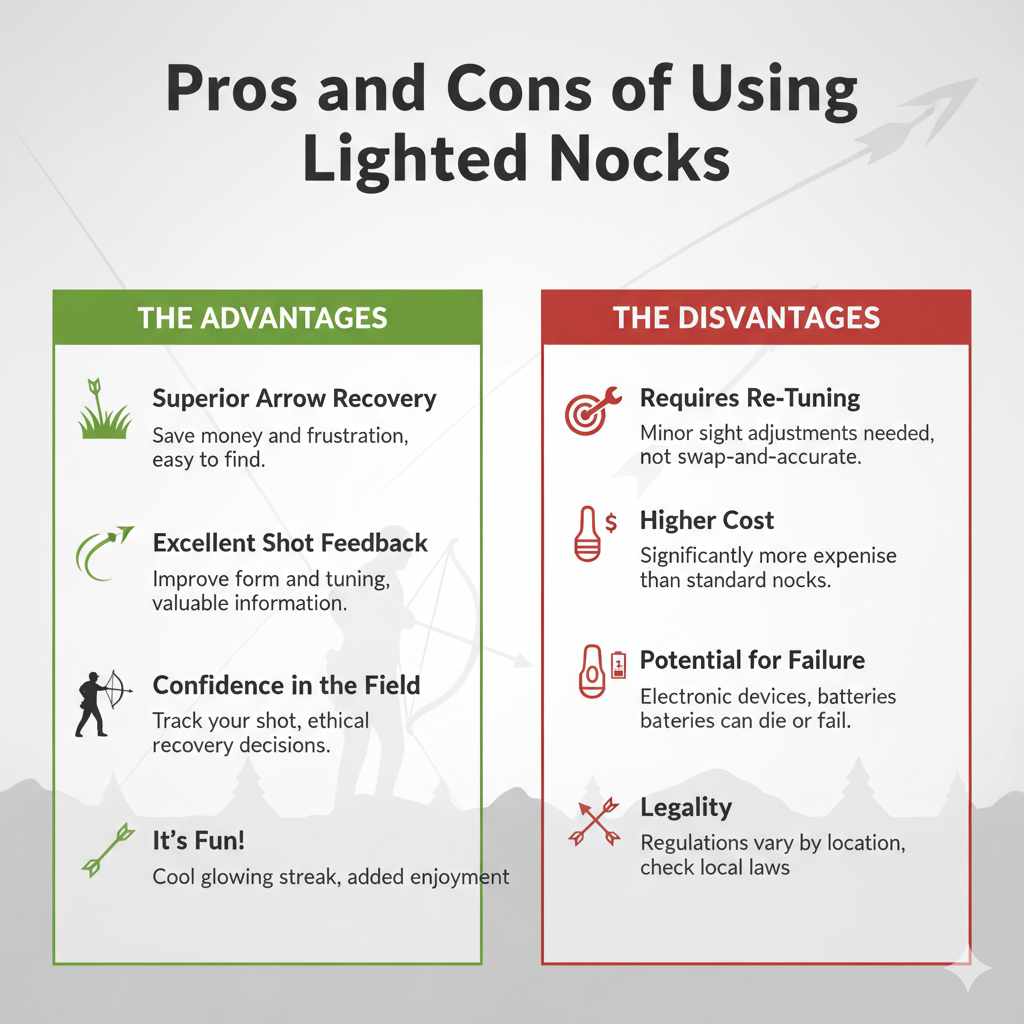
The Advantages
- Superior Arrow Recovery: This is the number one reason people use them. They can save you a lot of money and frustration by making arrows easy to find.
- Excellent Shot Feedback: Seeing the arrow’s flight gives you valuable information to improve your form and tuning.
- Confidence in the Field: Especially for bowhunters, knowing you can track your shot provides peace of mind and helps in making ethical recovery decisions.
- It’s Fun!: Let’s be honest, watching a glowing streak fly through the air is just plain cool. It adds another layer of enjoyment to shooting.
The Disadvantages
- Requires Re-Tuning: As we’ve discussed, you will need to make minor sight adjustments. You can’t just swap them in and expect to be accurate.
- Higher Cost: Lighted nocks are significantly more expensive than standard nocks.
- Potential for Failure: They are electronic devices with batteries. They can fail to light up, or the batteries can die over time.
- Legality: Some states and provinces have regulations regarding electronic components on arrows for hunting. Always check your local hunting regulations before using them in the field.
Frequently Asked Questions (FAQ)
Will a lighted nock make me less accurate?
No, not if you properly tune your bow for them. An untuned setup with lighted nocks will be less accurate, but after a few simple sight adjustments, you can be just as accurate as you were with standard nocks.
How much weight does a lighted nock add?
A lighted nock typically adds between 10 and 20 grains of weight compared to a standard nock. A standard nock is about 11 grains, while a lighted nock is usually between 20 and 30 grains.
Do I need to re-tune my broadheads after switching to lighted nocks?
Yes, absolutely. Since lighted nocks change your arrow’s flight, you must verify your broadhead’s point of impact. You should always practice with the exact setup (arrow, broadhead, and nock) that you plan to hunt with.
Are lighted nocks legal for hunting everywhere?
No. While they are legal in most places, a few states have specific restrictions against electronic devices on arrows. It is your responsibility to check your local fish and game regulations before heading out on a hunt.
Can I practice with standard nocks and hunt with lighted nocks?
This is not recommended. To ensure the best accuracy, you should have dedicated practice arrows that are identical to your hunting arrows, including the lighted nocks. If you want to save battery life, you can practice with the lighted nocks without activating them.
How long do lighted nock batteries last?
Most lighted nock batteries are rated for over 20 hours of continuous use. This is more than enough for finding your arrow, even if you have to leave it overnight. The batteries have a long shelf life but can lose power over several years.
Conclusion: Are Lighted Nocks Right for You?
So, we come back to our original question: do lighted nocks affect arrow flight? The answer is a clear yes. But the more important truth is that this effect is small, predictable, and easily managed with basic tuning.
For the vast majority of archers, especially bowhunters, the incredible benefit of seeing your shot and quickly recovering your arrow is well worth the five minutes it takes to adjust your sight pins. The confidence and peace of mind they provide in the field are invaluable.
Don’t be intimidated by the technical talk of spine and FOC. Think of it simply as adding a new piece of equipment that requires a quick check-up. By following the simple steps outlined above, you can get all the advantages of lighted nocks without sacrificing any of the accuracy you’ve worked so hard to build. Now, go get them tuned up and enjoy the light show!