
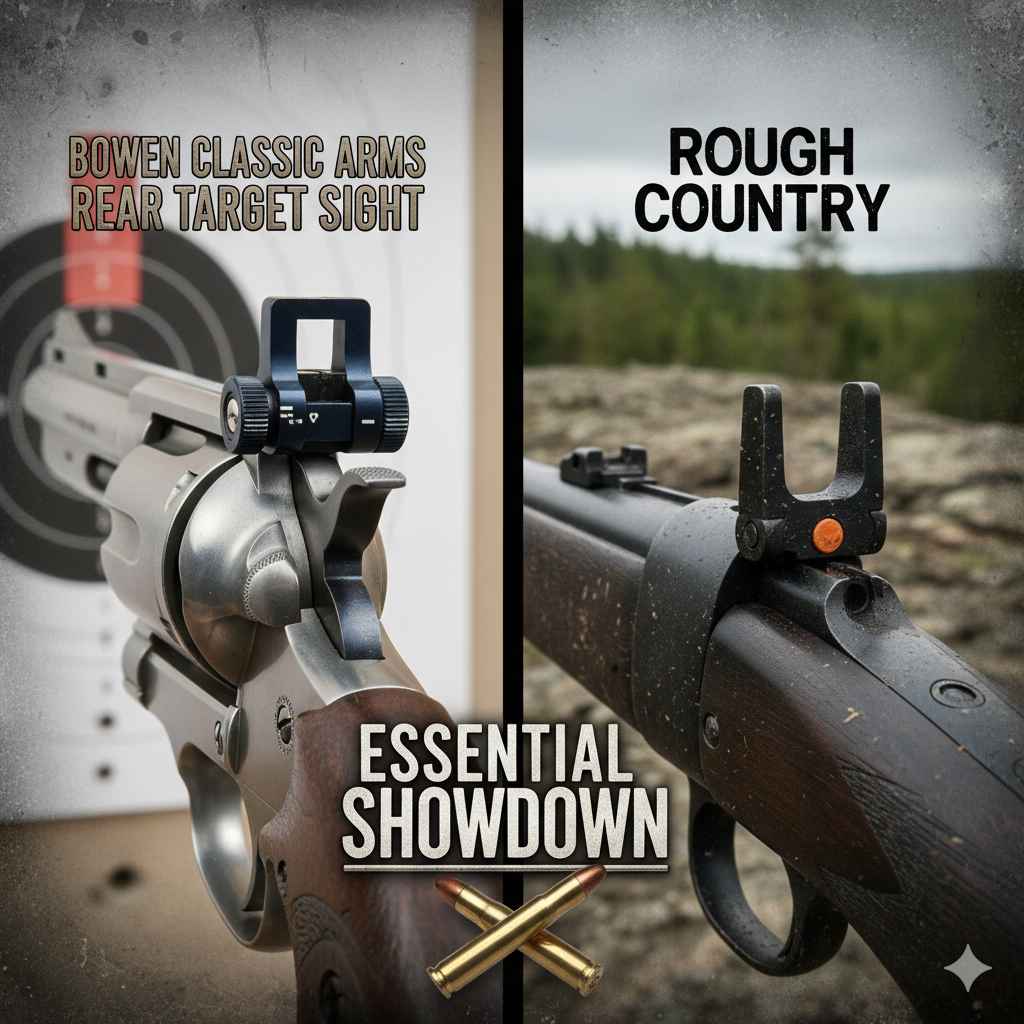
Choosing between the Bowen Classic Arms Rear Target Sight and a Rough Country sight depends on your rifle type and desired precision. Bowen excels in highly adjustable, traditional precision for lever actions, while Rough Country often focuses on durable, simple upgrades for modern sporting rifles, offering distinct performance trade-offs for varying shooting styles.
Picking the right rear sight can feel confusing when you are new to improving your rifle’s accuracy. You want sights that help you hit the bullseye, but complex terms like “target sight” and brand names can seem overwhelming. Do you need the fine-tuning of a Bowen, or the rugged simplicity of a Rough Country? Don’t worry! As your guide, I break down these two popular, yet very different, options. We will look at what makes each sight great for beginners and hobbyists. By the end of this guide, you will know exactly which sight fits your rifle and your shooting goals best. Let’s simplify this process so you can get back to enjoying your time at the range.
Understanding Rear Sights: Why the Upgrade Matters
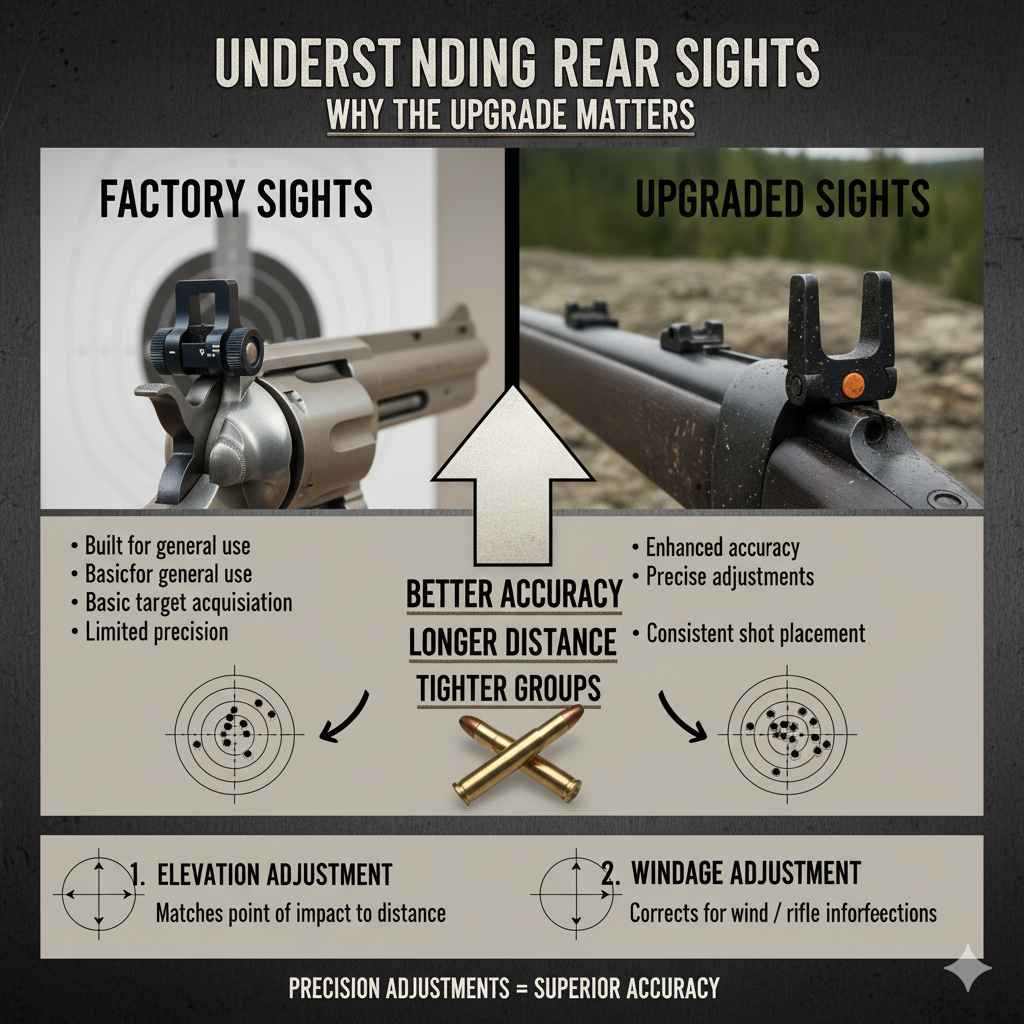
Before diving into the comparison, let’s quickly cover why upgrading your factory sights is often the first step toward better accuracy. Most factory sights are built for general use. They work fine for just seeing the target. However, if you want to group your shots tightly, especially at longer distances, you need something better.
Rear sights help you achieve precision in two key ways:
1. Elevation Adjustment: This lets you move the point of impact up or down so your bullets hit where you aim, regardless of the distance.
2. Windage Adjustment: This allows you to move the point of impact left or right to correct for wind or slight rifle imperfections.
The difference between a basic sight and a high-quality target sight like those from Bowen is the smoothness and precision of these adjustments.
Bowen Classic Arms Rear Target Sight: Precision Engineering for Classic Rifles
Bowen Classic Arms is highly respected in the world of lever-action rifles and classic firearms customization. When you choose a Bowen sight, you are usually choosing meticulous craftsmanship designed for serious target shooters or hunters needing reliable, repeatable accuracy.
Who is the Bowen Sight Best For?
The Bowen sight system shines brightest when mounted on lever-action rifles (like Marlins or Winchesters) or classic single-shot rifles where extreme precision is needed, often replacing a factory buckhorn sight.
Key Features of Bowen Target Sights
Bowen sights focus heavily on fine-tuning. They are built to be adjusted easily and hold their zero (stay accurately sighted) even after being moved.
Fine Adjustments: They typically offer very fine click adjustments for both elevation and windage. This means a small turn makes a small, predictable change in where your bullet lands.
Robust Construction: Made from quality steel, they are built to last and withstand the recoil of powerful cartridges.
Aesthetic Match: They are often designed to complement the classic look of older or customized firearms.
Pros and Cons of Choosing Bowen
For the beginner, it is important to weigh the benefits against the learning curve.
| Pros (What You Gain) | Cons (Things to Watch For) |
|---|---|
| Exceptional fine-tuning capabilities for pinpoint accuracy. | Higher initial cost compared to simpler options. |
| Holds zero reliably under heavy recoil. | Installation can sometimes require precise drilling or tapping of the receiver. |
| Excellent reputation in the precision lever-action community. | May be overkill if you only shoot short ranges casually. |
Rough Country Rear Sights: Durability and Simplicity for Modern Rifles
Rough Country is better known in the off-road and truck accessory world, but they also produce tactical and sporting firearm accessories, focusing heavily on durability and rugged performance, often paired with modern sporting rifles or scopes.
Who is the Rough Country Sight Best For?
Rough Country sights are often aimed at shooters who need something that can take a beating, survive harsh weather, and be very straightforward to use. They frequently feature simple elevation adjustments and robust mounting systems designed for quick installation on Picatinny or Weaver rails common on AR-style platforms.
Key Features of Rough Country Sights
The philosophy here seems to be “tough and simple.”
Rugged Design: Built to withstand bumps, drops, and environmental exposure.
Ease of Mounting: Often designed for tool-less or simple tool mounting onto standard rails.
Clear Sight Picture: While not always offering the micro-adjustments of a Bowen, the sight picture is usually designed for quick target acquisition.
Pros and Cons of Choosing Rough Country
If you prioritize ease of use and toughness over micro-adjustments, Rough Country offers great value.
| Pros (What You Gain) | Cons (Things to Watch For) |
|---|---|
| Excellent durability and weather resistance. | Adjustments might be coarser, making very fine tuning harder. |
| Often more budget-friendly for the entry-level upgrade. | May not fit perfectly on older or specialized classic receivers without adapters. |
| Straightforward, often rail-mounted installation. | Reputation is primarily outside the niche of dedicated target shooting. |
The Essential Showdown: Head-to-Head Comparison
To help you decide, let’s put the typical characteristics of a Bowen Classic Arms Target Sight against a representative Rough Country rear sight side-by-side. Remember, specific features vary by model, but this comparison reflects the general design philosophies.
Comparison Table: Bowen vs. Rough Country Philosophy
| Feature | Bowen Classic Arms Rear Target Sight | Rough Country Rear Sight (Typical) |
| :— | :— | :— |
| Primary Focus | Extreme Precision & Fine Adjustment | Durability & Quick Acquisition |
| Typical Platform | Lever-action, Single-shot Rifles | AR-style, Modern Sporting Rifles |
| Adjustment Type | Very fine, repeatable clicks | Simpler detents or large screws |
| Installation Need | Often requires receiver tapping/drilling | Usually mounts directly to existing rails |
| Target User | Hobbyist seeking competition-level grouping | Shooter needing a reliable backup or primary iron sight |
| Cost Level | Mid to High | Entry to Mid |
When to Lean Towards Bowen Classic Arms
You should strongly consider a Bowen sight if your main goal is competitive shooting accuracy on a traditional rifle platform, or if you frequently shoot at varying, longer distances where small sight adjustments significantly affect your impact point.
Think of Bowen like a high-end drafting pencil—every slight turn matters for precision work.
When to Lean Towards Rough Country
If you need a rugged, reliable sight that can handle being carried through the woods or used as a solid backup sight on a tactical rifle, and you mainly shoot at medium ranges where broad adjustments suffice, Rough Country often provides better value and toughness.
Think of Rough Country like a trusty, heavy-duty utility knife—it does its job reliably, no matter the conditions.
Installation Basics: Getting Your New Sights Mounted Safely
No matter which sight you choose, proper installation is crucial for safety and accuracy. A poorly mounted sight will never hold its zero. Always prioritize safety, which includes securely fastening the sight. Always consult the manual specific to your chosen sight.
General Steps for Mounting a Rear Sight
This process assumes you are mounting a sight onto existing receiver holes (common with Bowen) or a standard rail (common with Rough Country).
- Safety First: Unload your firearm completely. Visually and physically confirm the chamber is empty. Never work on a loaded firearm.
- Remove Old Sight (If Applicable): Carefully remove the existing rear sight. If removing a factory buckhorn, you may need specific tools to pry it up without damaging the receiver finish.
- Clean the Mounting Surface: Use a lint-free cloth and a mild solvent (like rubbing alcohol) to clean the area where the new sight will sit. A clean surface ensures the screws seat correctly.
- Position the New Sight: Place the new rear sight onto the mounting holes or rail. Ensure it is perfectly centered and aligned with the bore axis (if possible, use a bore sighting tool first).
- Apply Thread Locker (Crucial for Firearms): For screws holding iron sights, especially under heavy recoil, a small drop of medium-strength thread locker (like blue Loctite) is highly recommended. This prevents vibration from loosening the screws. Do not use high-strength red Loctite, as removal later will be extremely difficult.
- Torque the Screws: Tighten the mounting screws evenly, using a quality torque wrench if specified in the sight instructions. Tighten them in a crisscross pattern (like tightening lug nuts on a car tire) to ensure even pressure.
- Check Functionality: Once mounted, gently test the adjustment knobs. They should turn smoothly but offer enough resistance that they won’t move accidentally.
For detailed guidance on securely mounting accessories, understanding proper torque specifications is vital. Organizations like the Sporting Arms and Ammunition Manufacturers’ Institute (SAAMI) provide foundational standards for firearm assembly, which is good background reading for anyone serious about gunsmithing or mounting accessories.
The Crucial Next Step: Sighting In Your New Rear Sight
Installing the sight is only half the battle. You must “sight in” the rifle—meaning you must adjust the sight so that where you aim matches where the bullet lands at a specific distance.
Sighting In Simplified for Beginners
This process is often called “zeroing.” We recommend starting at a short, manageable distance, like 25 yards, especially for high-powered rifles.
Step 1: Set Initial Adjustments
If your sight has elevation adjustment, try to set both elevation and windage near the middle of their adjustment range. This gives you maximum room to move the point of impact up, down, left, or right during zeroing.
Step 2: Fire a Test Group
Shoot a group of 3–5 shots aimed consistently at the center of your target at 25 yards. Do not worry about hitting the center yet; just observe where the shots cluster.
Step 3: Analyze and Adjust
Look at where the center of your group landed relative to your aiming point.
If shots are too low: You need to raise the impact point. Adjust the elevation knob in the direction that raises the impact (often “Up”).
If shots are too far left: You need to move the impact point to the right. Adjust the windage knob in the direction that moves the impact right (often marked “R” for Right).
Step 4: Repeat Until Zeroed
Make one adjustment, fire another 3-5 shots, and repeat the analysis. Continue this process until the center of your group is consistently hitting the center of your aiming point at 25 yards.
Understanding MOA and Clicks
This is where target sights like Bowen often shine. Precision sights are often calibrated in Minutes of Angle (MOA).
1 MOA is roughly a 1-inch circle at 100 yards.
If your sight adjustment moves the point of impact 1/4 MOA per click, then at 100 yards, one click moves the bullet 0.25 inches. At 50 yards, one click moves the bullet 0.125 inches (1/8th of an inch).
Knowing your sight’s MOA-per-click value allows you to calculate adjustments much faster, especially when moving to longer ranges like 100 or 200 yards.
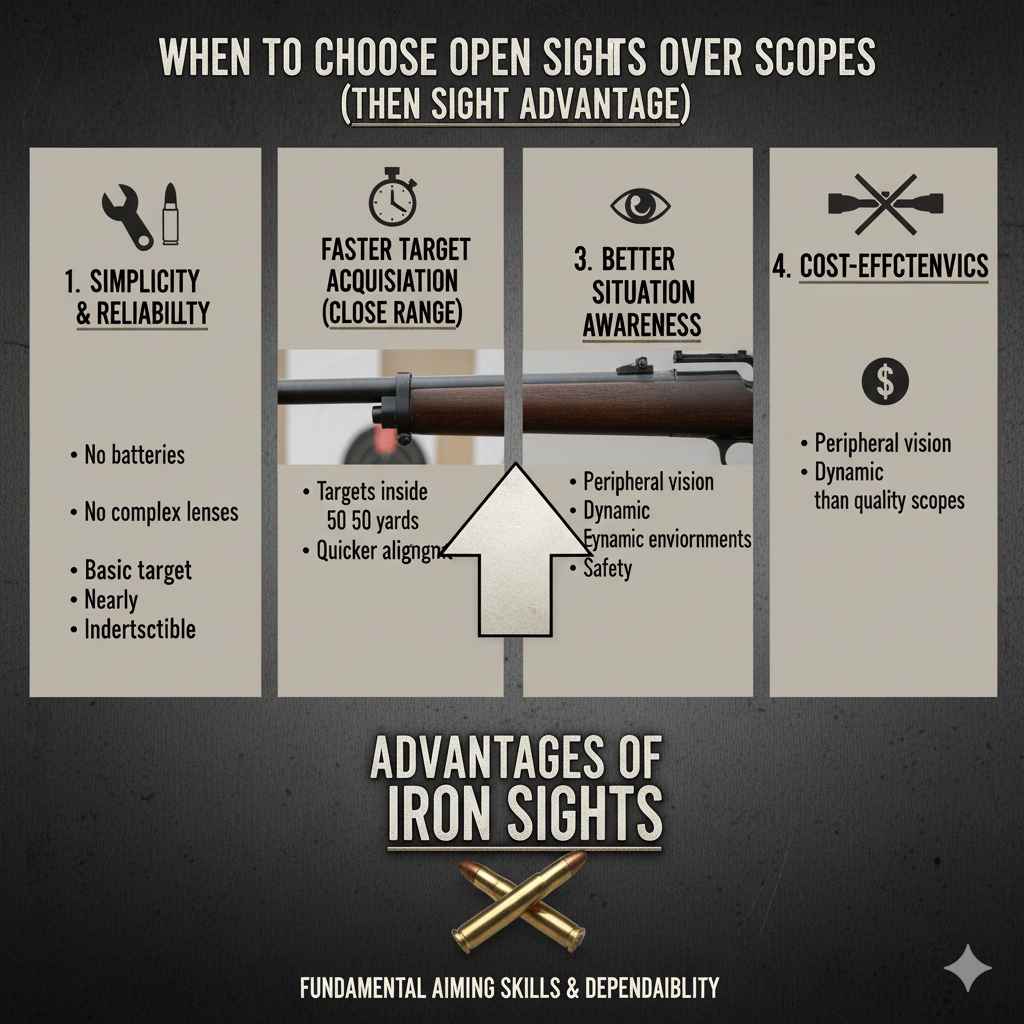
When to Choose Open Sights Over Scopes (The Iron Sight Advantage)
Some beginners feel they must have a scope. However, iron sights (like the Bowen and Rough Country options) offer distinct advantages, especially for beginners learning fundamental aiming skills.
Advantages of Iron Sights
1. Simplicity and Reliability: Iron sights have no batteries, no complex lenses, and are nearly indestructible compared to most scopes.
2. Faster Target Acquisition at Close Range: For targets inside 50 yards, aligning iron sights can often be quicker than zooming in with a variable scope.
3. Better Situational Awareness: Because your eye is closer to the bore axis and you look over the sights rather than through a tube, you maintain better peripheral vision. This is important for safety and situational awareness when hunting or shooting in dynamic environments.
4. Cost-Effectiveness: Quality iron sights are generally much less expensive than quality scopes.
Frequently Asked Questions (FAQ) for New Sight Buyers
Here are answers to common questions newcomers have about choosing and installing rear sights.
Q1: Do I need a specific front sight if I buy a new rear sight?
Yes, absolutely. Rear sights and front sights must work together. If you replace your rear sight, you often need to replace the front sight as well to ensure they match in height and style for proper zeroing. A high rear sight paired with a low front sight will mean you have to aim far below the target.
Q2: Can I use a Bowen sight on an AR-15?
While Bowen specializes in classic rifles, some models might be adapted for modern platforms. However, generally, Rough Country (or similar tactical sight manufacturers) are better designed for the standard Picatinny rails found on AR-15s. Always check the specific mounting base of the Bowen sight.
Q3: What is the most important adjustment: elevation or windage?
Both are equally important for ultimate accuracy, but for initial zeroing, elevation is often addressed first. Most shooters zero for elevation at a standard range (like 50 or 100 yards) before fine-tuning windage based on local environmental conditions.
Q4: Do I need a gunsmith to install a Bowen Classic Arms sight?
If your rifle requires drilling and tapping new holes into the receiver (common for older Marlins), yes, professional installation is highly recommended to ensure the holes are straight, properly spaced, and tapped to the correct thread pitch. If the sight uses existing dovetails, you might be able to use a proper sight pusher tool yourself.
Q5: How often should I check my zero after installation?
If you installed the sight correctly with thread locker, it should hold zero for a very long time. However, it is best practice to fire a 3-shot group once every 100–200 rounds or after any significant bump or drop to ensure everything is still tight and accurate.
Q6: Which sight is better for very small targets at 200 yards?
For pinpoint accuracy at extended ranges like 200 yards, the Bowen Classic Arms Rear Target Sight will generally be superior due to its capacity for very fine, predictable click adjustments, allowing you to dial in precisely for distance compensation.
Beyond the Sights: Practice Makes Perfect
Choosing between the precision focus of Bowen and the rugged simplicity of Rough Country is a great first step. But remember, even the best sights won’t shoot the target for you! The most significant factor in improving your accuracy is consistent, safe practice.
Conclusion: Making Your Final Decision
Deciding between the Bowen Classic Arms Rear Target Sight and a Rough Country counterpart boils down to what kind of shooting you enjoy most and what rifle you are modifying.
If your heart belongs to a classic lever gun, and you dream of ringing steel consistently at 100 yards or more with iron sights, invest in the fine precision offered by Bowen. It requires a slightly higher commitment in terms of cost and potentially professional installation, but the return is superior adjustability.
If you need a rugged, no-fuss, durable backup sight for a modern setup, or if you are budget-conscious while upgrading from basic factory sights, the robust nature of a Rough Country sight makes it an excellent, confidence-inspiring choice.
Whichever path you choose, know that you are taking a positive step toward better control and greater enjoyment of your shooting hobby. Focus on a safe installation, take the time to properly sight it in at the range, and watch your confidence (and your groupings) improve! Happy shooting!