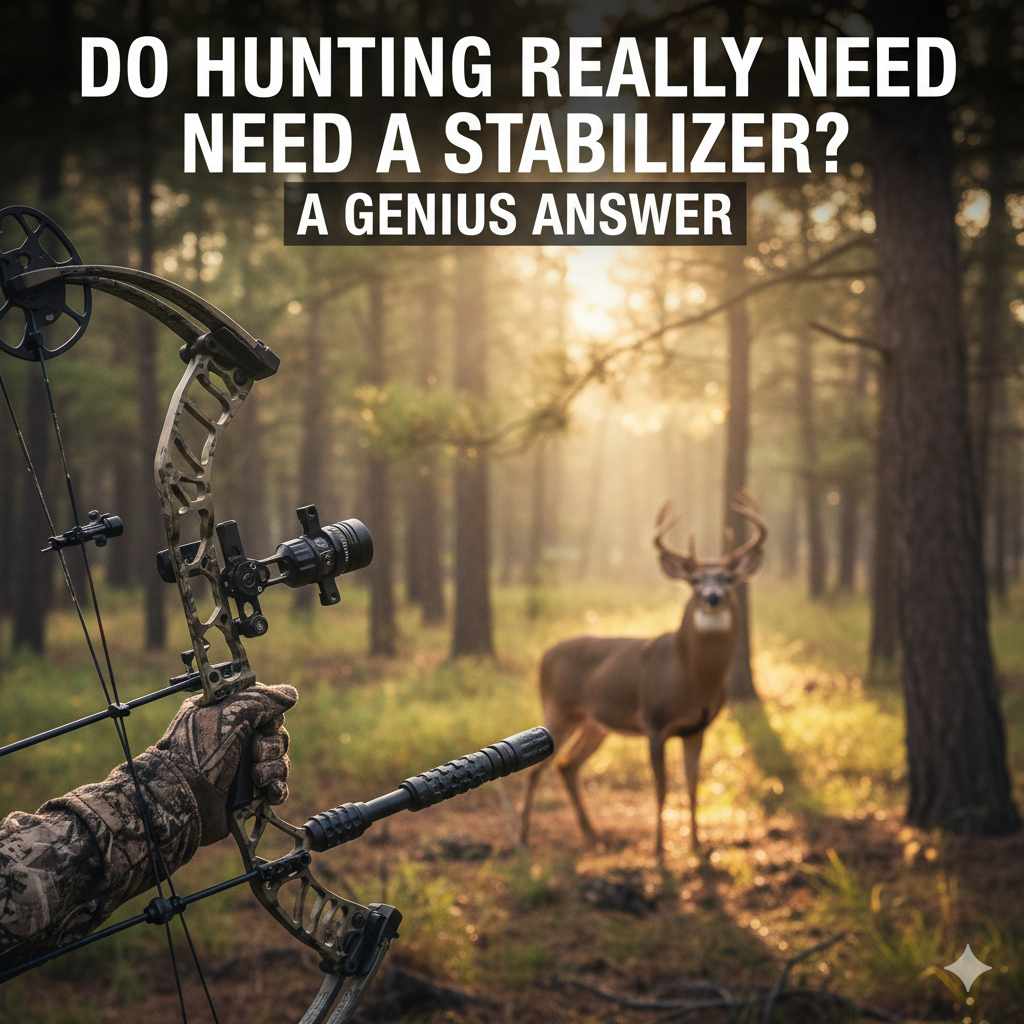
While not strictly necessary for every hunter, a stabilizer is a genius tool for improving accuracy, especially at longer distances. It adds balance, reduces vibration, and helps you hold steady for a cleaner shot. For beginners, a short to mid-length stabilizer is an excellent way to build confidence and tighten arrow groups.
Hey there, fellow archers! Salman here. If you’ve ever found yourself staring at a wall of bow accessories, you’ve probably asked the big question: “Do I really need a stabilizer on my hunting bow?” It’s one of the most common things I hear from new hunters. The options seem endless, and it’s easy to feel overwhelmed.
Don’t worry, you’re in the right place. We’re going to cut through the confusion together. This guide will give you a simple, genius answer to that question. We’ll break down what stabilizers do, why you might (or might not) want one, and how to choose the perfect one for your needs. Let’s make your bow feel like a natural extension of your arm!
What in the World is a Bow Stabilizer Anyway?
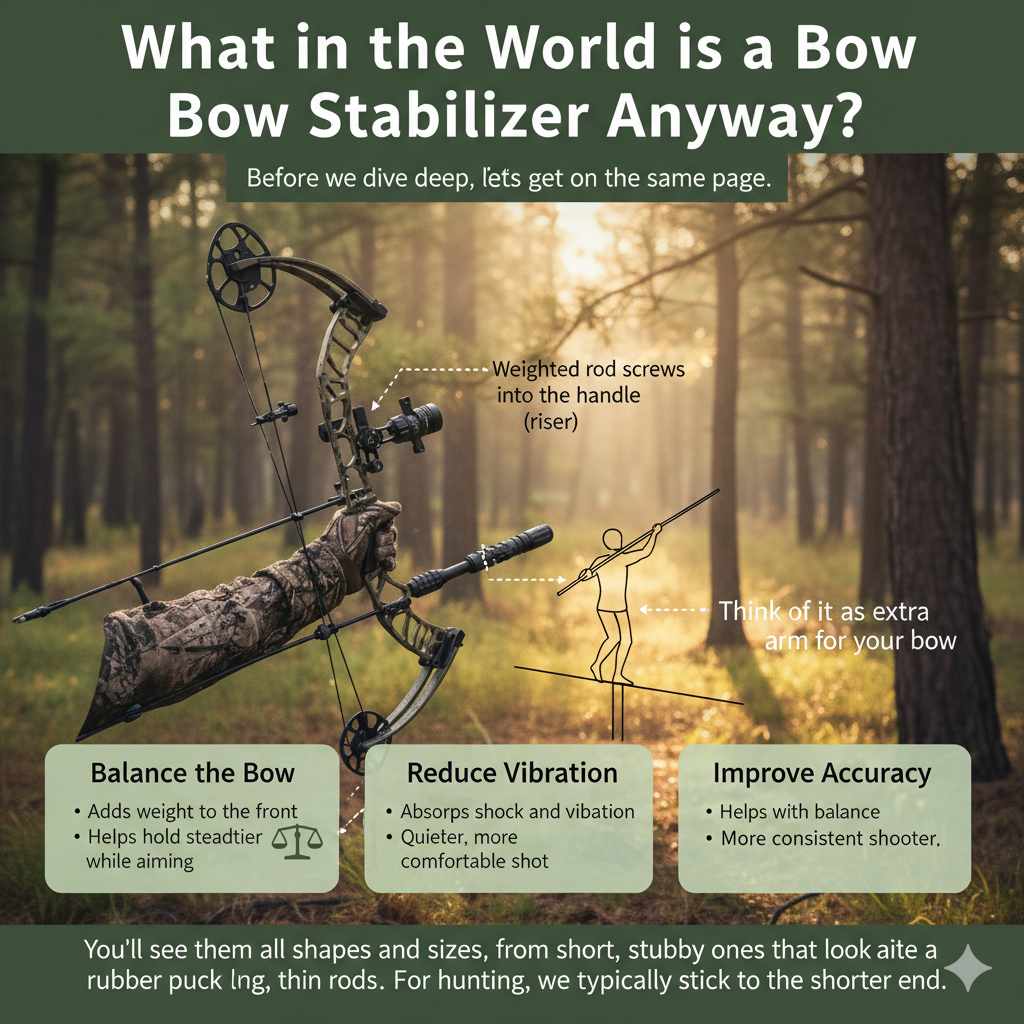
Before we dive deep, let’s get on the same page. What exactly is a bow stabilizer? In simple terms, a stabilizer is a weighted rod that you screw into the front of your bow’s riser (the main handle section). Think of it as an extra arm for your bow.
Its job isn’t just to look cool, though some of them do! A stabilizer has three primary functions:
- Balance the Bow: It adds weight to the front, which helps you hold the bow steadier while aiming.
- Reduce Vibration: It absorbs the shock and vibration that happens when you release the arrow, leading to a quieter and more comfortable shot.
- Improve Accuracy: By helping with balance and reducing vibration, it naturally helps you become a more consistent and accurate shooter.
You’ll see them in all shapes and sizes, from short, stubby ones that look like a rubber hockey puck to long, thin rods that competitive archers use. For hunting, we typically stick to the shorter end of the spectrum, but we’ll get into that more later.
The Genius Answer: It All Depends on Your Hunting Style
So, do you need one? The honest, genius answer is: it depends. A stabilizer is a tool, and the right tool depends on the job. A bow fresh from the box will shoot an arrow just fine without one. Many skilled hunters have filled their tags for years with a bare bow. However, a stabilizer can make the job of shooting accurately much, much easier, especially in certain situations.
Let’s look at a few common hunting scenarios to see where a stabilizer can be your best friend or just extra weight to carry.
Scenario 1: You’re a Treestand or Blind Hunter
If you spend most of your time hunting from a fixed position like a treestand or a ground blind, a stabilizer is almost always a huge advantage. Why? Because you aren’t hiking for miles. The extra weight isn’t a big deal, but the benefits are massive.
- Stability is Key: You often have time to wait for the perfect shot. A stabilizer helps you hold your pin steady on the target for longer without getting tired or shaky.
- Quiet is Critical: Animals have incredible hearing. The vibration-dampening qualities of a stabilizer will make your bow noticeably quieter, reducing the chance of a deer “jumping the string.”
- Confidence at the Moment of Truth: When that buck of a lifetime finally steps out, your nerves will be firing. A well-balanced bow feels more forgiving and helps you execute a smooth, confident shot.
For this style of hunting, a stabilizer in the 6-to-10-inch range is a fantastic choice. It gives you all the benefits without being so long that it gets in the way of a window or a tree branch.
Scenario 2: You’re a Spot-and-Stalk Hunter in Thick Woods
Now, let’s say you hunt in thick forests or dense brush, where you’re constantly moving, ducking under branches, and navigating tight spaces. This is where the decision gets a bit trickier.
A long stabilizer can be a real pain. It can snag on twigs, make noise, and generally get in your way. In this case, many hunters opt for either a very short stabilizer (4-6 inches) or none at all.
- A Short Stabilizer (4-6 inches): This is a great compromise. It’s short enough to stay out of the way but still provides excellent vibration and noise reduction. It won’t give you the same aiming stability as a longer one, but it makes the bow much more pleasant to shoot.
- No Stabilizer: Some hunters prefer a completely bare bow for maneuverability. If your shots are typically close (under 30 yards), you can definitely become proficient without one. The key is practice and focusing on your form.
Scenario 3: You’re an Open Country Hunter
If you hunt out west in open plains or mountains, you’re likely taking longer shots. This is where a stabilizer transitions from a helpful accessory to an almost essential piece of equipment. When you’re aiming at a target 40, 50, or even 60 yards away, every tiny wobble is magnified.
- Long-Range Precision: A longer stabilizer (10-12 inches) will make a world of difference in your ability to hold steady for these demanding shots. The added forward weight slows down your pin movement, allowing for much finer aiming.
- Wind Resistance: A well-balanced bow is also easier to hold steady in a crosswind, which is a common challenge in open country.
Here, the added weight and length are a worthwhile trade-off for the massive boost in downrange accuracy.
How Stabilizers Actually Work: The Simple Science Behind the Magic
It feels like magic when you add a stabilizer and suddenly your groups tighten up, but it’s all based on some simple physics. Understanding how it works can help you appreciate what it’s doing for you on every shot.
1. The Power of Inertia (Adding Forward Weight)
Remember learning about inertia in school? It’s the principle that an object at rest wants to stay at rest. By adding weight to the front of your bow, away from your hand, you increase its inertia. This makes the bow much more resistant to the tiny, involuntary movements and muscle twitches you make while aiming. Your pin will appear to “float” more slowly and calmly on the target instead of bouncing around erratically.
2. Taming the Beast (Vibration and Noise Dampening)
When you release an arrow, a huge amount of energy is transferred from the limbs through the riser and into your hand. This creates vibration (what we call “hand shock”) and noise. Stabilizers are typically made with rubber or other dampening materials designed to soak up that energy like a sponge. This results in:
- A quieter shot, which is crucial for hunting.
- A more comfortable, dead-in-the-hand feel, which reduces flinching and improves follow-through.
According to safety resources like the Pennsylvania Hunter-Ed course, a quiet and well-maintained bow is a hallmark of an ethical and effective hunter.
3. Fighting the Twist (Counteracting Torque)
Bow torque is a fancy term for twisting the bow’s riser with your grip as you shoot. It’s a very common accuracy-killer, especially for beginners. Because a stabilizer pushes weight forward, it forces you to use your bow arm muscles more effectively to hold it up, which can promote a more relaxed, torque-free grip on the handle. A stable foundation prevents this twisting motion and leads to more consistent arrow flight.
A Look at Different Hunting Stabilizers
Choosing a stabilizer can be confusing because there are so many options. Let’s break down the most common types for hunting so you can see what might work best for you.
| Stabilizer Type | Common Length | Best For | Pros | Cons |
|---|---|---|---|---|
| Short / Compact | 4 – 6 inches | Thick woods, treestands, maneuverability | Excellent vibration/noise control, very compact, lightweight | Minimal balancing effect for long-range aiming |
| Mid-Range / All-Around | 6 – 10 inches | The “do-it-all” hunter, treestands, ground blinds | Great balance of stability and maneuverability, significant noise reduction | Can feel a bit long in very thick brush |
| Long / Open Country | 10 – 12+ inches | Western hunting, long-range shooting (40+ yards) | Maximum aiming stability, best for holding steady in wind | Heavy, cumbersome, can easily snag on obstacles |
Do YOU Need a Stabilizer? A Simple Checklist
Still on the fence? Ask yourself these questions. The more times you answer “yes,” the more you’ll benefit from adding a stabilizer to your hunting bow.
- Does your sight pin seem to bounce around the target when you aim? A stabilizer will slow that movement down significantly.
- Do you plan on taking shots beyond 30 yards? Accuracy becomes much more challenging at longer distances, and a stabilizer is a massive help.
- Does your bow feel like it “jumps” out of your hand when you shoot? This is hand shock, and a stabilizer is the #1 tool to fix it.
- Is your bow loud when you shoot it? A good stabilizer will absorb sound-causing vibrations.
- Do you struggle with consistency, with some arrows hitting perfectly and others flying wild? A stabilizer helps make your setup more forgiving of small form errors.
How to Choose Your First Hunting Stabilizer: A Step-by-Step Guide
Ready to pick one out? It’s not as hard as it looks. Follow these simple steps to find the perfect match for your bow and your hunting style.
- Assess Your Hunting Environment First: Think about the scenarios we discussed. Are you in a tight treestand or a wide-open field? Your primary hunting location is the biggest factor. For most beginners hunting in mixed terrain, a 6- or 8-inch stabilizer is the perfect starting point.
- Consider the Weight: Stabilizers come with different weights. Some even have adjustable weight systems. More weight equals more stability, but also more to carry. A good starting point is something in the 5- to 8-ounce range. You can always add or remove weight later.
- Look for Great Dampening Technology: The best hunting stabilizers have significant rubber or gel-like components. This is what eats up the vibration and makes your bow quiet. Look at the design—if it has a lot of rubber fins or a flexible body, it’s likely designed for maximum dampening.
- Don’t Break the Bank: You do not need to spend hundreds of dollars on your first stabilizer. There are many fantastic options from reputable brands for under $50 that will provide 90% of the benefit of the super high-end models. Focus on function over brand name.
- Visit a Pro Shop if Possible: The best way to know what feels right is to try it. A good archery pro shop will let you screw a few different stabilizers onto your bow. You will instantly feel the difference in balance and can pick the one that feels most natural to you.
What About Those Complex V-Bars and Side Rods?
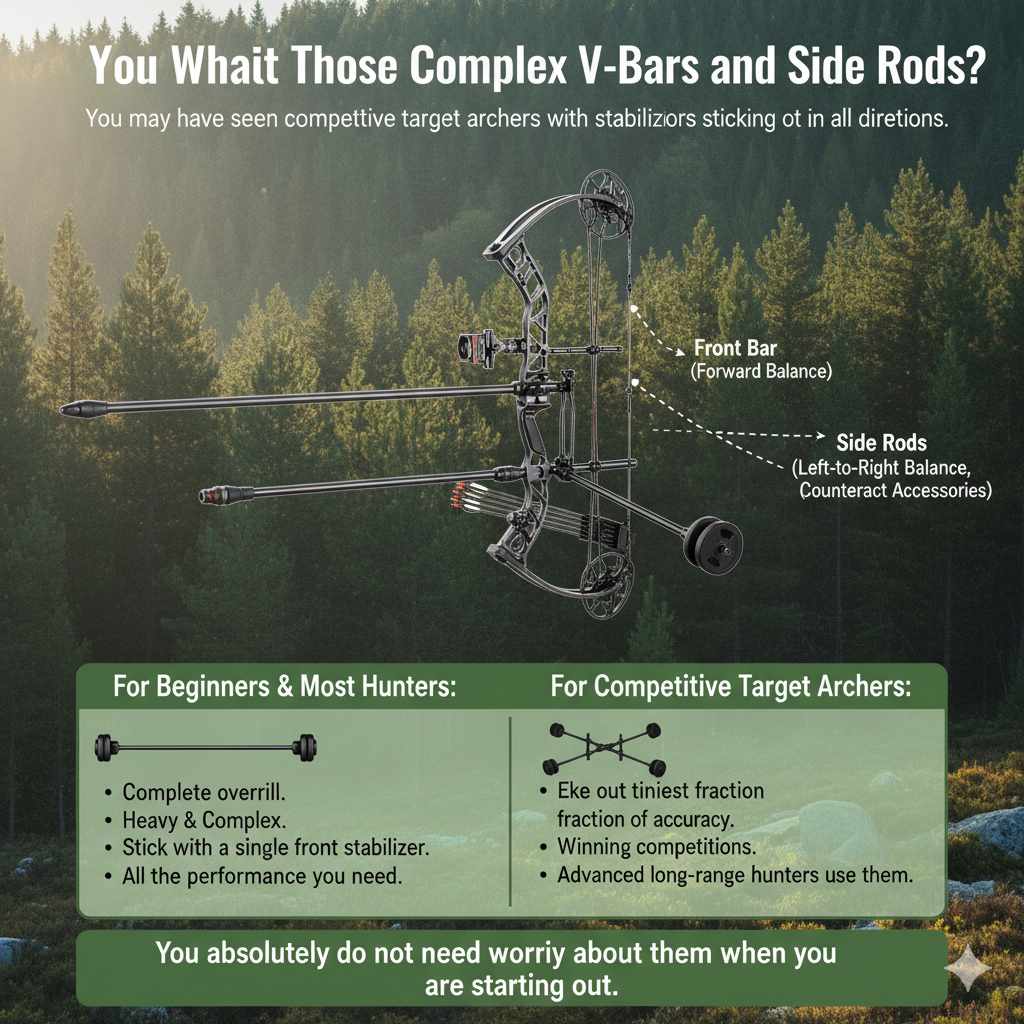
You may have seen competitive target archers with stabilizers sticking out in all directions. These are called V-bars or side-rod systems. They use a front bar for forward balance and one or more side bars to create a perfect left-to-right balance and offset the weight of accessories like your sight and quiver.
For a beginner or even most intermediate hunters, this is complete overkill. These systems are heavy, complex, and designed to eke out the tiniest fraction of accuracy needed for winning competitions. While some advanced long-range hunters use them, you absolutely do not need to worry about them when you are starting out. Stick with a single front stabilizer. It will give you all the performance you need to be a successful and ethical hunter.
Frequently Asked Questions (FAQ)
1. Can I hunt effectively without a stabilizer?
Absolutely. For centuries, hunters used bows with no accessories at all. If you primarily hunt in thick cover and take shots under 30 yards, you can become very proficient without one. It just requires more practice to perfect your form and hold steady.
2. Does a heavier stabilizer mean better accuracy?
Not necessarily. More weight provides more stability (a slower-moving pin), but it also causes fatigue faster. The key is finding a balance. You want enough weight to steady your aim but not so much that you struggle to hold the bow up for an extended period.
3. How do I install a stabilizer?
It’s incredibly easy! Almost all modern bows have a threaded hole on the front of the riser, just below the grip. You simply screw the stabilizer in by hand until it’s snug. No tools are required.
4. Do stabilizers really make a bow quieter?
Yes, significantly. A huge amount of the noise from a bowshot comes from vibration in the riser. A good stabilizer, especially one with a lot of rubber dampening material, absorbs this vibration before it can become sound. It’s one of the best ways to quiet a bow.
5. What’s the best stabilizer length for a beginner hunter?
For a beginner, a 6-inch or 8-inch stabilizer is the perfect starting point. This length provides an excellent combination of aiming stability and vibration reduction without being too long or cumbersome for most hunting situations.
6. Will a stabilizer fix all my accuracy problems?
No. A stabilizer is a tool to help with balance and vibration, but it can’t fix fundamental flaws in your archery form, such as an inconsistent anchor point or a jerky release. Good coaching and consistent practice are still the most important keys to accuracy.
7. Are expensive stabilizers worth the money for a hunter?
For most hunters, no. While high-end stabilizers made of premium carbon and with complex dampening systems are excellent, you can get 90% of the performance and benefit from a much more affordable model. Focus on a reputable brand and a design that feels good to you, not the price tag.
Conclusion: Your Bow, Your Choice
So, do hunting bows really need a stabilizer? No, they don’t need one to function. But a stabilizer is one of the most effective and affordable upgrades you can make to shoot more accurately, more quietly, and more confidently. It’s a genius piece of equipment that helps correct for our natural human shakiness and makes the whole archery experience more forgiving and enjoyable.
My advice for any beginner is to start with an affordable, mid-length (6-8 inch) stabilizer. It’s the best all-around option that will immediately improve the feel of your bow and the tightness of your arrow groups. From there, you can experiment as you grow as an archer. But for now, focus on the fundamentals, trust your equipment, and enjoy every moment you get to spend outdoors with your bow. Happy hunting!