
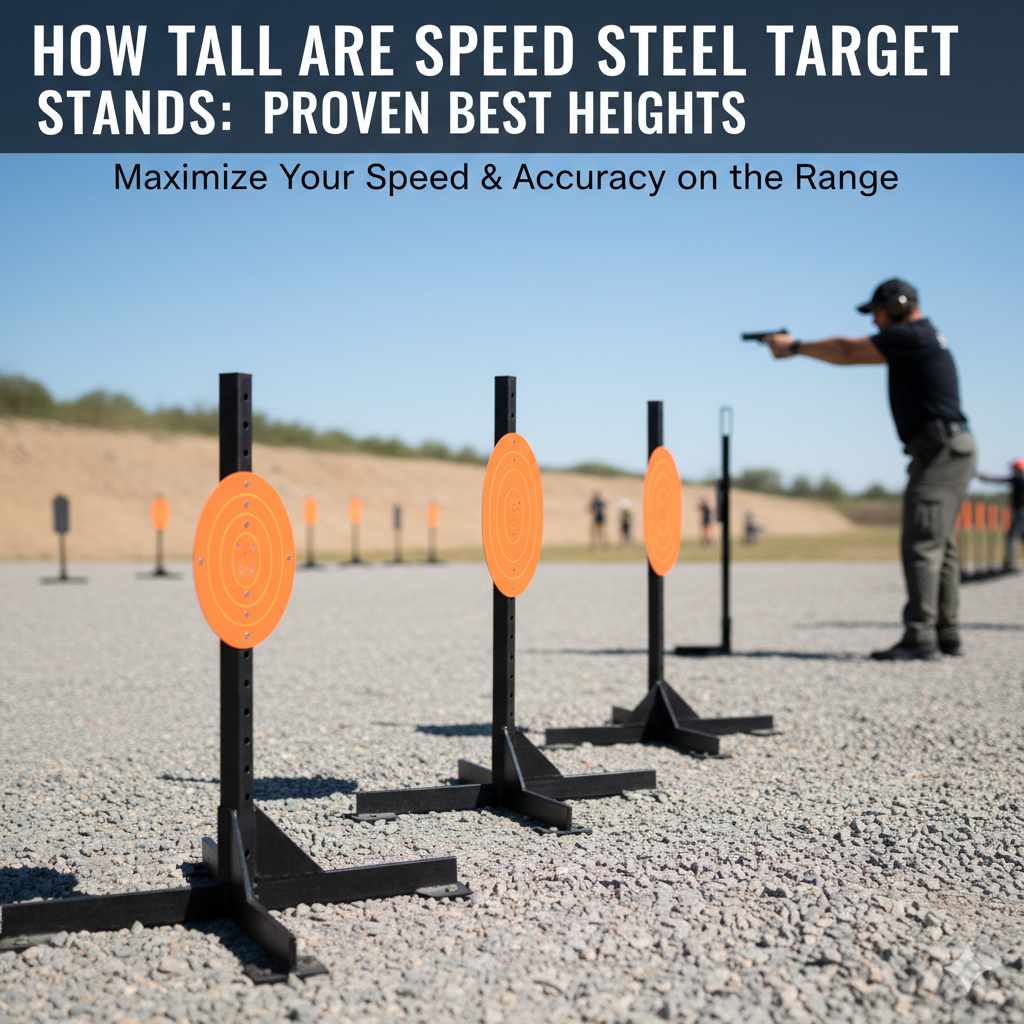
For most pistol and rifle shooting, the best height for a speed steel target stand places the center of the target between 4 to 5 feet off the ground. This height mimics the average human torso, providing realistic practice for competition and self-defense scenarios while ensuring shots safely strike the target and backstop.
Setting up your steel targets for the first time can be exciting. You have the gear, you’ve found a safe place to shoot, and you’re ready to hear that satisfying “ping!” But then a question pops up: how high should the target actually be? It seems simple, but getting the height right is one of the most important steps for safe and effective practice. Placing it too low or too high can cause problems.
Don’t worry, this is a common question, and the answer is easier than you think. I’m here to walk you through everything you need to know. We’ll cover the proven best heights for steel target stands, why it matters so much, and how to set them up perfectly every time. Let’s make sure your range time is fun, productive, and above all, safe.
Why Target Stand Height Is a Big Deal
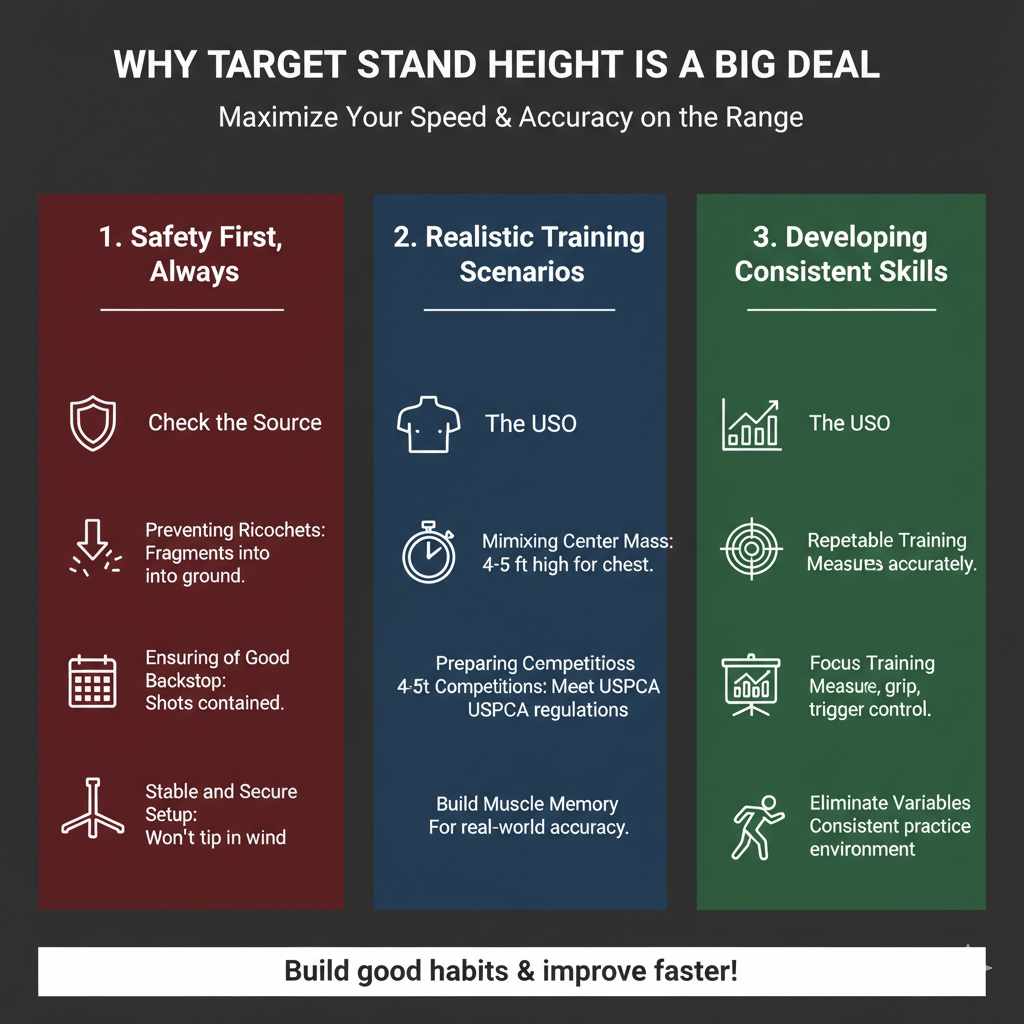
You might think that as long as you hit the steel, the height doesn’t matter. But it plays a huge role in three key areas: safety, realistic training, and building consistent skills. Getting it right from the start helps you build good habits.
1. Safety First, Always
Safety is the number one rule in shooting. The height of your target stand directly impacts where bullets go after they hit the steel. Here’s how:
- Preventing Ricochets: When a bullet hits a steel target, it fragments. A properly positioned target, combined with a downward angle, directs those fragments safely into the ground. If a target is too low, fragments could ricochet unpredictably off the ground in your direction.
- Ensuring a Good Backstop: Your target should always be placed in front of a solid backstop, like a large dirt berm. Setting your target too high increases the risk of a missed shot going over the backstop, which is extremely dangerous. The ideal height keeps your shots centered and safely contained.
- Stable and Secure Setup: A target at the proper height is often more stable. A top-heavy, overly high stand can tip over, especially in the wind or after being hit. A stable stand is a safe stand.
2. Realistic Training Scenarios
Whether you’re training for a competition or for self-defense, you want your practice to be as realistic as possible. Target height is a huge part of this.
- Mimicking Center Mass: For most shooting disciplines, the goal is to hit the center mass of a threat. Placing the center of your steel target between 4 and 5 feet from the ground simulates the chest area of an average-sized adult. This helps you build muscle memory for real-world accuracy.
- Preparing for Competitions: Organizations like the United States Practical Shooting Association (USPSA) have specific rules for target height. Practicing at regulation heights ensures you’re ready for match day. You’ll know exactly what to expect.
3. Developing Consistent Skills
Consistency is the key to becoming a better shooter. By standardizing your target height, you create a repeatable training environment. This allows you to truly measure your progress. If your target height changes every time you practice, it’s hard to know if your improving skills or just adjusting to a new setup. A consistent height helps you focus on the fundamentals: your stance, grip, sight alignment, and trigger control.
Standard Heights for Different Shooting Disciplines
While the 4-to-5-foot rule is a great starting point, different shooting sports have their own specific guidelines. Knowing these helps you train specifically for the events you enjoy. Let’s look at some of the most popular ones.
USPSA and IPSC Target Heights
In practical shooting sports like USPSA and IPSC, courses of fire are designed to simulate dynamic scenarios. Target heights can vary to create a challenge, but there are general rules. Most targets are set to represent a realistic encounter.
- Typical Height: The rules often state that the top of a standard cardboard target cannot be more than 6 feet high. For steel poppers and plates, the center is usually set at a natural torso level, around 4 to 5 feet.
- Why It Works: This variability forces you to adapt, but the average height remains consistent with a center-mass hold. Practicing in this height range prepares you for almost any stage you might encounter.
Steel Challenge Target Heights
The Steel Challenge is all about speed. You shoot five steel plates as fast as you can. The target heights and distances are standardized across every official match, so you can practice the exact same stages you’ll see in competition.
- Standardized Setup: The targets in Steel Challenge are set at consistent heights to ensure a level playing field. Most plates are centered between 4 and 5 feet, making the transitions smooth and predictable.
- Practice Tip: If you’re serious about Steel Challenge, get the official course of fire diagrams. They will tell you the exact height, distance, and placement for every target on every stage.
3-Gun and Multi-Gun Competitions
3-Gun is incredibly dynamic, involving pistols, rifles, and shotguns. Target arrays are complex and can include everything from close-range steel to long-distance rifle targets.
- Height Varies Greatly: Because of the varied nature of the sport, target heights can be all over the place. You might shoot a pistol plate at 4 feet, then engage a rifle target on a stand that’s only 3 feet tall to force you into a kneeling or prone position.
- Training Approach: For 3-Gun, it’s best to practice with a variety of target heights. Use an adjustable stand to simulate different scenarios. Set some targets at standard torso height and others lower to practice changing shooting positions.
Here is a simple table to help you remember the most common heights for each discipline:
| Shooting Discipline | Common Target Type | Recommended Center-Mass Height | Key Considerations |
|---|---|---|---|
| USPSA / IPSC | Cardboard Silhouettes, Steel Poppers | 4 feet to 5.5 feet | Height can vary to create challenges, but this is the most common range. |
| Steel Challenge | Round or Square Steel Plates | 4 feet to 5 feet | Heights are standardized for every stage to ensure fairness. |
| 3-Gun / Multi-Gun | Various Steel and Cardboard | 2 feet to 6 feet | Train with varied heights to practice different shooting positions. |
| General Plinking / Practice | Any Steel Target | 4.5 feet (approx. chest height) | This is a great all-around height for building solid fundamentals. |
Factors That Change the “Best” Height for You
The standard heights are a fantastic guideline, but the “perfect” height can also depend on you and your specific situation. Think of the standards as the starting point, and then fine-tune from there.
Your Height and Stance
A shooter who is 6’5″ will have a different line of sight than a shooter who is 5’2″. While you should still practice at standard competition heights, you might find that adjusting the target slightly for your personal practice sessions feels more natural. The goal is to present the target so that you can assume a comfortable, stable shooting stance without having to crane your neck up or hunch down too much.
Your Shooting Position
Are you always shooting from a standing position? Or does your training involve kneeling, sitting, or even prone positions? The height of your stand needs to accommodate your training goals.
- Standing: The 4-to-5-foot rule is perfect.
- Kneeling or Sitting: You’ll need a much shorter stand, perhaps one that places the target only 2 to 3 feet off the ground.
- Prone: For prone shooting, the target needs to be very low to the ground, often on a stand that is just 12 to 18 inches tall.
This is where adjustable stands or having a few different lengths of 2×4 lumber for your stand base becomes incredibly useful.
The Terrain of Your Shooting Range
Not everyone shoots on a perfectly flat, manicured range. If you’re shooting on uneven ground, you need to account for it.
- Shooting Uphill: If the target is on higher ground than you are, it will appear lower. You may need a slightly taller stand to bring it up to your natural point of aim.
- Shooting Downhill: If you are on higher ground than the target, it will appear higher. You may need a shorter stand. The most important thing here is to ensure your bullets will still impact the backstop safely. The National Shooting Sports Foundation (NSSF) always emphasizes knowing your target and what is beyond it.
How to Set Up Your Steel Target Stand Perfectly
Now that we know the “why” and “what,” let’s cover the “how.” Here is a simple, step-by-step guide to setting up your target stand for the best results.
- Choose a Safe Spot: Find a level piece of ground in front of a reliable backstop. Make sure there is nothing around that could cause a dangerous ricochet (like rocks or tree stumps).
- Assemble the Base: Put your stand base together. Most common designs use a simple metal bracket that holds a wooden 2×4 upright. Make sure the base is stable and doesn’t wobble.
- Measure Your Upright: Cut your 2×4 to the desired length. For a target centered at 4.5 feet (54 inches), and a hanger that drops the target 6 inches, you’ll want your 2×4 to be about 4 feet long. It’s a good idea to have a few different lengths on hand.
- Mount the Target: Attach your steel target to its hanger, and place the hanger on top of the 2×4. Use quality Grade 8 bolts and springs or durable straps to hang the target. This allows it to absorb energy and swing, which increases its lifespan and safety.
- Check the Height and Angle: Use a tape measure to check the height from the ground to the center of the target. Adjust as needed. Crucially, ensure the target has a slight downward angle of about 20 degrees. This directs bullet fragments safely into the dirt in front of the stand. Most quality target hangers build this angle in automatically.
- Final Safety Check: Take a few steps back and look at your setup. Is it stable? Is it angled down? Is it directly in front of the backstop? If everything looks good, you’re ready to start shooting.
Common Mistakes to Avoid
Setting up steel targets is easy, but a few common mistakes can cause problems. Here’s what to watch out for and how to fix it.
| The Mistake | Why It’s a Problem | How to Fix It |
|---|---|---|
| Target Is Too Low | Increases the chance of bullets or fragments skipping off the ground toward the shooter. It’s also an unrealistic training picture. | Use a longer 2×4 or a taller stand to raise the center of the target to at least 3.5-4 feet. |
| Target Is Too High | A missed shot is more likely to clear the backstop. The stand can also become top-heavy and unstable. | Use a shorter 2×4 to bring the target down. Ensure the top of the target is well below the top of your backstop. |
| Stand Is Unstable | The stand can fall over from bullet impacts or wind, creating a frustrating and potentially unsafe situation. | Set the stand on level ground. If the design allows, use stakes to secure the legs. Choose a stand with a wide, stable base. |
| Target Has No Downward Angle | A target that is perfectly vertical can send bullet fragments straight back toward the shooting line. This is very dangerous. | Use a target hanger designed to create a 20-degree downward angle. Never bolt a steel target directly and rigidly to the stand. |
Adjustable vs. Fixed Height Stands: Which is for You?
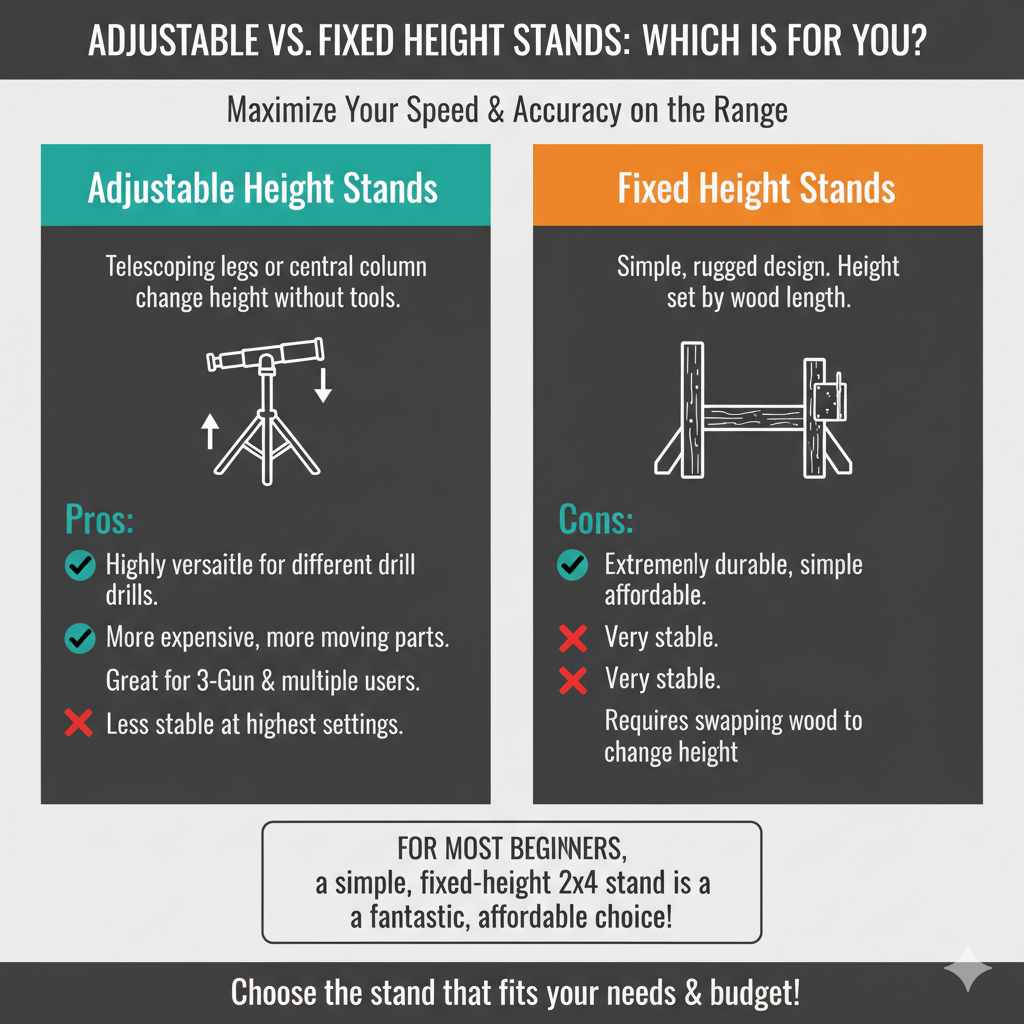
When you’re shopping for a stand, you’ll see two main types: fixed height and adjustable. Both are great options, but they serve different needs.
Adjustable Height Stands
These stands have telescoping legs or a central column that lets you change the target height without tools.
- Pros: Highly versatile for different drills and shooting positions. Great for 3-Gun practice or if multiple people of different heights use the same stand.
- Cons: Can be more expensive and may have more moving parts that could fail. Some designs can be less stable at their highest settings.
Fixed Height Stands
These are typically simple, rugged designs like the common 2×4 bracket stand. The height is determined by the length of the wood you use.
- Pros: Extremely durable, simple, and often more affordable. They are usually very stable.
- Cons: Less versatile. To change the height, you need to swap out the 2×4, which isn’t as quick as an adjustable stand.
For most beginners, a simple, fixed-height stand that uses a 2×4 is a fantastic and affordable choice. It’s rugged, reliable, and you can easily change the height by simply bringing a few different lengths of wood to the range.
Frequently Asked Questions (FAQ)
What is the best height for a pistol steel target?
The best height for a pistol steel target is to have the center of the plate between 4 and 5 feet off the ground. This simulates the center mass of an adult and is a standard for most types of competitive and defensive pistol training.
Should steel targets be angled?
Yes, absolutely. A steel target should always be angled downward at approximately 20 degrees. This is a critical safety feature that directs bullet splatter and fragments down into the ground, away from the shooter.
How far away should I stand from a steel target?
For pistols, the generally accepted safe minimum distance is 10-12 yards. For rifles shooting lead-core ammunition, the minimum is 100 yards. These distances ensure the bullet fragments have lost enough energy that they won’t cause injury.
Can I use any wood for my target stand?
A standard, untreated 2×4 from a hardware store is the most common and effective choice. It’s cheap, easy to find, and can withstand many indirect hits. Avoid using pressure-treated wood, as it can release harmful chemicals when shot and splintered.
What’s the difference between AR500 and AR550 steel?
The number refers to the steel’s hardness on the Brinell scale. AR500 is the industry standard for most pistol and rifle rounds. AR550 is slightly harder and more resistant to pitting from high-velocity rifle rounds, but it can also be more brittle. For most shooters, AR500 is the perfect choice.
Why is my target stand falling over?
There are a few common reasons. The ground may not be level, the stand might have a narrow or lightweight base, or you are shooting a heavy rifle caliber at a light target setup. Try to find level ground, or consider a stand with a wider footprint or stakes to secure it.
Is it safe to shoot steel targets up close?
It is only safe if you follow strict rules. You must maintain minimum safe distances (e.g., 10+ yards for pistols), use frangible ammunition designed for close-quarters training, and wear proper protective gear, including wrap-around eye protection. For general practice, always respect the standard minimum distances.
Conclusion: Set It Right and Have Fun
Figuring out the right height for your speed steel target stand isn’t about following a single, rigid rule. It’s about understanding the principles of safety, realism, and consistency. For the vast majority of your shooting practice, setting the center of your target between 4 and 5 feet off the ground is the proven best choice. It’s the sweet spot for safety and for building practical skills that translate to competition or self-defense.
Remember to always start with a stable base, ensure your target is angled downward, and place it in front of a solid backstop. From there, don’t be afraid to adjust for your specific training goals, whether that means setting a target low for kneeling practice or matching the exact heights for an upcoming Steel Challenge match.
Now you have the knowledge to set up your range like a pro. Go enjoy that satisfying “ping” of steel, knowing your setup is safe, smart, and designed to make you a better shooter. Stay safe and have fun!