
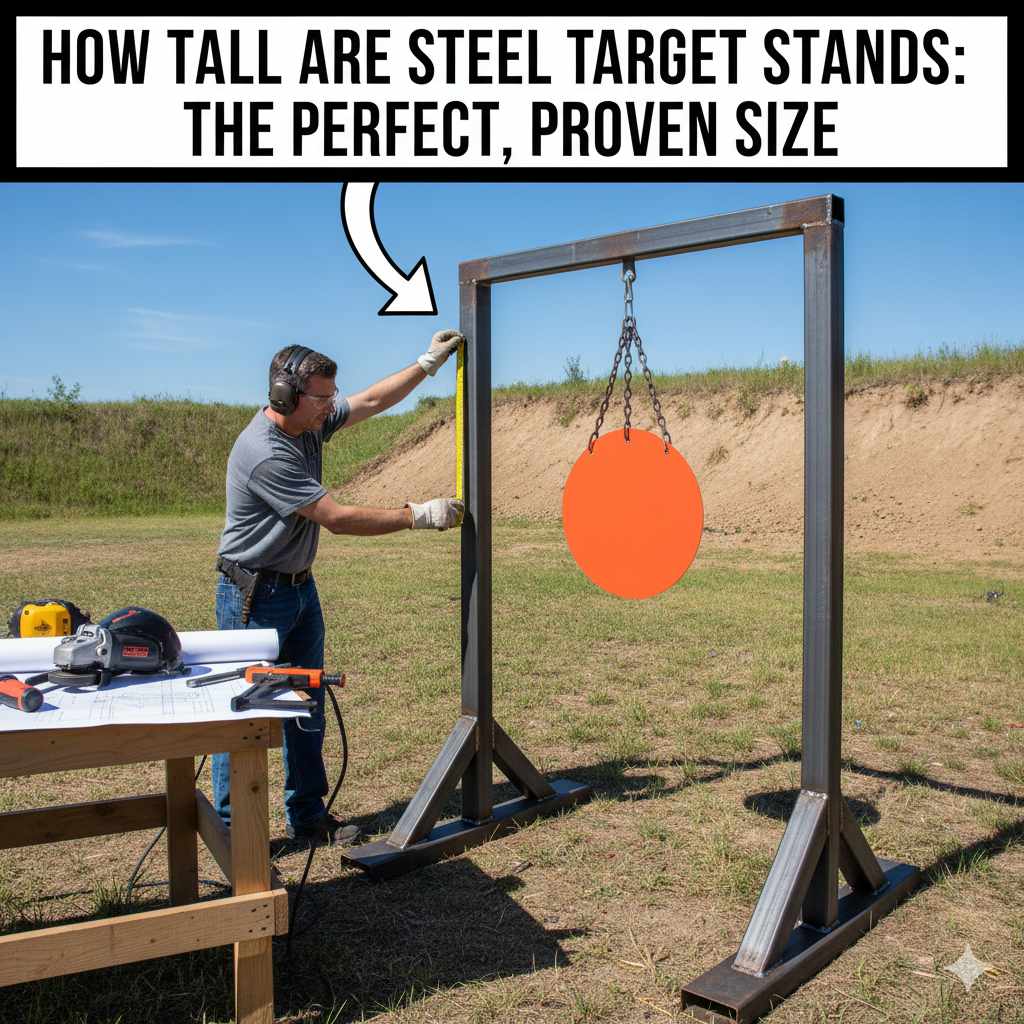
For most pistol and rifle practice, the perfect steel target stand height is 3 to 4 feet tall. This places the center of a standard silhouette target at chest level (around 55-60 inches from the ground), creating a realistic and safe training scenario by directing bullet fragments downward into the ground.
Have you ever set up a steel target, taken a few steps back, and thought, “Does that look right?” Getting the height of your target stand just right can feel like a guessing game. If it’s too low, it feels unrealistic. If it’s too high, it might feel unstable or unsafe. It’s a common hurdle for shooters who just want to practice safely and effectively.
Don’t worry, you’re not alone in wondering this! The good news is that there’s a simple, proven answer that works for most situations. In this guide, I’ll walk you through exactly how tall your steel target stands should be. We’ll cover the perfect height for safe, effective practice and look at a few reasons why you might adjust it for specific goals. Let’s make your range time safer and more fun.
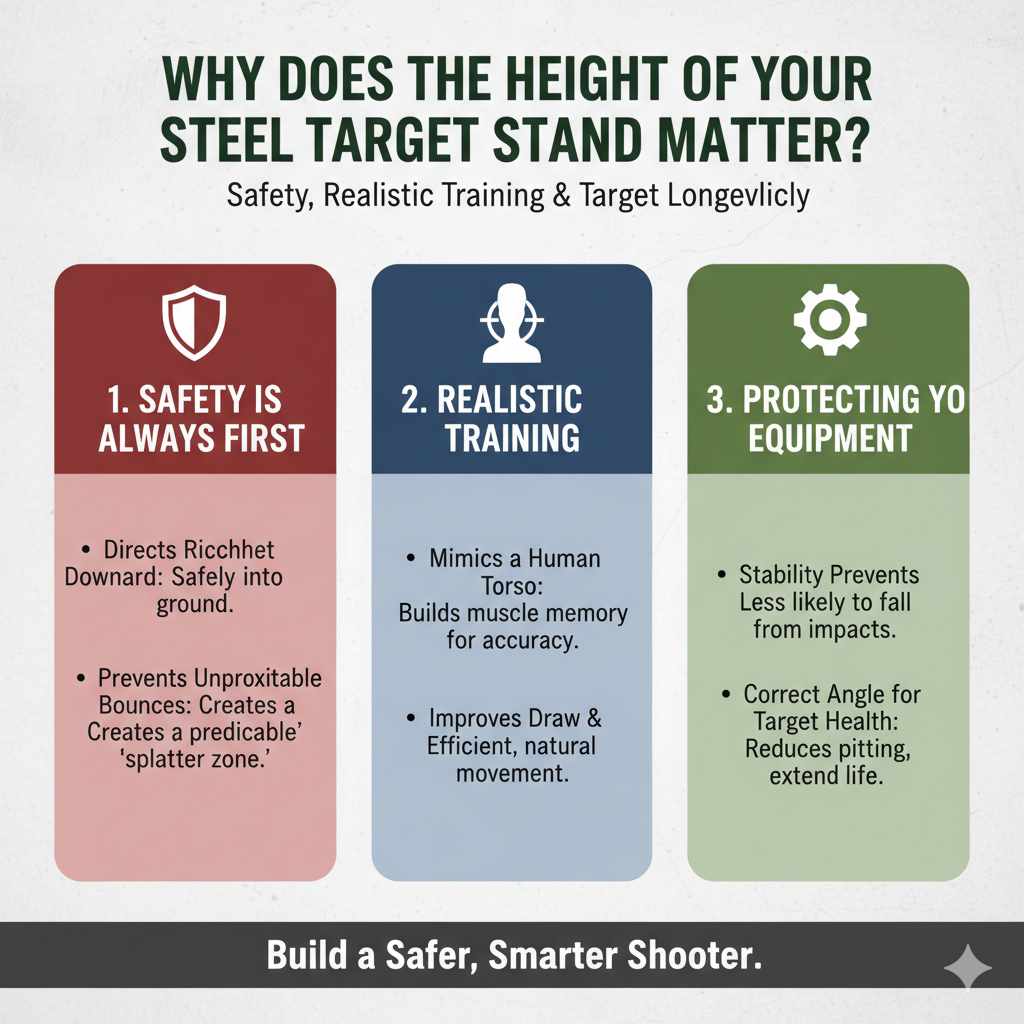
Why Does the Height of Your Steel Target Stand Matter?
You might think that as long as you can hit the target, the stand height doesn’t matter much. But it actually plays a huge role in three key areas: safety, realistic training, and target longevity. Getting it right builds good habits and keeps everyone safe.
1. Safety is Always First
The single most important reason to use a stand of the proper height is safety. When a bullet hits a steel target, it doesn’t just stop. It fragments into tiny, fast-moving pieces. A correctly positioned target helps manage where these fragments go.
- Directing Ricochet Downward: By placing your target at chest height and ensuring it can swing or is angled slightly downward, the force of the bullet strike directs most fragments safely into the ground in front of the target.
- Preventing Unpredictable Bounces: A target that is too low can cause fragments to skip across the ground in unpredictable directions. A target that is too high and angled improperly could send fragments upward, which is also a hazard. The ideal height helps create a predictable “splatter zone.”
Think of it like skipping a stone on water. You want the stone to hit the water at the right angle to control where it goes. It’s the same idea with bullet fragments and your steel target.
2. Realistic and Effective Training
For most of us, practice is about getting better. Whether you’re preparing for a competition or simply improving your marksmanship, you want your training to translate to the real world. Target height is a huge part of that.
- Mimicking a Human Torso: A stand that is 3 to 4 feet tall places the center of most targets (like an IPSC or IDPA silhouette) right in the center mass or “vital zone” of an average-height person. This helps you build muscle memory for accurate shot placement.
- Improving Your Draw and Presentation: Practicing your draw from a holster to a realistically positioned target is much more effective than aiming down at the ground or up in the air. It trains your body to move efficiently and naturally.
3. Protecting Your Equipment
Believe it or not, the right stand height can even help your gear last longer. A stable stand that holds the target securely prevents unnecessary stress on the target and the stand itself.
- Stability Prevents Damage: A well-balanced stand is less likely to fall over from bullet impacts, especially from more powerful rifle rounds. A falling target can hit rocks, get dented, or damage the stand’s legs.
- Correct Angle for Target Health: The stand’s job is to hold the target at a slight downward angle. This not only directs fragments down but also reduces the direct, blunt force on the steel, which helps prevent pitting and extends its life. You can find more details on steel target safety from organizations like the National Shooting Sports Foundation (NSSF).
The Gold Standard: A Proven Height for All-Around Use
So, what’s the magic number? For general-purpose shooting with both pistols and rifles, a stand that holds the top of the 2×4 or mounting post at around 48 inches (4 feet) is the perfect starting point.
Here’s why this works so well:
- Positions the Target Center: When you hang a standard 18-inch tall silhouette target from a 4-foot post, the center of the target ends up being about 55-60 inches off the ground. This is the ideal chest-height zone for realistic practice.
- Offers Great Visibility: This height ensures your target is clearly visible over most low-lying grass or shrubs without being so high that it becomes unstable.
- Promotes Safety: It’s the sweet spot for encouraging a slight downward angle, sending bullet fragments safely into the dirt berm or ground below.
If you only build or buy one set of stands, aim for this 3-to-4-foot height range. It’s the most versatile and effective size for building strong fundamentals.
When to Adjust Your Target Stand Height
While the 3-4 foot range is a fantastic all-around choice, there are specific situations where you might want to go shorter or taller. Your training goals should always guide your equipment choices.
The table below breaks down different stand heights and their best uses.
| Stand Height | Best For | Pros | Cons |
|---|---|---|---|
| 1-2 Feet (Low) | Prone rifle shooting, small varmint targets, specialty drills. | Very stable, low profile, easy to transport. Simulates shooting at small ground targets. | Unrealistic for defensive or competition practice. Fragments may skip if the ground is hard and flat. |
| 3-4 Feet (Standard) | General pistol and rifle practice, competition training (USPSA/IDPA), defensive drills. | Positions target at a realistic chest height. Excellent balance of stability and realism. Safest for fragment management. | Can be slightly bulky to transport compared to very short stands. |
| 5-6 Feet (Tall) | Simulating headshots, shooting over cover, specific long-range scenarios where visibility is an issue. | Provides a realistic head-level target. Highly visible at a distance. | Higher center of gravity makes it less stable, especially in wind or with heavy targets. May require sandbags to secure. |
DIY vs. Buying a Pre-Made Stand: Which is Right for You?
Once you know the height you need, you have two main options: buy a stand or build your own. Both are great choices, but they fit different needs and budgets. Let’s look at the pros and cons of each.
Buying a Steel Target Stand
Purchasing a stand from a reputable manufacturer is the quickest and easiest way to get started. These are often sold as complete kits with a base, a post mount, and sometimes a target hanger.
- Pros:
- Convenience: Ready to use right out of the box. No tools or assembly skills required.
- Engineered for Safety: Designed by professionals to be stable and hold the target at the correct angle.
- Durability: Often made from steel for long-lasting use, though some use wood posts as a consumable part.
- Cons:
- Cost: Can be more expensive than building your own.
- Less Customization: You’re limited to the heights and designs offered by the manufacturer.
Building Your Own (DIY) Stand
If you’re handy with basic tools, building your own stand can be a rewarding and cost-effective project. The most common DIY design uses a simple 2×4 lumber base and upright.
- Pros:
- Affordable: You can often build a stand for a fraction of the cost of a pre-made one.
- Customizable: You can build it to the exact height and width you need for your specific targets and training style.
- Easy to Repair: If a stray shot damages the 2×4 upright, it’s cheap and easy to replace.
- Cons:
- Requires Tools and Time: You’ll need a saw, drill, and some basic hardware to build it.
- Safety is on You: You are responsible for ensuring your design is stable and safe. An unstable stand can be a serious hazard.
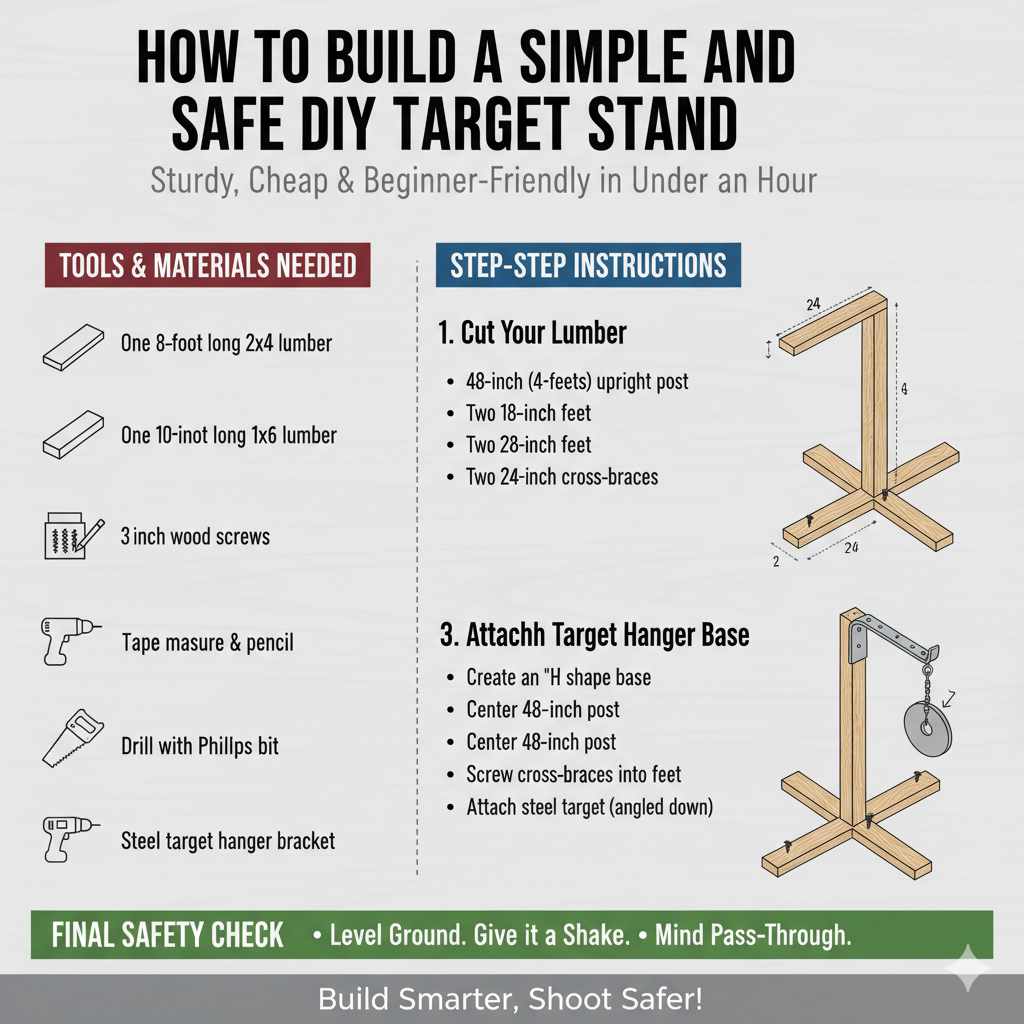
How to Build a Simple and Safe DIY Target Stand
Ready to build your own? This simple design is sturdy, cheap, and perfect for beginners. It requires minimal tools and can be built in under an hour.
Tools and Materials Needed:
- One 8-foot long 2×4 piece of lumber
- One 10-foot long 1×6 piece of lumber (or another 8-foot 2×4)
- A box of 3-inch wood screws or deck screws
- A tape measure and pencil
- A drill with a Phillips head bit
- A saw (a miter saw is fastest, but a hand saw works too)
- A steel target hanger bracket (these are designed to hold a 2×4 and your target)
Step-by-Step Instructions:
- Cut Your Lumber: Precision is helpful but not critical. The goal is a stable base.
- From the 8-foot 2×4, cut one piece at 48 inches (4 feet). This will be your upright post.
- From the remaining piece of the 2×4, cut two pieces at 18 inches each. These will be the feet.
- From the 1×6 (or other 2×4), cut two pieces at 24 inches each. These will be the cross-braces for the feet.
- Assemble the Base: Create an “H” shape for the base.
- Lay the two 18-inch feet on the ground, parallel to each other.
- Place your 48-inch upright post standing up in the middle, centered between them.
- Lay the two 24-inch cross-braces flat across the feet, one on each side of the upright post. Make sure they are pressed tightly against the upright.
- Secure the Base:
- Using your drill and 3-inch screws, drive two screws through each cross-brace into the feet below. You should use a total of 8 screws for the base (4 for each cross-brace).
- This design clamps the upright post in place without needing to screw into it, making it super easy to replace if it gets shot up. For a more permanent hold, you can drive screws through the cross-braces into the upright as well.
- Attach the Target Hanger:
- Slide your steel target hanger bracket over the top of the 48-inch upright post. Most of these brackets are designed for a snug fit.
- Follow the manufacturer’s instructions to attach your steel target to the hanger using the included bolts or chains. Ensure the target can swing freely.
- Final Safety Check:
- Place the stand on level ground and make sure it doesn’t wobble. If you shoot on uneven terrain, you might consider making the base wider for extra stability.
- Confirm your target is angled slightly downward. The forward lean is crucial for safety. For great tips on how to safely set up your range, you can consult guides like those from the National Rifle Association (NRA).
Frequently Asked Questions (FAQ)
What is the best height for a pistol target stand?
For pistol shooting, a stand that is 3 to 4 feet tall is ideal. This places the center of the target in the A-zone or center mass of a silhouette, which is perfect for defensive and competition-style training.
Can I use the same stand for rifle and pistol targets?
Yes, absolutely! The standard 3-4 foot stand height is versatile and works perfectly for both pistol and rifle practice. The main difference will be the minimum safe distance you stand from the target, not the height of the stand itself.
How do I stop my target stand from falling over?
If your stand is unstable, especially in wind or on uneven ground, you can place sandbags or weights on the feet of the base. Using a wider base (longer feet or cross-braces) when you build it can also dramatically improve stability.
What angle should my steel target be?
Your steel target should hang at a downward angle of about 20 degrees. This angle ensures that when a bullet strikes the target, the fragments are deflected safely into the ground. Most commercial target hangers are designed to create this angle automatically.
Is it safe to build my own steel target stand?
Yes, it is very safe as long as you build a stable design. The key is to make sure the base is wide enough that it won’t tip over from the force of a bullet impact or a gust of wind. Always test its stability before you start shooting.
How far away should I be from a steel target?
Safety is all about distance. For pistols, the minimum safe distance is typically 10-15 yards. For rifles firing lead-core ammunition, the minimum safe distance is 100 yards. Never shoot steel targets with steel-core, armor-piercing, or other hardened penetrator ammunition.
What kind of steel should my target be made of?
Always use targets made from high-quality, through-hardened AR500 or AR550 steel. This type of steel is hard enough to withstand bullet impacts without denting or cratering, which is essential for safety. Softer steels can be damaged, creating unsafe surfaces that can cause unpredictable ricochets.
Conclusion: The Right Height for Confident Practice
Choosing the right height for your steel target stand doesn’t have to be complicated. For nearly every shooter, a stand that is 3 to 4 feet tall is the perfect, proven size. This simple choice makes your practice safer by directing fragments downward, more effective by presenting a realistic target, and more enjoyable by giving you a stable, reliable setup.
Whether you choose to buy a pre-made stand for convenience or build your own for a custom fit, focusing on that chest-level target placement will help you build confidence and skill. Remember to always follow safety rules, especially regarding minimum distances and proper ammunition. Now you have the knowledge to set up your range correctly, so you can spend less time guessing and more time enjoying the rewarding clang of steel.