
Choosing the right compound bow can be tricky, especially if you’re just starting out. One of the first things you’ll see are the different sizes, like the differences in the 31″ vs 35″ Compound Bow: Key Differences. It can feel like a lot to take in at once! Don’t worry, we’re going to break down these differences so you can make an informed choice. We’ll explore the main aspects, so you can find a bow that fits you perfectly. Let’s get started and explore how the bow’s physical dimensions affect its performance.
Choosing the Right Bow: What to Think About
Selecting a compound bow means looking at several factors. Beyond the size, other things also matter. You’ll want to consider your draw length. Draw length is the distance from the bow’s string at full draw to the pivot point of the bow’s grip. It directly impacts your comfort and accuracy. Also, think about the bow’s draw weight, which measures the force needed to pull the string back.
Furthermore, consider the bow’s overall weight and how comfortable it feels in your hands. Finally, think about the bow’s let-off, which is the percentage of the draw weight held at full draw. These are all things that will affect your experience. Considering these aspects will help you find a bow that fits your body and your archery goals.
Draw Length and Its Importance
The draw length is a critical measurement. A bow with the wrong draw length can lead to poor shooting form. This will affect your accuracy and could also cause discomfort. A draw length that is too long makes it hard to pull the string back smoothly. Conversely, a draw length that is too short will limit your power and range. To determine your draw length, you’ll need to measure your arm span. Then, you’ll divide this measurement by 2.5. This will give you an estimated draw length.
Many archery shops also offer draw length measurements to help you get the most accurate fit. Remember that the draw length on a compound bow can be adjusted. This allows you to find the perfect fit for your comfort.
Measuring Your Arm Span: Stand with your arms outstretched. Measure the distance from the tip of one middle finger to the tip of the other.
Accurately measuring your arm span is the first step toward finding the correct draw length for your bow. Incorrect measurements will lead to an improperly fitted bow, which can be hard to use.
Using the Arm Span Measurement: Divide your arm span (measured in inches) by 2.5.
This simple calculation gives you a rough idea of your draw length. It helps to start the process of choosing the correct bow for you.
Consulting a Professional: Go to an archery shop and get help from a pro to make sure you have the perfect draw length.
Professionals use specialized tools to get the most accurate measurement. They will help you select the ideal bow for your needs.
Draw Weight Explained
Draw weight, measured in pounds, signifies the force needed to pull the bowstring to full draw. A higher draw weight increases the arrow’s velocity and range. Lower draw weights are easier to manage and ideal for beginners. It’s important to select a draw weight that is suitable for your physical strength. Beginners should start with a lower draw weight to help develop proper form. As you improve, you can increase the draw weight. Most bows let you change the draw weight. This will help you find the right balance between power and control.
Starting with a Lower Weight: Beginning archers should start with a lower draw weight.
This allows you to focus on form. It also helps to prevent injuries.
Finding the Right Balance: The goal is to find a draw weight that offers enough power for your archery goals.
Choosing the right draw weight involves finding a balance between power, control, and comfort.
Adjusting Draw Weight: Most bows let you adjust the draw weight.
This feature lets you customize your bow as your skills and strength improve.

Physical Size: 31″ vs 35″ Compound Bow Differences
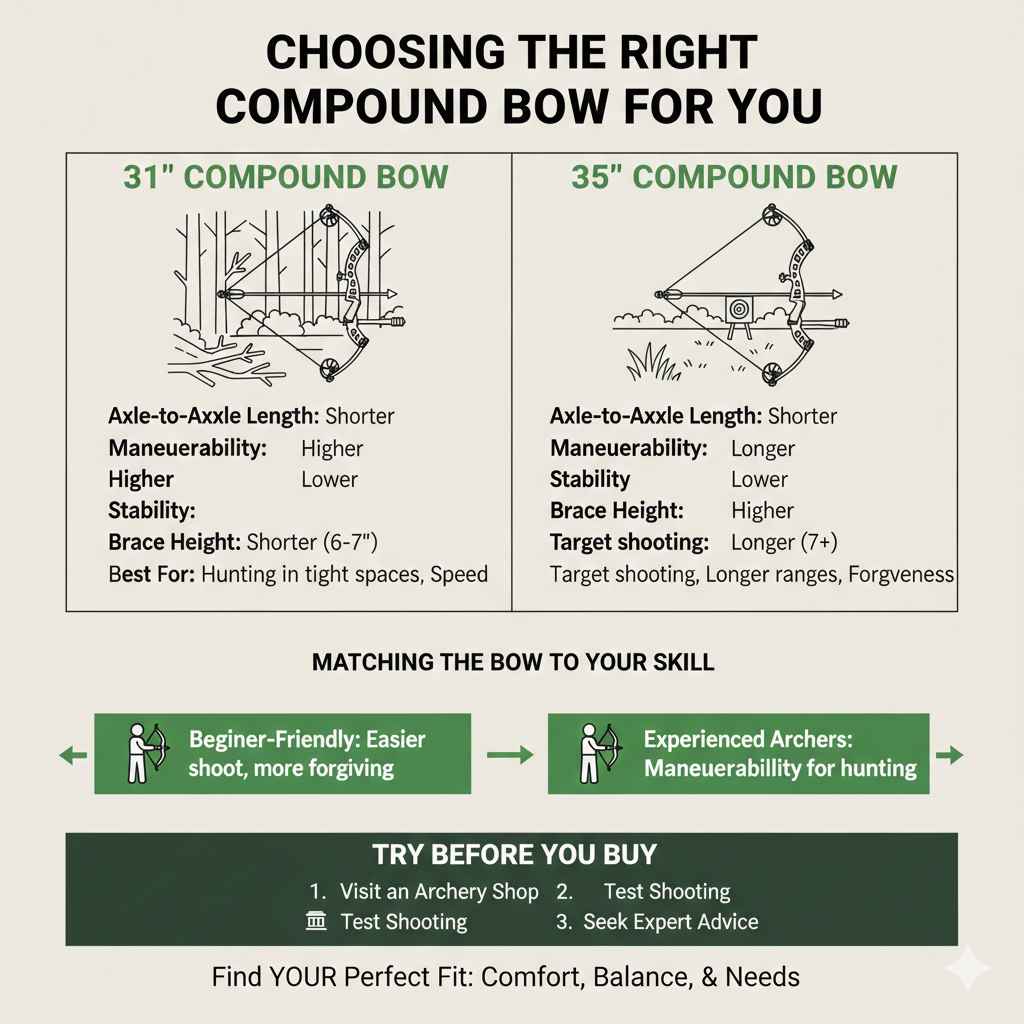
The overall size of a compound bow directly influences its use. The 31″ and 35″ sizes indicate the bow’s axle-to-axle length. This is measured from the center of the top cam to the center of the bottom cam. The 31″ bow is usually more compact, offering better maneuverability in tight spaces. The 35″ bow, on the other hand, provides greater stability. It also offers a longer brace height, which is the distance from the string to the bow’s grip. This increases forgiveness and accuracy. Your shooting style and the environment you’re hunting or shooting in will help you decide which size to select.
Maneuverability and Portability
Maneuverability is a key factor. Shorter bows, like the 31″ model, are easier to handle in confined areas. They are useful for hunting from tree stands or in thick brush. The compact size of a bow also makes it easier to carry. A 35″ bow is generally longer, which might be a bit more challenging to use in tight spaces. The ability to move quickly and efficiently is a huge advantage for hunters. However, if you will be primarily using your bow in open spaces, a 35″ might be more suitable.
Compact Bows: 31″ bows excel in environments. They allow you to move in these confined spaces.
The smaller size allows archers to navigate obstacles such as thick brush or tree stands with ease.
Mobility Matters: When it comes to hunting, mobility is a major advantage.
A smaller bow can make it easier to position yourself for the perfect shot. This is especially true when tracking game in the field.
Carrying and Transporting: Short bows are simpler to carry and transport.
The compact design makes them less cumbersome when moving through the woods or loading your gear in a vehicle.
Stability and Forgiveness
Stability and forgiveness are important for accuracy. The longer axle-to-axle length of a 35″ bow provides increased stability. This results in more accurate shots. A 35″ bow typically has a longer brace height. This means that the string is further away from the bow’s grip. This longer distance is more forgiving, which means the bow is less sensitive to small errors in your form. A 31″ bow may require more precise shooting technique, particularly at longer distances. The choice depends on your experience and shooting needs. Experienced archers can often find their accuracy with either size.
Longer Axle-to-Axle Length: This provides a wider stance and better stability during the shot.
This gives the bow more resistance to movement, which in turn leads to more accurate shots. This is a very important feature for experienced archers.
Brace Height: A longer brace height means that the string is further from the grip.
This design is more forgiving of small errors in your form. This is especially true at longer distances.
Accuracy at a Distance: Generally, the 35″ bow performs better at longer ranges.
Its greater stability and increased forgiveness make it easier to maintain accuracy over longer distances.
Shooting Style and Application
The use of the bow will guide your choice. For hunting in dense environments, where quick maneuverability is necessary, a 31″ bow might be a good fit. If your priority is accuracy at longer ranges, a 35″ bow could be better. The type of archery you do influences your choice. For 3D archery or target shooting, where precise shots are critical, a 35″ bow’s stability can be a plus. Consider your current skill level and what you want to improve. If you’re a beginner, a more forgiving bow, like the 35″ model, may help. Remember, the best bow is the one that best suits your individual needs and the type of archery you want to practice.
Hunting Scenarios
Hunting environments shape bow selection. In situations such as hunting in a tree stand or ground blind, the compact size and maneuverability of a 31″ bow are very helpful. The ability to draw and shoot quickly in tight spaces can mean the difference between success and failure. For hunters that are hunting in open terrain, the greater stability and accuracy of a 35″ bow can provide a better advantage, particularly at longer distances. When hunting, the ability to make a clean, ethical shot is essential.
Tree Stand Hunting: A 31″ bow is easier to handle in the enclosed space.
Its smaller profile means it’s less likely to hit branches. It also provides better maneuverability.
Ground Blind Hunting: The compact design allows for quick draws and shots.
This advantage is especially useful when quick reactions are needed.
Open Terrain Hunting: The 35″ bow’s stability can increase your accuracy at longer distances.
This is extremely important when engaging moving targets or taking shots in open fields.
Target Archery and 3D Archery
Target and 3D archery need accuracy. In these sports, consistent performance is very important. The 35″ compound bow is often a favorite. Its greater stability and brace height improve shot accuracy. These features help to improve your scores. 3D archery often involves shooting at targets in various positions and distances. The increased forgiveness of a 35″ bow can be a benefit when it comes to dealing with the changes in terrain and angles. With target archery, your goal is to hit the center of the target. With its stability and draw, a 35″ bow can help. The right size bow will depend on your experience and how you like to shoot.
Consistent Accuracy: The 35″ bow is often selected because of its potential for accuracy.
The longer axle-to-axle length and increased stability offer more precise shot placement.
Forgiveness is Key: Archers in these sports have to handle the angles and terrains.
The added forgiveness of the 35″ bow can reduce the impact of small form errors. This improves consistency.
Target and 3D Archery Differences: You may prefer the 35″ bow for both disciplines.
Both sports place a high value on accuracy and consistency. The 35″ bow can aid in scoring high and having a successful performance.
Key Features for Each Bow Size
There are differences in both 31″ and 35″ bows. The 31″ bow is usually known for its lightweight and small profile. This makes it easier to use in tight spaces. These bows frequently have a faster arrow speed. The 35″ bow is usually known for its stability and precision. It is also designed for longer distances. Understanding the details of each bow helps to make the correct selection for your needs. Both bows have strengths, so choosing the one for you depends on what you value most.
31″ Compound Bow Features
The 31″ compound bow has a combination of features. It focuses on maneuverability and speed. The smaller size is usually lightweight, which makes it easier to move. This design is also more suitable for close-range shots. The shorter axle-to-axle length provides benefits in confined spaces. These are very beneficial for those seeking a bow with these features.
Compact Design: Its smaller size allows for better use.
This design is easy to handle and move around, making it a good choice for hunting from tree stands or in thick brush.
Faster Arrow Speed: Shorter bows sometimes provide a higher arrow speed.
This enables a flatter trajectory and helps you improve your success rate at all distances.
Draw Weight Considerations: Bows are usually designed for draw weights.
These features help to accommodate a wide variety of users, from beginners to experienced archers.
35″ Compound Bow Features
The 35″ compound bow stands out for its stability and precision. This bow’s longer axle-to-axle length improves its stability. This promotes accurate shots, particularly at longer ranges. The longer brace height makes the bow more forgiving of form errors. The bow’s design helps to promote accuracy, making it a top choice for target shooting or other activities. Its qualities make it a valuable asset for archers looking for dependability and performance.
Enhanced Stability: The long length of a 35″ bow provides increased stability.
This allows for more steady aim. This promotes better consistency during your shots.
Greater Forgiveness: This means the bow is more forgiving of small errors.
This is especially important at long ranges. This will help you maintain accuracy.
Target Shooting Advantages: These bows are very useful for target shooting.
The stability and accuracy boost will make a difference in your scores.
Choosing the Right Bow for You
Deciding between a 31″ and a 35″ compound bow requires considering your needs and goals. Think about where you’ll be shooting. If you’re planning on hunting in tight spaces, the 31″ bow’s maneuverability may be an asset. If accuracy at longer ranges is your priority, the 35″ bow may be a better option. Consider your level of experience. Also, think about your strength and your draw length. It’s usually best to visit an archery shop to try out different bows. This will give you a better sense of which one feels most comfortable and fits your needs.
According to Archery 360, a typical 31″ bow has a brace height of 6-7 inches. A 35″ bow has a brace height that is usually about 7 inches or more.
| Feature | 31″ Compound Bow | 35″ Compound Bow |
|---|---|---|
| Axle-to-Axle Length | Shorter | Longer |
| Maneuverability | Higher | Lower |
| Stability | Lower | Higher |
| Brace Height | Typically shorter | Typically longer |
| Best For | Hunting in tight spaces, speed | Target shooting, longer ranges, forgiveness |
Based on a study by the National Field Archery Association, archers using longer axle-to-axle bows (like the 35″ model) consistently scored slightly higher in target archery competitions due to increased stability.
Matching the Bow to Your Skill
It’s important to match the bow to your experience. For beginners, a 35″ bow can offer an advantage because of its increased forgiveness. The stability of the 35″ bow can help you correct form errors. More experienced archers can usually benefit from the maneuverability of the 31″ bow. This is especially true if you are hunting or shooting in a specific situation. The best bow is the one that lets you use your skills most effectively. It’s important to select a bow that fits your shooting style, strength, and needs.
Beginner-Friendly: The increased forgiveness of the 35″ bow helps with accuracy.
Beginners often find it easier to shoot well with a 35″ bow.
Experience Levels: Many archers start with the 35″ and move on to the 31″ as they get better.
With practice and experience, archers can increase their ability to handle different bow types.
Skill-Specific Needs: The best bow depends on your skill and the type of archery you are doing.
A bow that fits your skill will help you reach your goals. It also makes your archery experience more fun.
Trying Before You Buy
Always try the bow before buying it. Many archery shops have ranges where you can shoot different bows. Try out both sizes, and think about your comfort and accuracy. Also, listen to the guidance of the staff. They can provide important details to help you choose the best bow. Consider talking to other archers. This will help you get valuable tips about what is best for you. The most important thing is to select a bow that you feel comfortable with.
Visiting an Archery Shop: Archery shops offer an array of bows.
There, you can test different models and find the best fit.
Test Shooting: The chance to shoot each bow will reveal its feel and performance.
Pay close attention to comfort, balance, and how you feel about the bow after the shot.
Seek Expert Advice: Staff are there to help with selecting the best bow.
They can give you guidance and details to make the right choice.
Frequently Asked Questions
Question: What is the most important factor in choosing a compound bow?
Answer: Your draw length and draw weight are the most important factors.
Question: Is a 31″ bow suitable for beginners?
Answer: Yes, a 31″ bow can be suitable. However, the 35″ bow’s extra stability may be easier for beginners.
Question: Which bow size is more accurate?
Answer: The 35″ bow tends to provide more accuracy at longer ranges due to its stability.
Question: What’s the main difference in feel between the two bows?
Answer: The 31″ bow is often more maneuverable. The 35″ bow offers more stability.
Question: How do hunting environments influence the bow choice?
Answer: A 31″ bow is often better for tight spaces. A 35″ bow can be a benefit for longer shots.
Final Thoughts
The choice between a 31″ and a 35″ compound bow comes down to your individual needs and the situations where you’ll be shooting. The 31″ bow offers better maneuverability and is easy to use in tight spaces. The 35″ bow offers more stability and greater forgiveness for shots at longer distances. The right pick will fit your shooting style, experience, and the environments you will be in. Think about your goals and try out different bows before deciding. With the correct bow, you’ll be well on your way to enjoying the fun of archery. So, explore different options, get some expert guidance, and get ready to enjoy archery.