
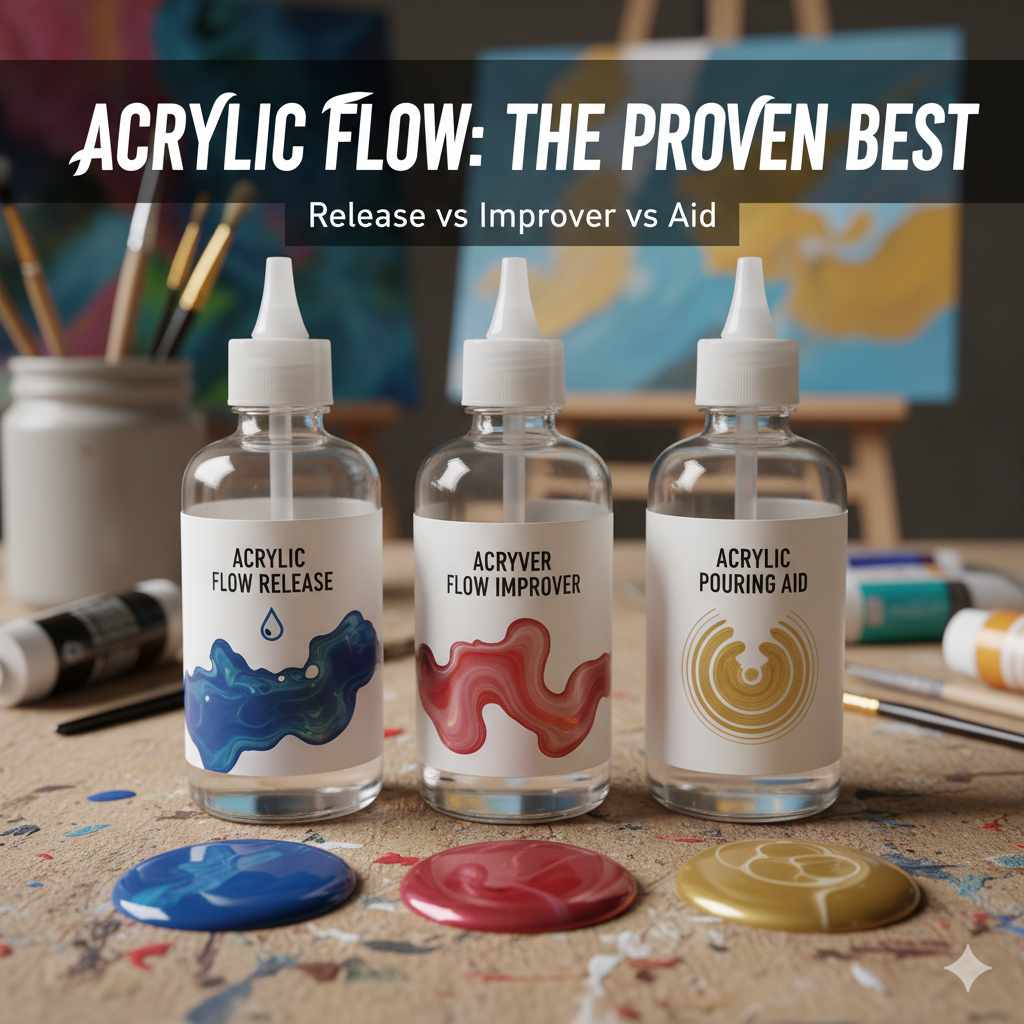
For smooth, even acrylic painting, Flow Improver, Flow Aid, and Flow Release are essentially the same product—a wetting agent that breaks water’s surface tension. The “proven best” is any of these, as they all achieve the same goal: making your paint flow like ink without losing color vibrancy. Just choose a reputable brand and follow the instructions.
Have you ever tried to paint a long, clean line, only to have your acrylic paint drag or skip across the canvas? Or maybe you wanted to create a beautiful, watercolor-like wash, but the paint clumped up instead. It’s a frustrating feeling, and it happens to almost every new acrylic painter. You might hear people talking about flow release, improver, or aid, and it all sounds so confusing.
Don’t worry, you’re in the right place! This guide will clear up all the confusion. We’ll break down exactly what these products are, how they work, and which one is the right choice for your art. Think of me as your friendly art coach, here to make your painting journey smoother, easier, and a lot more fun. Let’s dive in and unlock the secret to flowing, beautiful paint.
First, What Are Acrylic Mediums?
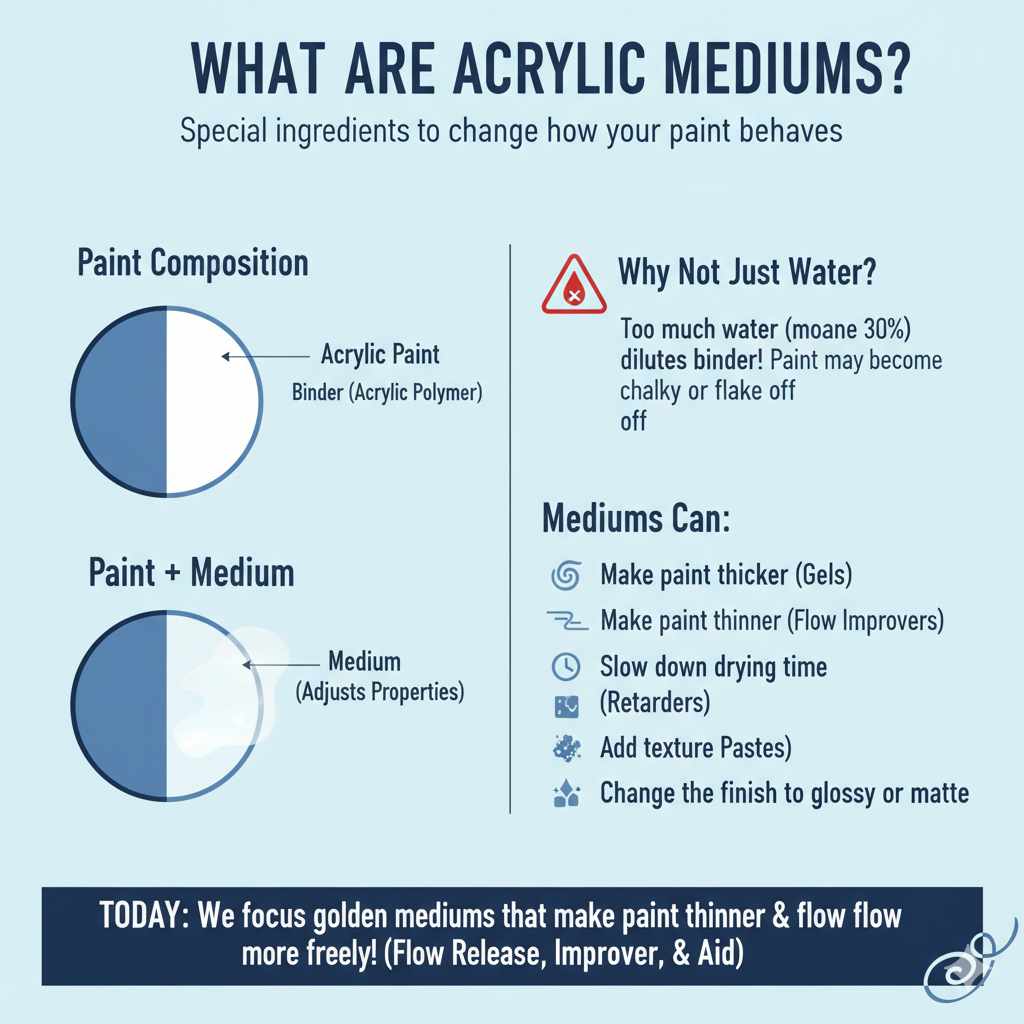
Before we compare the different “flow” products, let’s quickly cover what an acrylic medium is. Think of mediums as special ingredients you can add to your acrylic paint to change how it behaves. Your paint is made of pigment (the color) and a binder (the acrylic polymer that holds it together). When you add a medium, you’re adjusting the paint’s properties without breaking down that essential binder.
You might ask, “Can’t I just use water?” You can, but only up to a point. Adding too much water (generally more than 30%) can dilute the acrylic binder so much that the paint won’t stick properly to your canvas. Once it dries, it might look chalky or even flake off. Mediums are designed to thin your paint or change its characteristics while keeping the binder strong and stable.
Mediums can:
- Make paint thicker (Gels)
- Make paint thinner (Flow Improvers)
- Slow down drying time (Retarders)
- Add texture (Modeling Pastes)
- Change the finish to glossy or matte
Today, we’re focusing on the ones that make your paint thinner and flow more freely. This is where the terms “flow release,” “flow improver,” and “flow aid” come in.
The Big Reveal: Flow Improver vs. Aid vs. Release
Let’s get straight to the biggest source of confusion. What is the difference between acrylic flow improver, flow aid, and flow release? The simple answer is: almost nothing.
They are all different names for the same type of product.
Different brands use different marketing terms, which is why it gets so confusing. Liquitex might call it “Flow Aid,” while Golden calls it “Acrylic Flow Release,” and Winsor & Newton calls it “Flow Improver.” But at their core, they all do the exact same thing. They are “surfactants” or “wetting agents.”
So, What Do They Actually Do?
Imagine a drop of water on a waxy leaf. It beads up, right? That’s because of surface tension. Water molecules like to stick together. A flow improver is like a special soap that breaks that surface tension. When you add it to your paint and water mixture, it allows the paint to spread out evenly and smoothly instead of beading up or resisting the surface.
A flow improver does NOT:
- Thin the paint’s color intensity significantly.
- Slow the drying time in a major way (that’s a job for a retarder).
- Act as a binder on its own (it must be mixed with paint).
Its one and only job is to make your thinned-down acrylic paint flow like a dream. It’s perfect for staining raw canvas, creating smooth washes of color, or painting crisp, long lines without your brush dragging.
When Should You Use a Flow Improver?
Now that you know what it is, when would you actually reach for a bottle of flow improver (or aid, or release)? Here are the perfect scenarios for this amazing medium.
1. For Staining and Wash Techniques
If you want to achieve a watercolor-like effect with acrylics, flow improver is your best friend. It allows you to thin your paint with water to create transparent layers of color that soak into the canvas or paper evenly. Without it, a watery acrylic mix can look blotchy and uneven. With it, you get a beautiful, consistent stain.
2. For Crisp Detail and Line Work
Are you a detail-oriented artist? Trying to paint fine lines, like whiskers on an animal or the rigging on a ship, can be tricky. Thinned paint often wants to bead up. Flow improver lets you thin the paint to an inky consistency that flows smoothly off the tip of your brush, giving you incredible control for detailed work.
3. For Airbrushing
If you use an airbrush, you know that your paint needs to be very thin to pass through the nozzle without clogging it. Flow improver is a key ingredient in most airbrush medium recipes. It helps the thinned paint flow perfectly through the airbrush for a fine, even spray.
4. To Reduce Brushstrokes
Sometimes you want a perfectly flat, smooth area of color with no visible brushstrokes. By adding a little flow improver to your paint, it will “level out” more as it dries, minimizing the texture left by your brush. This is great for artists working on hard-edge abstractions or super-realistic styles.
Flow Improver vs. Other Common Mediums
Part of the confusion often comes from mixing up flow improvers with other popular acrylic mediums. Let’s clear that up with a simple table. The two most common culprits are Pouring Medium and Retarder.
| Medium Type | Primary Purpose | Effect on Paint | Best For… |
|---|---|---|---|
| Flow Improver / Aid / Release | Reduces surface tension | Makes paint flow like ink, increases transparency when thinned | Staining, washes, line work, airbrushing |
| Pouring Medium | Creates fluid paint for pouring | Thins paint while maintaining body, creates “cells” | Acrylic pouring, fluid art, abstract puddles |
| Retarder | Slows down drying time | Keeps paint wet longer for blending | Blending colors smoothly (like oil paint), wet-on-wet techniques |
As you can see, they each have a very specific job. Using a pouring medium when you want a watercolor wash won’t work well—it’s too thick. And using a flow improver when you want to blend for an hour won’t help either—it doesn’t significantly slow the drying time. Choosing the right tool for the job is the key to success.
How to Use Acrylic Flow Improver: A Step-by-Step Guide
Ready to try it out? Using a flow improver is incredibly easy, but there is one crucial step that many beginners miss. You must mix it with water first before adding it to your paint.
Here’s your simple, foolproof process:
Read the BottleEvery brand has a slightly different recommended ratio. Before you do anything, read the instructions on your specific product. They will tell you the maximum ratio of improver to water. It’s usually something like 1 part improver to 20 parts water.
Create Your “Flow Water”In a separate container (a small jar or cup works well), mix your flow improver with water. A great pro-tip is to use distilled water, which you can get from any grocery store. Tap water can sometimes have minerals that affect your paint, but for most hobbyists, tap water is fine. For example, if the ratio is 1:20, you could mix 1 capful of flow improver with 20 capfuls of water. Make a small batch to start.
Add the Mixture to Your PaintSqueeze out your acrylic paint onto your palette. Now, instead of dipping your brush in plain water to thin your paint, use your new “flow water” mixture. Slowly add a little bit at a time, mixing it into your paint until you reach your desired consistency.
Test the ConsistencyOn a scrap piece of paper or canvas, test how the paint flows from your brush. Is it thin enough? Too thin? Adjust by adding more of your flow water mixture or more paint until it feels just right. You’re looking for a smooth, consistent flow without the color looking weak or washed out.
Paint Away!That’s it! You’re ready to paint. Enjoy those smooth lines and beautiful, even washes. Remember to clean your brushes thoroughly with soap and water when you’re done.
The Proven Best: Which Brand Should You Choose?
So, we’ve established that “improver,” “aid,” and “release” are all the same thing. The final question is, which brand is the “proven best”? Honestly, the major, well-respected art supply companies all make excellent, reliable products. You can’t go wrong with any of these top contenders:
- Golden Artist Colors Acrylic Flow Release: Golden is a professional-grade brand known for its high-quality pigments and mediums. Their Flow Release is excellent and highly concentrated.
- Liquitex Professional Flow Aid: Liquitex is another industry giant. Their Flow Aid is a popular choice for artists at all levels and is widely available. You can learn more about their mediums directly from their official resources page.
- Winsor & Newton Artists’ Acrylic Flow Improver: A historic and trusted brand, their Flow Improver is reliable and works wonderfully for thinning paints for fine detail or washes.
The “best” one for you will likely come down to availability and price in your local art store. Since they all perform the same function, feel confident picking up any of these brands. The most important thing isn’t the name on the bottle, but learning how to use the product correctly.
Common Mistakes to Avoid
As you start experimenting, keep these common beginner mistakes in mind. Avoiding them will save you a lot of frustration!
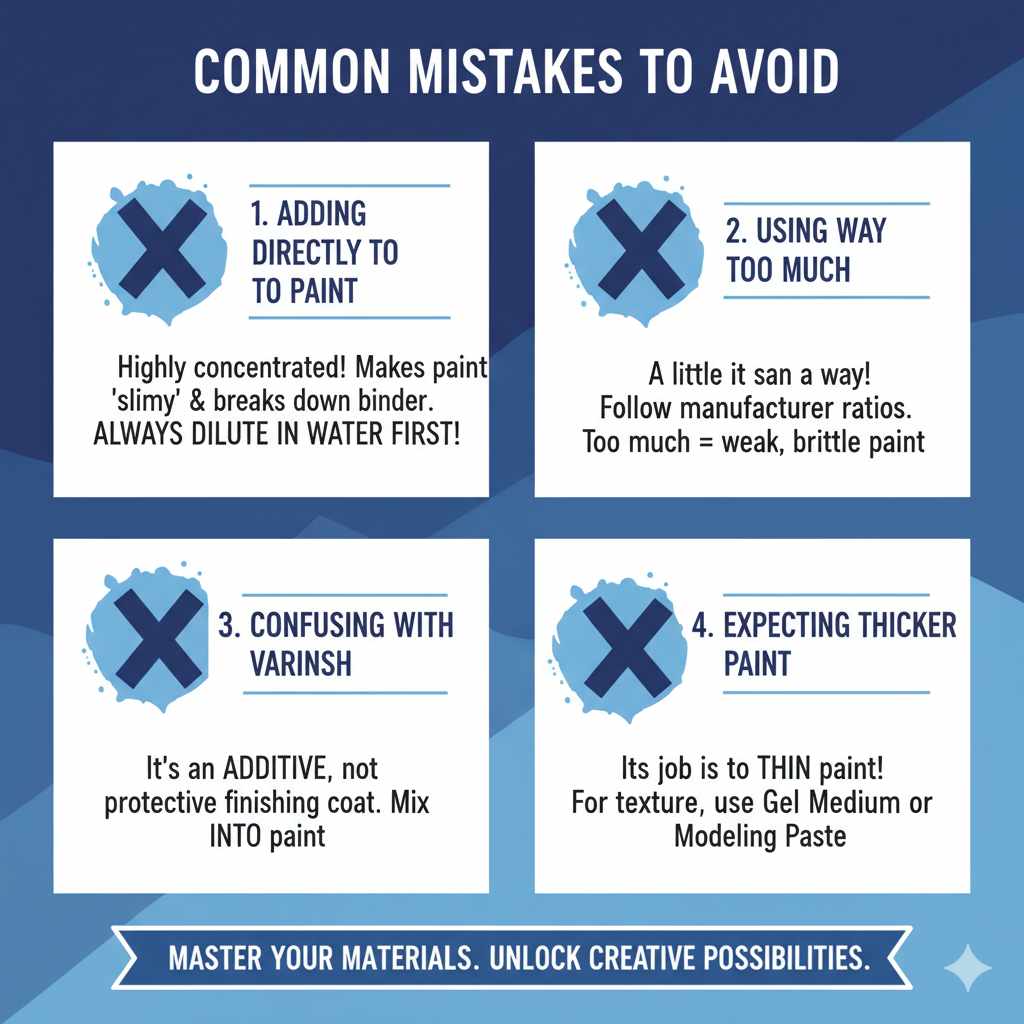
- Adding Flow Improver Directly to Paint: This is the biggest mistake. Flow improvers are highly concentrated. Adding them directly to paint can make it feel slimy and may even break down the acrylic binder. Always dilute it in water first!
- Using Way Too Much: A little goes a long way. Stick to the manufacturer’s recommended ratios. Using too much surfactant can lead to a weak, brittle paint film once it dries.
- Confusing it with a Varnish: Flow improver is an additive, not a finishing coat. It has no protective qualities and should always be mixed into the paint itself.
- Expecting it to Make Paint Thicker: Remember, its job is the opposite! If you want to build up texture, you need a Gel Medium or Modeling Paste, not a flow improver.
Painting with acrylics is a journey of discovery. Every medium is a new tool in your toolkit, opening up a world of creative possibilities. By understanding what a flow improver does—and what it doesn’t do—you’ve taken a huge step toward mastering your materials and bringing your artistic vision to life.
Frequently Asked Questions (FAQ)
1. What is the difference between acrylic flow improver and flow aid?
There is no functional difference. “Flow Improver,” “Flow Aid,” and “Flow Release” are just different brand names for the same type of product: a surfactant (or wetting agent) that reduces the surface tension of water to make acrylic paint flow more smoothly.
2. Can I just use water instead of a flow improver?
You can use water to thin acrylics, but only to a certain point. Adding more than about 30% water can weaken the paint’s binder, causing it to lift off the canvas or dry with a chalky finish. A flow improver allows you to create very thin, watery paint without compromising its permanence and adhesion.
3. Will flow improver make my paint dry glossy?
No. Most flow improvers have little to no effect on the final sheen of your paint. The finish (matte, satin, or gloss) will still be determined by the paint itself or by any other mediums or varnishes you use.
4. Can I use flow improver for acrylic pouring?
While some artists add a drop or two to their pouring mixture, a flow improver is not a substitute for a pouring medium. A pouring medium is specifically designed to create a thick but fluid paint that forms “cells” and dries to a smooth, even layer. Flow improver simply thins the paint.
5. How much flow improver should I use?
Always follow the manufacturer’s instructions on the bottle. A typical ratio is 1 part flow improver to 10-20 parts water. You then use this water/improver mixture to thin your paints. Never add the concentrated improver directly to your paint.
6. Do I have to use distilled water?
Using distilled water is recommended by many manufacturers, like those at the Smithsonian’s Museum Conservation Institute, because it is free of minerals that could potentially react with the paint. However, for everyday painting and hobby work, clean tap water is usually perfectly fine.
7. Is acrylic flow improver toxic?
Most modern acrylic mediums, including flow improvers, are water-based and non-toxic. However, you should never ingest them and should always work in a well-ventilated area. It’s also a good practice to avoid getting paint and mediums on your skin.
Your Path to Smoother Painting
So there you have it. The mystery of “flow release vs. improver vs. aid” is solved! The simple truth is that they are all your allies in the quest for smooth, beautiful paint application. There is no single “proven best” product, only the “proven best” technique for the effect you want to achieve.
Remember the key takeaway: these products are wetting agents that you mix with water first. They are perfect for staining, creating fine lines, and achieving watercolor-like effects. They are not the same as pouring mediums or retarders, which serve completely different purposes.
The next time you’re at the art store, you can walk down the mediums aisle with confidence. Grab a bottle of flow improver from a trusted brand, take it home, and start experimenting. Mix it up, test it out, and see how it transforms the way your paint moves across the canvas. Happy painting!