
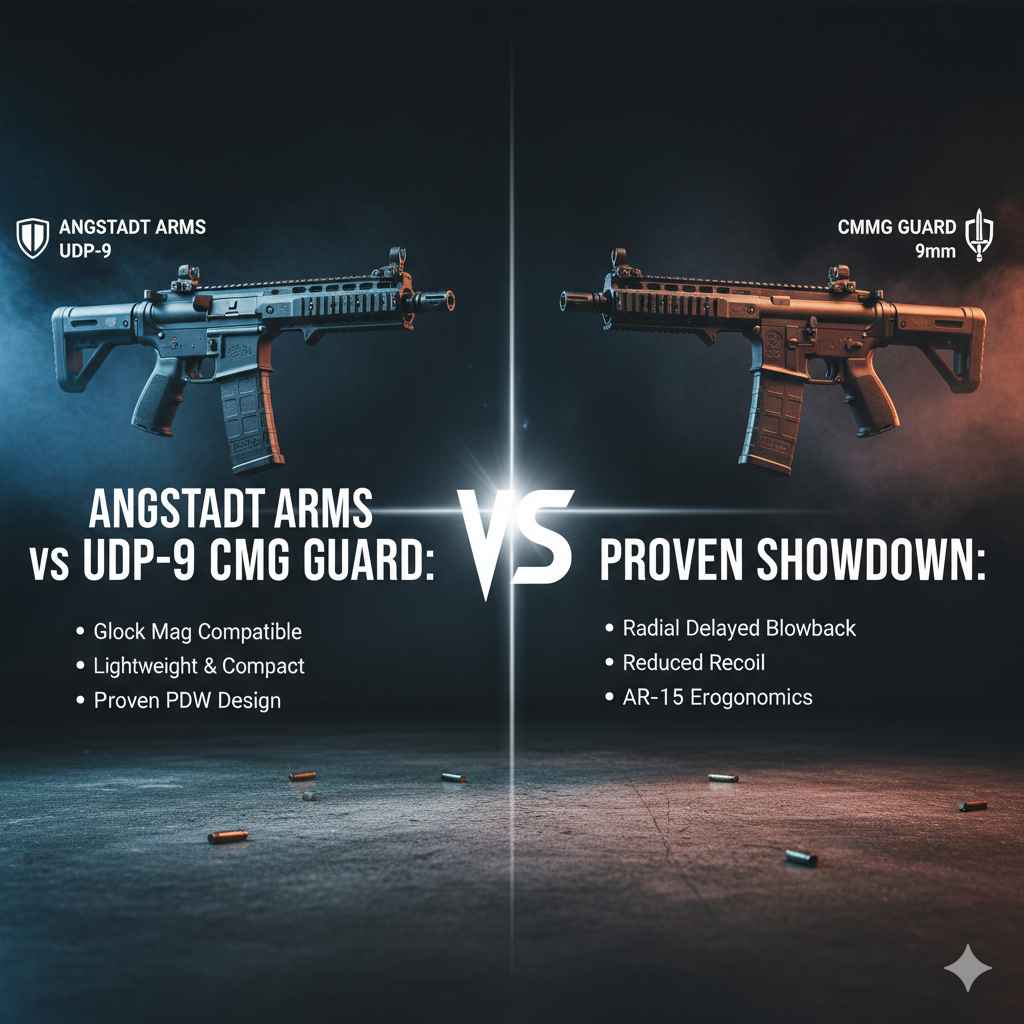
The Angstadt Arms UDP-9 and CMMG Guard are top choices for reliable 9mm PCCs. The UDP-9 often wins on compact design and simplicity, while the Guard shines with its customizable radial locking system and high part commonality with the AR platform. Choosing depends on your priority: ultimate compactness or AR standardization.
Welcome, fellow shooter! Are you looking to step into the exciting world of Pistol Caliber Carbines (PCCs), specifically chambered in the affordable and fun 9mm? It is easy to feel lost when looking at the Angstadt Arms UDP-9 and the CMMG Guard. Both are excellent firearms, but they feel different in the hand and operate slightly differently. Comparing the Angstadt Arms UDP-9 vs CMMG Guard can seem confusing because they both promise reliability. Don’t worry! We are going to break down these two powerhouses piece by piece. Think of me as your friendly coach, showing you exactly what makes each one great for your first or next 9mm build. Let’s clear up the confusion and help you choose the perfect carbine for your range days.
Understanding the 9mm PCC Craze
Why are so many people flocking to 9mm carbines like the UDP-9 and the Guard? It’s simple: fun, affordability, and lower recoil. Shooting 9mm through a rifle-length barrel is much softer than shooting traditional rifle rounds. This means less fatigue, easier follow-up shots, and more time enjoying the range.
PCCs are fantastic for several reasons:
- Budget-Friendly Ammo: 9mm practice ammo is usually much cheaper than rifle ammunition.
- Low Recoil: Great for new shooters or those sensitive to heavy recoil.
- Home Defense Utility: Offers familiar handling without the over-penetration concerns sometimes associated with high-powered rifle rounds (though safe storage is always key).
When you look at the Angstadt Arms UDP-9 vs CMMG Guard, you are looking at two different philosophies on how to build the best 9mm platform. Let’s explore what sets them apart.

Angstadt Arms UDP-9: The Compact Specialist
The Angstadt Arms UDP-9 is famous for being incredibly compact and utilizing a simple, robust blowback design. If your main goal is something that tucks away easily and feels straightforward, the UDP-9 is a strong contender.
Key Features of the UDP-9
The UDP-9 is designed around simplicity and compactness. It often appeals to those who value a small footprint.
- Integrated Upper/Lower: Unlike many AR-style platforms, the UDP-9 features a monolithic upper receiver that houses the bolt and buffer system tightly.
- Simple Blowback Operation: It uses a direct blowback system, which is mechanically less complex than delayed blowback systems, leading to fewer potential failure points.
- Glock Magazine Compatibility: It almost universally accepts Glock magazines, which are readily available and reliable.
One of the biggest advantages you notice immediately when handling the UDP-9 is its overall size. It is often shorter and lighter than many AR-pattern PCCs, making it excellent for tight spaces or easy transport.
Pros and Cons: UDP-9 at a Glance
To help you decide, here is a quick look at where the UDP-9 shines and where it might fall a little short for some users.
| Pros (What Shooters Love) | Cons (Things to Consider) |
|---|---|
| Extremely Compact Size | Less common parts availability compared to ARs |
| Simple, Proven Blowback System | Heavier felt recoil than delayed systems |
| Sleek, Minimalist Aesthetic | More proprietary parts |
| Reliable Glock Magazine Integration | Limited direct modification options |
CMMG Guard: The AR-Platform Powerhouse
CMMG has been a major player in the 9mm PCC market for years, largely due to their innovative Radial Delayed Blowback system and their commitment to AR platform compatibility. The CMMG Guard is essentially their refined, ready-to-go AR-style 9mm PCC.
The Magic of Radial Delayed Blowback
This is where the CMMG truly sets itself apart from standard blowback designs like the UDP-9. Most 9mm PCCs use direct blowback. This works, but it requires a very heavy bolt to keep the action closed until chamber pressure drops. This heavy bolt moving back and forth causes significant felt recoil.
CMMG’s Radial Delayed Blowback system uses a locking system that delays the bolt opening briefly using a rotating bolt head, similar to what you might see in a centerfire rifle, just adapted for pistol cartridges. This dramatically reduces the weight of the bolt carrier group and significantly tames recoil.
According to CMMG’s own testing and public documentation, this design can reduce felt recoil by up to 30% compared to traditional blowback systems. For a beginner, this means smoother shooting and faster sight recovery between shots.
AR Standardization is Key
Since the Guard is built around the AR platform, virtually every part you’d normally upgrade on an AR rifle—the buffer tube, stock, pistol grip, safety selector, and trigger—can be swapped out easily. This customization is a massive draw for many hobbyists.
If you are already familiar with AR maintenance, the Guard will feel instantly familiar. You can upgrade the trigger, drop in a favorite grip, or change the stock without learning a totally new system. This adherence to established standards is why many shooters turn to CMMG. For more technical information on firearm mechanisms, reputable sources like the National Shooting Sports Foundation (NSSF) often discuss these engineering differences.
Pros and Cons: CMMG Guard Breakdown
The Guard offers a different set of advantages, focusing heavily on shooter comfort and modularity.
| Pros (What Shooters Love) | Cons (Things to Consider) |
|---|---|
| Significantly Reduced Felt Recoil (Radial Delay) | Generally larger/longer than the UDP-9 |
| Full AR Platform Modularity | More moving parts in the operating system |
| Excellent Suppressed Performance | Can be slightly more expensive initially |
| Wide availability of replacement parts | Standard direct blowback versions might be heavier |
Head-to-Head Showdown: Angstadt Arms UDP-9 vs CMMG Guard
Now that we have looked at each rifle individually, let’s put the Angstadt Arms UDP-9 vs CMMG Guard side-by-side in the areas that matter most to a new shooter.
1. Operating System and Recoil Management
This is arguably the biggest differentiator.
UDP-9 (Direct Blowback): Simple, tough, fewer parts. The downside is that the entire heavy bolt must move backward, leading to a snappier, more noticeable recoil impulse. It’s like hitting a wall—it stops hard.
CMMG Guard (Radial Delayed Blowback): More complex, but smoother. The system delays the action just enough to allow pressure to drop before the bolt cycles. This results in a softer push rather than a hard snap. For long shooting sessions, this makes a big difference.
2. Size and Portability
If you plan on transporting your PCC often or using it in close quarters, size matters.
The UDP-9 usually wins on pure compactness. Its design philosophy leans into minimizing overall length. If you are looking for something that feels more like a large submachine gun or a very compact rifle, the UDP-9’s profile is hard to beat.
The CMMG Guard, being based on the AR platform, will generally conform to the standard AR length, even with a compact buffer tube, making it slightly bulkier than the UDP-9.
3. Maintenance and Customization
As a beginner, you want something easy to clean but also something you can grow into.
For cleaning, the UDP-9’s simple blowback system is often easier to field strip and clean initially. There are fewer proprietary pieces interacting within the receiver.
For customization, the CMMG Guard is the clear winner. Because it uses standard AR components for the lower receiver (grip, safety, trigger group, buffer tube), upgrading your trigger or stock is as easy as watching any standard AR-15 tutorial. This modularity offers endless possibilities as your shooting interests evolve.
4. Magazine Compatibility
Both platforms typically favor Glock-style magazines, which is a huge plus for commonality. However, always confirm the specific model you are purchasing, as some niche variations might exist. Glock magazines are durable, widely available, and relatively inexpensive, making training sessions much more cost-effective.
Detailed Comparison Table: UDP-9 vs Guard
Here is a table summarizing the key technical aspects to help clarify the Angstadt Arms UDP-9 vs CMMG Guard debate for easy reference.
| Feature | Angstadt Arms UDP-9 | CMMG Guard (Radial Delay) |
|---|---|---|
| Operating System | Direct Blowback | Radial Delayed Blowback |
| Recoil Feel | Snappier/Sharper | Softer/Smoother |
| Overall Footprint | Very Compact/Monolithic | Standard AR size (Modular) |
| Modularity/Upgrades | Limited (Proprietary Upper) | Extremely High (AR Standard Lower) |
| Field Stripping Simplicity | Very Simple | Slightly more complex due to the bolt group |
Choosing Based on Your Goals: Which One Is Right for You?
As your coach, I want you to choose the tool that fits your specific needs. There is no single “best” carbine, only the best one for your shooting style.
Choose the Angstadt Arms UDP-9 if:
- You prioritize the absolute smallest, lightest package possible.
- You want the simplest possible maintenance routine for a 9mm PCC.
- You value a very sleek, non-AR aesthetic.
- You are comfortable with a slightly snappier recoil impulse.
Choose the CMMG Guard if:
- Recoil mitigation is your number one priority for comfort.
- You love tinkering and plan on customizing the stock, grip, and trigger extensively.
- You are already familiar with the AR platform and want a familiar manual of arms.
- You plan on shooting extensively, where the smoother action will reduce fatigue.
Beginner’s Guide to First Steps with Your New PCC
Once you decide between the UDP-9 and the Guard, the real fun begins! Since you are new to PCCs, here are a few simple steps to get you started safely and effectively.
Step 1: Mastering Safety First
Safety is non-negotiable. Before you even think about shooting, practice the four universal rules of firearm safety. Even with low-recoil 9mm rounds, safety rules always apply.
The four rules are:
- Treat every firearm as if it were loaded.
- Never point the muzzle at anything you are not willing to destroy.
- Keep your finger off the trigger until your sights are on the target and you are ready to fire.
- Be sure of your target and what is beyond it.
Step 2: Initial Cleaning and Lubrication
Even new firearms need a little TLC. Check your manual (for either the UDP-9 or the Guard) for the recommended disassembly procedure. A simple field strip is usually enough.
Use a quality gun oil and a few cotton swabs. Wipe down the bolt, feed ramp, and inside the chamber. For the UDP-9, pay close attention to the buffer area. For the Guard, ensure the rotating bolt head mechanism is clean.
Step 3: Magazine Loading Practice (Before the Range)
Loading magazines is a skill! Practicing at home saves time and frustration at the range.
Load the Glock magazines you plan to use (start with 10 rounds if you are new to loading magazines, as they can be stiff at first). Practice inserting the magazine firmly until you hear or feel the positive click. Practice dropping the magazine free by hitting the mag release button.
Step 4: Sighting In and Understanding Holdovers
Since 9mm PCCs shoot a relatively slow, heavy projectile compared to a rifle, gravity will affect the bullet path more noticeably.
When you go to the range, start close—10 to 15 yards is perfect. Fire a few shots slowly, focusing on a perfect sight picture (or red dot picture). Adjust your sights (or dot) until the point of aim matches the point of impact. Don’t rush this; get comfortable with the sight picture first.
The Role of Suppressors (Optional But Fun)
Many shooters buy a 9mm PCC specifically to run suppressed. Both the UDP-9 and the CMMG Guard handle suppression well, but the operating system makes a difference in the experience.
When you suppress a direct blowback gun like the UDP-9, you significantly quiet the report, but the heavy bolt is still slamming back violently. This can sometimes lead to increased gas blowback into the shooter’s face.
The CMMG Guard, thanks to its Radial Delayed Blowback, often runs even quieter and smoother when suppressed because the cycling mass is lighter to begin with, and the delay mechanism helps manage the pressure curve more effectively. If suppression is a major future goal, the Guard often earns praise in this area.

Frequently Asked Questions (FAQ) for New PCC Owners
Here are answers to common questions beginners have when looking at the Angstadt Arms UDP-9 vs CMMG Guard.
Q1: Which gun is better for a complete beginner, the UDP-9 or the Guard?
The CMMG Guard often feels better for beginners because the reduced recoil makes controlling the firearm easier during live fire. However, the UDP-9 is simpler mechanically, which some beginners prefer for understanding the basics.
Q2: Do both these carbines use the same magazines?
Most models of both the Angstadt Arms UDP-9 and the CMMG Guard are designed to reliably accept standard Glock magazines. Always verify the specific configuration before purchasing, but Glock mags are the standard for both.
Q3: Is the maintenance process difficult on these 9mm PCCs?
Both are generally easier to clean than centerfire rifles. The UDP-9 is simpler due to its direct blowback design. The CMMG Guard has a slightly more complex bolt group because of the radial delay system, but it is still very manageable for routine cleaning.
Q4: Can I shoot cheaper steel-cased 9mm ammo in both?
While steel-cased ammo is cheaper, many shooters prefer brass-cased ammunition for better reliability, especially in blowback systems. While the CMMG Guard’s system might be slightly more forgiving, sticking to brass is often recommended for the smoothest, most reliable performance in any 9mm PCC.
Q5: Which one is easier to mount an optic (like a red dot) on?
Since the CMMG Guard is built on the AR platform, it has a full-length Picatinny rail section on the upper receiver, which is the standard for mounting optics. The UDP-9 also accepts rails, but its integrated receiver shape might look slightly different when an optic is mounted compared to the standard AR look.
Q6: How important is the weight difference between the two?
For casual range use, the difference might not seem huge. However, if you plan on shooting standing up for long periods or carrying the PCC all day, the lighter, more compact UDP-9 will offer a noticeable advantage in handling fatigue.
Final Thoughts on Your PCC Choice
Deciding between the Angstadt Arms UDP-9 and the CMMG Guard is a great problem to have because you are choosing between two top-tier 9mm carbines.
If you want the smoothest shooting experience possible, enjoy the modularity of the AR world, and plan on extensive future upgrades, the CMMG Guard, with its excellent Radial Delayed Blowback system, is likely your perfect match. It’s built for the long haul of shooting enjoyment with reduced physical impact.
If your heart is set on ultimate portability, a streamlined, simple design, and a slightly lower overall profile, the Angstadt Arms UDP-9 offers fantastic performance in a very tight package. It proves that simplicity can still deliver high quality and fun.
Whatever you choose, remember that the best way to learn is by practicing safely and consistently. Both these firearms are proven platforms ready to deliver years of enjoyable shooting. Get out there, practice your fundamentals, and enjoy the smooth, affordable fun that a 9mm PCC brings to the range! Happy shooting!