How Are Traditional Bow Shoots Scored: Scoring Rules
Traditional bow shoots are scored by adding the numerical value of the ring that each arrow hits on the target. The highest score wins, with arrows closer to the center (the bullseye) earning more points. For more on this, see our related guide on How to Make a Horse Bow And Arrow. For more on this, see our related guide on How to Make a Folding Bow And Arrow.
For a closely related bow or archery topic, How to Hang a Traditional Bow: Essential gives readers a useful next step.
For a related aiming question, How to Put Sights on a Traditional Bow helps readers compare the next accuracy detail.
For a closely related bow or archery topic, Are Oneida Bow Only For Bow fishing Uses gives readers a useful next step.
Have you ever wondered how archers tally their scores in a traditional bow shoot? It can seem a bit mysterious, especially when you’re just starting out. You see arrows landing everywhere on the target, and then suddenly scores are announced, and you’re left thinking, “How did they get that number?” Don’t let it be a confusing part of your archery journey! Understanding the scoring system is simple and will help you track your progress and enjoy the sport even more. We’ll break down exactly how it works, step by step, making it easy for you to follow along and even calculate your own scores in no time. Get ready to hit your mark and understand every point you earn!
Understanding Traditional Bow Shoot Scoring
Welcome to the exciting world of traditional archery! As you begin your journey, one of the first things you’ll want to grasp is how scores are tallied. It’s a straightforward system designed to reward accuracy and consistency. Think of it as a friendly way to measure who’s hit the mark most effectively. Unlike some sports with complex penalties or bonus points, traditional archery scoring is refreshingly direct. Each arrow has the potential to earn points based on where it lands on the target face. The closer your arrow is to the very center, the more points you get! This system encourages you to aim with precision and refine your shooting technique.
The Target Face: Your Scoring Zone
The key to understanding traditional bow shoot scoring lies entirely with the target face itself. These aren’t just pretty circles; they are meticulously designed scoring zones. Each zone, or ring, has a specific point value assigned to it. The target face is typically divided into concentric circles, radiating outwards from the absolute center. It’s crucial to know that the color of the rings often corresponds to their point value, but the numerical system is the ultimate decider.
The highest-scoring area is the bullseye, the very center of the target. This is where every archer aims to place their arrows. As you move outwards from the bullseye, the point values decrease. This gradual decrease in points as you move away from the center is what incentivizes precision and control. It’s a simple but effective way to highlight the archer who can consistently place their arrows in the most challenging areas.
How to Read an Arrow’s Score
Once an arrow has been shot and impacts the target, a quick assessment determines its score. The rule of thumb is simple: the score awarded is the value of the highest-scoring ring the arrow has touched. This means if your arrow’s shaft passes through a 10-point ring and ends up in a 9-point ring, you score 10 points for that arrow. The arrow must break the line of a ring to receive that ring’s score. If it rests exactly on the line between a 9 and a 10, it is awarded the higher score of 10 points.
To make this even clearer, imagine the target face is divided into zones, each labeled with a number. When an arrow lands, you look at the arrow shaft and identify which zone the shaft is in. If it’s touching or within the zone marked ’10’, it’s 10 points. If it’s touching or within the zone marked ‘9’ but not the ’10’, it’s 9 points, and so on. This straightforward method ensures fairness and clarity for all participants.
The Point System: A Closer Look
The standard scoring system for most traditional archery shoots, particularly those sanctioned by organizations like USA Archery, uses a numerical scale that increases towards the center. While specific point values can vary slightly depending on the competition’s rules or target type, the general principle remains consistent.
Typically, targets are marked with circles, and the points are assigned as follows:
- Bullseye (Innermost Circle): Often worth 10 points.
- Next Ring Out: 9 points.
- Following Ring: 8 points.
- And so on, decreasing by one point for each successive ring moving outwards.
Some specialized targets or formats might use different point systems, but the core concept of higher points for central shots is universal in traditional archery. It is always a good practice to confirm the exact scoring rules with the event organizer before the shoot begins.
Example Score Calculation
Let’s walk through a quick example to solidify your understanding. Imagine you’re shooting at a standard target and you’ve let fly five arrows. Here’s where they landed:
- Arrow 1: Lands squarely in the bullseye (10-point ring). Score: 10
- Arrow 2: Hits just inside the 9-point ring. Score: 9
- Arrow 3: Lands on the line between the 8 and 9-point rings. Score: 9 (higher value)
- Arrow 4: Falls into the 7-point ring. Score: 7
- Arrow 5: Lands in the 5-point ring. Score: 5
To find your total score for these five arrows, you simply add up the individual scores:
10 + 9 + 9 + 7 + 5 = 40 points.
It’s that simple! Each successful arrow contributes to your overall tally, rewarding your precision.

Common Terminology in Scoring
As you get more involved in traditional archery shoots, you’ll hear a few terms frequently used when discussing scoring. Familiarizing yourself with these will make conversations and understanding the results much easier.
What is an “X” ring?
You might notice that targets often have a small circle within the bullseye. This is called the “X” ring. While the bullseye itself might be worth 10 points, the “X” ring is often used as a tie-breaker. If multiple archers have the same high score (e.g., all 10s), the archer with the most arrows in the “X” ring wins. So, an “X” often signifies 10 points, but it carries an extra significance for ranking purposes.
The Importance of “Breaking the Line”
We touched on this earlier, but it’s worth emphasizing: an arrow scores the points of the ring its shaft touches or breaks through. If an arrow splits the line between a 9 and a 10, it counts as a 10. This means even a very slightly off-center shot can still yield a high score if it grazes the better ring. This rule adds an exciting element to the accuracy required.
What If an Arrow Hits the Wrong Target?
If you accidentally shoot an arrow into a target that isn’t yours, or onto a part of the target face that has no scoring value (like the backing or outside the scoring rings), that arrow typically scores zero points. It’s a reminder of the importance of focus and awareness on the shooting line.
Different Types of Traditional Bow Shoots and Their Scoring Nuances
While the basic scoring principle of hitting rings remains constant, different styles of traditional archery shoots might have variations in targets, scoring zones, or competition formats. Understanding these can help you prepare for various events.
Field Archery
Field archery involves shooting at targets placed at measured distances across natural terrain, often through woods or fields. The targets can vary in size and may not always have the traditional concentric circles. Instead, they might be marked with distinct scoring zones. For these shoots, it’s crucial to know the exact scoring chart provided for that specific course. Some common point values might be 5, 4, 3, 2, 1 for different zones.
For example, a typical Field Archery target might have a bullseye worth 5, the next ring 4, and so on, down to 1 for the outer ring. Distances can range from very short to over 100 yards, making accuracy and distance judgment vital. The United States Field Archery Association (USFAA) is a key organization in this discipline.
3D Archery
In 3D archery, archers shoot at life-sized animal targets made of foam. The scoring zones are marked on the foam target, often mimicking vital organ areas of the animal. These zones usually have different point values, with the most central and vital areas offering the highest scores.
A common scoring system in 3D archery might look like this:
| Scoring Zone | Point Value | Description |
|---|---|---|
| Vitals (Heart/Lungs) | 10 points | Central, smallest ring, representing vital organs. Often has an “X” in the very center for tie-breaking. |
| Body Cavity | 8 points | A larger ring encompassing the main torso of the animal target. |
| Broken Ribs | 5 points | An outer ring indicating a less vital hit. |
The exact placement of these zones is critical, and judges carefully inspect each arrow’s impact. The thrill here comes from the realism and the challenge of estimating distance and hitting the correct zones on a 3D representation.
Target Archery (Indoor/Outdoor Rounds)
This is perhaps the most recognizable form of archery, shot at fixed distances on a standard circular target face. The scoring, as we’ve extensively discussed, is based on the rings. Outdoor rounds (like the FITA or World Archery round) use larger targets at longer distances, while indoor rounds use smaller targets at shorter distances.
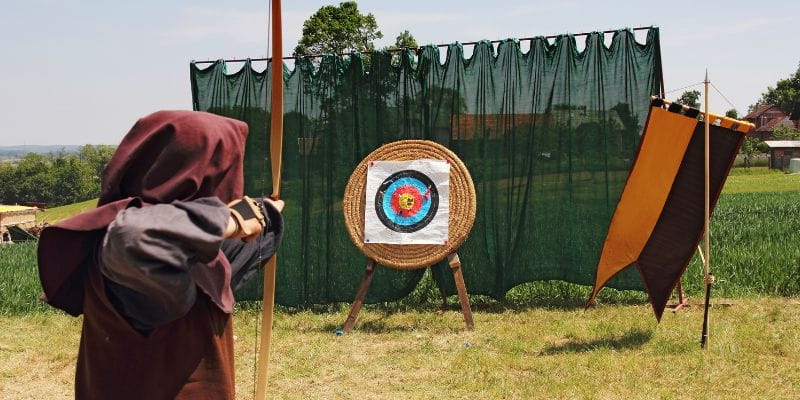
A standard outdoor target face (often referred to as a World Archery face) has 10 rings. The innermost ring is usually gold (10-9), followed by red (8-7), blue (6-5), black (4-3), and white (2-1). The innermost gold ring is often further divided by the X ring.
Here’s a typical breakdown for a standard target face:
| Color Band | Points | Description |
|---|---|---|
| Gold (Innermost) | 10, X | The bullseye and adjacent tie-breaker ring. |
| Red | 8, 9 | The next band outwards. |
| Blue | 5, 6, 7 | The middle band. |
| Black | 3, 4 | The fourth band. |
| White | 1, 2 | The outermost band. |
The scoring, of course, uses the numerical value of the ring touched.
Tips for Improving Your Score
Now that you understand how traditional bow shoots are scored, let’s talk about how you can improve your own accuracy and, consequently, your score. It’s a journey of practice, patience, and paying attention to the fundamentals.
Focus on Form and Consistency
The most significant factor in improving your score is consistent shooting form. This means developing a repeatable shot sequence from start to finish. Key elements include:
- Stance: Stand balanced and stable, feet shoulder-width apart.
- Grip: Hold the bow loosely but securely. Avoid a death grip.
- Draw: Draw the bowstring smoothly, using your back muscles, not just your arms.
- Anchor Point: Find a consistent spot on your face where your drawing hand touches. This is crucial for repeatability.
- Aiming: Focus on your intended point of impact.
- Release: Execute a clean release, allowing the string to fall away smoothly from your fingers or release aid.
- Follow-Through: Maintain your shooting form and focus even after the arrow has left the bow.
Practice with Purpose
Simply shooting arrows isn’t enough; you need to practice with a goal in mind.
- Set Goals: Aim to hit a specific ring on the target or achieve a certain score in a practice session.
- Analyze Your Shots: After each end (a group of arrows), look at where your arrows landed. Are they clustering together? Are they consistently high, low, left, or right? This feedback is invaluable for making adjustments.
- Vary Distances: Practice shooting at different distances to improve your distance judgment and ability to compensate for arrow drop.
- Shoot Under Pressure (Simulated): Practice shooting your rounds as if it were a competition. This helps you learn to manage nerves and maintain focus when it counts.
Equipment Check and Tuning
Ensure your bow and arrows are properly set up and tuned. This includes:
- Arrow Spine: Make sure your arrows are the correct “spine” (stiffness) for your bow to ensure they fly straight. An improperly spined arrow will fly erratically.
- Rest and Nocking Point: Ensure your arrow rest is properly aligned and your nocking point is set correctly to guide the arrow accurately off the bow.
- Bow Tuning: If you’re experiencing consistent flyers or groups that are too wide, your bow might need tuning. This could involve adjusting string tension, limb alignment, or other parameters depending on your bow type. This is a complex area often best handled with the help of a qualified archery technician initially.
Mental Game
Archery is as much a mental game as it is physical. Developing concentration and focus can significantly impact your scores.
- Stay Calm: Learn techniques to manage nerves and stay calm under pressure. Deep breathing exercises can be very helpful.
- Visualize Success: Before each shot, visualize the arrow flying true and hitting your intended target.
- Don’t Dwell on Mistakes: Every archer makes bad shots. Acknowledge it, learn from it if possible, and then let it go. Focus on the next arrow.
Frequently Asked Questions (FAQ)
Here are some common questions beginners have about scoring traditional bow shoots:
Q1: What is the highest possible score in a typical traditional archery shoot?
A: In most standard target archery, the highest score per arrow is 10 points. In a round with many arrows, your total score can be quite high. However, the “X” ring is often used as a tie-breaker, so while it might also count as 10 points, having more “X”s can be better if scores are tied.
Q2: Do I need special equipment to participate in a scored shoot?
A: For most beginner or local shoots, standard traditional archery equipment (recurve or longbows) is fine. Some advanced or specific competitive events might have rules about equipment specifications, so it’s always best to check the event rules beforehand. Ensure your equipment is safe and functional.
Q3: What happens if my arrow lands outside the scoring rings?
A: If an arrow lands outside the designated scoring zones on the target face, it receives no points, essentially scoring a zero for that arrow. It’s important to aim for the scoring areas.
Q4: How do officials determine which ring an arrow hit? Are they strict?
A: Officials use their judgment and experience to determine the ring. They are generally trained to be fair and consistent. If an arrow is right on the line, it’s typically awarded the higher score of the two rings it touches. Often, judging is done by simply looking at the deepest penetration of the arrow’s shaft into the target.
Q5: Are there different scoring systems for different types of traditional bows?
A: The core scoring method (points based on ring penetration) is the same for all traditional bows like longbows and recurve bows. However, the specific targets and scoring rounds might differ depending on whether you’re participating in field archery, 3D archery, or indoor/outdoor target archery.
Q6: My arrows are clustering, but not in the center. How do I adjust my aim?
A: If your arrows are grouping well but are consistently off-center, it means your form is relatively consistent. You need to make an adjustment based on where the arrows are landing relative to where you want them to land. For example, if your arrows are hitting high and left, you might need to aim slightly lower and right. Subtle adjustments are key, and it’s often best to move your aiming point by approximately half the distance your current group is away from the bullseye.
Q7: Can I use a sight on my traditional bow for a scored shoot?
A: Traditional archery often emphasizes shooting without sights. Many traditional archery competitions are specifically for “barebow” or “traditional” classes, which prohibit sights, stabilizers, and other modern accessories. If you want to use a sight, you’ll need to look for divisions or shoots that allow it, often called “Olympic Recurve” or similar, though that’s technically a modern category. Always check the class rules for the specific shoot you plan to enter.
Conclusion
Understanding how traditional bow shoots are scored is fundamental to enjoying and participating in this ancient and rewarding sport. It boils down to the simple, clear principle of awarding points based on where your arrows strike the target face, with the bullseye offering the highest rewards. Whether you’re aiming for a perfect 10 in target archery, hitting the vitals on a 3D animal, or navigating the terrain of field archery, the core concept remains the same: accuracy pays off.