

Not all British Royal Guards are armed. While many ceremonial guards carry historic firearms for tradition, those actively protecting royal residences or performing protection duties carry modern, active service firearms for immediate security needs. The difference depends entirely on their specific operational role at the time.
It is one of the most iconic images in the world: the scarlet tunics and tall bearskin hats of the British Royal Guards standing perfectly still. But as you watch them, a question often pops into your head: Do they actually carry guns? If so, are all of them armed? It can be confusing to tell the difference between the ceremonial guard you see at Buckingham Palace and the officers providing active security. Don’t worry! This is a very common question, and understanding the answer brings a whole new appreciation for their duty. We are going to break down exactly which guards carry weapons and why, making the situation perfectly clear for you. Let’s look closely at the gear and the roles of these dedicated soldiers.
Understanding the British Royal Guard Roles
The term “Royal Guard” often lumps several different roles into one image. To truly answer whether they are armed, we must first separate the ceremonial duties from the actual protection duties. It’s not just about what uniform they wear, but what job they are actively doing on that shift.
Ceremonial Guards: The Public-Facing Role
These are the guards most tourists see. Their primary purpose is tradition, continuity, and presenting the iconic image of the monarchy. They are part of the Household Division, which includes regiments like the Grenadier Guards, Coldstream Guards, Scots Guards, Irish Guards, and Welsh Guards.
The famous ceremony you see, often involving the Changing of the Guard, is steeped in history. Their presence is meant to be a visible symbol of the Sovereign’s protection, even if modern, armed police or specialized security personnel handle immediate threats.
Protection and Escort Guards: The Operational Role
Behind the scenes, or sometimes subtly integrated into the visible details, are guards whose primary role is active security. These soldiers are focused on immediate, armed response to potential threats against the Royal Family or their residences.
When the monarch is in residence, or when an event requires higher security, the rules change rapidly. These personnel are trained and equipped for active combat or threat neutralization, often wearing less obvious uniforms or specialized protective gear alongside their dress uniforms.

Are All British Royal Guards Armed? The Simple Answer
No. Not every guard you see performing a public-facing, traditional duty is carrying a firearm intended for active combat. However, virtually all guards assigned to duty involving the protection of a royal residence or person will be armed in some capacity, though the type of weapon varies drastically based on their specific task.
The Ceremonial Weapon: The Historic Firearm
When a guard is performing a purely ceremonial duty, such as the famous Changing of the Guard parade, they carry a specific, historical firearm. This weapon is part of the uniform and tradition. Think of it as a piece of necessary, functional history.
- The Type of Weapon: Typically, this is an older service rifle, such as the L85A2 or an earlier variant.
- Ammunition Status: Crucially, these ceremonial rifles are usually either unloaded or loaded with blanks (dummy rounds used for noise and display) when on public ceremonial parade routes.
- Purpose: The weapon serves as a symbol of military service and readiness, upholding the centuries-old tradition of guarding the Sovereign.
It’s important to understand that while they are carrying a rifle, they are not positioned to engage a threat using that specific rifle during a standard parade. Their training dictates that for immediate threat response, other protocols and specialized personnel take precedence, especially in high-visibility public areas where causing panic is counterproductive.
The Active Duty Firearm for Immediate Response
If you see a guard positioned near an entrance or patrolling an area deemed higher risk, or if they are operating outside of the main public parade routes, they are far more likely to be carrying a modern, fully operational, and loaded firearm.
These guards are part of the operational security detail. Their mandate is immediate threat neutralization. They are often members of specialist protection units or soldiers specifically assigned to sentry duty where the possibility of a hostile breach is a real, assessed risk.
For example, sentries posted directly at the gates of St. James’s Palace or Windsor Castle may be armed with modern weaponry appropriate for immediate action. This is standard operating procedure for protecting critical infrastructure and personnel, as advised by security assessments, such as those related to counter-terrorism preparedness.
Comparing Ceremonial vs. Operational Guard Armament
To make this distinction perfectly clear, let’s look at a side-by-side comparison of the typical loadout for guards performing two distinct functions in London.
| Guard Function | Primary Role | Typical Weapon Carried | Ammunition Status |
|---|---|---|---|
| Changing of the Guard (Parade Route) | Ceremonial Tradition & Public Display | Historic Service Rifle (e.g., older SA80 variant) | Blanks or Unloaded (Non-Combat Ready) |
| Sentry Duty (Palace Gates/Fixed Posts) | Active Security and Rapid Response | Modern Service Rifle (e.g., L85A3) or Pistol | Live Rounds (Combat Ready) |
| Royal Escort Duty (Motorcade) | Close Protection of Principal | Heavily Armed, often Carbines or Sub-Machine Guns | Live Rounds (Highest State of Readiness) |
This table shows that the concept of “Royal Guard” is not uniform; it’s defined by the assignment. If you are looking at a guard standing near an entrance that is clearly not part of the public parade square, they are almost certainly tasked with an active security role and are armed accordingly.
Why the Confusion Exists: The Unarmed Guard Myth
A major source of confusion stems from incidents where guards, particularly those performing standard sentry duty, have physically confronted individuals without firing their weapons, or have been filmed apparently unarmed in certain low-risk scenarios.
The Role of Verbal Command and Discipline
British military training heavily emphasizes discipline and de-escalation, even when armed. A Royal Guard is trained that their first line of defense is their presence, authority, and clear, loud verbal commands.
If someone steps out of line—say, by attempting to cross a barrier or touching the soldier—the soldier’s immediate response is to shout commands, such as “Stop!” or “Stand Back!” This is often mistaken for being unarmed. In reality, the armed guard is attempting to resolve the situation without escalating to force. Only if the threat persists or escalates drastically would they move to use their weapon.
The Difference Between Sentry and Close Protection
Let’s clarify the two main protective roles that involve weapons:
- Sentry Duty: Guards posted at static points (like a gate). They are armed with a rifle, and their immediate area is their responsibility. They are trained to hold that post.
- Close Protection Officers (CPOs): These officers travel with the Royal Family, often dressed in less traditional, contemporary suits, though sometimes they wear specialized military attire. They are always armed with the latest equipment and are focused solely on the principal’s safety, constantly scanning the environment for threats. These officers are definitely armed for immediate action.
The official UK government and Ministry of Defence guidance on security operations confirms that protection forces are equipped based on the assessed threat level for the location or individual they are guarding. You can find more about the structure of UK public service protection roles, which often intertwine with military security details, through official government defense pages.
How to Spot the Difference: A Beginner’s Guide
If you are visiting London and want to know in an instant whether the guard you are looking at is carrying a ceremonial weapon or an actively deployed firearm, here are a few quick visual cues. Remember, these are general guidelines, as security posture can change instantly.
Location Matters: Where Are They Standing?
If the guard is:
- Standing directly on the route where the main public parade (like the Guard Mounting at Horse Guards Parade or Buckingham Palace) is actively moving, their weapon is likely ceremonial.
- Standing inside a specific sentry box or posted directly at a reinforced door or gate that is not part of the main public viewing area, they are likely on active, armed duty.
Body Language and Equipment: Subtle Clues
While guards on parade are trained to be impassive, there are slight differences in their visible gear when they are actively armed for combat versus ceremonial parade:
| Feature | Ceremonial Posture (Likely Blanks/Unloaded) | Active Duty Posture (Likely Live Ammo) |
|---|---|---|
| Webbing/Kit | Minimal; often just ceremonial cross-belts. | May wear tactical webbing, sidearm holster, or comms gear underneath or visible. |
| Rifle Position | Often held in the “Slope Arms” or “Order Arms” position, designed for marching and standing still. | Often held at the “Stand Easy” or “Ready” position if at a sentry post, allowing for quicker acquisition. |
| Uniform Details | Immaculate, polished parade dress, often with white gloves. | Uniform may be slightly more functional, perhaps less gleaming, prioritizing operational readiness over perfection. |
If you see a guard wearing a harness that looks like it holds extra magazines or specialized communication equipment, they are operating under a security directive that necessitates live armament.
The Training Behind the Uniform: Readiness and Skill
It is vital to remember that whether armed with blanks or live ammunition, every soldier serving as a Royal Guard is a fully trained member of the British Army. Their discipline is legendary, and their training covers far more than just standing still.
Military Training Standardization
All guards are infantry soldiers first. This means they undergo rigorous combat training. The skills required to maintain a high-pressure sentry post are transferable to high-risk situations. Even if they are carrying a ceremonial weapon on a specific day, they retain the knowledge of how to operate their standard-issue service weapon effectively.
This rigorous, standardized approach ensures that if a sudden, real threat emerges during a public parade—a scenario military planners must always consider—the guards are capable of transitioning roles rapidly. They are trained to rely on surrounding security assets, but they are not helpless.
The Role of Armed Police Support
In major public areas like The Mall or outside high-profile royal residences, the uniformed soldiers are always backed up by heavily armed officers from the Metropolitan Police Service (the London police force). This is a crucial layer of defense.
While the Guard maintains the visual continuity and tradition, the Metropolitan Police’s specialist armed response units are responsible for immediate, decisive action against complex threats. Think of it as a layered defense system, rather than relying on just one type of soldier or officer.
For more detailed insight into the general role of the police protecting VIPs in the UK, resources from the College of Policing often detail the standards for firearms proficiency required for specialized units.
The Historical Context of Guard Armament
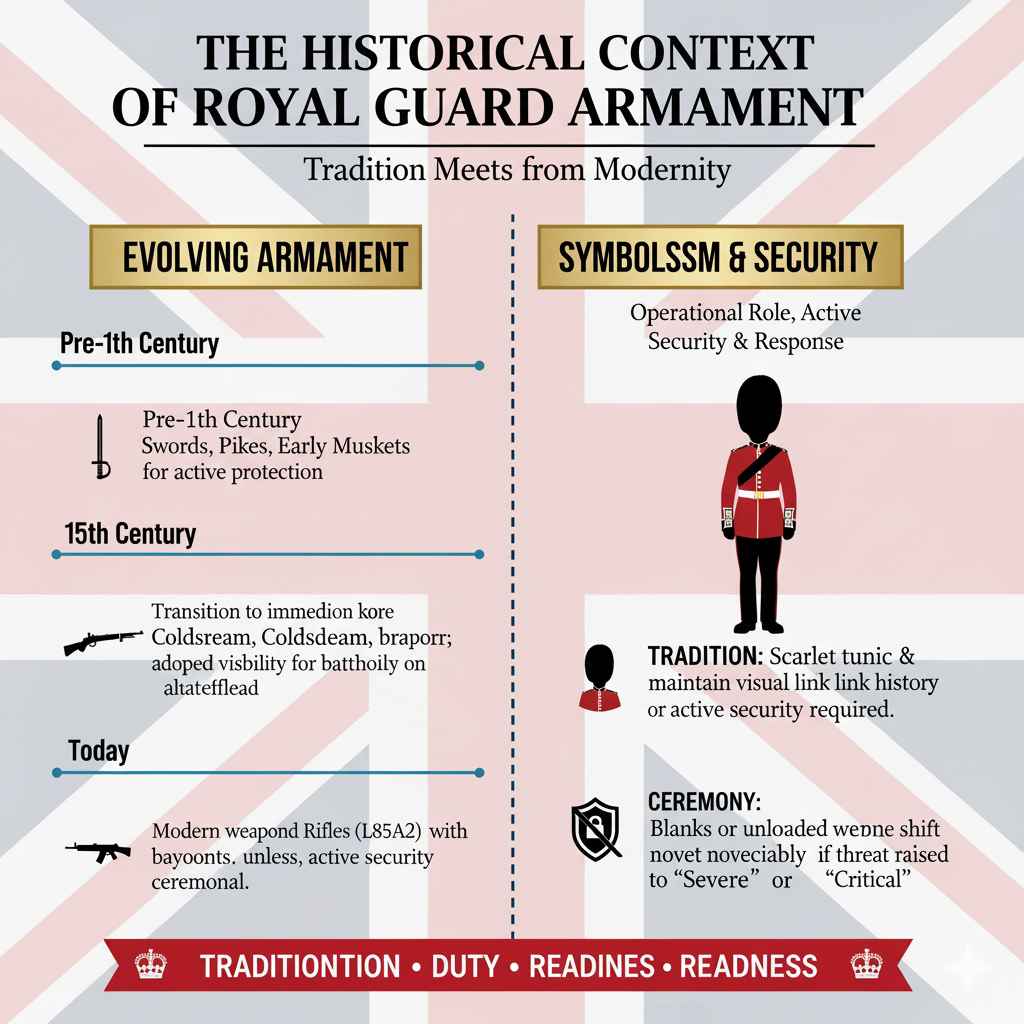
The tradition of the Royal Guard dates back centuries, long before modern firearms. Originally, guards protected the monarch with swords, pikes, and muskets. The transition to modern weapons reflects evolving threats.
The reason the ceremonial dress and weapons persist is tradition. The scarlet tunic and bearskin were adopted in the 19th century to make soldiers easier to spot on the battlefield (and in the smoke of early firearms). Today, that visibility serves a ceremonial purpose.
The use of blanks or unloaded weapons for parades maintains this visual link to the past while acknowledging that massive, public military displays do not require active combat readiness unless the security assessment demands it. If the threat level is raised to “Severe” or “Critical,” you would see a noticeable shift in the armament and posture of all personnel visible.
Frequently Asked Questions (FAQ) for Beginners
Q1: If a Royal Guard shouts at me, should I move?
A: Absolutely, yes. Always obey the instructions of a Royal Guard immediately. Whether they are carrying ceremonial or active weapons, their instruction is paramount for safety and security. Move exactly where they direct you to go.
Q2: Can I take a selfie with a guard on parade?
A: Generally, no, not while they are actively performing their duties, especially during the march or guard mounting. Interfering with their concentration or movement is a breach of discipline. Wait until the specific ceremony is over or find a designated photo spot away from their operational area.
Q3: How can I tell if their rifle is loaded with blanks?
A: You usually cannot tell just by looking at the outside of the rifle during a parade. The key indicator is their role and location. If they are clearly on a public marching route, assume the weapon is not ready for live engagement. Only operational sentries have their status confirmed as carrying live ammunition.
Q4: Who is responsible if a guard needs to fire their weapon?
A: If a military guard on duty fires their weapon in defense, the action falls under the rules of engagement specific to their current operational orders, which are sanctioned by the Ministry of Defence and ultimately the Crown. In contrast, armed police operate under different, but equally stringent, police use-of-force guidelines.
Q5: Are the guards armed during the Changing of the Guard?
A: Yes, the guards do carry rifles during the Changing of the Guard ceremony, because the weapon is an official part of their ceremonial uniform. However, during the public parade and ceremonial movements, these rifles are typically not loaded with live ammunition. They may be unloaded or fitted with blanks depending on the specific event. The primary purpose in this setting is tradition and visual representation of the monarch’s protection, while armed police and operational security teams nearby handle real-time security threats if needed.
Conclusion
So, are all British Royal Guards armed? The short answer is no—not in the same way or for the same purpose. The guards you commonly see in ceremonial settings, such as the famous Changing of the Guard, do carry rifles as part of their historic uniform. However, these weapons are usually not intended for active combat during public ceremonies.
At the same time, other guards assigned to active security roles at royal residences or during sensitive operations are fully armed with modern service weapons and live ammunition. Their mission is immediate protection of the Royal Family and royal properties.
Understanding this distinction helps explain the mix of tradition and real security that defines the British Royal Guard system. The ceremonial guards represent centuries of military heritage, while the operational guards—often supported by armed police—provide the modern protective force needed in today’s world.
In other words, the Royal Guards are both symbols of tradition and trained professional soldiers. Whether standing still for a ceremony or protecting a royal residence, they remain an essential part of the United Kingdom’s security and heritage. 🇬🇧