Are Chest Protectors Required In Olympic Fencing? Essential
Quick Summary: No, chest protectors are generally not required for male fencers competing under World Fencing Federation (FIE) rules in Olympic-style fencing (Foil, Épée, and Sabre). However, they are mandatory for all female fencers across all three weapons, primarily for safety and compliance with international regulations.
Welcome to the piste! Stepping into the world of competitive fencing can feel like learning a whole new language, especially when it comes to the required gear. If you’ve watched international competitions or are just starting lessons, you might wonder about protective wear. Is that piece of plastic or fabric under the jacket absolutely necessary? Figuring out exactly what you need can be confusing. Don’t worry! We’ll clear up the rules around chest protectors in Olympic fencing so you can focus on your footwork and scoring touches.
Understanding Protective Gear in Fencing: More Than Just a Jacket
Fencing is a sport of precision, speed, and trust. While we wear masks and protective gloves, other padding plays a crucial role in safety. The chest protector, often called a plastron or underarm protector, fits snugly beneath your jacket. Its main job is to add an extra layer of defense, especially against penetration or hard impacts.
But here’s where the rules get specific: the requirements change depending on your gender and the specific level of competition. For beginners, understanding these nuances is key to showing up prepared for your first tournament.
The Role of the Plastron (Underarm Protector)
Before diving into the Olympic specifics, let’s look at the gear itself. What exactly is a chest protector in fencing?
It’s usually a quilted, soft garment worn under the fencing jacket. Its primary purpose is two-fold:
1. Impact Absorption: To cushion the blow of an opponent’s blade, especially if it slips through the jacket fabric or hits a sensitive area.
2. Preventing Penetration: While modern jackets are tough (made of durable materials like Kevlar or heavy-duty ballistic nylon), the plastron provides a critical secondary barrier.
Many beginners assume that if the jacket looks thick enough, they don’t need this extra layer. However, most major fencing bodies mandate it, especially for certain competitors.

The Core Question: Required for the Olympics?
This is the big one that trips up new fencers. The answer depends entirely on who is fencing. The rules are set by the Fédération Internationale d’Escrime (FIE), the international governing body for the sport, whose rules dictate Olympic competition.
Mandatory for Female Fencers (All Weapons)
For women, the answer is a resounding yes.
According to FIE regulations, all female fencers must wear an underarm protector (plastron) beneath their fencing jacket during all official competitions, including the Olympics. This rule is enforced strictly across Foil, Épée, and Sabre.
Why this distinction? This requirement is a long-standing safety measure intended to provide maximum protection to the chest area, which is considered more vulnerable in female anatomy compared to male fencers, where the jacket structure might offer slightly different coverage. This is non-negotiable for compliance.
Not Required for Male Fencers (All Weapons)
For male fencers in Olympic-level competition, the chest protector (plastron) is not officially required by the FIE rulebook.
Male fencers typically rely solely on the strength and construction of their regulation fencing jacket, which must meet strict material resistance standards (usually 800 Newtons of resistance). If a male fencer chooses to wear one, it is entirely optional for personal comfort or added padding, but it is not a mandatory piece of safety equipment for official bouts.
This distinction often leads to confusion because many local clubs or youth leagues might still require all members to wear one for general safety practice, even if the FIE doesn’t demand it for adult men.
FIE Regulations: Getting Specific About Safety
To ensure fairness and safety at the highest level, the FIE has very detailed rules about what equipment is allowed and required. When we look at the official rulebook (often referencing sections related to weapons and clothing), the mandate for female protection stands out clearly.
Why Do the Rules Differ by Gender?
The difference in mandatory gear stems from historical safety standards and anatomical considerations. In many martial arts and combat sports, different levels of primary protection are often prescribed based on gender to ensure equivalent levels of safety across the board.
For fencing, the standard jacket material is rigorously tested. The FIE mandates that jackets (and breeches) must withstand at least 800 Newtons of force. For women, the plastron acts as an essential supplementary layer to meet these high safety standards universally.
The Three Olympic Weapons: Foil, Épée, and Sabre
Does the weapon you choose change the requirement? In Olympic fencing, the answer is no—the gender rule applies regardless of whether you fence with a point-tip weapon (Foil/Épée) or a cutting/thrusting weapon (Sabre).
Here is a breakdown table summarizing the mandatory requirement for the chest protector (plastron) in FIE competitions:
| Weapon | Gender | Chest Protector (Plastron) Requirement | Primary Reason |
|---|---|---|---|
| Foil | Male | Optional | Jacket provides sufficient primary protection (800N). |
| Foil | Female | Mandatory | Additional safety layer required by FIE regulations. |
| Épée | Male | Optional | Jacket provides sufficient primary protection (800N). |
| Épée | Female | Mandatory | Additional safety layer required by FIE regulations. |
| Sabre | Male | Optional | Jacket provides sufficient primary protection (800N). |
| Sabre | Female | Mandatory | Additional safety layer required by FIE regulations. |
This clarity should help you purchase the correct initial gear setup. If you are a male beginner, you have the option to skip this purchase initially, though many coaches still recommend it. If you are a female beginner, this purchase is essential before you step onto the competitive strip.
What About Youth and Cadet Fencing?
If you are new to the sport and your fencer is young (in the Youth or Cadet categories), the rules can sometimes be even stricter than the senior FIE level.
In many national governing bodies (like USA Fencing or various European federations), youth programs often mandate protective wear for all fencers, regardless of gender, simply to build the habit of layered safety from day one.
For example, while an 18-year-old male fencer might skip the plastron at an international event, a 14-year-old boy at a regional championship might be required to wear one by the local referee or sanctioning body. Always check the specific rules for the tournament you plan to enter, especially at the youth level.
The 800N Standard: Why Material Matters
The core of fencing safety is the required resistance of the outer clothing. The 800 Newton (N) requirement is extremely high. To put it in perspective, 800N is roughly equivalent to supporting 180 pounds of static weight without tearing.
When a blade hits the jacket, the energy transfer is rapid and focused. The jacket material must distribute this force across a wide area. If a plastron is worn, it helps dissipate this localized energy before it ever reaches the body, offering redundancy in protection. You can find more information on standardized safety gear requirements from organizations that develop safety standards for sports equipment, although specific fencing standards are maintained by the FIE.
Beginner Gear Checklist: What You Must Buy First
Whether required or optional, knowing what to buy is crucial. As a beginner, focusing on the mandatory items first will get you safely into the training hall.
Here are the essential items you need before taking your first competitive bout:
1. Mask: Must meet FIE safety standards (often 1600N rating for competitive masks).
2. Jacket: Must be the correct material and size.
3. Underarm Protector (Plastron): Mandatory for women; highly recommended for men.
4. Glove: Specific to the weapon (Foil/Épée glove is generally the same; Sabre gloves have different cuff requirements).
5. Breeches/Knickers: Must be the correct length and material.
6. Lamé (For Foil/Sabre): The metallic vest that registers electronic hits (required only when training/competing with electric scoring).
If you are a female fencer, prioritize the plastron purchase immediately after securing your mask and jacket.
How to Choose the Right Chest Protector
If you need one (or choose to wear one), selecting the right fit and material is important for comfort and safety compliance.
- Check the Material: Ensure it is designed specifically for fencing. While some older designs used simple padding, modern ones use durable, often stretchable materials that won’t bunch up under the jacket.
- Get the Right Size: The plastron must fit snugly against the body. If it’s too loose, it can shift, creating gaps where protection is needed or bunching uncomfortably near the armpit.
- Look for the Full Coverage Style: The best plastrons cover the entire torso, including the side under the armpit (the area most vulnerable to armpit shots that slip past the jacket).
- Consider Both Sides: Some plastrons are designed to be worn only on the non-weapon arm side, while others offer full coverage. For maximum safety, a full-torso design is usually best, ensuring protection on the front and back.
Remember, this gear sits right against your body. Comfort is key to maintaining focus during long bouts!
What Happens if You Show Up Without One? (The Referee’s Role)
In any official FIE competition, equipment checks happen before you step onto the strip. A referee or designated gear official will inspect your uniform.
If a female fencer presents for a bout without the mandatory plastron underneath her jacket, she will not be allowed to fence. She will typically be given a short grace period to correct the issue, often by borrowing one or quickly running to the locker room. If she cannot rectify the situation before the call to the strip time limit expires, she will forfeit the bout.
For male fencers, if a plastron is missing, no immediate penalty will occur unless the specific tournament rules mandated it separately (common only at very low-level, local events). However, equipment checks are serious business in high-level fencing.
Beyond the Olympics: Club and Collegiate Play
It is wise for beginners to operate under the strictest safety assumption—that they need the plastron—until they know otherwise.
Collegiate Fencing (NCAA)
Collegiate fencing in the US generally aligns closely with FIE standards. For women, the plastron is mandatory. For men, it is optional, though many college coaches strongly recommend it for added protection during intensive practice drills.
Local Club & Youth Leagues
At the very entry level, safety takes precedence over strict international adherence. Many fencing clubs will mandate that all members wear a plastron, regardless of gender or age, simply because training can involve accidental hits, and teaching good habits early is vital. Always defer to your coach’s instructions when training locally.
To learn more about general safety equipment beyond just the chest protector, you might find resources from established sporting goods safety organizations helpful in understanding impact standards.
Comparing Gear Requirements Across Sports
Fencing’s gear standards are unique compared to other combat sports. It helps to see where it sits:
| Sport | Primary Body Protection Requirement | Chest Protector Status (General) | Key Difference from Fencing |
| :— | :— | :— | :— |
| Olympic Fencing (Women) | 800N Jacket + Mandatory Plastron | Mandatory | Focus on blade penetration resistance. |
| Olympic Fencing (Men) | 800N Jacket Only | Optional | Less focus on primary torso padding redundancy. |
| Taekwondo (WT) | Chest Guard (Hogu) | Mandatory (Both Genders) | Hogu is large and covers the entire front/back for heavy body strikes. |
| Karate (WKF) | Body Protector (Optional/Varies) | Optional/Variable | Protection focuses on blocking and impact absorption, often lighter padding. |
The fencing approach is highly specialized—it protects against a sharp, concentrated force (the tip of a blade) rather than a wide impact (a kick or punch).
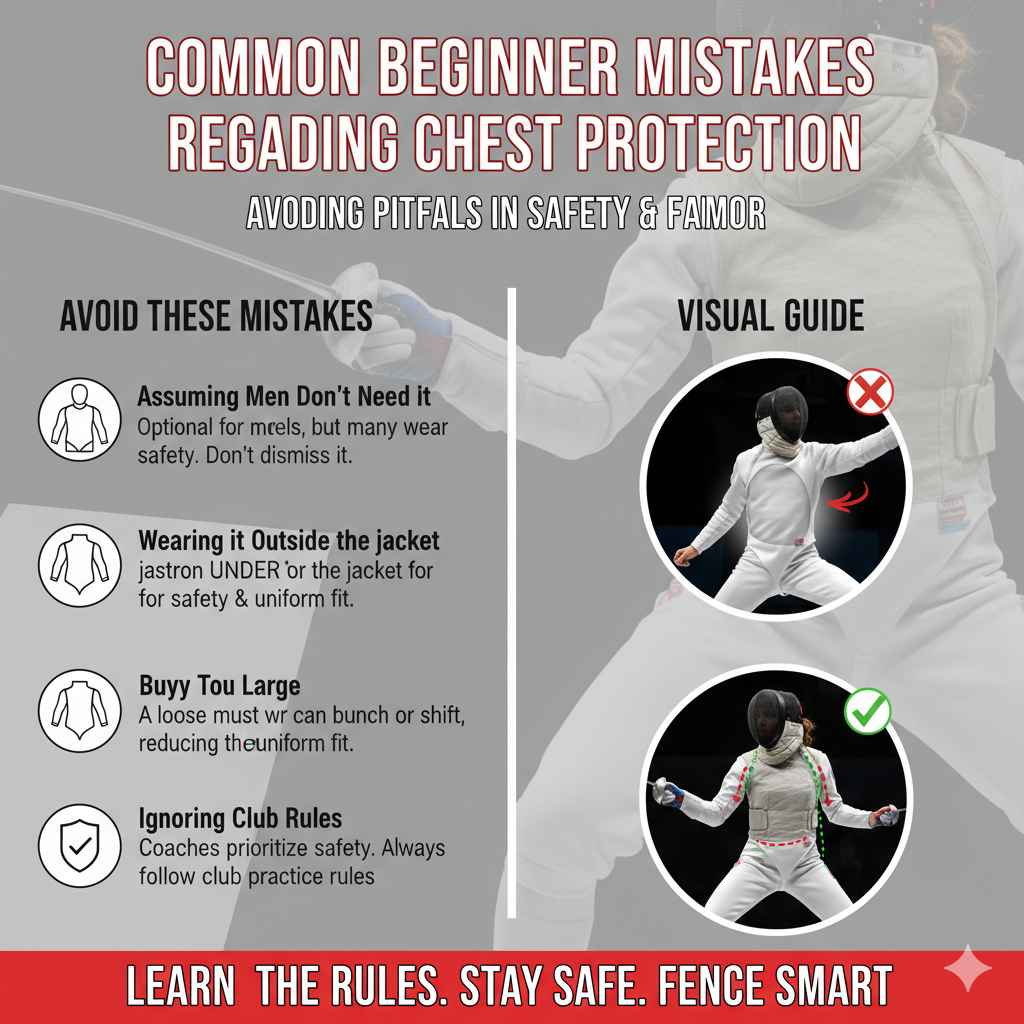
Common Beginner Mistakes Regarding Chest Protection
As a beginner, you want to avoid these common pitfalls when dealing with the plastron:
Assuming Men Don’t Need It: Even though it’s optional for men at the FIE level, many experienced fencers wear one for peace of mind. Don’t feel pressured, but don’t dismiss it purely because it’s optional.
Wearing it Outside the Jacket: The plastron must go under the jacket. Wearing it over the jacket defeats the purpose of standardized fitting and uniform presentation.
Buying Too Large: If the plastron hangs loose, it can bunch up and actually create uncomfortable pressure points or shift away from where it needs to protect during movement.
Ignoring Club Rules: If your coach says everyone wears one for practice, wear one. Club rules often prioritize maximum safety over FIE minimums.
FAQ: Answering Your Gear Questions
Here are quick answers to other common beginner questions about chest protection in fencing:
Q1: Is the chest protector the same as the lamé?
No. The lamé is the metallic, conductive vest worn over the jacket in Foil and Sabre to register electrical hits. The chest protector (plastron) is the soft padding worn under the jacket for physical safety.
Q2: Do I need a chest protector for electric scoring practice?
If you are a female fencer, yes, it must be worn underneath your lamé and jacket to meet safety standards. If you are male, it’s optional, but good practice to have on hand.
Q3: How thick should a mandatory plastron be?
The FIE does not specify a thickness but rather mandates that it must cover the entire front and back of the torso, extending up to the collarbones and down to the waist. The material must offer sufficient protective depth when compressed by the jacket.
Q4: Can I just use a simple athletic pad instead of a fencing plastron?
No. For sanctioned FIE events, you must use an approved fencing plastron. It is designed to work in conjunction with the 800N jacket fabric to prevent penetration, which standard athletic pads are not certified to do.
Q5: If I fence Épée, do the rules change for chest protection?
No. The gender-based requirement remains the same for all three Olympic weapons: mandatory for women, optional for men.
Q6: How often do I need to replace my plastron?
Unlike the jacket or lamé, which degrade with repeated hard impacts and washing, the plastron generally lasts a long time unless the stitching breaks or the fabric tears significantly. Check it annually for wear, but replacement is usually needed only when you notice physical damage.
Conclusion: Safety First, Confidence Second
Navigating the gear requirements in Olympic fencing can feel like a maze, but when it comes to the chest protector, the path is straightforward: If you are a female fencer, it is mandatory for all levels of competition. If you are a male fencer, it is optional but highly recommended for practice.
Understanding these specific rules allows you to prepare correctly for any event, whether it’s a local club bout or the intensity of an international competition. Remember, your equipment is your first line of defense, designed to keep you safe so you can fully concentrate on the beautiful, technical challenge of the bout. Focus on your stance, trust your gear, and enjoy the process of becoming a fencer!