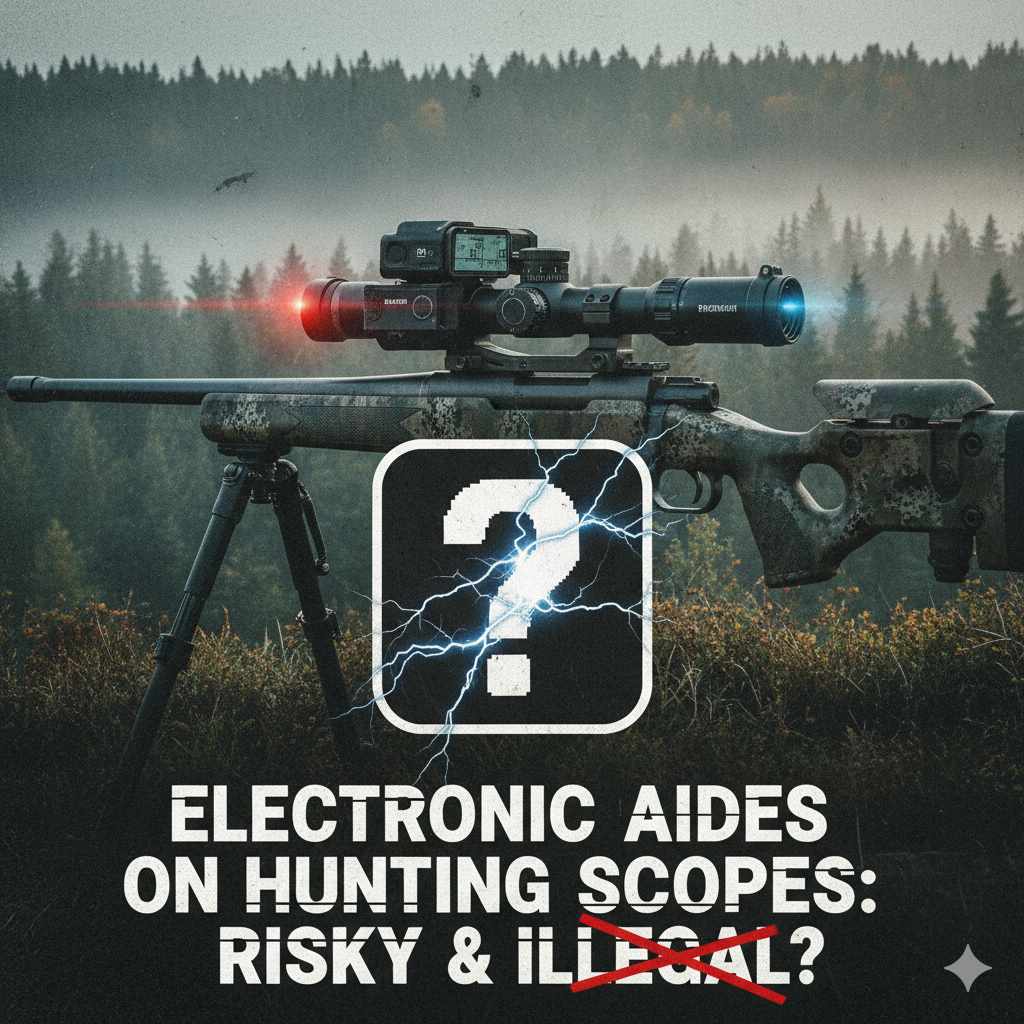
Yes, electronic aides on scopes can be illegal and risky for hunting, but it depends entirely on your state’s laws and the specific device. Many states restrict or ban electronics like lasers, night vision, and smart scopes to ensure “fair chase,” while others allow simple illuminated reticles. Always check your local regulations before hunting.
Hello, fellow hunters! Salman Arfeen here. If you’re getting into hunting, you’ve probably seen a huge variety of scopes out there. Some look simple, while others are packed with technology. This can be confusing! Many new hunters wonder if these high-tech scopes are even allowed, or if they’re a good idea. It’s a great question to ask.
The rules can feel like a maze, and nobody wants to make a mistake in the field. But don’t worry. I’m here to clear things up for you. We’ll walk through what these electronic aides are, how to know if they’re legal where you hunt, and whether they’re truly helpful for a beginner. Let’s get you feeling confident and ready for your hunt.
What Are Electronic Aides on Scopes?
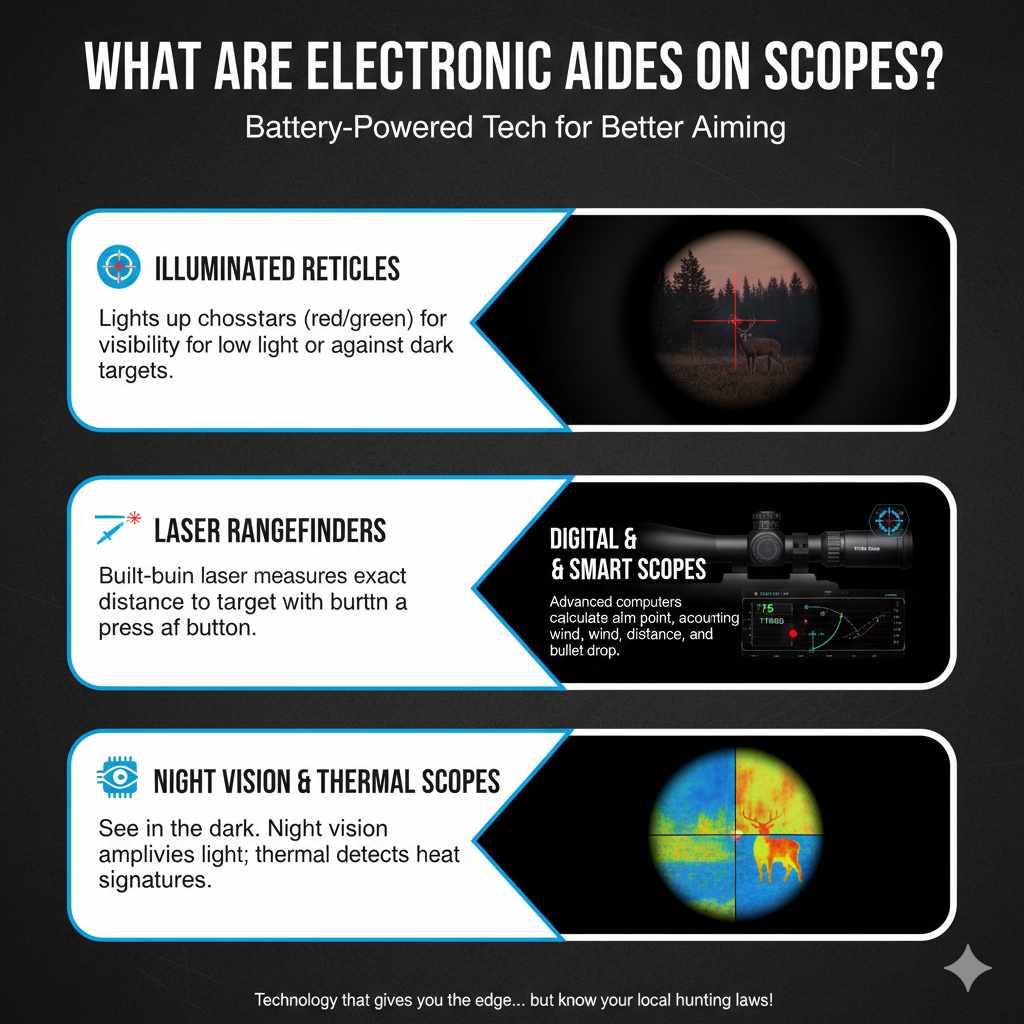
When we talk about “electronic aides” on scopes, we’re talking about any feature that needs a battery to work. These aren’t your grandpa’s simple glass-and-tube scopes. Technology has added some amazing, and sometimes complicated, new tools to help us aim. Think of them as helpful gadgets built right into your scope.
Here are the most common types you’ll see:
- Illuminated Reticles: This is one of the most popular features. It simply lights up the crosshairs (the reticle) inside your scope, usually in red or green. This makes it much easier to see your aiming point against a dark target or in low-light conditions like dawn and dusk.
- Laser Rangefinders: Some scopes have a built-in laser that measures the exact distance to your target. You look through the scope, press a button, and a number pops up telling you how far away your target is. This removes the guesswork from estimating distance.
- Digital and Smart Scopes: These are the most advanced. They can have digital displays, built-in cameras, and even computers that calculate where you need to aim. They can account for wind, distance, and the drop of your bullet automatically.
- Night Vision and Thermal Scopes: These devices allow you to see in the dark. Night vision amplifies tiny amounts of light, while thermal imaging detects heat signatures. They turn a dark field into a visible landscape.
The Big Question: Are They Legal?
This is where it gets tricky. The simple answer is: it depends entirely on where you are hunting. There is no single national law in the U.S. that covers electronic scopes for all hunting. Each state makes its own rules, and they can be very different from one another.
A scope that is perfectly legal in Texas might be illegal in Colorado. To make it even more complex, the rules can change based on the animal you are hunting or the specific hunting season (like archery vs. rifle season).
Why Laws Vary So Much
States create these rules for a few key reasons, and it mostly comes down to a concept called “fair chase.”
Fair chase is an ethical idea that the animal should have a reasonable chance to escape. It’s about balancing skill and technology. Many wildlife agencies feel that certain technologies give the hunter too much of an advantage. They worry that it removes the skill and challenge that are core parts of hunting.
For example, a scope that lets you see perfectly in total darkness or automatically calculates the perfect shot might be seen as taking away the “hunt” from hunting. The goal is to ensure hunting is a sport based on skill, patience, and knowledge of the outdoors—not just on who has the most advanced gear.
Common Types of Regulations You’ll Encounter
While you must check your local rules, regulations for electronic scopes often fall into a few general categories. This can give you an idea of what to look for.
- Generally Allowed: Simple illuminated reticles are legal in most states for most types of hunting. Because they don’t project any light onto the target or calculate anything for you, they are usually seen as a simple aiming aid, not an unfair advantage.
- Often Restricted: Devices that project light, like lasers, are frequently restricted. Many states ban any device that casts a beam of light onto the animal. The same goes for night vision and thermal scopes, which are often illegal for hunting game animals like deer but might be allowed for non-game animals like feral hogs or coyotes.
- Widely Banned: “Smart scopes” that have built-in computers to calculate bullet drop and wind adjustments are illegal for hunting in many places. The same applies to scopes that can connect to your phone or transmit a live video feed. These are almost always seen as a violation of fair chase principles.
To make this easier to understand, here’s a table summarizing the common types of electronic aides and their typical legal status. Remember, this is just a general guide!
| Electronic Aid | Common Function | Typical Legal Status for Big Game Hunting |
|---|---|---|
| Illuminated Reticle | Lights up the crosshairs for better visibility. | Generally Allowed. Most states permit this simple feature. |
| Built-in Laser Rangefinder | Measures the exact distance to a target. | Mixed. Some states allow it, but many prohibit scopes that project a laser beam. A separate, handheld rangefinder is usually legal. |
| Night Vision Scope | Amplifies light to allow you to see in the dark. | Widely Banned. Illegal for hunting most game animals in nearly all states. Some exceptions exist for predatory or nuisance animals. |
| Thermal Scope | Detects heat signatures to see animals in the dark. | Widely Banned. Similar to night vision, it is almost always illegal for game animals. |
| Smart Scope | Has a computer that calculates ballistics, wind, etc. | Almost Always Banned. Very few states allow this for ethical “fair chase” hunting. |
How to Check Your Local Hunting Regulations (The Right Way)
I cannot stress this enough: you must check the specific rules for the state and area where you plan to hunt. “I didn’t know” is not an excuse that will work with a game warden. Luckily, finding the rules is easier than you think if you follow these steps.
- Go to the Official Source. Your first and only stop should be your state’s official wildlife agency website. This could be called the Department of Fish and Wildlife, Game Commission, or Department of Natural Resources. A great place to find your state’s agency is the U.S. Fish and Wildlife Service’s state agency list.
- Find the Regulations Handbook. On the website, look for a section called “Hunting” or “Regulations.” You should find the current year’s hunting regulations handbook, usually as a free PDF download. Download it to your phone and computer.
- Search for Keywords. Instead of reading the whole document, use the search feature (Ctrl+F on a computer or the search function in your PDF reader). Search for key terms like:
- “electronic”
- “scope”
- “artificial light”
- “laser”
- “night vision”
- “computerized”
- Read the “Legal Equipment” and “Prohibited Methods” Sections. Pay close attention to these sections. They will clearly list what gear is allowed and what is forbidden. The rules might be listed under a specific animal, like “Deer Hunting Regulations.”
- When in Doubt, Call and Ask. If the language is confusing or you can’t find a clear answer, call the state wildlife agency directly. Their staff is there to help you follow the law. It is always better to ask a “silly question” than to get a fine or lose your hunting license.
Beyond the Law: Are Electronic Scopes Risky?
Even if a high-tech scope is legal to use, you should also ask yourself if it’s a practical and reliable choice. Technology is amazing, but it can also fail you when you need it most. Let’s look at the practical risks.
The Practical Risks: When Tech Fails
Hunting happens in the real world, with dirt, rain, and cold temperatures. This is where simple and rugged gear often shines. Here are some risks that come with complex electronics:
- Dead Batteries: This is the number one enemy of any electronic device. Imagine you’ve tracked a buck all morning, you finally have a clear shot, and your fancy scope’s display is dead. Always carry spare batteries, but remember that a simple scope never needs them.
- Durability Issues: Electronics and water do not mix well. A heavy downpour or a drop on a hard rock could damage the sensitive components inside a digital scope. Traditional scopes are built to be tough and are often waterproof and fog-proof.
- Complexity Under Pressure: When your heart is pounding and you have only a few seconds to take a shot, the last thing you want is to be fumbling with buttons and menus. A simple scope has one job: to help you see and aim. A smart scope might require you to navigate settings, which can cost you a valuable opportunity.
- Over-Reliance on Technology: A scope that tells you the distance and the perfect aiming point is helpful, but it can prevent you from learning essential hunting skills. What happens when it fails? A good hunter should know how to estimate range and understand their rifle’s performance without help from a computer.
The Ethical Debate: Skill vs. Technology
This is something every hunter thinks about. Is it more rewarding to succeed using your own skills, or is it better to use every tool available to ensure a quick, humane harvest? There’s no right answer, but it’s worth considering.
As a guide, I find immense satisfaction in teaching hunters to rely on their own abilities. Learning to judge distance, read the wind, and hold steady under pressure are skills that make you a better, more connected hunter. Technology can sometimes create a disconnect from the natural experience of the hunt.
Think of it as a tool to enhance your skills, not replace them. An illuminated reticle can help you apply your steady aim in low light. But a scope that does all the thinking for you might take away from the personal achievement of making a great shot.
Here’s a table that breaks down the pros and cons to help you decide what’s right for you.
| Aspect | Pros of Electronic Scopes (The Advantages) | Cons of Electronic Scopes (The Risks & Downsides) |
|---|---|---|
| Accuracy | Can increase precision, especially at long ranges, by calculating distance and bullet drop. | Can lead to overconfidence and taking unethical, long-range shots beyond your actual skill level. |
| Low-Light Performance | Illuminated reticles make it much easier to aim at dawn and dusk, which are prime hunting times. | Night vision/thermal is often illegal and can blur the lines of ethical shooting hours. |
| Speed | A built-in rangefinder can be faster than using a separate handheld device. | Fumbling with buttons and settings under pressure can be slower than using a simple scope. |
| Cost | Consolidates multiple tools (rangefinder, scope) into one device. | Significantly more expensive than traditional, high-quality scopes. |
| Reliability | High-end models can be very effective and durable. | Susceptible to battery failure, water damage, and electronic malfunctions. More complex means more things can break. |
| Skill Development | Can be a useful tool for learning about ballistics. | Can become a crutch that prevents you from learning fundamental hunting skills like range estimation. |
My Advice for Beginners: Keep It Simple
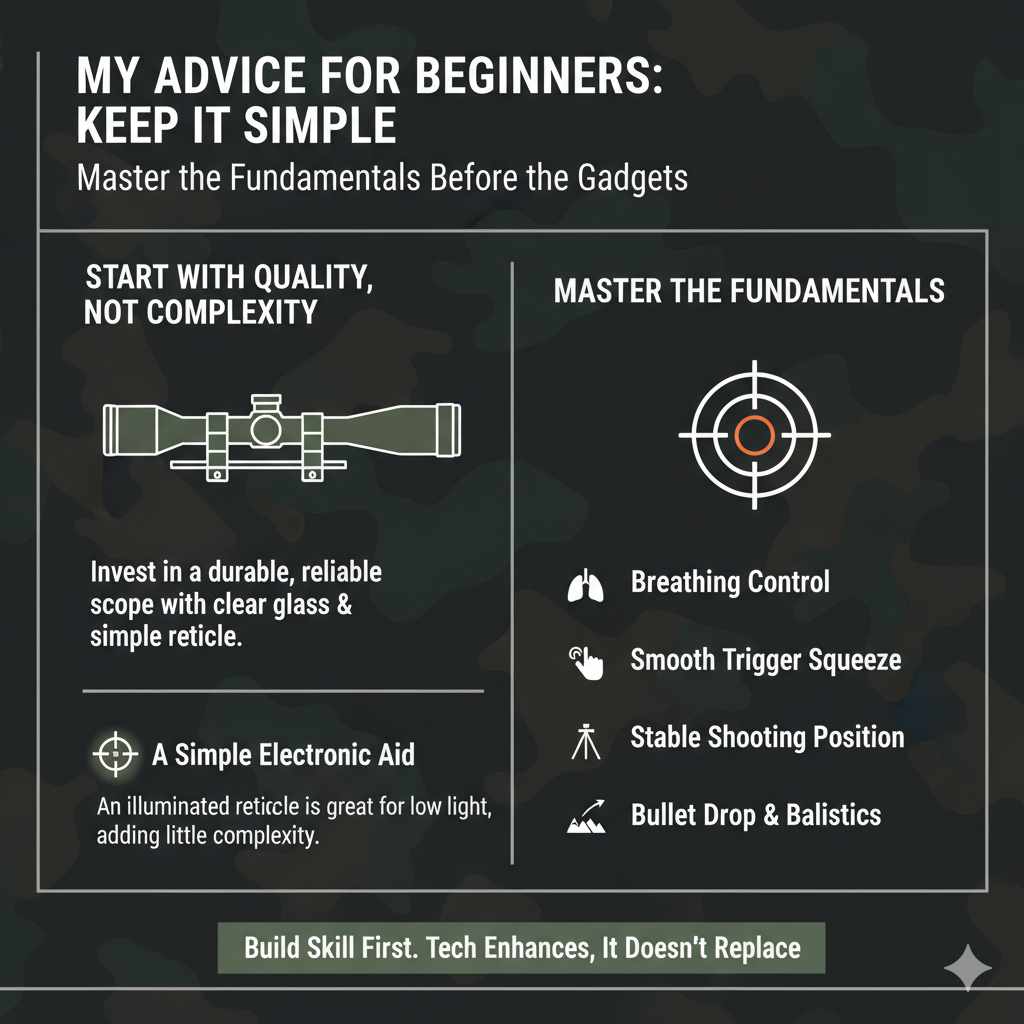
If you are just starting, my best advice is to keep your gear simple and reliable. Don’t get caught up in the marketing for the latest, most advanced scope. Instead, invest in a high-quality, durable scope from a reputable brand with clear glass and a simple reticle.
If you want a little electronic help, a scope with a simple illuminated reticle is a fantastic choice. It gives you a real advantage in low light without adding much complexity or risk of failure.
Focus your time and energy on mastering the fundamentals of marksmanship first. Learn things like:
- Proper breathing control
- A smooth trigger squeeze
- How to build a stable shooting position
- Estimating range to targets
- Understanding how much your bullet drops at different distances
Once you are confident in these skills, you can then explore more advanced technology. A smart scope won’t make you a good shooter if your fundamentals are weak. But a solid foundation of skill will make you an effective hunter with any equipment you choose.
FAQ: Your Questions on Electronic Scopes Answered
Is an illuminated reticle considered an illegal electronic aide?
Usually, no. An illuminated reticle is one of the most widely accepted electronic features on a scope. Because it only lights up the crosshairs and doesn’t project light or calculate data, most states allow it for big game hunting. However, you should still confirm this in your local regulations handbook.
What’s the difference between night vision and thermal scopes? Are they legal for hunting?
Night vision works by amplifying small amounts of existing light (like from the moon or stars) to create a visible image. Thermal imaging detects heat differences and creates an image based on the heat signatures of objects. Both are almost universally illegal for hunting game animals like deer, elk, and turkey. Some states allow them for hunting non-game animals or predators like coyotes and feral hogs, but the rules are very specific.
Can I use a scope with a built-in rangefinder?
This is a major gray area. Some states have no rule against it. Other states prohibit any device attached to a firearm that projects a beam of light, which a laser rangefinder does. In those states, a scope with a built-in laser rangefinder would be illegal, but a separate, handheld rangefinder would be perfectly fine. Check the rules on “lasers” and “artificial light.”
Why are smart scopes often illegal?
Smart scopes are often considered a violation of “fair chase” ethics. Wildlife management agencies feel that a scope that automatically calculates distance, wind, and bullet drop gives the hunter an unfair technological advantage over the animal. The laws are intended to promote hunting as a sport of skill, not a technological exercise.
Does the type of animal I’m hunting change the rules for scopes?
Yes, absolutely. The rules can be very different depending on the species. For example, a state might completely ban all electronics for turkey hunting but allow illuminated scopes for deer hunting. Furthermore, the rules for hunting predators or nuisance animals (like feral hogs) are often much more relaxed than the rules for hunting game animals.
What happens if I get caught using an illegal electronic scope?
The penalties can be severe. Depending on the state and the violation, you could face heavy fines, the confiscation of your firearm and scope, the loss of your hunting license for a year or more, and in some cases, even jail time. It is never worth the risk.
Are there any federal laws about electronic scopes, or is it all state-based?
Hunting is primarily regulated at the state level. Federal laws typically apply to migratory birds (like ducks and geese) or to hunting on federal lands, but the specific rules about equipment like scopes are almost always set by the individual state wildlife agencies.
Final Thoughts: Hunt Smart and Hunt Safe
Navigating the world of hunting technology can feel a little overwhelming at first, but it doesn’t have to be. The most important lesson is simple: your state’s official hunting regulation handbook is your best friend. Read it, understand it, and follow it.
Remember that technology is just a tool. It can’t replace the fundamental skills of a good hunter—patience, observation, and solid marksmanship. By focusing on building your skills and choosing simple, reliable equipment, you set yourself up for a lifetime of safe, ethical, and rewarding hunts.
So, get out there, practice your craft, and enjoy every moment in the great outdoors. Happy hunting!