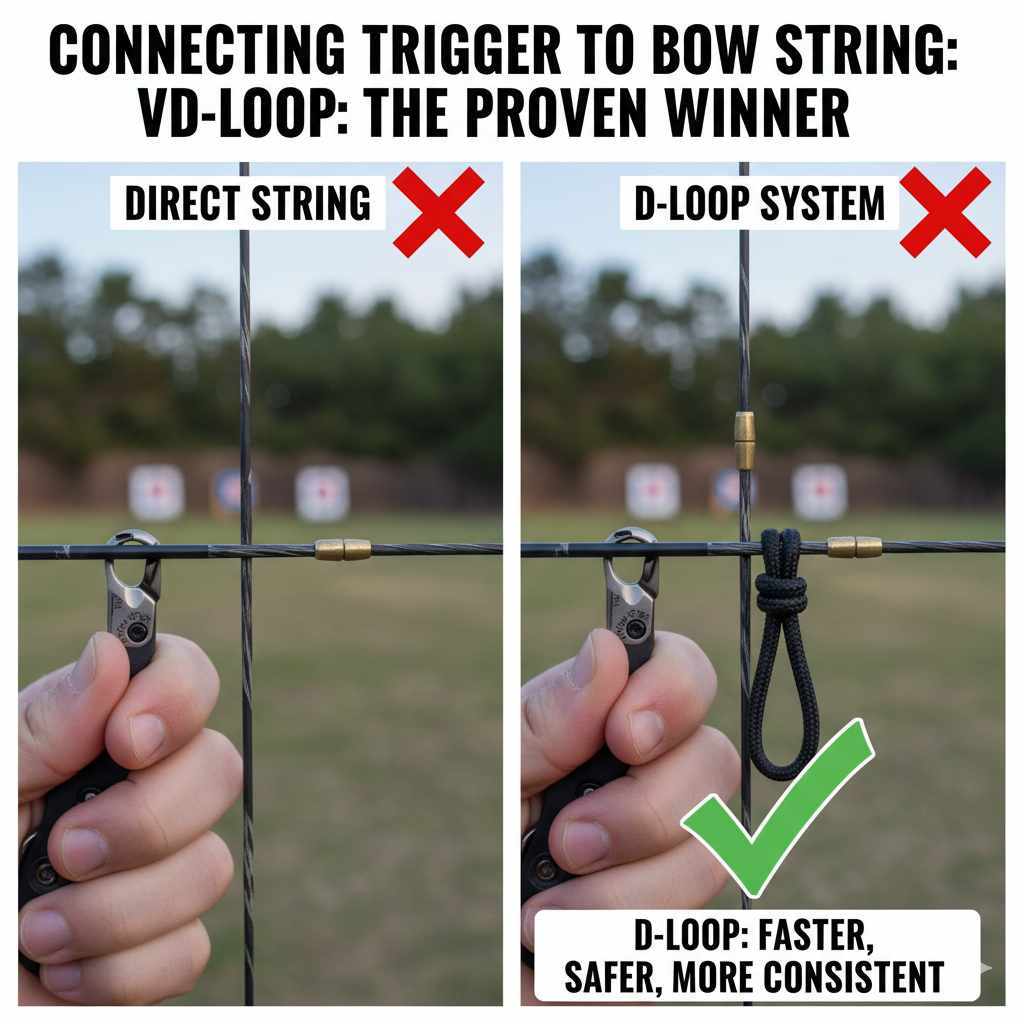
For archers using a mechanical release, connecting it to a D-loop is the proven winner. A D-loop protects your bow string from wear, improves shooting accuracy by preventing string torque, and is significantly safer. Attaching a release directly to the string can cause damage, inconsistent shots, and increase the risk of a dangerous misfire.
Hello, fellow archers! Salman Arfeen here, your friendly guide in the amazing world of archery. If you’re new to using a compound bow with a mechanical release aid, you’ve probably asked a very important question: should I clip my trigger right onto the bow string, or should I use that little cord loop I see on other bows?
It’s a great question, and the answer can make a huge difference in your safety, accuracy, and the life of your equipment. It might seem like a small detail, but this choice is one of the fundamentals of modern archery. Don’t worry, this isn’t complicated. I’m here to walk you through both methods, explain the pros and cons in simple terms, and show you why one method is the clear champion. Let’s get you shooting safely and accurately!
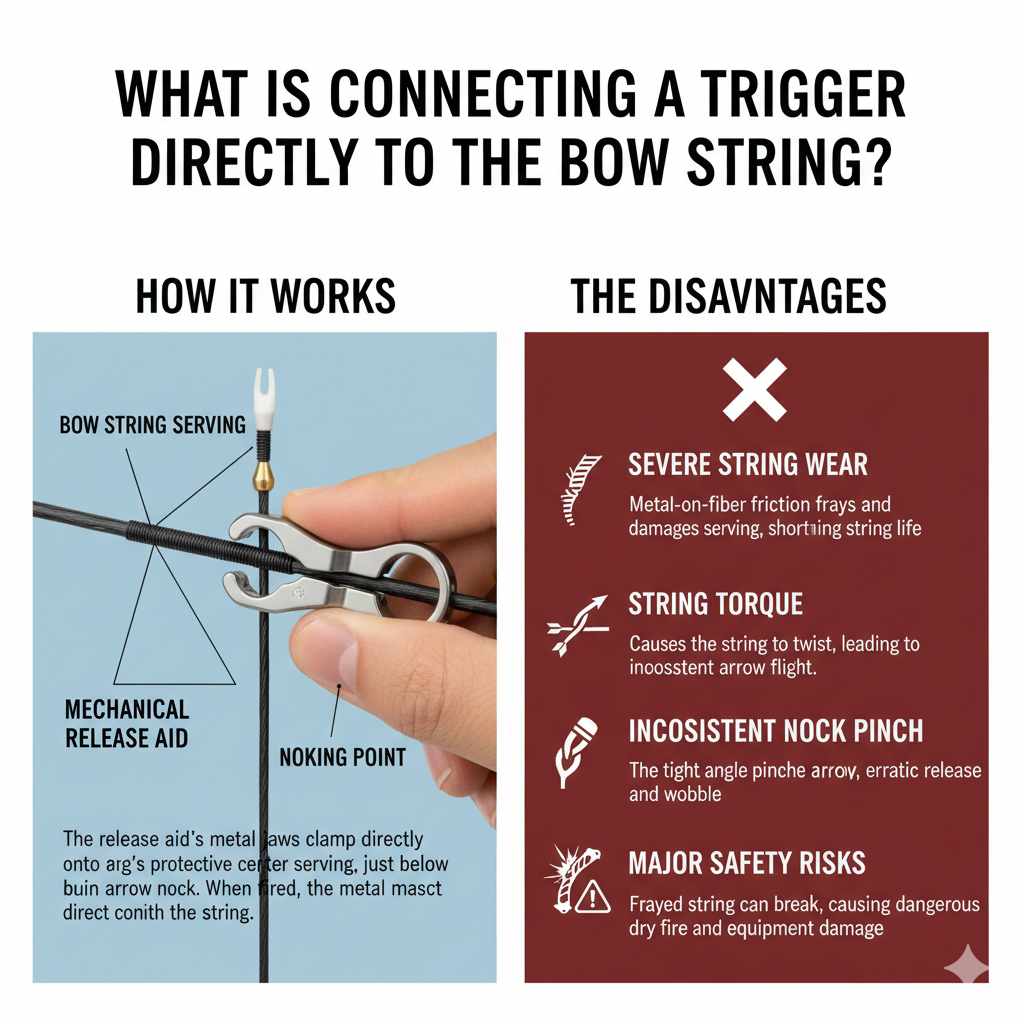
What is Connecting a Trigger Directly to the Bow String?
Let’s start with the older method: clipping your release aid’s trigger hook or caliper jaws directly onto the bow string. Before the invention of the D-loop, this was the only way to shoot with a mechanical release. An archer would attach the release to the string’s center serving, right below where the arrow nock sits.
The “serving” is the tough thread wrapped around the middle of your bow string. It’s designed to protect the string from the friction of drawing and releasing the arrow. When you connect directly, your metal release aid makes direct contact with this serving.
How It Works
The process seems simple on the surface. You take your release aid, open its jaws, and carefully clamp them around the bow string serving, usually just under the nocking point (the small brass or tied-on marker that shows where your arrow goes). Once attached, you can draw the bow back and fire.
While this method worked for archers in the past, equipment has evolved. Modern bows are faster and more powerful, and our understanding of arrow flight has improved. These advancements have highlighted the major downsides of this direct connection method.
The Disadvantages of Connecting Directly to the String
Connecting your trigger directly to the bow string is rarely recommended today for several critical reasons. It can negatively impact your gear, your safety, and your performance.
- Causes Severe String Wear: Your release aid is made of hard metal. Your bow string serving, while tough, is still just fiber thread. Every time you clip on, draw, and release, the metal jaws grind against the serving. Over time, this friction will fray and wear out the serving, eventually damaging the expensive bow string underneath.
- Creates String Torque: When you draw a bow with a release clipped directly to the string, it’s almost impossible not to apply a slight twisting force, or “torque.” This torque twists the bow string, which in turn affects how the arrow leaves the bow. This inconsistency makes it incredibly difficult to shoot tight, consistent arrow groups.
- Inconsistent Nock Pinch: The sharp angle of a drawn bow string can “pinch” the nock of the arrow. Attaching a release directly below the nock often makes this pinch worse. When you release, the pinched string doesn’t let go of the arrow cleanly, causing it to wobble and fly off course.
- Major Safety Risks: A worn-out serving can break unexpectedly. If your release slips off a frayed serving during your draw, the bow could “dry fire” (release without an arrow). A dry fire can cause catastrophic damage to the bow and can be extremely dangerous for the shooter and anyone nearby.
What is a D-Loop?
Now, let’s talk about the modern solution: the D-loop. A D-loop is a short, sturdy piece of cord that is tied securely onto the bow string’s center serving. It forms a “D” shape, creating a dedicated attachment point for your mechanical release aid. Instead of clipping onto the bow string itself, you clip onto this loop.
This simple piece of cord acts as a buffer between your expensive bow string and your metal release. It was invented to solve all the problems associated with connecting directly to the string, and it has become standard equipment on virtually every modern compound bow.
How It Works
Using a D-loop is simple and efficient. The loop is tied around the serving, typically framing the nocking points that position your arrow. You nock your arrow between these points as usual. Then, you hook your release aid to the D-loop cord. When you draw the bow, all the pressure is placed on the D-loop, not the bow string itself. This allows the string to remain perfectly straight and release the arrow with clean, consistent force every time.
The Huge Advantages of Using a D-Loop
The benefits of using a D-loop are so significant that it has become an essential part of modern archery. Here’s why it’s the proven winner.
- Protects Your Bow String: The D-loop takes all the wear and tear from the metal release aid. The cord is designed to be tough and durable, but it’s also inexpensive and easy to replace. Sacrificing a small piece of cord instead of your main bow string is a smart, cost-effective choice.
- Dramatically Improves Accuracy: By providing a torque-free connection point, the D-loop allows your bow string to travel forward in a perfectly straight line. This results in cleaner arrow flight and much tighter, more consistent groups on the target. It also eliminates the problem of nock pinch, allowing the arrow to leave the bow without any interference.
- Enhances Safety: A properly tied and maintained D-loop is incredibly strong and reliable. It provides a secure anchor for your release, dramatically reducing the risk of a slip-off that could lead to a dangerous dry fire. Checking a small D-loop for wear is much easier than inspecting an entire center serving.
- Provides a Consistent Anchor Point: The D-loop ensures your release aid connects at the exact same spot for every single shot. This consistency is a key ingredient for developing repeatable shooting form and achieving reliable accuracy.
Head-to-Head Comparison: String vs. D-Loop
To make the choice even clearer, let’s put the two methods side-by-side. This table shows how each method stacks up in the most important areas for any archer.
| Feature | Connecting Directly to String | Using a D-Loop |
|---|---|---|
| Accuracy | Poor. Introduces string torque and nock pinch, leading to inconsistent shots. | Excellent. Provides a torque-free release for clean arrow flight and tight groups. |
| Safety | Low. High risk of string wear leading to release slippage and dangerous dry fires. | High. Provides a secure and reliable connection, minimizing the risk of accidents. |
| Equipment Longevity | Damaging. Causes rapid wear on the bow string serving, requiring frequent and costly replacement. | Protective. The D-loop takes all the wear, preserving the life of your expensive bow string. |
| Consistency | Inconsistent. Hard to attach the release at the exact same spot and angle every time. | Very Consistent. Ensures the release connects perfectly for every shot, aiding muscle memory. |
| Cost | Seems free initially, but leads to expensive string replacements down the road. | Very low cost for the D-loop material. Saves a lot of money in the long run. |
Why the D-Loop is the Proven Winner for Modern Archery
As you can see, the D-loop wins in every important category. It is the safer, more accurate, and more economical choice for any archer using a mechanical release. By isolating your release from the bow string, you eliminate a whole host of problems that can frustrate beginners and limit the potential of even experienced shooters.
Think of it this way: you wouldn’t tow a heavy trailer with a rope tied directly to your car’s bumper; you’d use a proper trailer hitch designed for the job. The D-loop is the “trailer hitch” of archery—it’s the correct and purpose-built tool for connecting your release aid to your bow. Major archery organizations and educational resources, like the comprehensive guides found on Archery 360, all recommend the D-loop as standard practice for safety and performance.
How to Tie Your Own D-Loop: A Beginner’s Guide
Learning to tie your own D-loop is a great skill for any archer. It saves you a trip to the pro shop and gives you more confidence in your gear. It might look tricky, but with a little practice, it’s quite simple. Follow these steps carefully.
Tools You’ll Need
- D-Loop Material: A piece of stiff, braided cord specifically made for D-loops. Don’t use any other kind of string. You’ll need about 4-5 inches.
- Lighter or Small Torch: For melting the ends of the cord to prevent fraying.
- D-Loop Pliers (Recommended): These special pliers are used to stretch and tighten the loop, ensuring the knots are rock-solid. You can use regular needle-nose pliers, but D-loop pliers work much better.
- Bow Square (Optional but helpful): To make sure your nocking points are in the right place before you start.
Step-by-Step Instructions
- Prepare the Cord: Cut a piece of D-loop material about 4.5 inches long. Using your lighter, carefully melt one end of the cord until a small, mushroom-shaped ball forms. This “ball” will act as a stopper and prevent the knot from ever pulling through. Let it cool completely.
- Tie the First Knot: Place the cord behind your bow string, just above your top nocking point. The melted end should be on the side facing you. Wrap the non-melted end around the bow string twice, moving away from you. Then, pass the non-melted end through the loop you just created. This is a constrictor knot. Pull it snug, but not completely tight yet.
- Tie the Second Knot: Now take the long, non-melted end of the cord and bring it down below your bottom nocking point. Repeat the exact same knot on the other side. Place the cord behind the string, wrap it around twice, and pass the end through the loop.
- Form the “D” and Tighten: You should now have two loose knots on your bow string with the cord forming a “D” shape. Gently pull on the long end to snug up the second knot. Trim this end, leaving about a quarter-inch of cord. Carefully melt this end just like you did the first one, creating another mushroom-shaped stopper.
- Set the Knots: This is the most important step! Use your D-loop pliers to set the knots. Insert the jaws of the pliers inside the D-loop and spread the handles apart. This will stretch the loop and cinch the knots down incredibly tight onto the bow string serving. They should not be able to move at all. Your D-loop is now ready to use!
Safety First: Common Mistakes to Avoid
Your D-loop is a critical piece of safety equipment. Always pay attention to its condition and avoid these common mistakes.
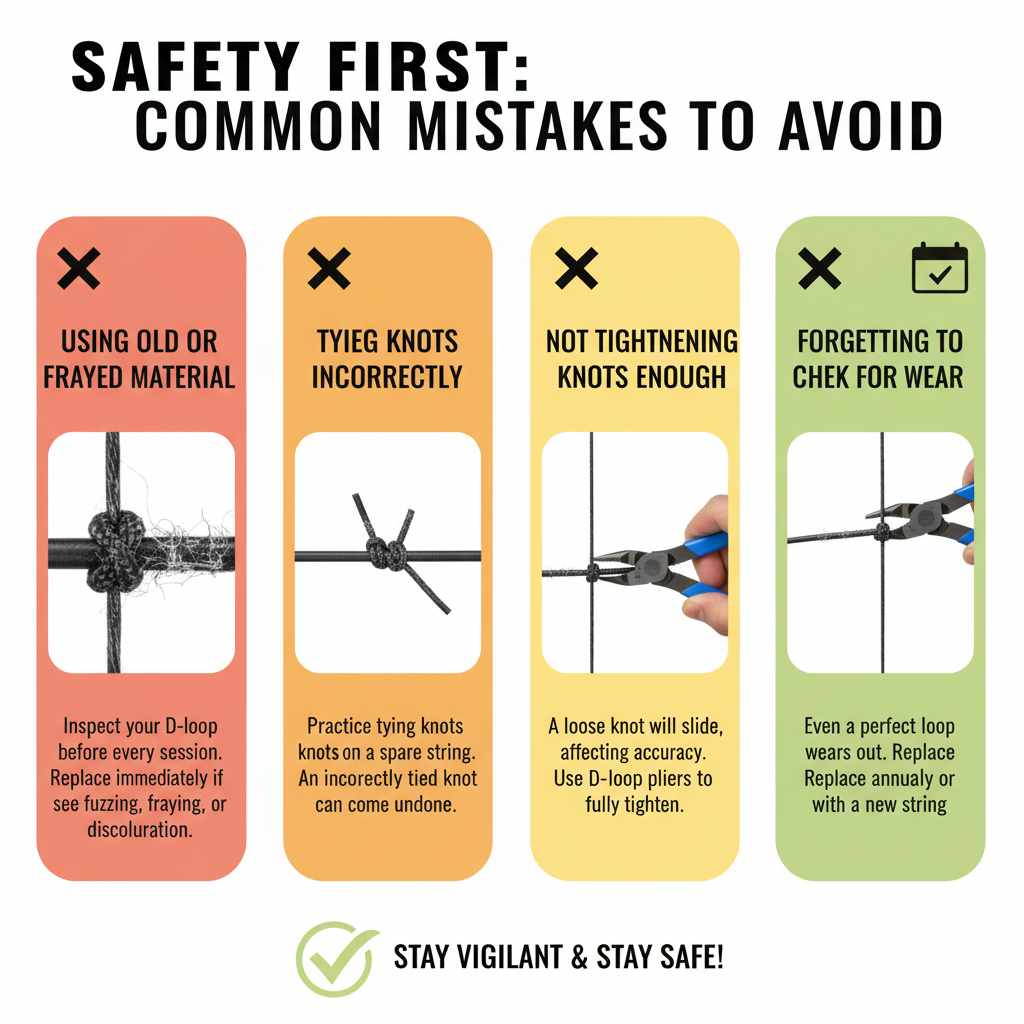
- Using Old or Frayed Material: Inspect your D-loop before every shooting session. If you see any signs of fuzzing, fraying, or discoloration, replace it immediately.
- Tying Knots Incorrectly: Practice tying the knots a few times on a spare piece of string before doing it on your bow. An incorrectly tied knot can come undone under pressure.
- Not Tightening the Knots Enough: A loose knot can slide on the serving, which will throw off your nocking point and your accuracy. Use D-loop pliers to make sure they are fully tightened.
- Forgetting to Check for Wear: Even a perfectly tied loop will wear out over time. It’s a good habit to replace your D-loop once a year or whenever you get a new bow string.
Frequently Asked Questions (FAQ)
What is D-loop material made of?
D-loop material is typically a stiff, no-stretch braided cord made from materials like BCY or Dyneema. This prevents the loop from stretching during the draw cycle, which would cause inconsistent shots. Never use regular string or paracord, as they are not designed to handle the extreme forces.
How often should I replace my D-loop?
A good rule of thumb is to replace your D-loop at least once a year or every time you replace your bow string. You should also replace it immediately if you see any signs of wear, such as fraying or fuzzing. It’s a very cheap part, so it’s better to be safe than sorry.
Does a D-loop affect my bow’s speed?
Technically, adding any weight to a bow string will slightly decrease its speed, but the effect of a D-loop is so small that it is practically unnoticeable. The massive gains in accuracy and consistency far outweigh the tiny, theoretical loss of one or two feet per second of arrow speed.
Is it hard to learn to tie a D-loop?
Not at all! It may seem intimidating at first, but after watching a video and practicing a couple of times, most people can tie a solid D-loop in just a few minutes. It’s a very rewarding skill for any archer to learn.
What happens if my D-loop breaks?
If a D-loop breaks while you are drawing the bow, it will feel like a misfire. Your release will come back toward you, so it’s important to always use proper form and not “punch” the trigger. While startling, a breaking D-loop is much safer than the bow string itself breaking. This is another reason why regular inspection is crucial.
Can I use any kind of release aid with a D-loop?
Yes, virtually all modern caliper and hook-style release aids are designed to be used with a D-loop. The smooth, rounded surface of the D-loop cord is much better for the release mechanism than the abrasive serving of the bow string.
Should my D-loop be able to spin on the string?
A properly tightened D-loop should not spin freely or slide up and down easily. It needs to be cinched down very tightly to provide a consistent nocking point. If you can easily twist your D-loop with your fingers, the knots are too loose and need to be tightened with D-loop pliers.
Your Path to Better, Safer Shooting
So, there you have it. When it comes to connecting your trigger to your bow, the choice is clear. The D-loop isn’t just a preference; it’s a fundamental piece of modern archery equipment that provides huge benefits for your accuracy, your safety, and the health of your bow.
By moving away from the old method of clipping directly to the string, you are setting yourself up for success. You’ll spend less money on string repairs, more time building confidence, and you’ll see the results in tighter arrow groups on the target. Archery is a journey of continuous improvement, and making smart equipment choices like this is a huge step in the right direction.
Now, go inspect your bow. If you don’t have a D-loop, make it your next priority. Learn to tie one yourself or visit your local pro shop. It’s a small change that will make a world of difference. Happy shooting, and always remember to be safe and have fun!