
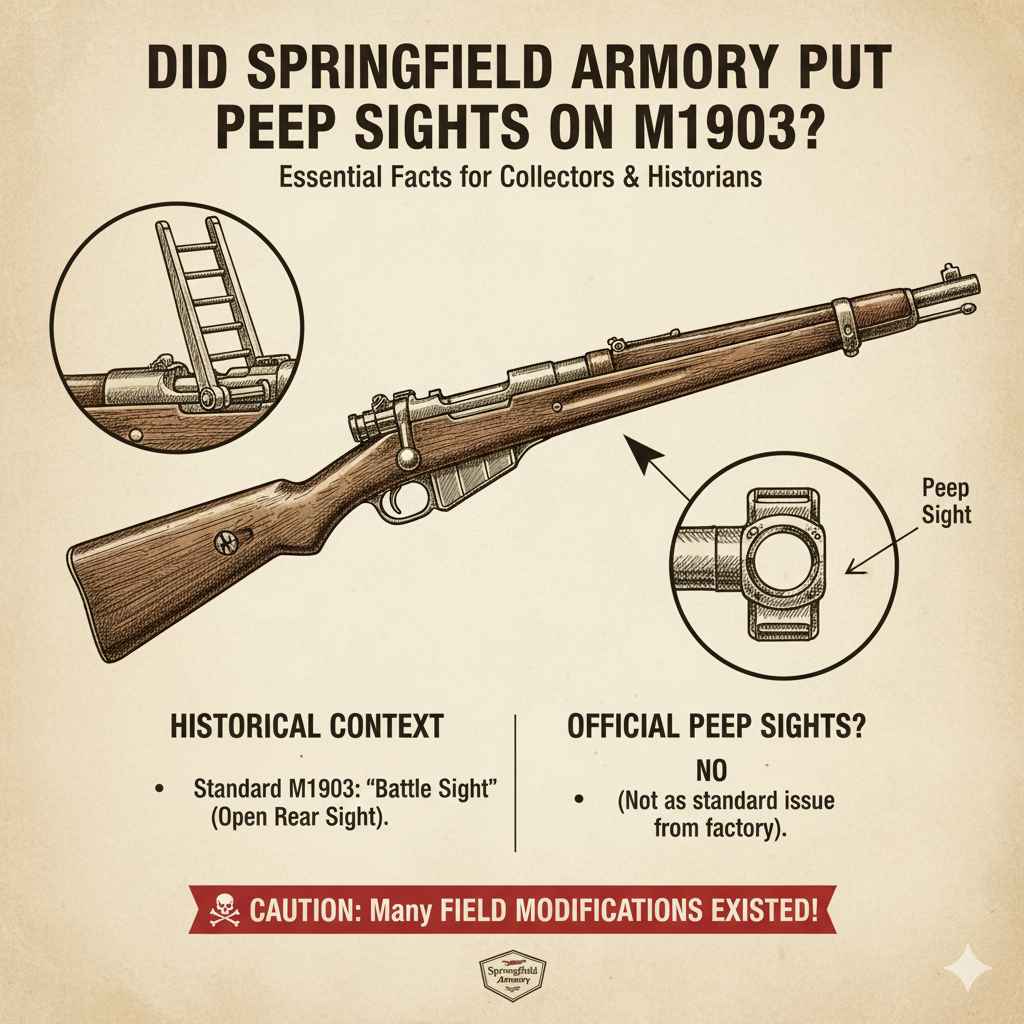
While the standard M1903 rifle left the factory with basic iron sights, many military and civilian rifles later featured peep sights, most famously the adjustable Model 1903-A3. For beginners, understanding the difference between the original and modified sights is key to appreciating this classic rifle’s evolution.
Welcome to the world of classic firearms, where history meets precision! If you are exploring the fantastic Springfield M1903 rifle, you might notice that the sights sometimes look different. Many new shooters wonder: did Springfield Armory actually install those cool, adjustable peep sights on the M1903 when it was first made? It is a very common question, and the answer can be a little tricky because the M1903 line changed a lot over time. Don’t worry; we will clear up all the confusion right now. Understanding the sights helps you appreciate the rifle’s journey through history. We will walk through exactly which models got which sights, step by step, so you can confidently identify your rifle’s setup.
The M1903 Rifle: A Quick Look Back
The M1903 Springfield rifle is an American legend. It served the U.S. military for decades, starting around 1903. It was based on the famous Mauser design but was built right here in the USA. For beginners, think of this rifle as the precursor to the M1 Garand. It is known for its excellent accuracy and robust build quality.
When we talk about sights, we are talking about how you aim the rifle. Iron sights (the basic kind) consist of a front post and a rear notch. Peep sights, however, use a small hole (the “peep”) that you look through, which helps focus your eye and often allows for more precise adjustments.
Original Configuration: The Early M1903 Sights
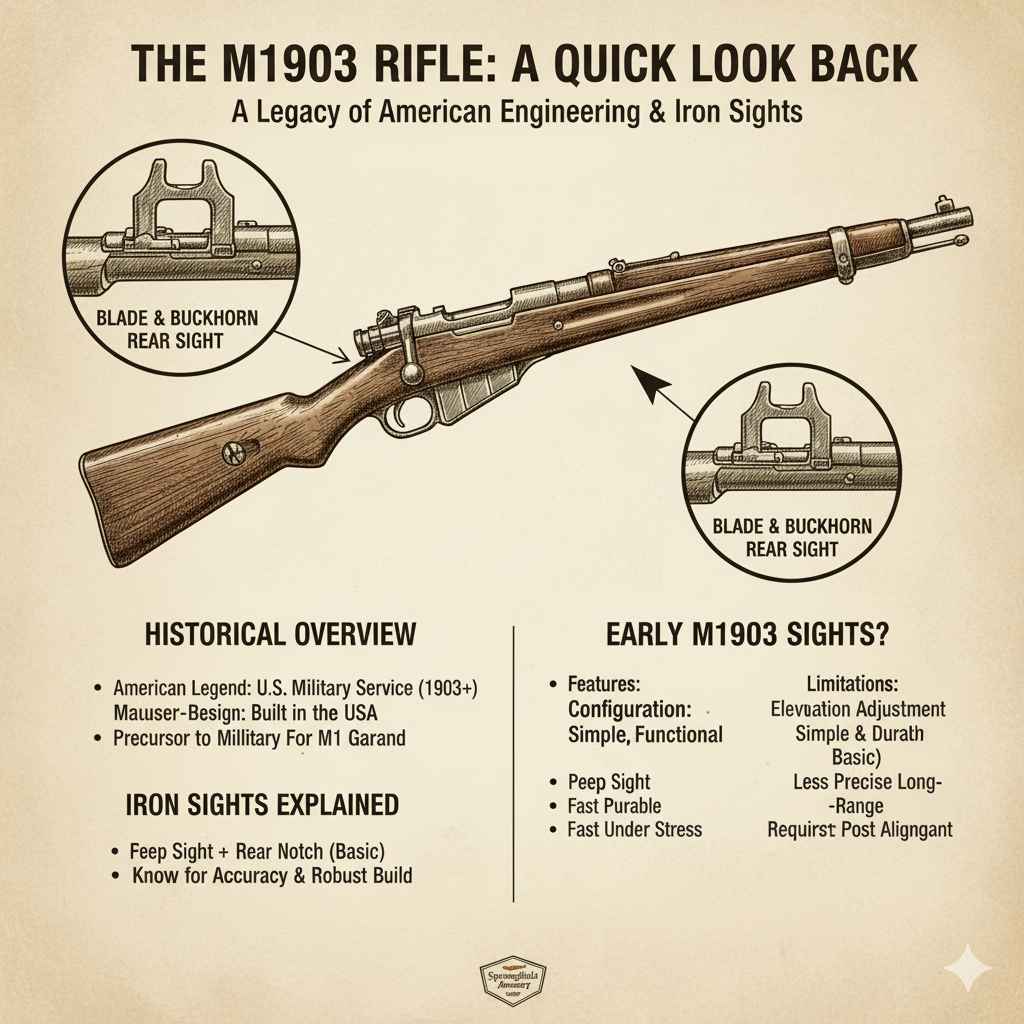
When the first M1903 rifles were rolling out of the Springfield Armory in the early 1900s, they used a very standard type of iron sight. These were functional but simple, designed for fast acquisition in military settings.
The Standard Rear Sight: The “Blade” or “Buckhorn”
The very early M1903s came equipped with a fixed or slightly adjustable rear sight. This was typically a simple blade or a rudimentary “buckhorn” style sight that could be adjusted for elevation (how high or low the bullet hits) but not much for windage (left or right).
Simplicity: Easy to use under stress.
Durability: Built tough for field use.
Limitation: Less precise for long-range target shooting compared to later models.
These sights relied on the shooter aligning the front post inside the rear notch. This is great for general-purpose shooting but can frustrate someone trying to achieve pinpoint accuracy at 200 yards or more.
The Big Change: When Peep Sights Entered the Picture
So, did Springfield Armory ever put peep sights on the M1903? Yes, they did! But it wasn’t on the very first models. The introduction of the peep sight was a significant upgrade, usually tied to later production runs or specific model designations.
The M1903-A3 and the Famous Receiver Sight
The most common M1903 you will see today that features a factory-installed peep sight is the M1903-A3. This version was adopted later, around World War II, as a more cost-effective replacement for the M1 Garand in some production lines.
The defining feature of the A3 model is the rear peep sight mounted directly onto the receiver (the main body of the rifle). This is not an accessory added later; it was built into the rifle design.
Why the Change to Peep Sights?
The military realized that for better accuracy, especially in training and for dedicated riflemen, a peep sight was superior. Peep sights offer several advantages that help even a beginner focus better:
1. Clarity: By looking through a small hole, your eye is naturally drawn to center the front sight post inside it. This reduces “eyeball error.”
2. Precision: They allow for very fine adjustments for windage and elevation, making long-range shooting much more achievable.
3. Consistency: Once you get used to them, your sight picture remains almost identical shot after shot.
Key Differences in Sight Types
To help you tell the models apart easily, here is a simple breakdown of the sight hardware you might find:
| Rifle Model | Typical Rear Sight Type | Adjustment Capability | General Purpose |
|---|---|---|---|
| Original M1903 (Pre-1932) | Leaf Sight (Attached to barrel band) | Elevation Only (Often) | Military Service |
| M1903-A1 | Similar to Original, sometimes slightly refined | Limited | Transition Period |
| M1903-A3 (The Peep Sight Standard) | Receiver Mounted Peep Sight (Adjustable) | Full Elevation & Windage | WWII Standard Issue |
This table shows that if your M1903 has a true factory-installed peep sight mounted on the receiver, you likely have an M1903-A3 variant.
How to Identify Your M1903 Sight Setup
As a beginner, the first thing you need to do is identify what you are working with. This identification impacts how you sight in the rifle and what aftermarket upgrades might fit.
Step 1: Locate the Rear Sight Assembly
Look closely at where the rear sight is mounted.
If the rear sight is attached to the barrel band or located far forward on the receiver bridge: It is likely the older, non-peep style blade sight. These are generally not windage-adjustable from the factory without specialized tools or replacement parts.
If the rear sight is mounted directly onto the flat top of the receiver, usually near the bolt handle: This is the peep sight configuration, characteristic of the A3 models.
Step 2: Examine the Peep Sight Mechanism (If Present)
If you have a peep sight, examine how it adjusts. The M1903-A3 receiver sights are typically very robust.
1. Elevation Knob: There is usually a knob on the right side that you turn to raise or lower the point of impact.
2. Windage Adjustment: The entire sight base often has a mechanism, sometimes requiring a small screwdriver or tool, to shift it slightly left or right.
For historical accuracy, note that the earlier M1903s often used sights manufactured by companies like Rock Island Arsenal (RIA) or even subcontracted parts, but the peep sight is the hallmark of the M1903-A3 overhaul.
Step 3: Check the Front Sight
The front sight also changed. Early M1903s had a distinct blade, sometimes hooded. The M1903-A3 often switched to a simpler, more easily mass-produced front sight base, sometimes called the “sawn-off” or “post” style, to go along with the new rear peep sight.
Post-Factory Modifications: The Civilian Factor
Here is where things get interesting for collectors and hobbyists. Even if your M1903 was originally sold without a peep sight, it is extremely common to find them upgraded later.
Many original M1903 rifles were sold to civilians after they were retired from military service. Since peep sights offer superior accuracy for target shooting (which many hobbyists prefer), owners frequently installed aftermarket peep sight systems.
Popular Aftermarket Peep Sights
If you see a peep sight that looks very robust, perhaps mounted using the existing screw holes near the rear of the receiver, it might be an aftermarket addition. Two very popular brands known for making excellent peep sights for the M1903 include:
Lyman: Famous for their target sights, Lyman offered various models (like the 48) that could be fit to the M1903 receiver.
Buehler: Another highly respected name that produced quality mounting hardware and sights for these classic rifles.
These aftermarket sights often look different from the standard-issue M1903-A3 sights. They might be taller, have larger adjustment knobs, or use a different mounting footprint.
Action Item: Inspecting for Aftermarket Parts
When inspecting a rifle you might want to buy or shoot, always look closely at the receiver screws holding the rear sight. If the sight looks like it was added later, you might see slightly different screw heads or mounting brackets that don’t perfectly match the original military blueprints. If you are interested in learning more about historical rifle modifications, resources like the U.S. Rifle Collectors Forum often have detailed threads on identifying these exact components.
Why Peep Sights Improve Beginner Accuracy
As someone just starting out, aiming can feel like guesswork. The peep sight takes some of that guesswork away. Think of it like using a circular target versus a rectangular one—the circle guides your eye better.
The Archery Analogy (Focusing Your Aim)
In archery, we teach beginners to focus intently on the target, letting the blurred sight pin settle where it needs to be. Peep sights work similarly for rifles. When you look through a tiny hole:
1. The Eye Centers Naturally: Your brain automatically tries to center the two sight elements (front post and rear aperture) within the small opening.
2. Depth Perception Improved:** You gain a clearer focus on the front sight, which is the crucial aiming element.
This forced focus leads to more repeatable sight pictures, which is the foundation of good shooting, whether you are using a bow or a rifle.
Maintenance and Adjustment: Getting Started with Your Peep Sights
If you have an M1903 with a peep sight (especially an A3), you need to know how to adjust it safely and effectively. Remember, these adjustments are subtle, especially at shorter ranges.
Safety First!
Before touching any adjustment screws, always ensure the rifle is unloaded. Point it in a safe direction and physically check the chamber. Safety is the first rule in all shooting sports.
Zeroing Your Rifle (The Process of Sight Adjustment)
To “zero” means to adjust the sights so that the bullet hits exactly where you are aiming at a specific distance (usually 100 or 200 yards).
Here is a simplified, beginner-friendly process for zeroing a rifle with adjustable peep sights:
- Set the Distance: Decide on your zero range (e.g., 100 yards).
- Shoot Groups: Fire a small group of three shots from a stable rest (like a sandbag) at that distance.
- Analyze the Impact: Look where the center of your group landed relative to your aim point.
- Adjust Elevation: If you hit low, turn the elevation knob up (or clockwise, depending on the sight markings) to move the impact point higher. Remember: turning the rear sight element up moves the impact up.
- Adjust Windage: If you hit left, turn the windage screw to move the sight right* (this moves the impact point to the right).
- Repeat: Fire another group of three shots and repeat the adjustment process until the group centers on your aim point.
It is often best to make small, incremental adjustments. A full turn on many M1903 sights corresponds to a significant change in impact at distance. Start with half-turns.
Understanding Sight Graduations
The A3 sights often have markings (like “2” or “3” clicks) etched on them. These markings correspond to precise changes in impact at set distances. For instance, one click might move the impact 1 minute of angle (MOA). One MOA at 100 yards is about 1.04 inches. Knowing this helps you decide how far to turn the dial!
The M1903-A4 Sniper Rifle Sights
It is important to mention the M1903 variant most famous for its accuracy: the M1903-A4 sniper rifle. This rifle is an exception to the peep sight discussion because it removed the iron sights entirely!
The M1903-A4 rifles utilized a scope mount (like the Weaver 330C or Lyman Alaskan scope) attached to the receiver. This means that while the A3 used the best iron sights available at the time, the A4 went straight to optical magnification for the designated marksman role.
Historical Context: Why the Peep Sight Took So Long
Why didn’t Springfield Armory just put peep sights on the M1903 right away in 1903? The answer usually boils down to doctrine, cost, and current technology.
In 1903, the U.S. military was still transitioning its shooting philosophy. The idea of the standard infantryman engaging targets precisely beyond 300 yards was not the primary goal. The simpler leaf sight was deemed adequate for the expected combat ranges of the time.
Furthermore, designing and implementing a robust, standardized receiver-mounted peep sight required more manufacturing steps and cost. It wasn’t until the urgency of large-scale mobilization (leading to the M1903-A3 production) that manufacturers prioritized accuracy improvements over the simplicity of the earlier design. The technology was available, but military adoption takes time.
We can see this evolution mirrored in other firearms. For example, the British Lee-Enfield rifle went through similar sight upgrades as combat ranges increased over its long service life.
Pros and Cons of the Peep Sighted M1903 (A3 Style)
For a beginner looking to start shooting the M1903 platform, understanding the trade-offs of the peep-sighted A3 versus the original rifle is helpful.
Advantages of the Peep Sighted M1903
- Superior Precision: Easier to achieve tighter groups, especially in good light.
- Better Sight Picture: The aperture sight naturally helps the shooter focus correctly.
- Ease of Adjustment: Windage adjustment is a game-changer for true zeroing.
- Collector Value: Original A3 rifles are highly sought after for their distinct look and service history.
Disadvantages of the Peep Sighted M1903
- Low Light Performance: If the light is dim, the small aperture can become hard to see through, making aiming slow.
- Complexity: More moving parts mean more potential points of failure or confusion for a novice adjuster.
- Historical Inaccuracy (If Modified): If you have an early M1903 with a Lyman sight added later, it won’t have the same historical pedigree as an original A3, though it will shoot just as well!
The Role of the Front Sight in Peep Shooting
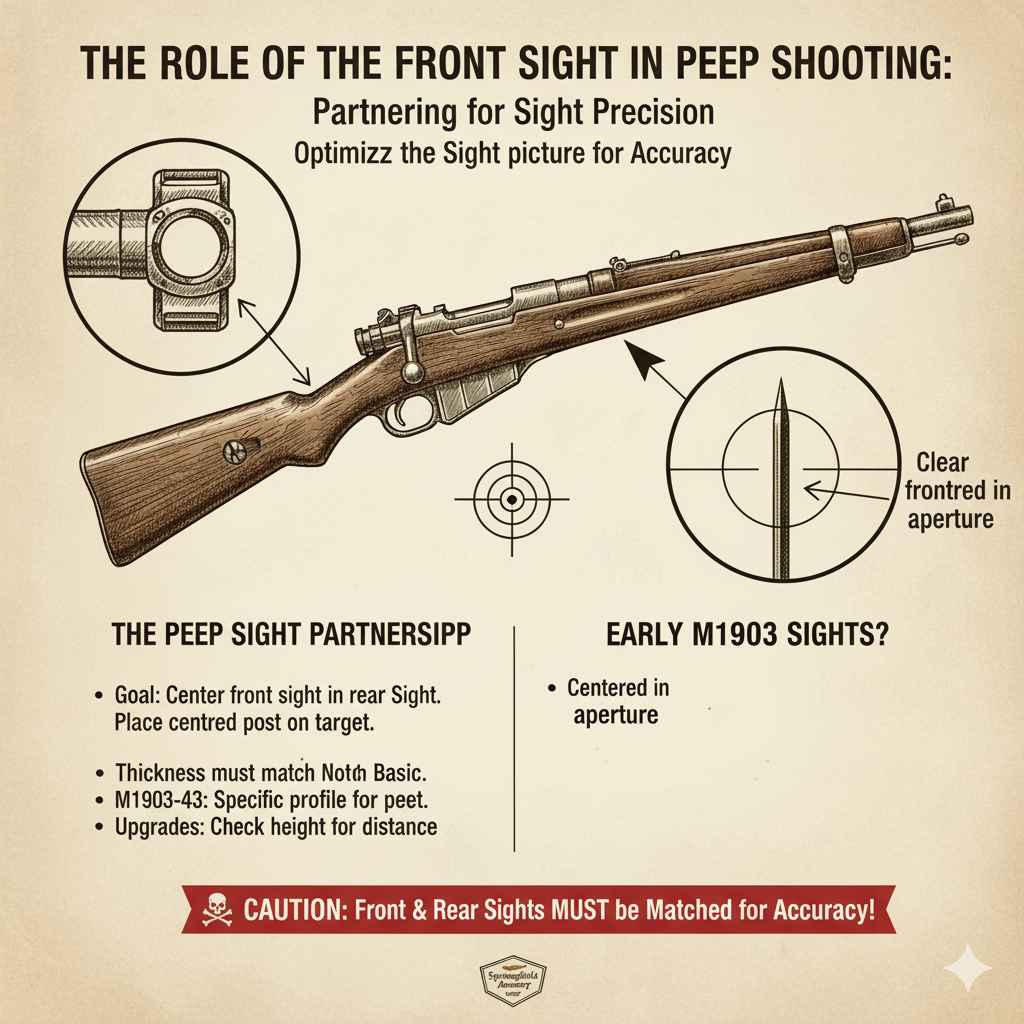
You cannot talk about the rear peep sight without discussing its partner: the front sight. When using a peep sight, the goal is always the same: center the front sight post perfectly within the rear aperture, and then place that centered post on the target.
If your front sight is too thick or too thin for the rear aperture, you will never achieve maximum precision. This is another reason why the M1903-A3 came with a specific front sight profile designed to work optimally with the new rear peep sight.
If you ever upgrade an older M1903 to a peep sight, you might consider checking if the front sight height is correct for your intended shooting distance, though most quality aftermarket sights account for standard military front sight heights.
FAQ: Beginner Questions About M1903 Sights
Here are some quick answers to the most common questions new M1903 owners have regarding their sights.
Q1: Can I add a peep sight to my original M1903?
A: Yes! Many companies sell aftermarket peep sights that use the existing receiver screw holes or sometimes even the rear band area. This is a common and highly recommended upgrade for target shooting.
Q2: Are the sights on an M1903-A3 sighted in for 100 yards from the factory?
A: Not necessarily. While they were zeroed before leaving the arsenal, the exact impact point depends heavily on the specific ammunition used, which was not standardized for civilian sale. You must re-zero the rifle yourself for safety and accuracy.
Q3: What is the difference between a “receiver sight” and a “barrel sight”?
A: A receiver sight (the peep sight on the A3) mounts on the strong main body of the rifle (the receiver). A barrel sight mounts further forward on the barrel or barrel band. Receiver sights are generally more stable and accurate.
Q4: How do I clean the tiny hole on a peep sight?
A: Use a soft cotton swab or a wooden toothpick to gently remove dust or debris from the aperture. Avoid using metal tools because they can scratch or widen the hole. If dirt is stubborn, lightly dampen the swab with gun-cleaning solvent and wipe carefully.
Q5: Are peep sights better than scopes for the M1903?
A: It depends on the purpose. Peep sights are excellent for traditional shooting, training, and maintaining the historical feel of the rifle. Scopes provide magnification and are better for long-range precision. However, many shooters prefer peep sights because they are faster, simpler, and maintain the rifle’s classic configuration.
Q6: Can beginners learn to shoot accurately with peep sights?
A: Absolutely. In fact, many instructors believe peep sights are the best iron sight system for beginners. They naturally guide your eye to center the front sight and target, making it easier to build good shooting fundamentals before moving to optics.
Conclusion: The Evolution of the M1903 Sight System
So, did Springfield Armory put peep sights on the M1903? The answer is yes—but mainly on the later M1903-A3 variant, where the receiver-mounted peep sight became the standard factory configuration. Earlier M1903 rifles originally used barrel-mounted leaf or notch sights, which were simpler but less precise.
Over time, the advantages of peep sights—better accuracy, easier alignment, and more consistent shooting—made them the preferred design for military training and target shooting. That is why the M1903-A3 incorporated a receiver-mounted adjustable aperture sight as a major improvement.
Today, collectors and shooters may encounter several different sight setups on M1903 rifles:
- Original barrel-mounted leaf sights on early models
- Factory receiver peep sights on M1903-A3 rifles
- Aftermarket peep sights added later for civilian target shooting
Understanding these differences not only helps you identify your rifle but also deepens your appreciation for the evolution of one of America’s most iconic military firearms. Whether you are a collector, historian, or beginner shooter, recognizing the sight system is an important step toward mastering and enjoying the legendary Springfield M1903.