

Yes, deer absolutely notice ground blinds, especially if they are new, poorly placed, or smell like a human. Your success depends entirely on making the blind a natural, scent-free part of the landscape. Ignoring this leads to spooked deer and missed opportunities. This guide shows you how to avoid common, dangerous errors.
Have you ever set up a ground blind, feeling confident and hidden, only to watch deer spot it from a hundred yards away and bolt? It’s a frustrating feeling that makes you question everything. You might think, “It’s a camouflage tent, it’s supposed to work!” The truth is, a ground blind is a tool, and like any tool, its success depends on how you use it.
Many new hunters make a few simple mistakes that turn their perfect hideout into a big, scary box that deer avoid. But don’t worry, these errors are easy to fix. We are going to walk through exactly why deer bust you in a blind and how you can make yours practically invisible. Let’s get you hidden so you can focus on the hunt.
First, Understand How a Deer Thinks
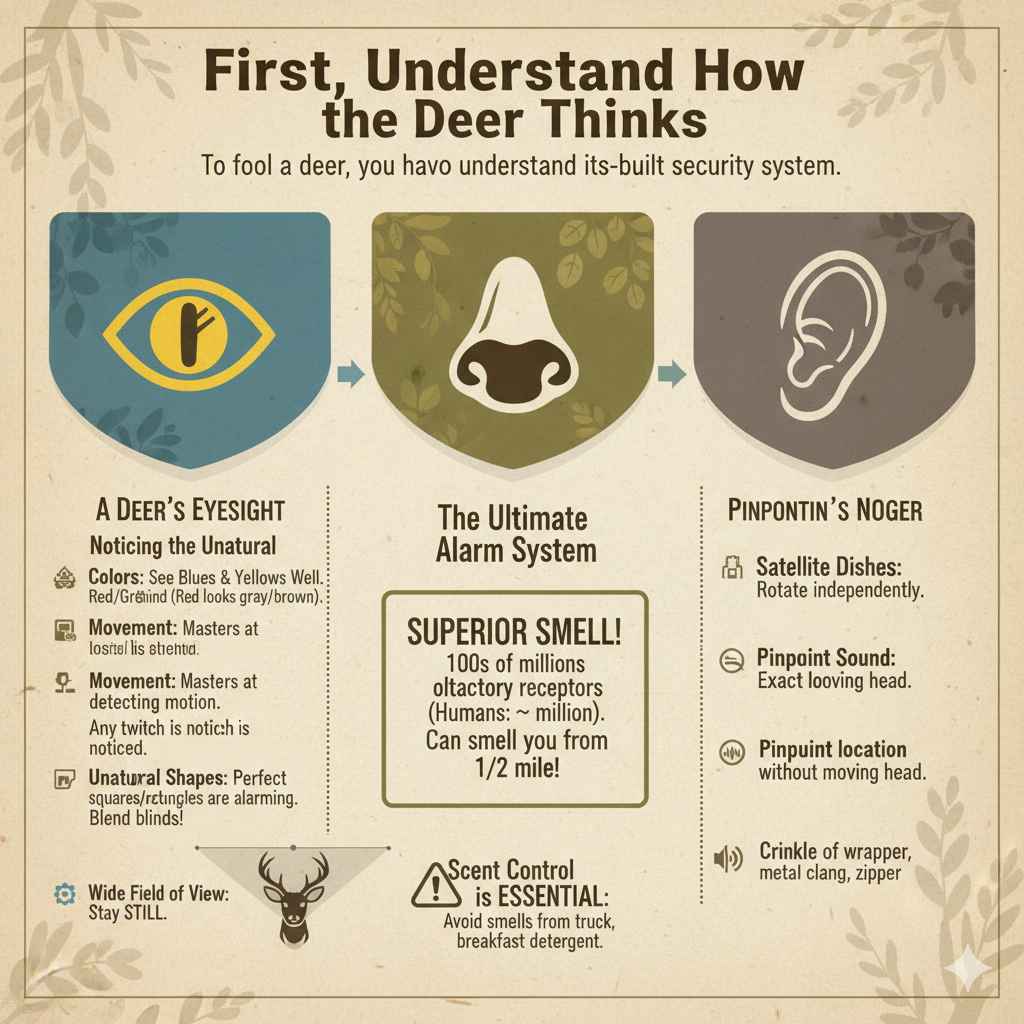
To fool a deer, you have to understand its built-in security system. Deer survive by noticing anything that seems out of place. Their eyes, nose, and ears work together to detect danger from every angle. Let’s break it down in simple terms.
A Deer’s Eyesight: Noticing the Unnatural
A deer’s vision is its first line of defense. It’s very different from ours. They don’t see colors like we do; research suggests they see blues and yellows well but are red-green colorblind. This means your fancy red plaid jacket looks like a dull gray or brown to them. However, they are masters at detecting two things:
- Movement: Even the slightest twitch, like raising your bow or turning your head too quickly, stands out to them. Their eyes are built to catch any motion in their surroundings.
- Unnatural Shapes: A perfect square or rectangle does not exist in nature. A ground blind, with its sharp edges and flat sides, is a giant red flag if it’s not blended into the environment.
They also have an incredibly wide field of view, about 300 degrees, which helps them see almost all around without moving their head. This is why staying still is so critical.
A Deer’s Nose: The Ultimate Alarm System
If you remember one thing, let it be this: a deer’s greatest defense is its sense of smell. According to researchers at Mississippi State University, a deer’s nose has hundreds of millions of olfactory receptors. To put that in perspective, we humans have about five million. They can smell you from over half a mile away if the wind is right.
Your blind might be perfectly hidden, but if it smells like your truck, your breakfast, or your laundry detergent, the game is over before it begins. Scent control is not optional; it’s essential.
A Deer’s Ears: Pinpointing Danger
A deer’s ears are like two large satellite dishes that can rotate independently. This allows them to pinpoint the exact location of a sound without even turning their head. The crinkle of a snack wrapper, the clang of an arrow against your bow, or the zipper on your blind can all alert a deer to your presence long before they ever see you.
The 6 Dangerous Errors That Spook Deer
Now that you know how a deer’s senses work, it’s easy to see how these common mistakes can ruin your hunt. Avoiding them will instantly improve your chances.
Error #1: The “Sore Thumb” Placement
Placing your blind in the middle of an open field with nothing around it is the number one mistake. It sticks out like a sore thumb. Deer know their territory like the back of their hoof. A new, large object appearing overnight is suspicious and will make them wary.
The Fix: Always use natural cover. Place your blind in front of a large tree, a thick bush, or a cluster of rocks. This breaks up its silhouette and makes it look like part of the existing landscape.
Error #2: The “Human Scent Bomb”
You can be completely invisible and silent, but if the wind carries your scent to the deer, they will know you’re there. Many hunters set up their blind without considering wind direction or controlling their own odor.
The Fix: Always check the prevailing wind direction before setting up. Position your blind downwind of where you expect deer to appear. Practice strict scent control by washing your clothes in scent-free detergent, showering with scent-free soap, and spraying down your gear (and yourself) with a scent eliminator.
Error #3: The Unnatural “Box” Shape
A ground blind has a very distinct, unnatural shape. Even with a camouflage pattern, the sharp, vertical lines of the corners and the flat roof can be easily spotted by a deer’s keen eye. They are looking for things that don’t belong.
The Fix: “Brush in” your blind. Use natural vegetation from the immediate area—branches, leaves, tall grass—to break up the blind’s outline. Attach it to the loops on the outside of your blind to make it look like a natural bush, not a box.
Error #4: The Noise Factory
It’s easy to forget how much noise we make. Zipping open a window, adjusting your chair, or dropping your rangefinder can sound incredibly loud in a quiet woods. These unnatural sounds are instant alerts for any deer nearby.
The Fix: Set up your gear before you sit down. Make sure your chair doesn’t squeak. Practice moving slowly and deliberately. If you need to open a window, do it very slowly. Open only the windows you absolutely need for shooting.
Error #5: The Sudden Movement
The inside of a blind is dark, which helps hide you. But when you move in front of an open window, your silhouette is clearly visible against the dark background. A deer can easily catch this movement, especially if you move quickly.
The Fix: Wear dark clothing, including a face mask and gloves, to blend in with the dark interior of the blind. Keep the back windows closed to avoid being backlit. When you need to move, do it in slow motion. Use the shoot-through mesh on your blind windows whenever possible.
Error #6: The Naked Blind
Setting up a brand-new, shiny blind on the day of your hunt is a recipe for failure. The blind will have factory smells, and its sudden appearance will make deer nervous. They need time to accept it as part of their environment.
The Fix: Set your blind up at least one to two weeks before you plan to hunt in it. This gives deer time to get used to its presence. It also allows the blind to air out and pick up the natural smells of the forest, which helps it blend in.
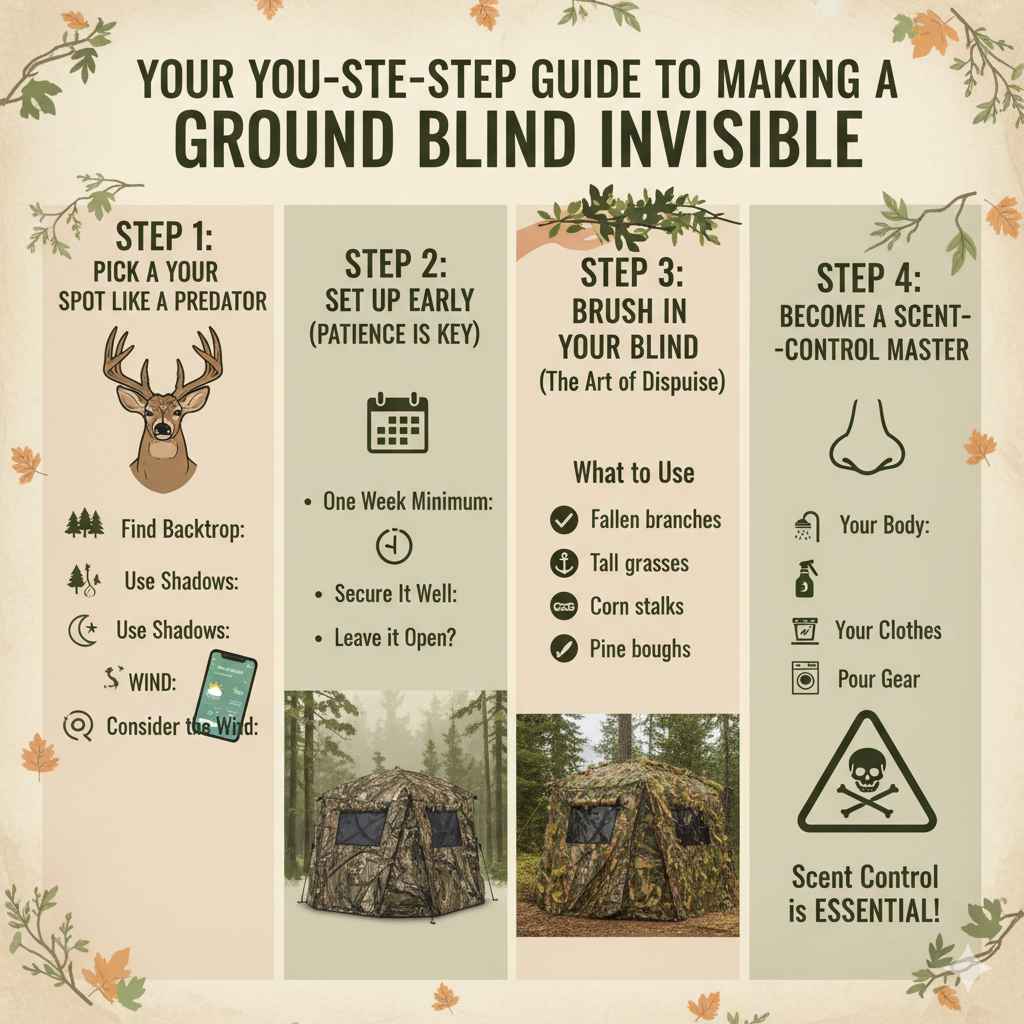
Your Step-by-Step Guide to Making a Ground Blind Invisible
Ready to make your blind disappear? Follow these steps, and you’ll be well on your way to fooling even the wariest old buck.
Step 1: Pick Your Spot Like a Predator
Location is everything. Don’t just look for a spot with a good view; look for a spot that offers natural concealment.
- Find a Backdrop: Never set your blind out in the open. Look for a large tree, a dense thicket, a fallen log, or a rock outcropping to place your blind against. This instantly hides half of your blind and breaks up its outline.
- Use Shadows: Pay attention to how the sun moves. A blind placed in the shadows of trees will be much harder to see than one sitting in direct sunlight.
- Consider the Wind: As we discussed, the wind is your enemy. Use a weather app to check the dominant wind direction for your hunting days. Set up your blind so the wind will be blowing your scent away from the deer trails or feeding areas you’re watching. The National Weather Service is a reliable source for wind forecasts.
Step 2: Set Up Early (Patience is Key)
Deer are creatures of habit. Anything new in their home is cause for alarm. You need to give them time to accept your blind as a harmless part of the scenery.
- One Week Minimum: Try to set up your blind at least a week before you hunt. Two weeks is even better.
- Secure It Well: Make sure your blind is staked down securely so it doesn’t flap in the wind. A flapping blind is a moving object, and movement spooks deer.
- Leave it Open: Some hunters recommend leaving the windows slightly open to let the inside air out and help it smell more like the woods.
Step 3: Brush In Your Blind (The Art of Disguise)
This is the most important step for visual concealment. Your goal is to make the blind look like a lump of natural vegetation. Most blinds come with loops for this exact purpose.
What to Use:
- Fallen branches with leaves still on them
- Tall grasses or weeds from the area
- Corn stalks if you are on the edge of a cornfield
- Pine boughs or cedar branches
Don’t just pile stuff on top. Weave branches into the loops on the sides and top of the blind. Stick some taller grasses into the ground around the base. The goal is to eliminate all straight lines and sharp corners.
Step 4: Become a Scent-Control Master
You must assume the wind will shift. Your scent control is your last line of defense. This is a three-part process:
- Your Body: Shower with scent-free soap and shampoo before every hunt. Do not use deodorant, cologne, or any scented products.
- Your Clothes: Wash all your hunting clothes, including base layers, in scent-free detergent. Dry them outside if possible, away from household smells. Store them in a scent-proof bag or container until you get to your hunting spot.
- Your Gear: Spray down your blind, your pack, your bow, and your boots with a scent-eliminating spray before you walk in. Do this every time.
Here’s a look at some common scent control methods:
| Method | How It Works | Pros | Cons |
|---|---|---|---|
| Scent-Eliminating Sprays | Uses molecules to bond with and neutralize odor-causing bacteria. | Easy to use, portable, effective for gear. | Needs to be reapplied, can be costly over time. |
| Carbon Clothing | Activated carbon is woven into the fabric to absorb human scent. | Provides continuous scent protection. | Expensive, requires special care to “recharge” the carbon. |
| Ozone Generators | Creates O3 (ozone), which destroys scent molecules in the air. | Highly effective for enclosed spaces like a blind or scent-proof bag. | Can be expensive, requires a power source, health concerns with direct inhalation. |
| Scent-Free Soaps & Detergents | Removes existing odors without adding any artificial fragrance. | Inexpensive, fundamental first step for scent control. | Only removes scent; doesn’t prevent you from creating new scent. |
Step 5: Master the Art of Silence
Once you’re in the blind, your job is to be a silent statue. Organize your gear so everything you need is within easy reach without shuffling around. Practice drawing your bow slowly and silently. If your chair squeaks, fix it or get a new one. The woods are quiet, and your noises will travel far.
Step 6: Control the “Black Hole” Effect
An open window on a dark blind creates a dark, black square that can look unnatural to a deer. This is especially true on a bright, sunny day.
The Fix: Use the shoot-through mesh windows that come with most blinds. This mesh breaks up the “black hole” while still allowing you to see out and shoot an arrow through it (always use fixed-blade broadheads with mesh). Keep all windows you are not using completely closed. This makes the interior darker and hides your movements better.
| Window Option | Concealment Level | Visibility | Best For |
|---|---|---|---|
| Fully Open | Low | Excellent | Gun hunting where minimal movement is required to shoot. |
| Shoot-Through Mesh | High | Good | Bowhunting, as it hides movement while you draw your bow. |
| Partially Open (Slit) | Medium | Fair | Peeking or filming, but can be awkward for shooting. |
| Fully Closed | Excellent | None | All back and side windows that you are not actively watching from. |
Pop-Up Blinds vs. Natural Blinds: What’s Right for You?
A “pop-up” blind is the portable, tent-like structure we’ve been discussing. A “natural” blind is one you build yourself from fallen logs, branches, and other materials on-site. Both can be effective, but they serve different needs.
| Feature | Pop-Up Ground Blind | Natural Ground Blind |
|---|---|---|
| Portability | Excellent. Folds up into a small bag. | None. It is built and left on-site. |
| Concealment | Good, but requires brushing in to look natural. | Excellent. Made from the immediate surroundings. |
| Weather Protection | Good. Protects from wind and rain. | Poor to fair, depending on construction. |
| Scent Control | Good. The walls help contain some human scent. | Poor. Your scent is easily carried by the wind. |
| Setup Time | Fast (5-10 minutes to pop up). | Slow (can take an hour or more to build). |
| Best For | Beginners, mobile hunters, bowhunting, bad weather. | Hunters on private land, areas where it can be left for a long time. |
Frequently Asked Questions (FAQ)
How long does it take for deer to get used to a ground blind?
It varies, but a good rule of thumb is to set your blind up at least one to two weeks before you plan to hunt from it. This gives them enough time to see it, investigate it, and accept it as a normal, non-threatening object in their environment.
Can deer see the color of my blind?
Not really. Deer are red-green colorblind, so the specific shades of green and brown on your camouflage pattern don’t matter as much as the pattern’s ability to break up your blind’s outline. Contrast is more important than color. A dark, solid shape is what they’ll notice.
Is it better to leave the windows open or closed?
Keep as many windows closed as possible. A closed blind makes the interior darker, which hides you better. Only open the specific windows you need to shoot out of. Use the shoot-through mesh over those windows to further conceal yourself and any movements you make.
Do I need to brush in a camouflage blind?
Yes, absolutely! Camouflage helps, but it doesn’t hide the unnatural shape of a box. Brushing in your blind with local vegetation is the most critical step to making it blend in and look like a natural part of the landscape. Without it, even the best camo pattern can still look like a cube in the woods.
How do I control my scent inside the blind?
Start with a clean body and clean clothes. Avoid bringing smelly foods like tuna or onions. You can use a small, portable ozone generator inside the blind to continuously destroy scent molecules, but be sure to follow the manufacturer’s safety instructions. Scent-eliminating sprays can also be used on your gear inside the blind.
Can I set up a ground blind the same day I hunt?
You can, but it is much less effective. This is often called “running and gunning.” If you must do this, your placement and brushing-in technique must be perfect. Find a location with tons of natural cover to hide the blind and spend extra time making it look like it belongs there. Your chances are lower, but it’s not impossible.
What’s the biggest mistake beginners make with ground blinds?
The biggest mistake is underestimating a deer’s senses. Beginners often think the camouflage fabric is enough. They neglect to brush it in, fail to control their scent, or set it up in a bad location. They treat it like a magic invisibility cloak, when in reality, it’s a tool that requires skill and preparation to use effectively.
Conclusion: It’s All About Preparation
So, do deer notice ground blinds? Yes, but only when we make it easy for them. A poorly placed, noisy, smelly blind is a beacon of danger to a deer. But a well-placed, brushed-in, and scent-free blind becomes just another part of the woods.
Success isn’t about having the most expensive gear; it’s about understanding the animal you’re hunting and paying attention to the details. By avoiding these common errors and taking the time to set up your blind properly, you transform it from a liability into your greatest asset. Be patient, be quiet, be clean, and blend in. Do that, and you’ll find that deer will walk by your hideout without a second glance, giving you the perfect opportunity you’ve been waiting for.