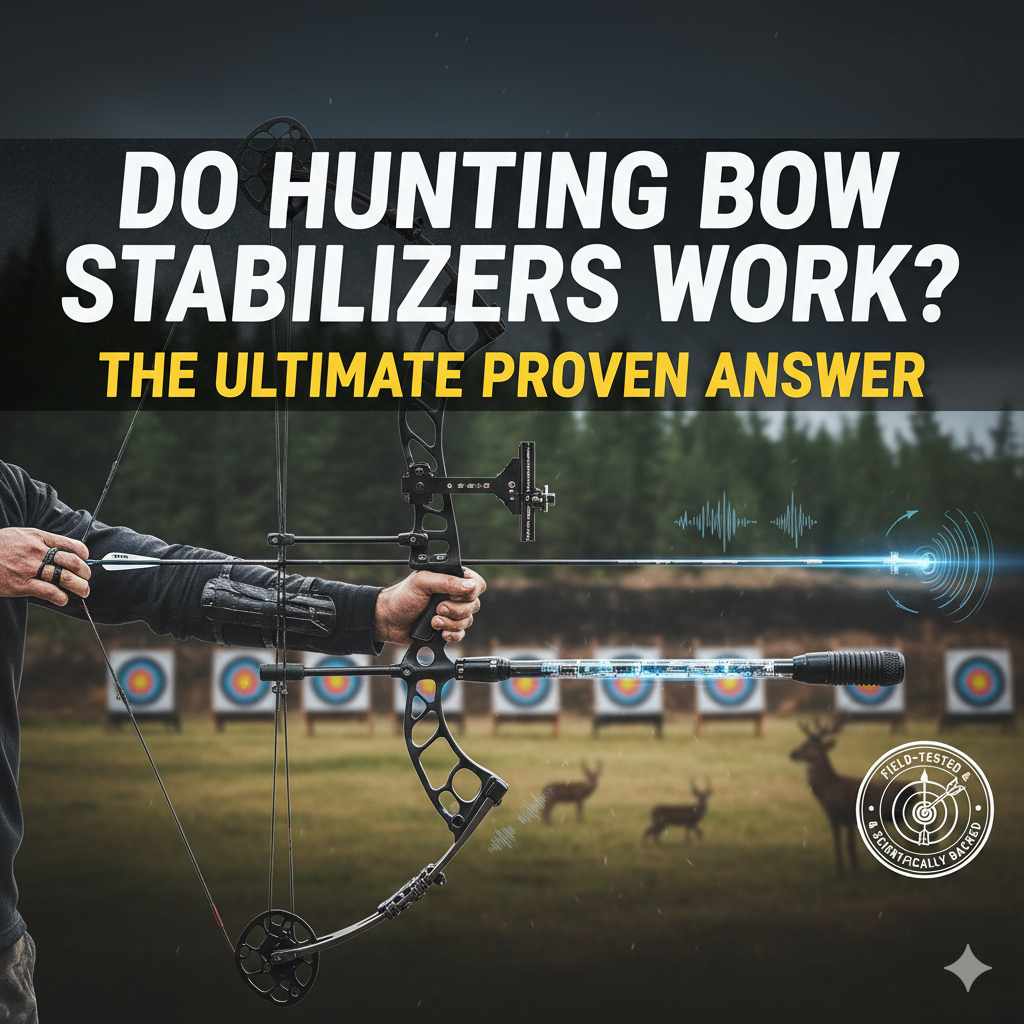
Yes, hunting bow stabilizers absolutely work. They are proven to improve accuracy by adding forward weight, which steadies your aim and reduces bow torque at the shot. They also significantly dampen vibration and noise, resulting in a smoother, quieter, and more consistent shooting experience for both beginners and experienced hunters.
Hello, I’m Salman Arfeen. If you’ve ever wondered about that rod sticking out from the front of a hunting bow, you’re not alone. Many new archers ask me, “Do those stabilizers actually do anything, or are they just for looks?” It’s a great question, and the answer can make a big difference in your confidence and accuracy.
That little accessory can seem confusing, but its purpose is simple: to help you shoot better. A shaky aim or a loud, vibrating bow can be frustrating, but a stabilizer is designed to fix those exact problems. In this guide, I’ll walk you through exactly how they work, why they are so effective, and how to choose the perfect one for your needs. Let’s make your next shot your best one yet.
What is a Bow Stabilizer and What Does It Do?
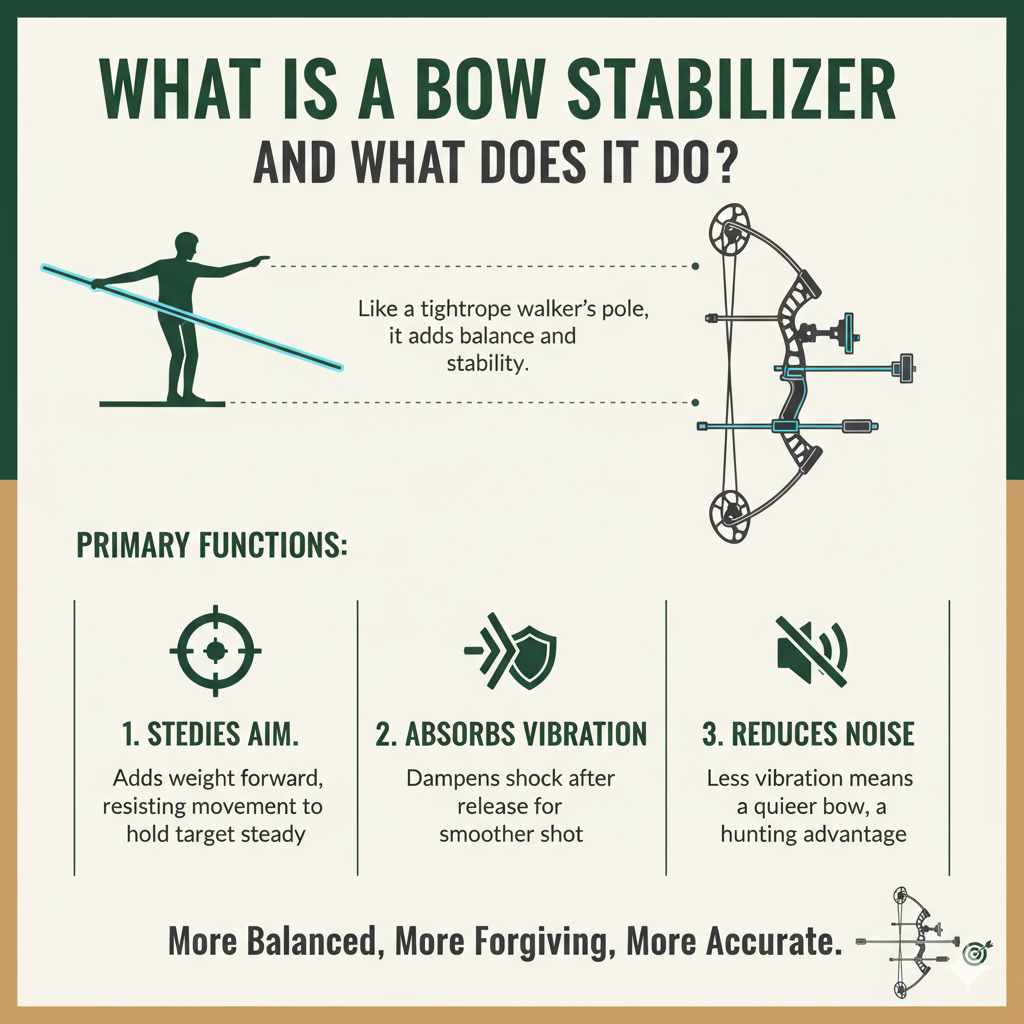
Think of a bow stabilizer like the balancing pole a tightrope walker uses. It doesn’t magically make them a better walker, but it helps them stay steady and correct for small wobbles. In the same way, a bow stabilizer is a weighted rod that you screw into the front of your bow’s riser (the main handle section).
Its primary job is to add weight and length away from the bow, which accomplishes three key things:
- It steadies your aim. By adding weight forward and away from your hand, it helps the bow resist movement. This makes it easier to hold your pin steady on the target.
- It absorbs vibration. When you release the arrow, a lot of energy is transferred back into the bow. A stabilizer, often filled with rubber or other dampening materials, soaks up that “shock,” making the shot feel smoother and more comfortable.
- It makes the bow quieter. All that vibration creates noise. By reducing the vibration, a stabilizer naturally reduces the sound of your bow, which is a huge advantage when hunting.
So, a stabilizer isn’t just a fancy accessory. It’s a functional piece of equipment designed to make your bow more balanced, more forgiving, and ultimately, more accurate.
The Simple Science: How Stabilizers Make You a Better Shot
You don’t need a physics degree to understand how a stabilizer works. The principles are actually very simple and have a huge impact on your shooting. Let’s break down the “how” in easy-to-understand terms.
1. Increasing Inertia for a Rock-Solid Aim
Inertia is just a fancy word for an object’s resistance to being moved. A heavier object has more inertia. By adding a stabilizer, you are adding weight to the front of your bow.
Imagine trying to hold a feather perfectly still. The slightest breeze or twitch of your hand makes it move. Now, imagine holding a small rock. It’s much easier to keep steady, right? The stabilizer acts like that rock.
This added mass makes your bow less susceptible to the tiny muscle tremors in your arms and hands. Your pin will appear to “float” more slowly and calmly on the target instead of bouncing around, giving you more time to execute a perfect shot.
2. Reducing Bow Torque (The Dreaded Twist)
Bow torque is the unintentional twisting of the bow in your hand when you release the string. Everyone does it to some degree, especially when starting out. This tiny twist can send your arrow flying off-course, even if your aim was perfect.
A stabilizer helps fight this in two ways:
- It provides leverage. Because the stabilizer sticks out from the bow, it acts like a lever. This makes it much harder for you to accidentally twist the riser. Any small twisting motion in your grip has less effect on the overall bow.
- It encourages a proper grip. The forward pull of the stabilizer naturally encourages you to relax your hand and use a more open, repeatable grip, which is the foundation of good archery form. The Archery Trade Association emphasizes that a relaxed grip is critical for accuracy.
3. Dampening Vibration and Noise
When you release an arrow, the bowstring slams forward, and the limbs flex violently. This creates a powerful wave of vibration that you feel in your hand (often called “hand shock”) and hear as a loud “thwack.”
Modern stabilizers are engineering marvels designed to kill this energy. They are often built with internal rubber compounds, gels, or flexible materials that act like shock absorbers on a car. As the vibration travels from the riser into the stabilizer, these materials absorb and dissipate the energy, turning it into tiny amounts of heat.
The result?
- Less Hand Shock: Your bow feels dead in the hand, making it more comfortable and enjoyable to shoot.
- A Quieter Shot: Less vibration means less noise. A quiet bow can be the difference between a deer hearing your shot and jumping the string, or a successful hunt.
The Proven Benefits: What a Stabilizer Actually Does for You
Okay, we’ve covered the science. But what does that mean for you out in the field or at the range? The benefits are tangible and can transform your shooting experience.
Tighter Arrow Groups (Better Accuracy)
This is the number one reason hunters use stabilizers. By steadying your aim and reducing bow torque, stabilizers lead directly to more consistent shots. When your pin floats calmly on the target and your bow doesn’t twist upon release, your arrows will land closer together. An archer who can consistently shoot 4-inch groups at 30 yards might shrink that to 2-inch groups just by adding a well-balanced stabilizer.
Increased Confidence at Full Draw
Confidence is everything in archery. When your bow feels unstable and your pin is dancing all over the target, it’s easy to get anxious and rush the shot. This is called “target panic.” A stabilizer calms everything down. The steady feeling it provides allows you to relax, focus on your form, and execute a clean release with confidence, knowing the bow is working with you, not against you.
A Quieter, Stealthier Hunt
In bowhunting, silence is golden. A deer’s hearing is incredibly sensitive. A loud bow can cause a deer to “jump the string”—reacting to the sound of the shot and moving before the arrow arrives. A good stabilizer with dampening technology can shave precious decibels off your shot, making your setup stealthier and increasing your chances of a clean, ethical harvest.
Reduced Fatigue During Practice
Shooting a bow without a stabilizer can be jarring. The hand shock from each shot travels up your arm, and over a long practice session, this can lead to fatigue and even discomfort. By absorbing that vibration, a stabilizer makes shooting much more pleasant. You’ll be able to practice longer without getting tired, which means more time honing your skills.
Types of Hunting Bow Stabilizers: Finding Your Perfect Match
Stabilizers aren’t one-size-fits-all. They come in various lengths and styles, each designed for a different purpose. For hunting, we generally focus on shorter, more maneuverable options compared to the long rods you see on Olympic bows.
Short Stabilizers (4-6 inches)
- Best For: Treestand hunting, blind hunting, or moving through thick brush where a long stabilizer would get caught on everything.
- Primary Function: Excellent at vibration and noise dampening. They offer a moderate amount of stabilization for aiming.
- Pros: Very compact, lightweight, and won’t get in the way.
- Cons: Provides the least amount of aiming stability compared to longer models.
Mid-Length Stabilizers (6-10 inches)
- Best For: All-around bowhunting. This is the sweet spot for most hunters.
- Primary Function: A great balance of aiming stability, vibration control, and maneuverability.
- Pros: Offers a noticeable improvement in holding steady without being overly cumbersome.
- Cons: Can occasionally be a bit long for tight spaces in a treestand or blind.
Long Stabilizers (10-12 inches)
- Best For: Western hunting in open country or for hunters who prioritize maximum stability.
- Primary Function: Maximum aiming stability. The further the weight is from the bow, the more it resists movement.
- Pros: Makes your pin incredibly steady, excellent for longer-range shots.
- Cons: Can be bulky and awkward to carry in the woods. Can easily catch on branches.
Here’s a simple table to help you compare:
| Stabilizer Length | Primary Benefit | Ideal Hunting Style | Maneuverability |
|---|---|---|---|
| 4-6 inches | Vibration/Noise Dampening | Treestand, Blind, Thick Woods | Excellent |
| 6-10 inches | Balanced Stability & Dampening | All-Around, Versatile Hunting | Good |
| 10-12 inches | Maximum Aiming Stability | Open Country, Long-Range | Fair |
How to Choose the Right Hunting Stabilizer for YOU
With so many options, choosing can feel overwhelming. But if you follow these simple steps, you’ll find the perfect stabilizer for your bow and your hunting style.
Step 1: Think About Where and How You Hunt
Your hunting environment is the most important factor.
- Tight Spaces (Treestand/Blind): A shorter stabilizer (5-8 inches) is your best friend. It won’t bang against the stand or blind and will be much easier to manage.
- Spot-and-Stalk in Thick Woods: Again, shorter is better. A long stabilizer will constantly snag on branches and be a major annoyance.
- Open Country (Plains/West): Here, you can get away with a longer stabilizer (8-12 inches) to maximize your accuracy for potentially longer shots.
Step 2: Decide on Length vs. Stability
This is the classic trade-off. As we discussed, a longer stabilizer provides more stability but is less maneuverable. A good starting point for most hunters is an 8-inch stabilizer. It offers a significant boost in aiming stability without being too cumbersome. You can always go shorter or longer from there based on your personal preference.
Step 3: Consider Weight and Adjustability
Most quality stabilizers come with removable weights at the end. This is a fantastic feature! It allows you to customize the feel of your bow.
- Start with the standard weight. Shoot with it for a while and see how it feels.
- Is your pin still a bit floaty? Add a little more weight.
- Does the bow feel too front-heavy and hard to hold up? Remove some weight.
This “tuning” process helps you find the perfect balance for your specific setup and strength.
Step 4: Don’t Ignore the Dampening Technology
Look at what the stabilizer is made of. The best ones use a combination of a rigid carbon or aluminum body with flexible, rubber-like dampeners integrated into the design. This combination gives you the stiffness needed for stability and the absorption needed to kill vibration and noise. Reading reviews can often tell you which models are best at making the bow “dead in the hand.”
How to Install and Set Up Your Stabilizer (It’s Easy!)
This is one of the easiest upgrades you can make to your bow. You don’t need any special tools, and it takes less than a minute.
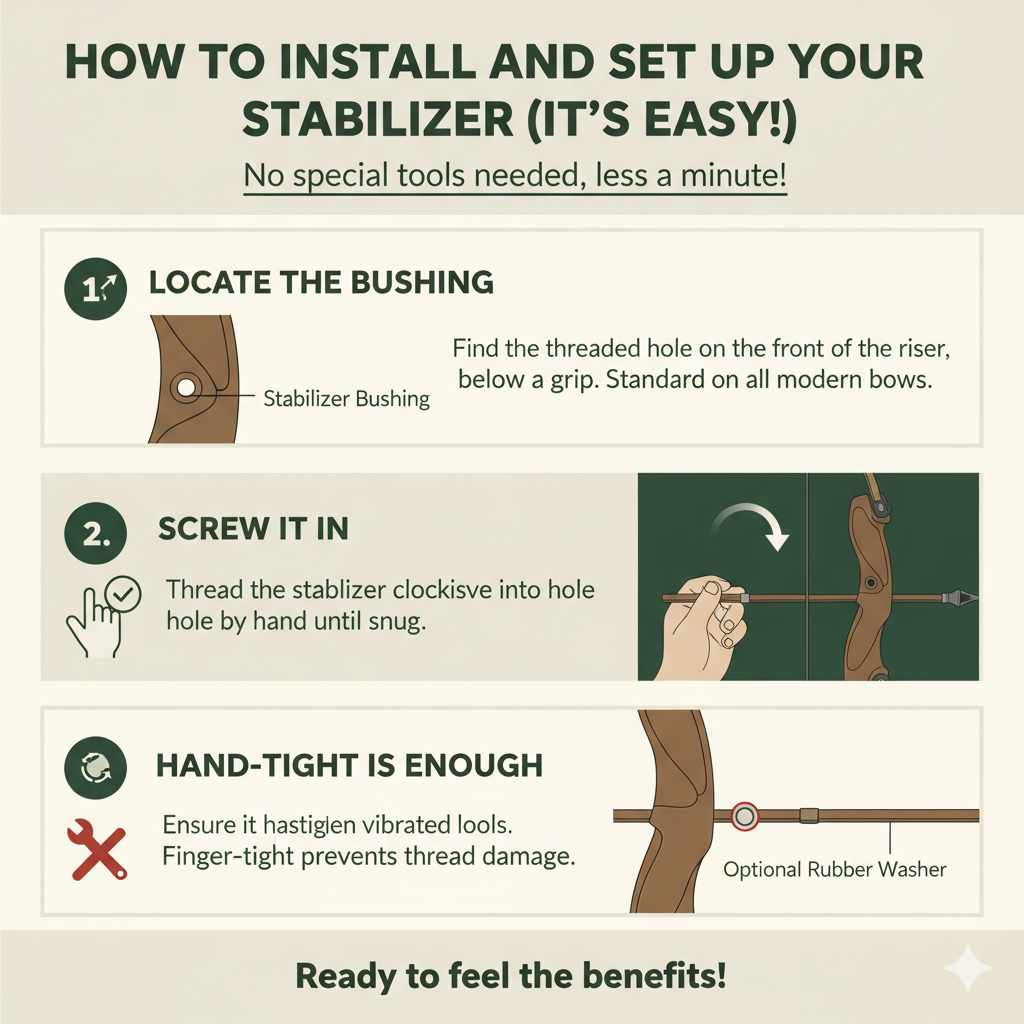
- Locate the Stabilizer Bushing: Look on the front of your bow’s riser, just below the grip. You’ll see a threaded hole. This is where the stabilizer screws in. According to educational resources like Hunter-Ed.com, this is a standard feature on all modern compound bows.
- Screw It In: Simply thread the stabilizer into the hole by hand. Turn it clockwise until it is snug.
- Hand-Tight is Enough: You don’t need to use a wrench or pliers. Just get it nice and firm with your hand. Over-tightening can damage the threads on your riser.
- Check It Periodically: After a few dozen shots, just give it a quick check to make sure it hasn’t vibrated loose. A small rubber washer between the stabilizer and the bow can help keep it tight.
That’s it! You’re ready to start feeling the benefits on the range.
Common Myths About Bow Stabilizers Debunked
There’s a lot of misinformation out there. Let’s clear up a few common myths I hear from new archers.
| The Myth | The Reality |
|---|---|
| “Stabilizers are just for looks or for professional shooters.” | Stabilizers provide real, measurable benefits for archers of all skill levels. In fact, beginners often see the most dramatic improvement because it helps correct for unsteadiness and grip inconsistencies. |
| “A longer stabilizer is always better for hunting.” | While longer stabilizers offer more stability, they are impractical for many hunting situations. A shorter, more maneuverable stabilizer is often the better choice for treestand or thick-woods hunting. Function over form is key. |
| “You need a super heavy stabilizer to see any difference.” | Balance is more important than pure weight. The goal is to find a weight that steadies your aim without making the bow feel sluggish or difficult to hold up. Many hunters find a 6-10 oz setup is the perfect sweet spot. |
| “A stabilizer will instantly fix my bad shooting.” | A stabilizer is a tool, not a magic wand. It can help you aim better and make your bow more forgiving, but it can’t fix poor form, a bad release, or target panic. It helps you get the most out of your practice, but you still have to put in the work. |
Frequently Asked Questions
What is the best length for a hunting bow stabilizer?
For most hunters, a stabilizer between 6 and 10 inches is the ideal sweet spot. This provides a great balance of aiming stability and maneuverability for various hunting situations, from treestands to open fields.
Can a stabilizer really make my bow quieter?
Yes, absolutely. A quality stabilizer is designed with rubber and other dampening materials specifically to absorb the vibration that causes noise. This can significantly reduce the “thwack” sound of your bow, making it stealthier.
Is a heavier stabilizer better?
Not necessarily. “Better” is about balance, not just weight. A stabilizer should be heavy enough to steady your pin, but not so heavy that it causes fatigue or makes the bow feel unbalanced. Many stabilizers have adjustable weights so you can find what works best for you.
Do I need a front and back stabilizer for hunting?
For hunting, a single front stabilizer is all you need. The complex front and back bar setups (V-bars) are designed for competitive target archers who need perfect balance for extreme precision. For hunting, they are generally too bulky and unnecessary.
Will a stabilizer fix my bad form?
No. A stabilizer can help mask or reduce the effects of minor form flaws, like a shaky hold or slight grip torque, but it cannot fix fundamental issues like a poor anchor point or a punchy release. It is a tool to enhance good form, not a replacement for it.
How much should I spend on a stabilizer?
You can find effective hunting stabilizers ranging from $40 to over $150. You don’t need to buy the most expensive model. A mid-range stabilizer ($50-$90) from a reputable brand will offer excellent vibration dampening and stability for most hunters.
Can I hunt without a stabilizer?
Of course! People have been successfully hunting with bows for thousands of years without stabilizers. However, modern compound bows are designed to be used with one for optimal balance and performance. Hunting without one may result in more vibration, noise, and a less steady hold.
The Final Verdict: A Must-Have for Most Hunters
So, do hunting bow stabilizers work? The answer is a resounding yes. They are one of the most effective accessories you can add to your bow to improve accuracy, reduce noise, and boost your confidence.
From the physics of inertia and torque to the real-world benefits of a quieter, smoother shot, the evidence is clear. A stabilizer helps you hold steadier, forgive small mistakes in your form, and makes your bow a more effective and pleasant tool to shoot.
While you can certainly hunt without one, adding a quality stabilizer is a simple, relatively inexpensive step that can pay huge dividends. It helps bridge the gap between a frustrating practice session and the satisfaction of watching your arrows fly true, time and time again. Find the right length and weight for your style of hunting, and I’m confident you’ll see the difference.