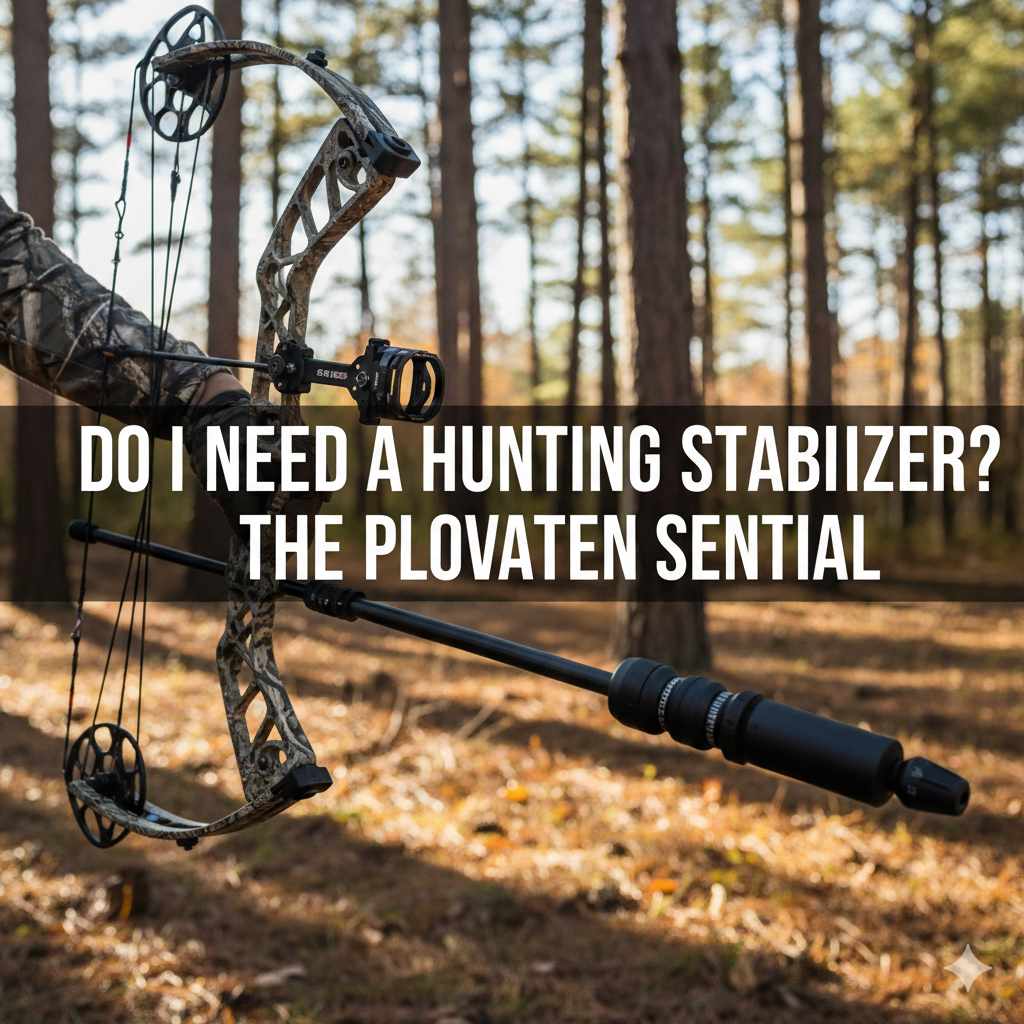
Yes, a hunting bow stabilizer is essential for most beginners and hobbyists. It significantly improves your aim by reducing wobbling, dampens noise and vibration for a smoother shot, and adds balance to your bow. This leads to tighter arrow groups, increased confidence, and a more forgiving shooting experience.
Welcome, fellow archer! I’m Salman Arfeen, and I’m here to help you get the most out of every shot. If you’re just starting out, your bow probably feels like a handful. You’re focused on your stance, your grip, and your aim. Then you see other archers with a long rod sticking out the front of their bows. You might wonder, “Do I really need one of those?
It’s a great question, and a common one! The short answer is that a bow stabilizer can be one of the best upgrades you make. It’s not just for the pros. It’s a tool that helps make shooting easier, quieter, and much more accurate. In this guide, we’ll walk through exactly what a stabilizer does and how to pick the right one for you. Let’s make your next shot your best one yet!
What Is a Bow Stabilizer, Anyway?
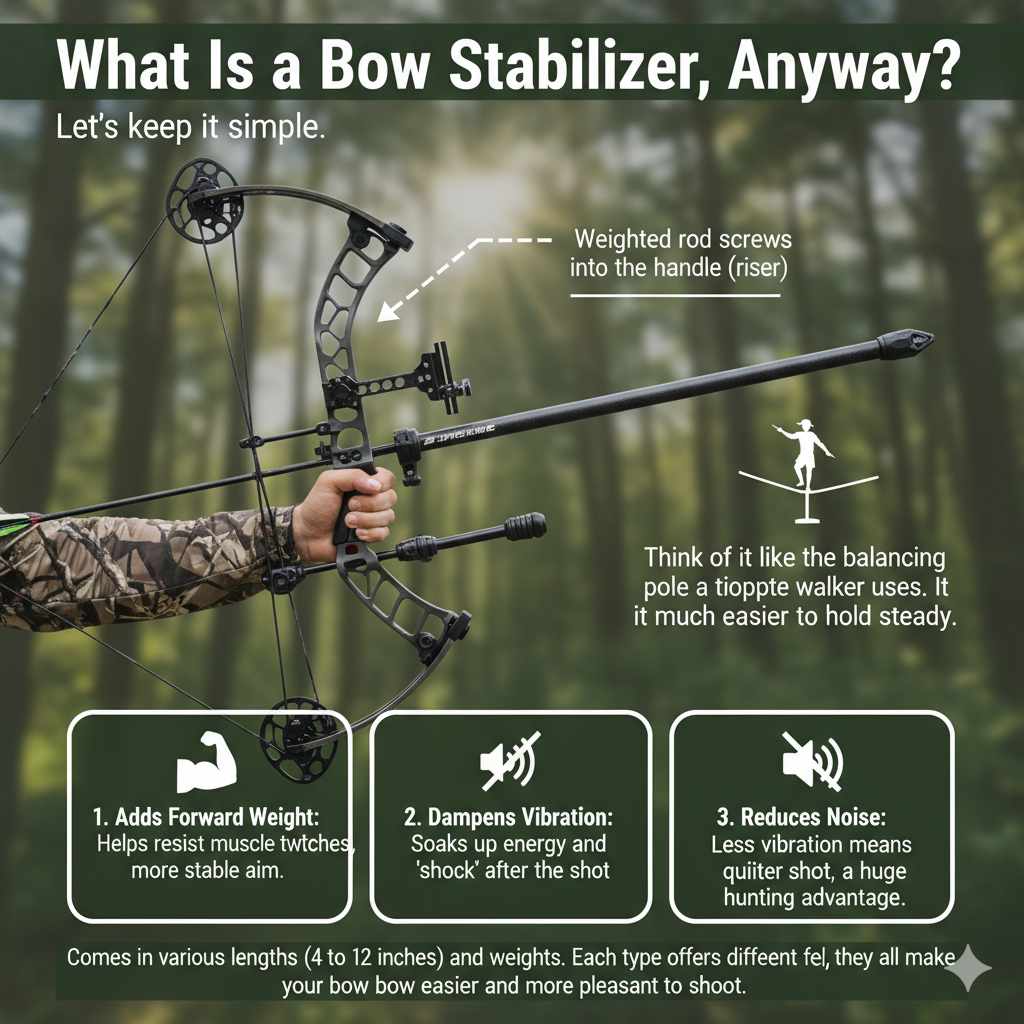
Let’s keep it simple. A bow stabilizer is a weighted rod that you screw into the front of your bow’s handle, also known as the riser. Think of it like the balancing pole a tightrope walker uses. It doesn’t magically aim for you, but it makes it much easier for you to hold the bow steady.
At its core, a stabilizer does three key things:
- Adds Forward Weight: This extra weight out front helps resist the tiny muscle twitches and shakes in your hand, so your aim stays more stable.
- Dampens Vibration: When you release the arrow, the bowstring and limbs create a lot of energy and vibration. The stabilizer, often filled with rubber or gel, acts like a sponge to soak up that “shock.”
- Reduces Noise: All that vibration creates sound. By reducing the vibration, a stabilizer naturally makes your shot quieter—a huge advantage when hunting.
You can find them in all sorts of lengths and weights, from short and stubby 4-inch models to long, thin 12-inch rods. Each one offers a different feel, but they all share the same goal: to make your bow easier and more pleasant to shoot.
How a Simple Rod Makes a Huge Difference: The Science Behind It
You don’t need a degree in physics to understand how a stabilizer works. It all comes down to a concept called inertia. Inertia is an object’s resistance to being moved. The heavier an object is and the farther its weight is from the center, the harder it is to move quickly.
When you add a stabilizer to your bow, you are moving weight forward, away from your hand. This increases the bow’s overall inertia. Now, when your muscles make tiny, shaky movements, the bow resists those movements more effectively. Your pin (the aiming dot in your sight) will appear to “float” more slowly over the target instead of bouncing around wildly.
As for vibration, think about hitting a tuning fork. It vibrates and makes a humming sound. If you touch it with a piece of rubber, the vibration and sound stop. The rubber absorbs the energy. A stabilizer works the same way. The materials inside it are designed to absorb the bow’s post-shot “twang,” leading to a dead-in-the-hand feel and a quieter release.
The Top 4 Benefits of Using a Hunting Bow Stabilizer
Adding a stabilizer isn’t just about looking cool. It offers real, practical benefits that you’ll notice from your first few shots. Let’s break down the most important advantages.
1. Dramatically Improved Aiming and Stability
This is the number one reason archers use a stabilizer. Holding a bow at full draw is tough. Your arms get tired, and your hands start to shake. A stabilizer acts like a counterbalance, making the bow want to stay upright and still. The added forward weight slows down the movement of your sight pin, making it easier to hold steady on your target. For a beginner, this is a game-changer. It builds confidence because you can physically see your aim becoming steadier.
2. Significant Reduction in Vibration and Noise
Have you ever shot a bow without a stabilizer? You can feel the “jump” and vibration travel right up your arm. It can be uncomfortable and even a bit startling. This is called hand shock. A quality stabilizer absorbs that jarring energy, making the shot feel much smoother and more comfortable. A side effect of absorbing this vibration is a much quieter bow. For a hunter, silence is golden. A quieter bow means the animal is less likely to “jump the string”—reacting to the sound of the shot before the arrow arrives.
3. Better Overall Bow Balance
Modern compound bows are not perfectly balanced. With accessories like a sight, quiver, and arrow rest added on, they often feel top-heavy and want to tilt to one side. A stabilizer helps correct this imbalance. By adding weight to the front and often slightly below the grip, it helps the bow sit more neutrally in your hand. A well-balanced bow is easier to hold for long periods and promotes better shooting form, as you aren’t fighting the bow’s desire to tip over.
4. Increased Accuracy and Forgiveness
When your aim is steadier and your shot is smoother, your accuracy naturally improves. But a stabilizer also makes your bow more “forgiving.” A forgiving bow is one that still shoots accurately even if your form isn’t perfect. Because the stabilizer resists movement, it can help smooth over a minor flaw in your release, like slightly torquing (twisting) the handle. This means your bad shots won’t be quite as bad, and your good shots will be grouped tighter together.
| Proven Benefits (Pros) | Potential Downsides (Cons) |
|---|---|
| Holds your aim much steadier on the target. | Adds overall weight to your bow setup. |
| Makes the shot significantly quieter. | Longer models can be bulky in thick woods. |
| Reduces hand shock and vibration for comfort. | Adds an extra cost to your initial setup. |
| Improves bow balance for better shooting form. | Can sometimes get snagged on branches or brush. |
| Increases forgiveness for less-than-perfect shots. | Choosing the right one can feel overwhelming at first. |
Choosing Your First Hunting Stabilizer: A Simple Guide
Walking into an archery shop and seeing a wall of stabilizers can be intimidating. But choosing your first one doesn’t have to be complicated. For hunting, we generally focus on stabilizers between 6 and 10 inches long. Here’s a simple way to think about your options.
Focus on Length First
The length of the stabilizer is its most important feature. The rule of thumb is simple: the longer the stabilizer, the more stability it provides. However, for hunting, a super-long stabilizer can be clumsy in the woods.
- Short Stabilizers (4-6 inches): These are great for hunters who navigate thick brush or sit in tight tree stands. They offer good vibration dampening and a modest amount of stabilization without getting in the way.
- Mid-Length Stabilizers (6-10 inches): This is the sweet spot for most hunters. A stabilizer in this range provides an excellent balance of stability, vibration control, and maneuverability. An 8-inch stabilizer is a fantastic starting point for almost any beginner.
- Long Stabilizers (10+ inches): These are typically used by target archers or hunters in open country (like the Midwest or West) where maneuverability isn’t a concern. They offer the maximum amount of stability.
Consider the Weight
Most modern stabilizers come with removable weights at the end. This is a fantastic feature because it lets you customize the feel. A good starting point is to have around 2 to 4 ounces of weight on the end of your stabilizer. You can experiment by adding or removing weights to see what feels best. The goal is to have enough weight to steady your aim without making the bow feel too heavy to hold comfortably.
Don’t Break the Bank
You do not need to buy the most expensive carbon fiber, multi-rod stabilizer on the market. Many excellent, affordable stabilizers made from aluminum and rubber will give you 90% of the benefit for a fraction of the cost. Start with a reputable brand’s entry-level or mid-range model. You can always upgrade later if you feel the need.
| Stabilizer Length | Ideal Hunting Scenario | Key Advantage |
|---|---|---|
| 4-6 inches | Thick woods, small tree stands, or ground blinds. | Maximum maneuverability and very compact. |
| 6-10 inches | All-around hunting, from woods to open fields. | The best balance of stability and practical size. |
| 10-12 inches | Open terrain, long-distance shooting, or crossover target use. | Maximum stability for the steadiest possible aim. |
How to Install a Bow Stabilizer in Under a Minute
Good news! This is one of the easiest things you will ever do to your bow. It requires no special tools and takes less than 60 seconds.
- Locate the Stabilizer Bushing: Look at the front of your bow’s riser, just below the grip. You will see a threaded hole. This is the stabilizer bushing, and it’s a standard size on almost every modern bow.
- Check the Threads: Your stabilizer will have a threaded screw on one end. Gently start screwing it into the bushing by hand. It should thread in smoothly. Do not force it; if it feels stuck, back it out and try again to ensure you aren’t cross-threading it.
- Tighten it Down: Screw the stabilizer in until it is snug. Hand-tight is perfectly fine. You don’t need to use a wrench or crank down on it. It just needs to be secure enough that it won’t vibrate loose.
- That’s It! You’re ready to shoot. After a few shots, just double-check that it is still snug.
The simple act of adding this component can have a profound impact. For a more detailed look at bow components, the USA Archery organization provides excellent resources for beginners getting familiar with their equipment.
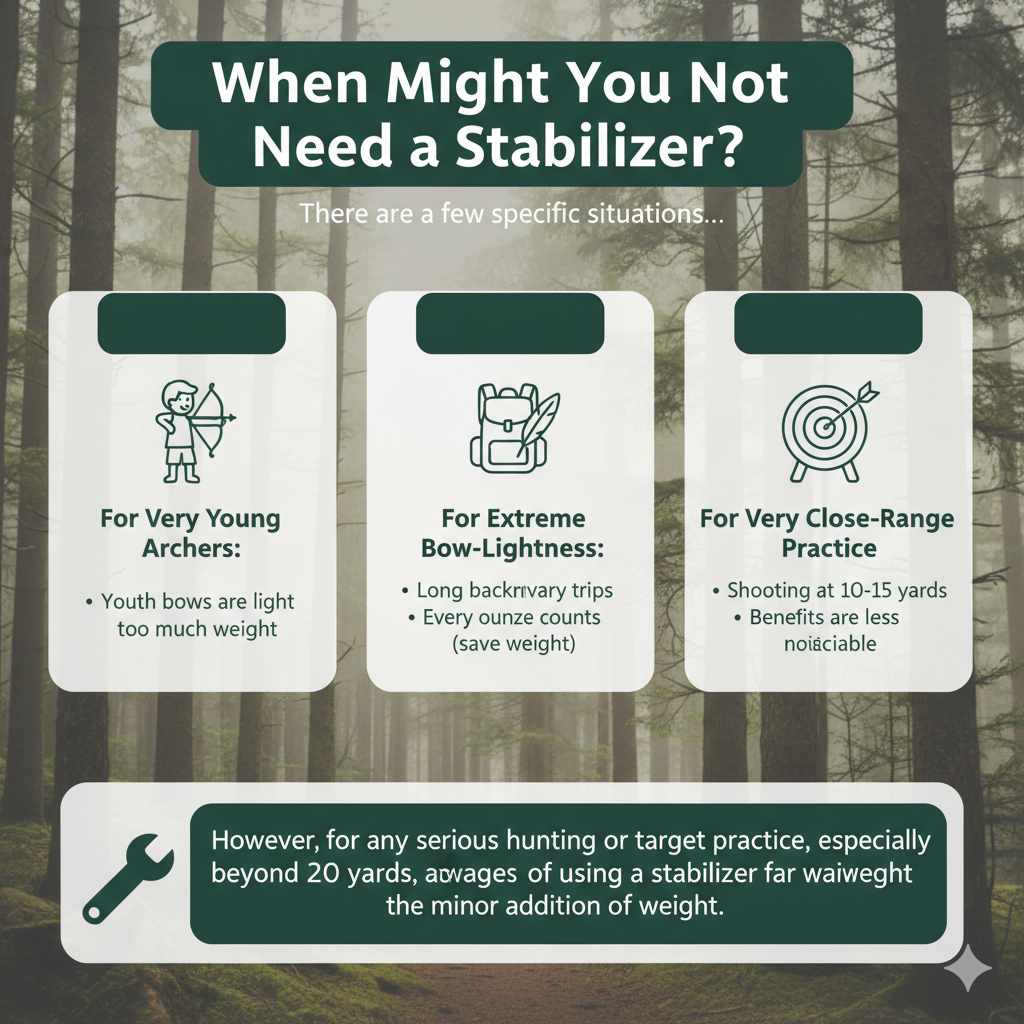
When Might You Not Need a Stabilizer?
While a stabilizer is beneficial for over 95% of archers, there are a few specific situations where you might choose to go without one.
- For very young archers: A youth bow is already very light. Adding a stabilizer might make it too heavy and cumbersome for a small child to hold properly.
- For extreme bow-lightness: Some hunters who go on long backcountry trips where every ounce counts may choose to leave the stabilizer at home to save weight.
- For very close-range practice: If you’re just shooting in your backyard at 10 or 15 yards, the benefits of a stabilizer will be less noticeable.
However, for any serious hunting or target practice, especially beyond 20 yards, the advantages of using a stabilizer far outweigh the minor addition of weight.
Frequently Asked Questions (FAQ)
Will a stabilizer make me a better archer instantly?
A stabilizer will instantly make your bow easier to aim and more pleasant to shoot. This allows you to practice better and build good habits faster. While it won’t replace good form and practice, it provides a much more stable platform, which helps almost every archer shoot better right away.
How heavy should my stabilizer be?
For a beginner hunter, start with the weights that come with your stabilizer, which is usually 2 to 4 ounces. The goal is to have enough weight to slow your pin movement without making the bow feel overly heavy. You want the bow to feel like it’s “settling” into the target, not like you’re fighting to hold it up.
Does a longer stabilizer always mean better accuracy?
Generally, a longer stabilizer provides more stability. However, for hunting, there’s a point of diminishing returns. A 12-inch stabilizer might be slightly steadier than an 8-inch one, but it’s also much more likely to get caught on a tree branch. An 8-inch stabilizer is often the perfect compromise for hunting accuracy and practicality.
Can I hunt without a stabilizer?
Absolutely. People have been hunting with bows for thousands of years without stabilizers. However, with a modern compound bow, a stabilizer makes ethical, accurate shots much easier to achieve, especially under pressure. It’s a tool that significantly increases your chances of success.
Are expensive carbon stabilizers really better?
Expensive carbon stabilizers are often lighter for their length and can be slightly better at dampening high-frequency vibrations. However, for a beginner, a well-made aluminum and rubber stabilizer provides nearly all the same benefits at a much lower cost. You will see a huge improvement even with an affordable model.
How do I know if my bow is balanced?
A simple test is to hold your bow by the grip with your hand open. If the top of the bow tips forward or backward aggressively, its balance could be improved. A stabilizer adds forward weight, helping it sit more level or tip slightly forward, which most archers find ideal for a steady shot.
Does a stabilizer reduce arm fatigue?
This is a common question. While it adds weight, a stabilizer can actually reduce fatigue during a long shooting session. Because it balances the bow, your muscles don’t have to work as hard to keep it from tipping. You’re simply supporting the weight rather than actively fighting an unbalanced rig, which leads to less strain over time.
Conclusion: Your Next Step to a Steadier Shot
So, do you need a hunting bow stabilizer? If you want to be a more accurate, confident, and effective archer, the answer is a resounding yes. It’s not just an accessory; it’s a fundamental piece of equipment that tames your bow, steadies your hand, and shrinks your arrow groups.
It helps transform a jumpy, loud bow into a smooth, quiet, and precise tool. For a beginner, the confidence boost you get from seeing your pin float calmly on the target is priceless. It allows you to focus on your form and execution, knowing the bow is working with you, not against you.
Don’t overthink it. Start with a simple, affordable 8-inch stabilizer. Screw it on, head to the range, and feel the difference for yourself. You’ll be amazed at how such a simple addition can have such a big impact on your shooting. Happy shooting, and may your arrows fly true!