
Yes, archery arm guards are absolutely usable on the right side. If you are a right-handed archer (meaning you draw the string with your right hand), the guard goes on your left (bow) arm. If you are a left-handed archer, the guard goes on your right (bow) arm for protection.
Welcome, fellow archer! If you’re new to the sport, you might be looking at your shiny new arm guard and wondering which arm it actually belongs on. This is a very common question, and it often causes a moment of confusion. You want to protect your arm, but you don’t want to look silly or, worse, use the gear incorrectly!
The simple answer is that an arm guard protects the arm holding the bow—the bow arm. Whether that’s your right or your left arm depends entirely on which hand you use to draw the string. Don’t worry; we’ll clear up this simple rule right now. This guide will explain exactly where that protective gear goes, why it matters for safety, and how to make sure you’re set up perfectly for your next shot. Let’s get you shooting safely and confidently!
Understanding the Bow Arm vs. the Draw Arm
The most crucial concept when fitting protective gear in archery is knowing which arm does what job. Many beginners confuse their “dominant hand” with their “bow hand.”
Dominant Hand vs. Shooting Hand
Your dominant hand is usually the one you write with. For most people, this is the right hand. However, in archery, we categorize shooters based on which hand holds the bow and which hand pulls the string:
- Right-Handed Archer (RH): This person holds the bow with their left hand and pulls the string back with their right hand.
- Left-Handed Archer (LH): This person holds the bow with their right hand and pulls the string back with their left hand.
The Arm Guard’s One Job: Protecting the Bow Arm
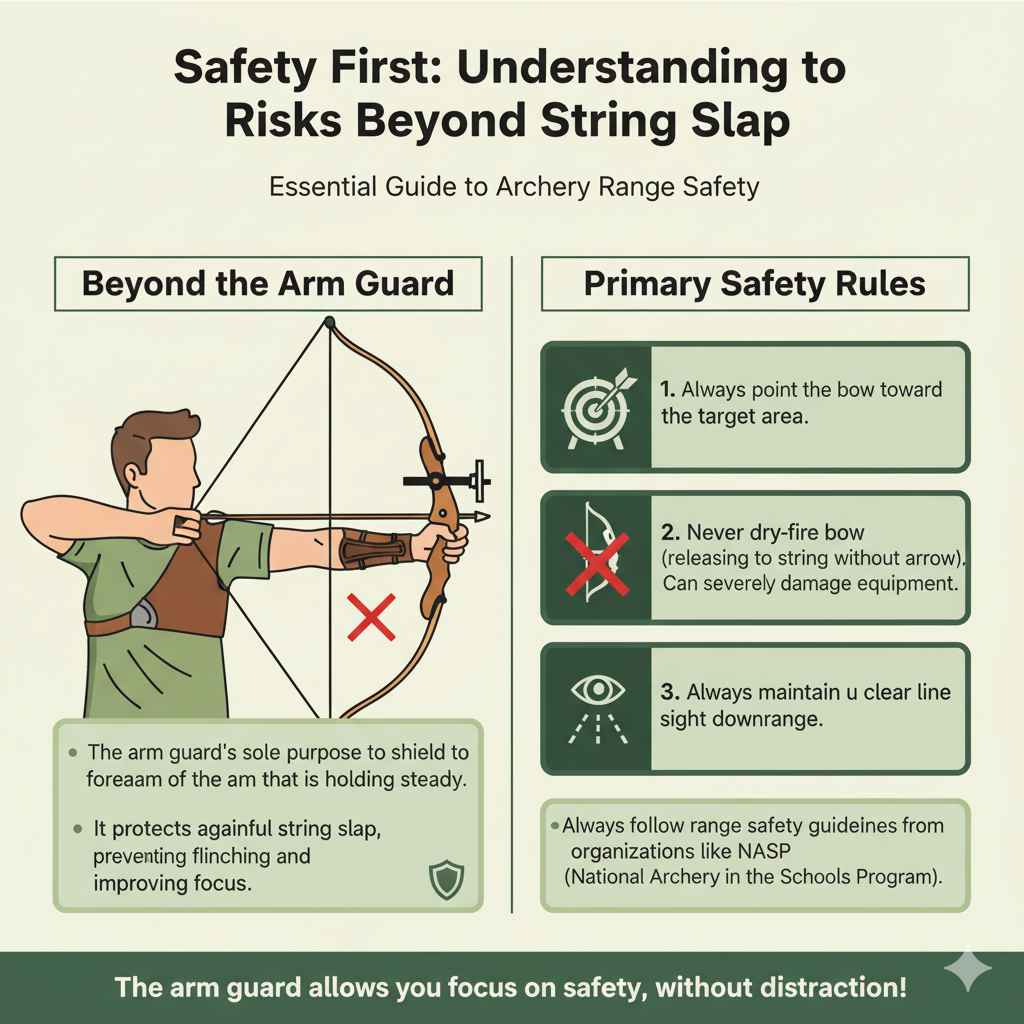
The arm guard’s sole purpose is to shield the forearm of the arm that is holding the bow steady. Why? Because when you release the arrow, the bowstring snaps forward very quickly. If the string hits your exposed forearm, it can sting badly or even cause a bruise—and that sting makes people flinch, ruining the shot!
Therefore, the arm guard is always worn on the arm holding the bow, regardless of whether that arm is your left or your right.

Determining Where Your Arm Guard Goes
Let’s break down the scenarios so you know exactly which side needs the protection.
Scenario 1: You are a Right-Handed Archer
If you are a right-handed archer:
You hold the bow in your left hand.
You draw the string with your right hand.
Conclusion: You must wear the arm guard on your left forearm.
Scenario 2: You are a Left-Handed Archer
If you are a left-handed archer:
You hold the bow in your right hand.
You draw the string with your left hand.
Conclusion: You must wear the arm guard on your right forearm.
This directly answers the core question: Yes, archery arm guards are absolutely usable on the right side if you are a left-handed archer. If you are right-handed, you will never use it on your right side; it belongs on the left.
Why Arm Guards are Non-Negotiable for Beginners
When you are starting out, consistency is low, and small errors are common. The bowstring is fast, and even if you have perfect form, an unexpected string slap can happen.
Common Reasons for String Slap
String slap (when the string hits your arm) usually happens due to one of these beginner issues:
- Holding the Bow Too Loosely: If your bow arm relaxes slightly at the shot, the bow might torque, causing the string to track slightly inward.
- Anchoring Inconsistently: If your draw length changes slightly, your release point can vary, allowing the string to catch the arm.
- Over-Drawing: Pulling the string back farther than your body is prepared for can cause your elbow to drop, putting the forearm in the string’s path.
- Improper Stance: If your body is not perpendicular (at a 90-degree angle) to the target, the string may not travel perfectly straight back.
An arm guard provides a solid barrier, removing the fear of getting hit. Removing that fear allows you to focus entirely on your aim and release, which speeds up your learning process dramatically.
Choosing the Right Arm Guard for Your Needs
Arm guards come in different materials and styles. While the location on your arm stays the same, the type you choose can affect comfort and performance.
Types of Arm Guards
Here is a quick breakdown of the common materials:
| Type | Best For | Pros | Cons |
|---|---|---|---|
| Leather (Traditional) | Recurve and Traditional Archers | Durable, classic look, good protection. | Can be bulky, requires breaking in. |
| Nylon/Elastic (Strap-on) | Beginners, Compound Archers | Lightweight, easy to adjust, very affordable. | Less durable than leather over time. |
| Clear Plastic/Composite | Archers needing high visibility | Excellent protection, allows you to see the limb/string path easily. | Can sometimes feel less flexible. |
Sizing and Fit: The Most Important Step
Whether you wear it on the right or left side, the fit must be secure. A loose guard will spin or shift, defeating its purpose.
Follow these steps to fit any standard three-strap arm guard:
- Determine Placement: Place the center of the guard on the soft, fleshy part of your bow arm forearm. It should cover from just below your elbow down toward your wrist (about 8-10 inches coverage is standard).
- Secure the Lower Strap: Fasten the strap closest to your wrist snugly. You should be able to comfortably slide one finger between the strap and your arm.
- Secure the Middle Strap: Fasten the middle strap. This strap often rests near the thickest part of your forearm. Keep it firm but not tight enough to restrict blood flow.
- Secure the Upper Strap: Fasten the strap closest to your elbow. This ensures the top edge doesn’t slide down during the shot sequence.
- Test the Draw: Draw your bow back fully several times. Watch the guard in a mirror. If it moves, slips, or rotates when you anchor, tighten the straps slightly, focusing on the middle and lower ones.
Remember, the key is protection without hindrance. You need to be able to draw smoothly, but the guard must stay put when the string whips past.
Arm Guards and Specific Archery Disciplines
The need for an arm guard is universal, but the exact equipment used might slightly change how you think about protection.
Compound Bow Shooting
Compound bows use cams and cables, resulting in a very fast string speed. This means the force upon contact is higher.
Requirement: Arm guards are essential for compound shooters, especially beginners, due to the speed of the string.
Right Side Usage: If you are a left-handed compound shooter, the guard absolutely must be on your right arm.
Recurve Bow Shooting
Recurve bows (Olympic style or traditional) are generally slower than compounds, but string slap is still very painful if you are shooting a high poundage.
Requirement: Highly recommended, especially when learning. Many experienced recurve shooters rely on the guard to prevent distraction.
Safety Note: Always check with your range safety officer or coach. Organizations like USA Archery strongly recommend protective gear for all levels.
Barebow Shooting
Barebow often involves higher draw weights and a slightly different anchor point, sometimes bringing the string closer to the face and arm.
Requirement: Protection is key. Because barebow shooters often rely less on mechanical aids, consistent form is paramount, and string slap is a major form-killer.
Myths About Arm Guard Use on the “Wrong” Side
Let’s address some common misconceptions that might make a new archer hesitant to use their guard correctly.
Myth 1: “It slows down my shooting.”
Reality: A properly fitted arm guard adds almost no noticeable drag or weight. If you feel it slowing you down, it’s likely too bulky or poorly secured, causing friction on your draw path. An effective guard only contacts the string after* the release.
Myth 2: “I only need it on the left side because I’m right-handed.”
Reality: This is only true if you shoot right-handed. If you are left-handed, your bow arm is your right arm, making the right-side guard essential. Never assume handedness dictates the guard placement; the bow arm dictates it.
Myth 3: “If I learn good form, I won’t need one.”
Reality: Even Olympic champions sometimes experience string slap due to tiny inconsistencies in breath, tension, or equipment setup. The arm guard is a safety net, not a crutch for bad form. It allows you to practice good form without the fear of pain interrupting your focus.
Practical Tip: How to Test Your Arm Guard Placement
Once you have your guard on the correct arm (left for RH archers, right for LH archers), you need to ensure it’s doing its job effectively before you shoot live arrows.
Here is a simple, safe drill you can do without even drawing a full arrow:
- Nock a Practice Arrow: Place a practice arrow on the string and draw the string back halfway (safely, without aiming).
- Check Arm Position: Ensure your bow arm is extended comfortably toward the target, making a straight line from your shoulder down your forearm.
- Simulate Release: While holding the bow steady, briskly open your fingers (as if releasing). Do not let the bow jerk forward. The string will snap forward.
- Inspect the Contact Point: Check where the string made contact with the guard. It should have hit the plastic or leather surface squarely.
- Feel the Fit: Did the guard move? If it rotated significantly, the straps need tightening. If the string barely touched it, you might need a wider guard or need to adjust your anchor slightly inward.
This test, performed safely in your backyard or on the range before full practice, confirms that your right-side guard (or left-side guard) is positioned perfectly for maximum protection.
When Do You Stop Needing an Arm Guard?
This is a question many dedicated beginners ask. The honest answer is: You don’t necessarily stop needing one, but you might find you rarely use it.
As your form becomes muscle memory, your release becomes cleaner, and your consistency improves, the string will naturally track away from your forearm. At that point, many archers transition to lighter, smaller protection, or put it away completely for short practice sessions.
However, I highly recommend keeping it in your quiver or gear bag for several reasons:
- High-Stress Situations: If you are shooting in a competition or an unfamiliar environment, nervousness can cause small form breaks. The guard offers insurance.
- Trying New Equipment: When you switch to a new bow, grip, or even a different type of arrow, your string path might temporarily change. Use the guard until you confirm the new setup is clean.
- Fatigue: When you get tired during a long session, your form degrades. The guard protects you when you need it most.
It’s a piece of equipment that signals you prioritize safety and consistency over perceived “advanced status.” There is nothing uncool about wearing protection when shooting equipment that can hurt you.
Safety First: Understanding the Risks Beyond String Slap
While the arm guard focuses on the string, proper protection is part of a larger safety picture. When discussing the bow arm (whether right or left), it’s vital to remember general range safety. For more information on maintaining a safe shooting environment, resources from organizations like the National Archery in the Schools Program often provide excellent foundational safety principles applicable to all ages and skill levels.
Your right-side protection (or left-side protection) prevents injury, but never forget the primary rules:
- Always point the bow toward the target area.
- Never dry-fire the bow (releasing the string without an arrow). Dry-firing can severely damage the bow limbs and is dangerous.
- Always maintain a clear line of sight downrange.
The arm guard is your frontline defense against the physics of the bow itself, allowing you to adhere to the external safety rules without distraction.
FAQ: Arm Guards and Right-Side Use
Here are some quick answers to common follow-up questions beginners have about their arm guards.
Q1: Can I wear my arm guard on the inside of my bow arm instead of the outside?
A: No, you should always wear the arm guard on the outside (the side facing the target) of your bow arm. This is where the string travels. Wearing it on the inside offers no protection.
Q2: If I am a right-handed archer, why would I ever need a guard on my right arm?
A: You shouldn’t need one on your right arm if you are right-handed, as your right arm is your draw arm. If you feel you need protection on your draw arm, it usually signals an issue with your release or string clearance, not an arm guard requirement.
Q3: How tight should the straps be for a left-handed shooter using a right-side guard?
A: The fit should be secure enough that the guard does not rotate or slide when you execute a full draw and release, but loose enough that you can still feel your forearm and maintain good circulation. Aim for firm, not tight.
Q4: Does the material of the arm guard affect which side it is designed for?
A: No. The material (leather, nylon, plastic) dictates durability and comfort, not the side it is worn on. Any standard guard can be used on the right or left forearm based purely on which arm is holding the bow.
Q5: My traditional leather guard seems too big for my arm. Should I still use it?
A: If it’s too big, it’s a safety hazard because it can shift. If you are a beginner, opt for an adjustable nylon guard that fits your current forearm size. A proper fit is more important than the material.
Q6: Can I use my partner’s arm guard if mine breaks temporarily?
A: Yes, provided it fits securely. If your partner is the opposite handedness (e.g., you are RH and they are LH), you will simply wear their guard on the opposite arm from what they wear it on, which is perfectly fine.
Conclusion: Confidence Through Protection
Learning archery is a journey built on safety, repetition, and confidence. We’ve established clearly that the question isn’t about the “right side” inherently, but rather, “Which side is my bow arm?”
If you draw with your right hand, the guard belongs on your left arm. If you draw with your left hand—meaning you are a left-handed archer—then yes, the arm guard is essential and perfectly usable on your right side.
Take the time to ensure your chosen guard fits snugly and covers the necessary area on your bow arm. By eliminating the worry of painful string slap, you free up your mental energy to focus on the core elements of good shooting: stance, anchor, and a smooth release. Gear up correctly, practice safely, and enjoy watching your skills improve session after session. Happy shooting!