
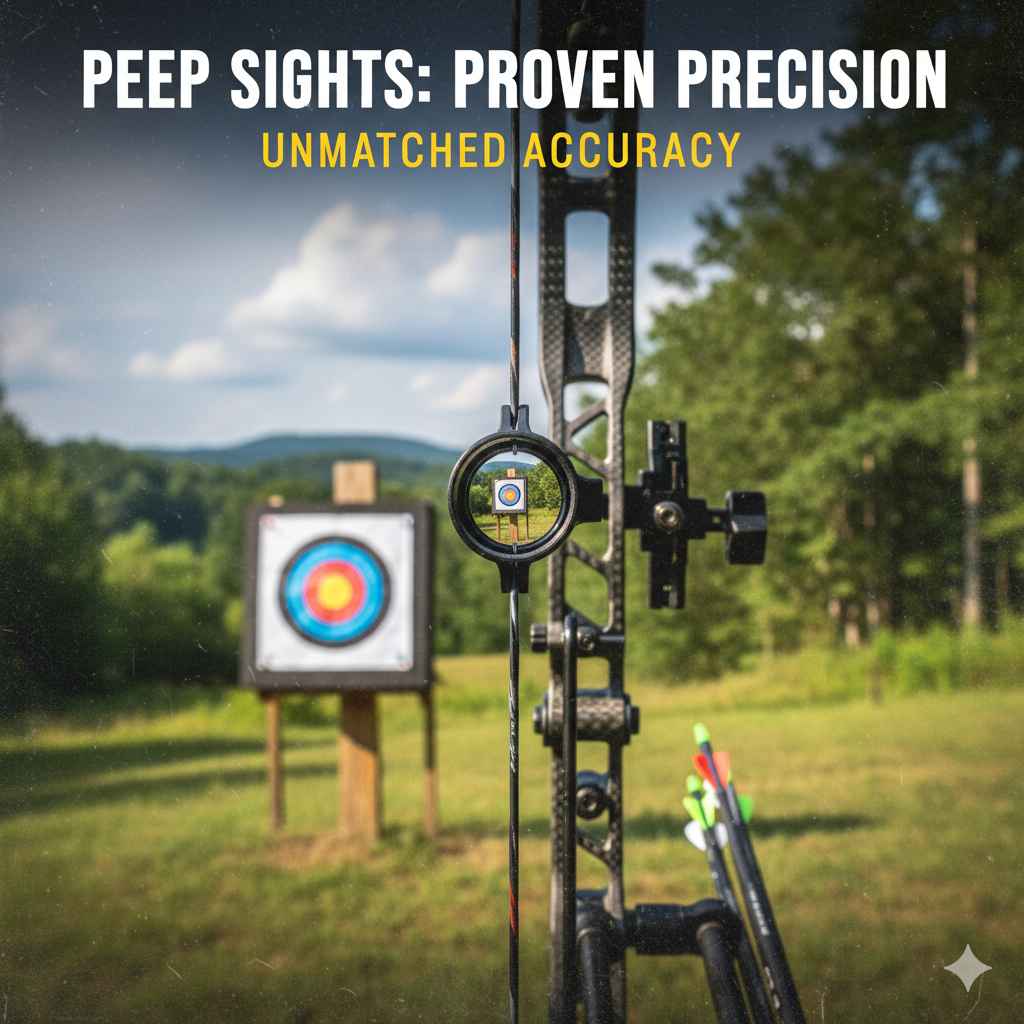
Yes, for many beginners and hunters, peep sights are often more accurate than traditional fixed sights because they create a larger, more consistent sight picture, allowing for quicker and more precise target alignment when properly set up.
Welcome to the wonderful world of archery! If you are looking to hit the bullseye more often, you might have heard about peep sights. These small circular sights can seem a bit mysterious when you first start out. Are they really better than the sights you already have on your bow? That is a very common question for new shooters. Trying to line up arrows perfectly can feel frustrating, but choosing the right equipment makes a huge difference. We are going to break down exactly what a peep sight is, how it works, and whether it is the “proven best” choice for your accuracy journey. Get ready to learn the simple steps to see clearer targets and shoot straighter arrows!
Understanding Archery Sights: What Are We Comparing?
Before we crown a winner, let’s quickly review the main ways archers aim their bows. Knowing the basics helps us understand why a peep sight might be an upgrade.
The Three Main Types of Aiming Systems
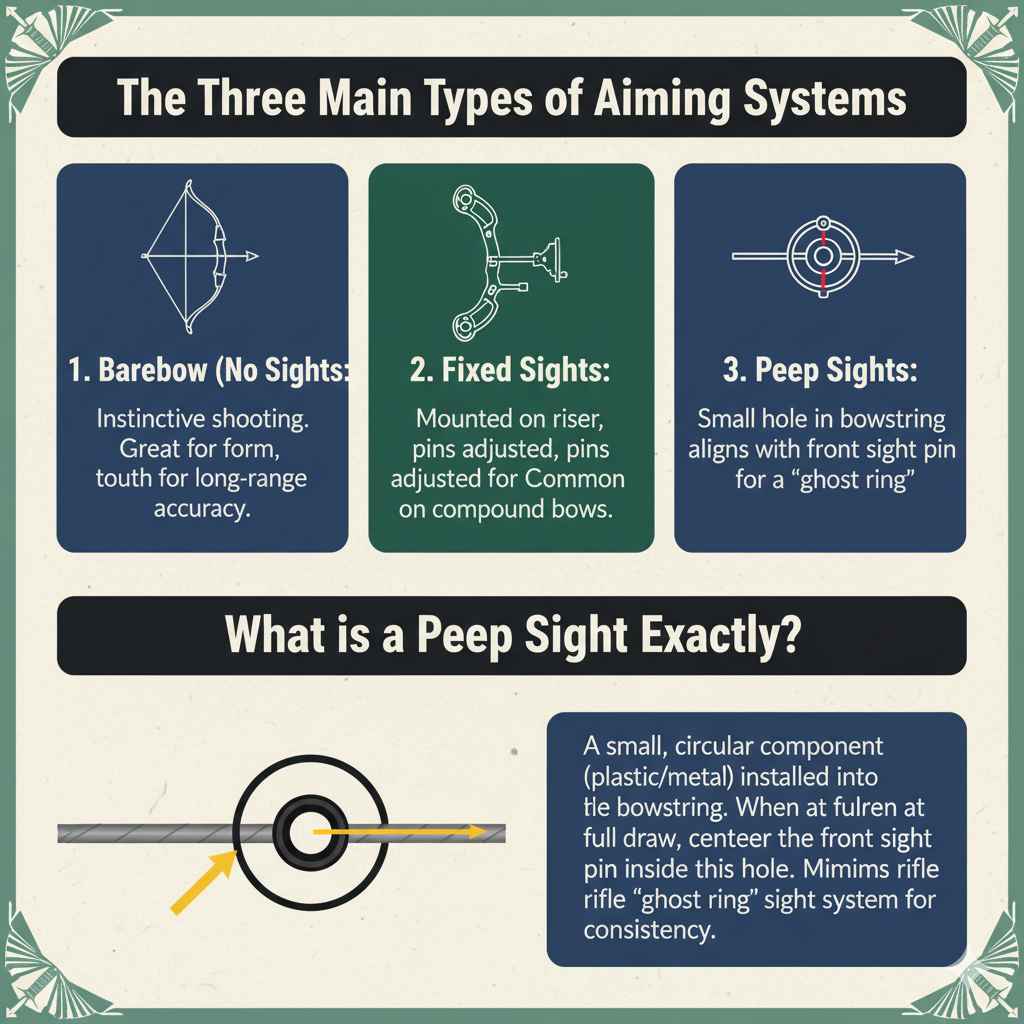
Most beginners start with one of these three methods:
1. Barebow (No Sights): This is shooting instinctively, relying on feel and experience. It is great for form building but tough for consistent accuracy at longer ranges.
2. Fixed Sights (Pin Sights): These are mounted to the riser and usually have one or more pins that you adjust for different distances. They are very common on compound bows.
3. Peep Sights: These are small apertures (holes) installed in your bowstring that you align with a front sight pin. This creates a “ghost ring” effect.
What is a Peep Sight Exactly?
A peep sight is a small, circular component, usually made of plastic or metal, that is installed into the bowstring loop. When you draw your bow back to full anchor, you look through this small hole. The goal is to perfectly center the front sight pin inside the circle of the peep.
This setup mimics the aiming process used in traditional rifle shooting, often referred to as a “ghost ring” sight system. The consistency it offers is what many archers claim makes it more accurate.
The Accuracy Debate: Are Peep Sights More Accurate?
The short answer is often yes, especially for target shooting and hunting consistency. But accuracy isn’t just about the equipment; it’s about how you use it. Let’s look at the proven reasons why peep sights often lead to tighter groups.
Why Peep Sights Improve Consistency
Accuracy in archery is all about repeatability—doing the exact same motion every single time. Peep sights enforce this repeatability better than many other systems for new shooters.
1. The Ghost Ring Effect
When you look through a peep sight, you see two circles: the outer circle (the peep itself) and the inner circle (your front sight pin).
If you are too high, the pin moves out of the peep circle.
If you are too low, the pin moves out of the peep circle.
This forces your eye and anchor point to be perfectly consistent. If the pin is centered in the peep, you know your head position is correct for that shot. This immediate visual feedback is incredibly helpful for beginners learning proper form.
2. Minimizing Parallax Error
Parallax error happens when your eye is not perfectly centered behind the sight pin. If your eye is slightly off-center, the arrow will impact slightly left or right of where you aimed.
Peep sights, especially when correctly sized for the shooter, act like a tunnel. They naturally guide your eye to the correct centerline alignment between your eye, the peep, and the front sight pin. This significantly reduces the common problem of sight alignment variation between shots.
3. Faster Target Acquisition
For hunters, time matters. A properly set-up peep sight allows you to quickly “frame” the target. Instead of focusing intensely on aligning three separate dots (pins) on a front sight housing, you are focusing on aligning one pin inside one circle. This often results in faster, more confident aiming.
Comparing Peep Sights to Standard Pin Sights
Most compound bows come standard with a multi-pin housing. How does the peep system stack up against this common setup?
| Feature | Peep Sight System | Standard Multi-Pin Sight |
|---|---|---|
| Sight Picture Simplicity | Very simple: Center the pin in the circle. | Complex: Align the pin head relative to the target AND the sight housing. |
| Anchor Consistency Check | Excellent. Forces exact head/eye placement. | Good, but relies heavily on pin placement relative to the target. |
| Adjustability (Hunting) | Requires scope magnification/clarity changes or lens adjustments. | Easy to adjust individual pins for distance. |
| Low Light Performance | Can be tricky; the small hole can block light. Often needs illumination. | Generally better light gathering due to larger housing. |
Conclusion on Accuracy: Peep sights excel at repeatable alignment, which directly translates to better accuracy, especially when learning. However, standard pin sights can offer more flexibility for extreme long-range shooting where you need precise, individually calibrated pins for many different yardages.
How to Install a Peep Sight: A Beginner’s Step-by-Step Guide
Installing a peep sight is not a task to take lightly, as it affects the timing and tuning of your entire bow system. While many beginners take their bow to a professional pro shop for installation (which I highly recommend for your first time), understanding the process is key.
Tools You Might Need (If Doing It Yourself)
Peep Sight (correct size for your setup—e.g., 1/4 inch, 3/8 inch)
Peep sight installation tool or serving jig
Bow press (If your bow requires twisting/untwisting the string to accommodate the peep)
Cable slide or string suppressor adjustments (sometimes needed)
Step-by-Step Installation Process
This process requires precision and an understanding of bow mechanics. If you are unsure about using a bow press, please visit a certified technician.
- Determine Peep Placement: The peep needs to be positioned so that when you draw the bow to your full anchor point (where your string touches your face/hand), the peep is perfectly aligned with your eye and your front sight.
- Mark the String: The proper location is usually found by drawing the bow back on a target. A good starting point is roughly 1.5 inches forward of your peep anchor point, but this varies greatly based on draw length and draw weight.
- Prepare the String: If your bowstring is served (wrapped) where the peep goes, you must remove that serving material carefully to expose the main strands of the string.
- Install the Peep: Slide the peep onto the string strands. Depending on the style, you might need to use a specialized tool to open the string slightly or physically wedge the peep into place.
- Secure the Peep: This is the most critical step. The peep must be locked in place so it cannot rotate or slide under the tension of the draw. Professionals use specialized wrapping or tying techniques, or they might use specialized housing clamps.
- Re-Serve (If Necessary): If you removed serving material, you must re-serve over the peep area to lock it down securely and protect the string from fraying.
- Check Timing (Crucial!): After installation, the string tension may change, which can affect the timing (cam synchronization) of compound bows. You MUST check this with a bow press to ensure the cams remain synchronized for safe and accurate shooting.
Sizing Your Peep Sight for Optimal Accuracy
One of the biggest secrets to peep sight accuracy is choosing the right size. A peep that is too large makes aiming vague; one that is too small can cause you to miss the sight picture entirely, especially in low light or when adrenaline is high.
Peep Size Guidelines for Beginners
The goal is a sight picture where the pin is visible but framed tightly by the peep ring.
- For Target Shooting (Indoor/Long Range): Smaller apertures (1/8 inch or 3/16 inch) are often preferred. They offer a sharper view and less visual distraction, forcing excellent focus.
- For Hunting (Variable Light): Medium apertures (3/16 inch to 1/4 inch) are generally recommended. They provide enough light gathering for dawn/dusk shooting while still offering a clear frame.
- Beginners: Start slightly larger (1/4 inch). It is easier to find the sight picture initially, allowing you to focus more on anchoring and release mechanics.
Expert Tip: Check out resources from archery governing bodies, like the National Archery in the Schools Program (NASP) guidelines, which often recommend specific sizes based on age and draw length to ensure proper sight picture development for young archers. (While NASP focuses on lower poundage equipment, their sight picture philosophy is sound.)
Integrating Peep Sights with Other Equipment
A peep sight rarely works alone. It needs to coordinate perfectly with your front sight housing, especially on modern compound bows.
Peep Aperture Lenses and Clarity
Many competitive and serious bowhunters use specialized lenses inside their peep sights. These lenses often contain magnification or colored dots (plexes) to help aim.
- Magnification Lenses: These act like reading glasses for your sight picture. They make the front sight pin appear closer and clearer, which helps if you struggle with vision focusing on near vs. far objects.
- Clarity/Color Dots: Some lenses come with a single colored dot inside the peep. You align this dot with the target rather than aligning a physical pin. This can simplify the focus even further.
Important Note on Hunting: If you use a magnified lens, you must be extremely careful about how far away the animal is. Magnification changes your perceived point of impact at different ranges, sometimes by several inches if not properly compensated for. Always practice extensively at known distances before relying on a magnified peep for hunting.
The Role of the Front Sight Pin
Your peep sight determines where your eye is looking, but your front sight pin determines where you aim. For maximum accuracy with a peep system, you need a good front sight.
If you have a single-pin housing, ensure the pin head is small enough that it doesn’t obscure too much of the target when centered in the peep. Many archers prefer fiber optic pins for brightness, as they draw the eye right into the center of the sight picture you are trying to create.
Training Protocols: How to Practice for Peep Sight Accuracy
Owning the “most accurate” equipment doesn’t guarantee results. Accuracy comes from dedicated, focused practice. Here is how you can use your new peep sight to build confidence.
Phase 1: Mastering the Sight Picture (Close Range)
Start close—5 to 10 yards. The goal here is not hitting the target, but achieving the same sight picture every time.
- Draw to full anchor.
- Look through the peep.
- Achieve the perfect alignment: Pin centered in the peep circle.
- Do not shoot yet. Hold that position for three seconds.
- Relax, repeat 10 times. This builds muscle memory for alignment.
- Now, shoot, focusing only on maintaining that perfect picture until release.
Phase 2: Distance Calibration
Once your sight picture feels natural, begin moving back.
If using a single pin, use the dot method (placing the pin dead center on the bullseye) for your closest preferred yardage (e.g., 20 yards).
If using multi-pins, adjust each pin based on your bow’s tune.
We must ensure the peep moves with the archer. If you find your groups are widening significantly as you move back, it might indicate you are “peeping high” or “peeping low” due to inconsistent anchor points, not a flaw in the sight itself.
Phase 3: Shooting Under Pressure
Accuracy under pressure (like in a hunting situation) requires the alignment to become subconscious.
Practice drawing quickly from a standing position.
Have a friend call out distances unexpectedly.
* Use a timer to ensure you aren’t taking too long—rushing leads to tension, which ruins accuracy.
Peep Sights vs. Scopes (For Compound Bows)
For archers using compound bows, the biggest alternative to a peep sight system is using a scope, which often features crosshairs or a large dot.
| System | Primary Advantage | Primary Disadvantage | Best Suited For |
| :— | :— | :— | :— |
| Peep Sight | Excellent for teaching consistent anchor/eye placement. Simpler visual input. | Can struggle in low light if not illuminated; requires fine-tuning of peep size. | General target shooting and typical hunting ranges (20–40 yards). |
| Scope | Superior clarity and magnification at long range; excellent for small targets. | Prone to parallax error if the eye is not perfectly centered; more complex setup. | Competition target archery (FITA/WA); extreme long-range hunting. |
While scopes offer unmatched clarity for identifying a tiny spot on a target at 60+ yards, the peep system excels because it forces the body to align correctly before the target is even fully focused on. For the average beginner seeking better grouping, the peep provides that essential physical feedback loop.
Safety Considerations When Using Peep Sights
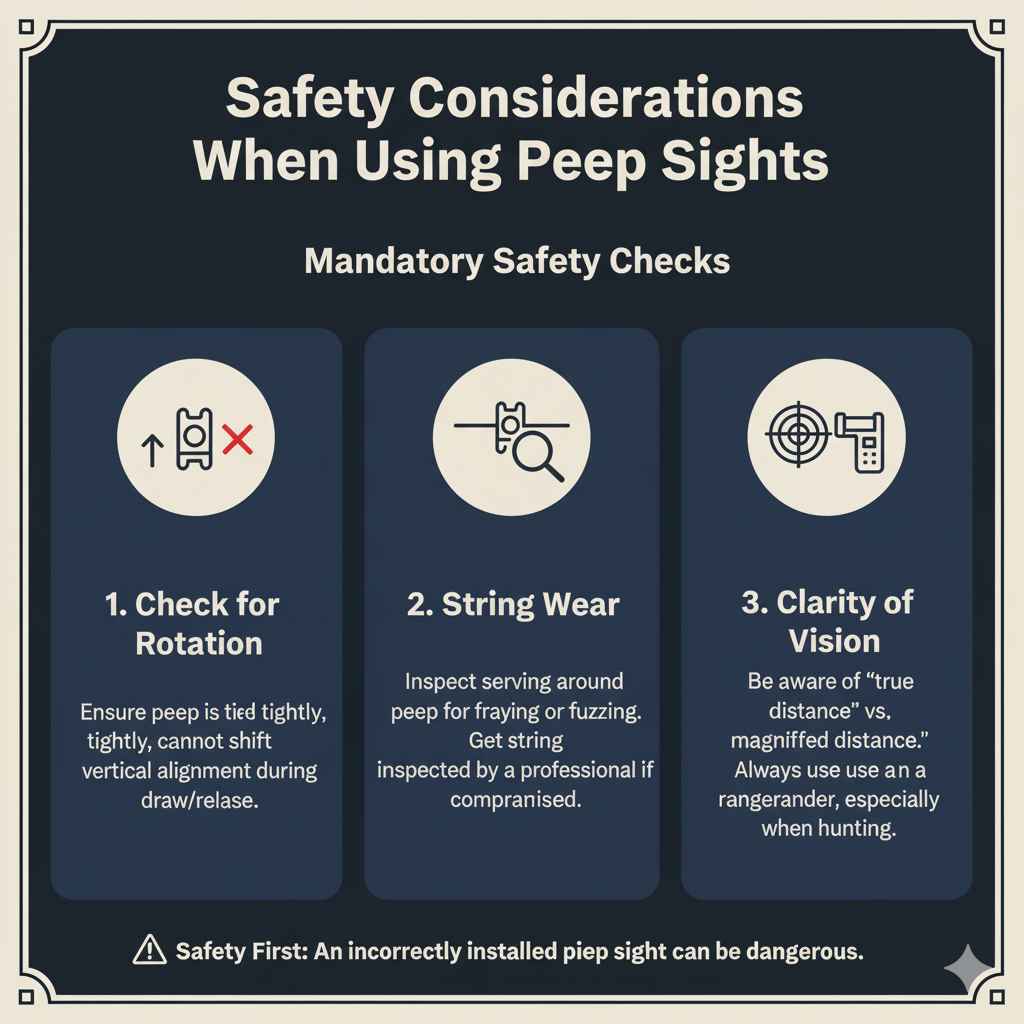
When you add anything to your bowstring, safety becomes paramount. A peep sight, if installed incorrectly, can be dangerous.
Mandatory Safety Checks:
1. Check for Rotation: Always ensure the peep is tied in so tightly that it cannot rotate or shift its vertical alignment when you draw and release the bow. A shifting peep changes your aim point instantly and unpredictably.
2. String Wear: The area around the peep is a high-stress point. Regularly inspect the serving around the peep for any fraying, fuzzing, or signs of wear. If the serving looks compromised, get the string inspected by a professional.
3. Clarity of Vision: If you use a magnified lens and are hunting, be aware of the “true distance” versus the “magnified distance.” Never rely on magnification to guess yardage in the field. Always use a rangefinder.
Frequently Asked Questions (FAQ) for Peep Sight Beginners
Q1: Do I need a different peep sight for hunting versus target shooting?
It is often recommended. Hunting peeps are usually slightly larger (like 1/4 inch) to gather more light at dawn or dusk. Target peeps are smaller (1/8 inch) for maximum precision when the light is excellent.
Q2: Will installing a peep sight require me to re-tune my bow?
Yes, almost certainly, especially on a compound bow. Installing anything onto the string changes the string length and tension, which affects cam timing. You must have your bow re-timed and possibly re-leveled by a technician after peep installation.
Q3: My peep keeps spinning when I draw. What is wrong?
This means the peep is not properly tied in or served. It must be locked securely in place so the top and bottom of the circle are always vertical. A spinning peep makes accurate shooting impossible. Take it to a shop for re-tying.
Q4: Can I use a peep sight with traditional recurve bows?
Generally, no. Peep sights are designed specifically for systems with cables and cams (compound bows) where the string comes to a definite stop at anchor. Traditional bows rely on consistent hand pressure and bare-eye aiming.
Q5: How do I know if my peep is the right size for my eye?
When you anchor correctly and look through the peep, the front sight pin should fill the center of the circle, but there should still be a noticeable gap of the peep ring visible all the way around the pin. If the ring touches the pin, it might be too small.
Q6: What is “peep wobble”?
“Peep wobble” is when the peep slightly shifts up or down as you hold at full draw, usually due to a slight movement of your head or anchor point. It is a sign that you need more consistency in your back tension and anchor form.
Conclusion: Embracing Consistency for Better Archery
So, are peep sights the “proven best” for accuracy? For the beginner or intermediate archer focused on building solid habits for consistent shooting, the answer is a resounding yes.
Peep sights are not magic; they are simply a superior aiming tool for enforcing body placement. They take the guesswork out of whether your head is in the right spot by providing a clear, inescapable visual cue: the center of the circle. This forced consistency helps bridge the gap between knowing what good form looks like and actually executing it shot after shot.
Remember, your equipment is only as good as your practice routine. Install your peep sight safely, choose the size that works best for your shooting conditions, and then commit to practicing that perfect sight picture. You will find your groups tightening up, your confidence soaring, and your enjoyment of archery reaching new, accurate heights. Happy shooting!