
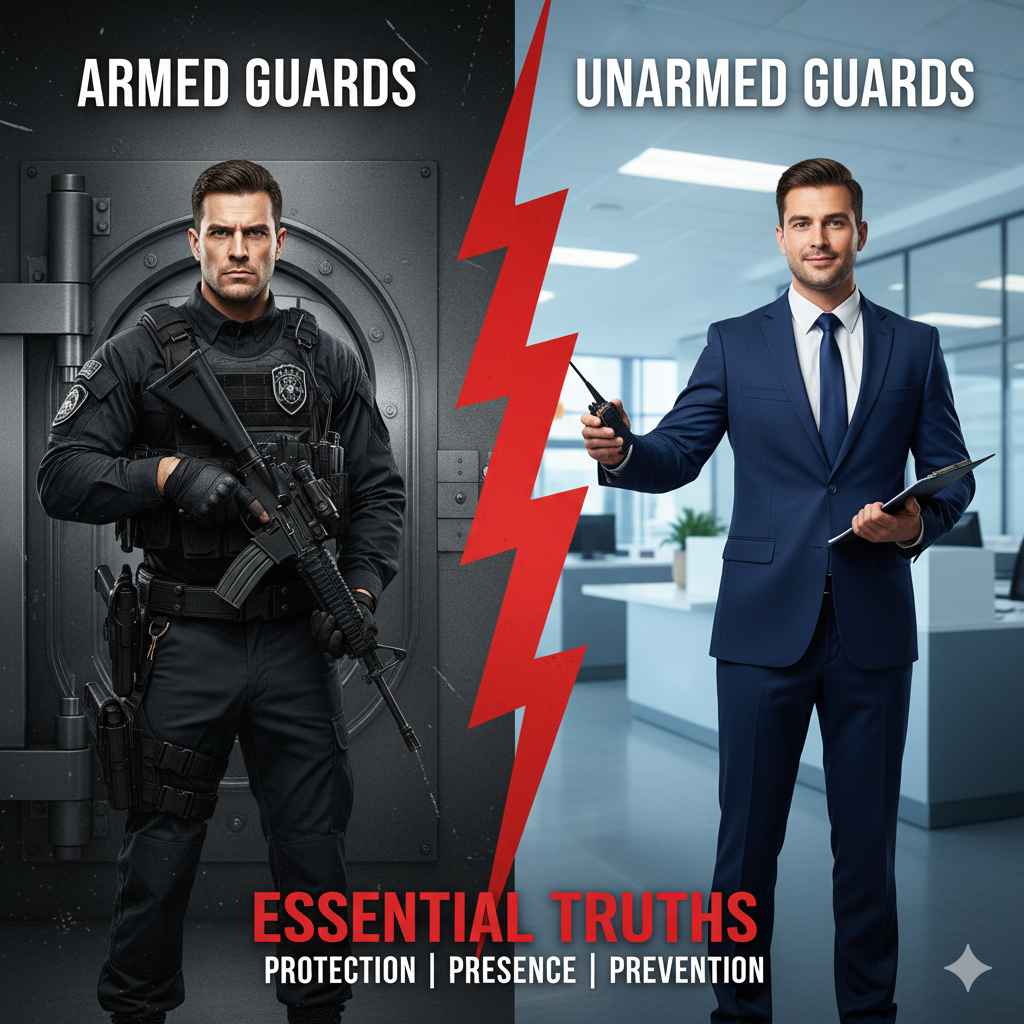
Armed guards vs unarmed guards: The essential truth is that the right choice depends entirely on your specific security needs, budget, and the threat level assessment of your location. Armed guards deter serious crime but cost more, while unarmed guards offer visible presence and monitoring, ideal for low-risk environments.
Choosing the right security guard can feel confusing, especially when you first start looking. Should you hire someone who carries a weapon, or is a visible presence enough? Many people worry about making the wrong choice, feeling like they are either overspending or leaving themselves vulnerable. Don’t worry; this is a common point of confusion for everyone setting up security!
We are here to clear up the noise and give you simple, straightforward facts about armed guards versus unarmed guards. Think of me as your guide, helping you select the perfect tool for the job, just like picking the right arrow for your bow. We will look at what each type does best, when you really need the extra layer of defense, and what the costs look like. Let’s make this security decision easy and boost your peace of mind!
Understanding the Core Difference: Presence vs. Force
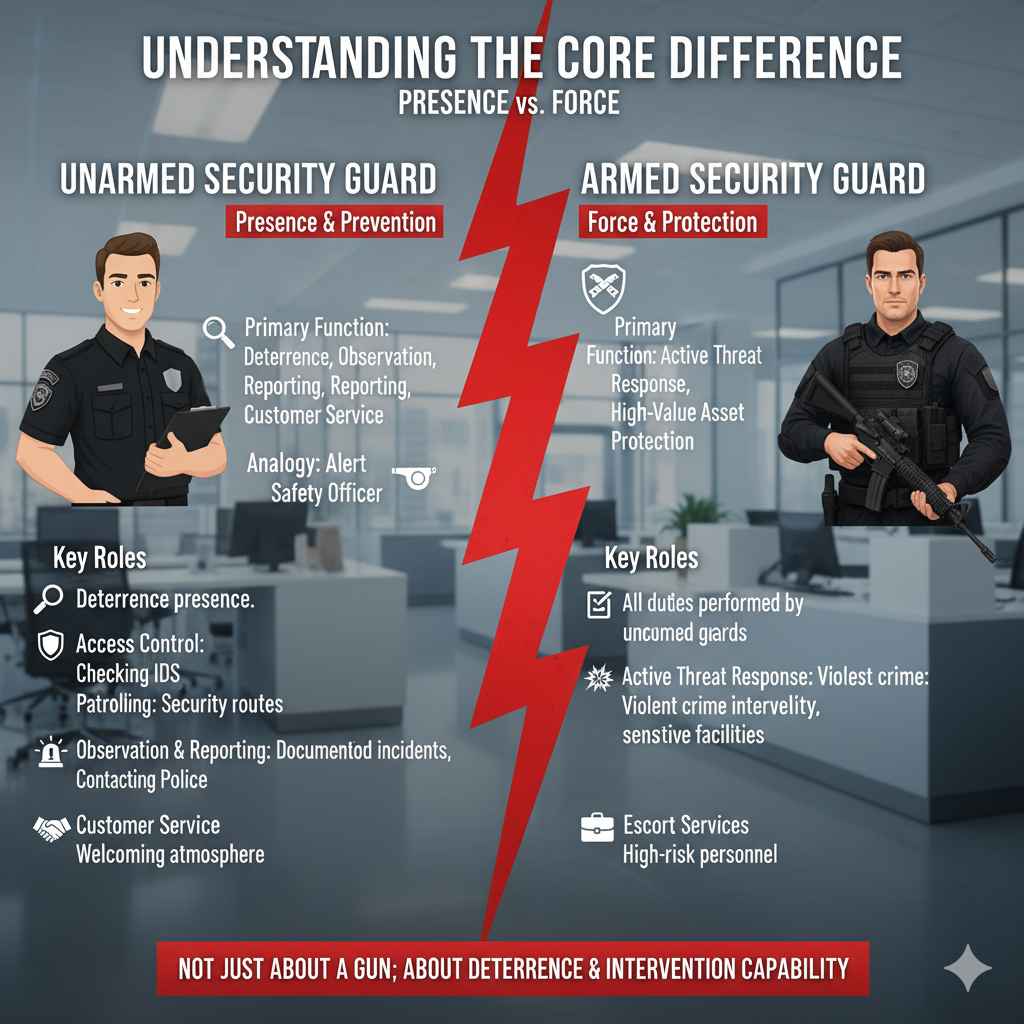
At the very heart of the matter, the difference between armed and unarmed guards comes down to their primary function and the level of response they are authorized and equipped to handle. It’s not just about whether they carry a gun; it’s about deterrence and intervention capability.
What is an Unarmed Security Guard?
An unarmed guard is a highly visible security professional who focuses on deterrence, observation, reporting, and customer service. They act as the first line of defense by simply being present.
Think of an unarmed guard like a very alert safety officer at your local range. They ensure everyone follows the rules, watches for potential hazards, and calls for help if something serious happens. They rely on their training, communication skills, and adherence to safety protocols.
Key Roles of Unarmed Guards
- Deterrence: A uniformed presence discourages petty theft and unwanted loitering.
- Access Control: Checking IDs, monitoring entry/exit points, and issuing visitor badges.
- Patrolling: Walking regular routes to ensure premises are secure and alerting staff to unlocked doors or unusual activity.
- Observation and Reporting: Documenting incidents, writing detailed reports, and immediately contacting law enforcement (police) when necessary.
- Customer Service: Providing directions and maintaining a professional, welcoming atmosphere.
What is an Armed Security Guard?
An armed security guard is a professional who is licensed, trained, and authorized to carry a firearm while on duty. This designation brings significant added responsibility and a higher level of required training.
If the unarmed guard is the safety officer, the armed guard is the backup specialist—trained to intervene decisively when a situation escalates beyond simple deterrence or de-escalation techniques. Their presence is often meant to handle higher risks, such as protecting high-value assets or locations known to face threats.
Key Roles of Armed Guards
- All duties performed by unarmed guards.
- Active Threat Response: Intervening directly in situations involving violent crime, active shooters, or armed robbery, as permitted by law and training.
- High-Value Asset Protection: Guarding cash transit, jewelry stores, or sensitive corporate facilities.
- Escort Services: Providing security for high-risk personnel movements.
Armed Guards vs. Unarmed Guards: A Direct Comparison Table
To help you visualize the main differences quickly, here is a simple side-by-side comparison. This helps clarify where your security budget might be best spent.
| Feature | Unarmed Security Guard | Armed Security Guard |
|---|---|---|
| Primary Focus | Deterrence, Observation, Reporting | Deterrence, Observation, and Armed Intervention |
| Equipment | Radio, flashlight, notepad, uniform | All unarmed equipment PLUS authorized firearm and specialized gear |
| Training Level | Basic security licensing, CPR/First Aid | Extensive firearm qualification, advanced defensive tactics, legal firearms training |
| Cost | Lower hourly rate | Significantly higher hourly rate (due to training and liability) |
| Best For | Retail environments, office lobbies, event monitoring, low-risk areas | Banks, high-security sites, executive protection, areas with known violent crime risks |
When to Choose Unarmed Security: The Power of Presence
For many standard business needs, an unarmed guard is not just adequate—it’s the smarter, more cost-effective choice. Unarmed guards excel in situations where visibility and adherence to procedure are more important than the capacity for armed engagement.
Situations Suited for Unarmed Guards
- Retail Stores and Malls: Their main job is preventing shoplifting, monitoring exits, and ensuring customers feel safe. A visible presence is often enough to stop impulse theft.
- Corporate Lobbies and Front Desks: They manage visitor logs, verify identities, and provide a professional first impression while controlling access to sensitive areas.
- Residential Communities: For homeowners’ associations or apartment complexes, they enforce parking rules, monitor gates, and report suspicious activity to residents and management.
- Construction Sites (After Hours): Deterring vandalism and equipment theft without needing armed confrontation, which can escalate minor trespassing into a major legal issue.
- Events and Trade Shows: Managing crowd flow, checking tickets, and ensuring general order without the need for lethal force capability.
Remember, the goal of security is often prevention, not reaction. A well-trained unarmed guard can de-escalate minor conflicts verbally—a skill that sometimes becomes harder to use effectively when a weapon is already drawn.
When Armed Security Becomes Necessary: Assessing the Threat Level
Hiring armed security is a significant step that should be based on a thorough risk assessment. You hire armed guards when the potential loss or danger outweighs the increased cost and the inherent risks associated with having a weapon on site.
Key Indicators That You Might Need Armed Guards
- High-Value Targets: Locations dealing with large amounts of cash, irreplaceable art, or proprietary technology (e.g., jewelry stores, casinos, research labs).
- Known or Documented Threats: If your business has faced previous robberies, credible threats of violence, or is operating in a high-crime area where police response times are slow.
- Executive Protection: Protecting individuals who are at high risk due to their public profile or business dealings.
- Regulatory Requirements: Some industries, like certain financial institutions, may be legally required to maintain armed security presence based on federal or state regulations. For example, understanding federal security standards can be helpful when dealing with sensitive data handling.
It is vital to understand that armed guards are not just people with guns; they are highly specialized personnel. The cost reflects the rigorous ongoing training, insurance liability, and specialized equipment required to maintain that level of preparedness. If you are considering this route, always check local regulations regarding firearm carry permits, which vary widely across states. You can often find state-specific requirements via official government licensing websites, such as those maintained by state police departments.
The Crucial Factor: Training and Legalities
Whether armed or unarmed, the quality of training separates a professional guard from someone simply wearing a uniform. When dealing with armed guards, the legal scrutiny increases exponentially.
Training Focus for Unarmed Guards
Unarmed training focuses heavily on soft skills and protocol adherence:
- Conflict De-escalation Techniques (Verbal Judo).
- Report Writing Accuracy (crucial for legal evidence).
- Emergency Evacuation Procedures.
- First Aid and CPR certification.
Training Focus for Armed Guards
The requirements for armed guards go much further. They must demonstrate consistent proficiency with their assigned weapon. Poor training here is dangerous for everyone involved.
- Firearms Qualification: Regular, documented testing to prove marksmanship under stressful conditions. This isn’t a one-time test.
- Use of Force Continuum: Extensive training on when and how force (up to lethal force) is legally justified. Misunderstanding this can lead to criminal charges for the guard and massive liability for the employer.
- Scenario-Based Simulations: Practicing responses to active threats in realistic environments.
- Legal Updates: Staying current with changing self-defense and open/concealed carry laws relevant to their duty areas.
Cost Considerations: Budgeting for Security
Security is an investment. The cost difference between armed and unarmed services is substantial and directly reflects the increased overhead associated with armed personnel.
Factors Influencing Security Guard Rates
Rates fluctuate based on several core factors, regardless of arming status:
- Location (Metropolitan areas are usually more expensive).
- Required level of specialization (e.g., guards with specific technical certifications).
- Hours needed (overtime or graveyard shifts cost more).
- The reputation and insurance coverage of the security company.
However, the primary driver of the rate gap is arming:
| Security Type | Typical Hourly Range (Example Only) | Why the Difference? |
|---|---|---|
| Unarmed Guard | $20 – $35 per hour | Standard licensing and insurance costs. |
| Armed Guard | $35 – $60+ per hour | Includes higher insurance premiums, weapon maintenance, specialized ongoing training certification fees, and higher required pay scale for specialized skill. |
If your budget is tight, consider leveraging unarmed guards for visibility and using technology (like high-definition cameras or smart access systems) to cover gaps where an armed presence might otherwise seem necessary.
The Liability Landscape: Whose Responsibility Is It?
This is perhaps the most critical, non-obvious difference between armed and unarmed staffing. When you hire a security professional, you hire their training, judgment, and the potential consequences of their actions.
Liability with Unarmed Guards
The liability risk generally centers on negligence:
- Did the guard fail to report a known hazard?
- Did they ignore a trespasser who later caused damage?
- Did they fail to follow standard emergency protocols (like calling 911)?
These claims usually revolve around the failure to provide the basic duty of care expected of a visible presence.
Liability with Armed Guards
The stakes are dramatically higher. If an armed guard uses force—especially lethal force—the legal fallout can involve the guard, the security company, and the hiring client (your business).
If a guard misjudges a situation and injures an innocent person or uses excessive force against a non-lethal threat, the resulting lawsuits can be financially devastating. This is why armed contracts require the security firm to carry extremely high liability insurance policies—policies that translate directly into higher hourly billing rates for you, the client.
De-escalation: The Skill Both Types Must Master
No matter which guard you hire, the best security outcome is one where no force is necessary at all. De-escalation is the art of talking someone down from a dangerous situation.
De-escalation in Practice
For unarmed guards, de-escalation is their primary tool for resolving conflict. They use techniques like:
- Active Listening: Making the subject feel heard.
- Maintaining Safe Distance: Ensuring physical space for safety.
- Tone Control: Keeping their voice calm and measured.
For armed guards, de-escalation remains the preferred first step. A well-trained armed guard will always attempt to resolve the situation verbally first. Drawing a weapon should be the absolute last resort when imminent danger to life is present. Their advanced training helps them recognize when verbal tactics are failing and the threshold for using force has been crossed.
Making the Final Decision: A Step-by-Step Approach
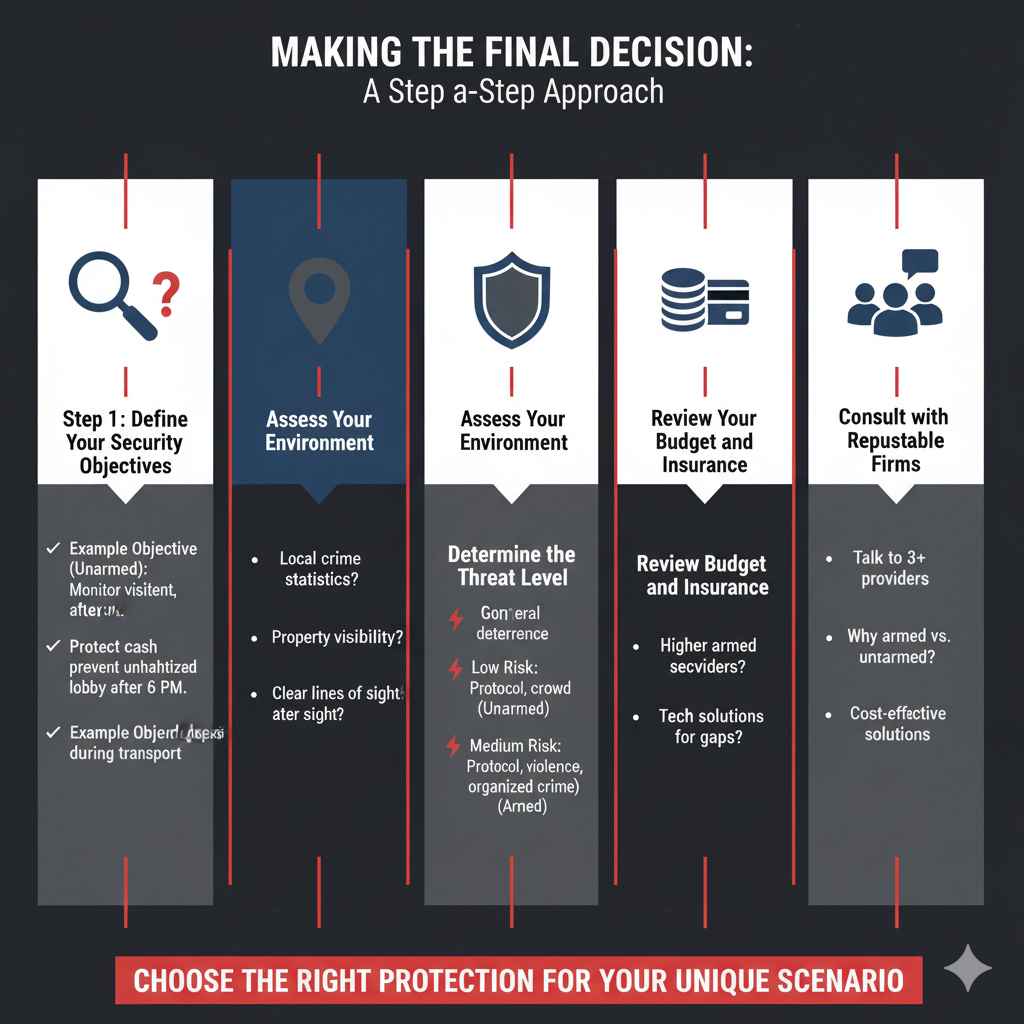
To help you confidently move forward, use this structured approach to finalize your choice between armed and unarmed security.
Step 1: Define Your Security Objectives (The “What”)
Be brutally honest about what you are trying to prevent. Are you stopping package theft, managing employee access, or protecting millions in inventory from organized thieves?
Example Objective: “We need to monitor visitors and prevent unauthorized entry into our lobby after 6 PM.” (Suggests Unarmed).
Example Objective: “We need to protect cash deposits being moved from the vault to the armored transport vehicle.” (Suggests Armed).
Step 2: Assess Your Environment (The “Where”)
What is the crime profile of the immediate area? Check local crime statistics. Is the property highly visible or secluded? Are there clear lines of sight?
Step 3: Determine the Threat Level (The “Why”)
Use a simple scale:
- Low Risk: General deterrence needed. (Unarmed)
- Medium Risk: Need protocol enforcement and visible control over crowds or access. (Unarmed often suffices, sometimes supplemented by technology).
- High Risk: Imminent threat of armed violence or high probability of organized crime targeting assets. (Armed required).
Step 4: Review Your Budget and Insurance
Can you afford the higher premiums and hourly rates of armed security? If the budget only allows for an unarmed guard, do not try to force that person into an armed role. Hire the right guard for the budget you have, or look for technology solutions to cover the gap.
Step 5: Consult with Reputable Firms
Talk to at least three licensed security providers. Ask them specifically why they recommend armed versus unarmed for your unique scenario. A good firm will guide you toward the most cost-effective solution that meets safety needs, not just try to upsell you.
Frequently Asked Questions (FAQ) for Beginners
Q1: Can an unarmed guard physically stop a criminal?
A: An unarmed guard is trained to use physical restraint techniques to detain someone only until law enforcement arrives, provided it is safe to do so. They cannot use weapons or force that would cause serious bodily harm. Their primary goal is to observe and report.
Q2: Do armed guards have to patrol armed or can they be concealed?
A: This depends entirely on the contract, the site requirements, and state law. Guards protecting banks often wear visible uniforms and visible sidearms. Guards providing executive protection often operate under strict concealed carry protocols for discretion.
Q3: If I hire an unarmed guard, can they call the police for me?
A: Absolutely. Communication is a fundamental part of their job. If an unarmed guard witnesses a crime or emergency, their immediate responsibility is to use their radio or phone to summon emergency services (police, fire, EMS) and report the situation clearly.
Q4: Is armed security always more expensive than hiring private police officers?
A: Generally, yes. Private armed security guards are typically less expensive per hour than hiring off-duty police officers (who charge a premium for their sworn status and legal authority), but armed guards are significantly more expensive than unarmed guards.
Q5: What happens if an armed guard misuses their weapon?
A: If the misuse is proven, the guard faces criminal charges and loss of licensing. Your company faces massive civil liability lawsuits. This risk underscores why vetting the guard’s training and the company’s insurance is non-negotiable.
Q6: Can an unarmed guard carry pepper spray or a baton?
A: This depends on the state and the specific licensing the guard holds. In many jurisdictions, specific certifications are required to carry even non-lethal defensive tools like pepper spray. Always confirm the guard’s authorization with the contracting company.
Conclusion: Finding Your Security Sweet Spot
Deciding between armed guards vs unarmed guards is really about matching your required level of safety to your operational environment and budget. There is no single “best” answer; there is only the best answer for you.
If your need is primarily about maintaining order, visibility, access control, and discouraging minor issues, the professional, highly visible presence of an unarmed guard offers excellent value and peace of mind. They are the foundation of good site security.
If, however, you are guarding assets that thieves know are valuable, or if you operate in an area where the risk of serious, immediate violence is measurable, the specialized training and defensive capability of an armed guard are necessary expenditures. Remember, you are paying not just for the person, but for their specialized, legally sound ability to intervene when things go critically wrong.
Take your time, follow the assessment steps, and always prioritize working with licensed, reputable security firms that emphasize ongoing training. By understanding these essential truths, you can choose a security solution that keeps your property and people