Armed Security Guard vs Police Officer: Proven Essential
Armed security guard vs police officer roles are distinct: Police enforce criminal law for the public, while armed guards protect specific private property or individuals under contract, often with limited arrest powers based on state law.
For a related rules or safety question, Are Air National Guard Jets Armed? Essential gives readers more context before making assumptions.
For a related rules or safety question, Are All British Royal Guards Armed? Essential gives readers more context before making assumptions.
For a closely related bow or archery topic, Cockieast Arm Wrestler Vs Prisoner Guard: Showdown gives readers a useful next step.
Welcome, friend! If you’ve ever wondered about the difference between an armed security guard and a police officer, you are definitely not alone. It’s easy to mix them up when you see someone in uniform carrying a badge or a weapon. These two roles look similar from a distance, but what they actually do and what laws they follow are very different. This confusion can lead to misunderstandings about who to call in an emergency. Don’t worry! We are going to clear this up simply. I’ll walk you through exactly what makes each role unique, focusing on their power, training, and purpose. Let’s dive in and make this clear so you always know who you are dealing with.
Understanding the Core Difference: Public Duty vs. Private Contract
The simplest way to look at an armed security guard versus a police officer is to consider their boss and their main job. Think of it like this: one works for everyone, and the other works for a specific paying client.
The Police Officer: A Public Servant
Police officers are agents of the government—local, county, state, or federal. Their authority comes directly from the law and is given to them to maintain public order and enforce criminal statutes for the entire community.
- Authority Source: Public trust and government mandate.
- Jurisdiction: Generally covers a specific geographic area (city limits, county lines, etc.).
- Primary Goal: Enforce criminal law, investigate crimes, and protect the general public.
- Arrest Power: Full authority to make arrests based on probable cause for any crime committed in their presence or under warrant.
When you dial 911, you are usually calling someone whose job is fundamentally about maintaining the peace according to criminal codes.
The Armed Security Guard: A Private Protector
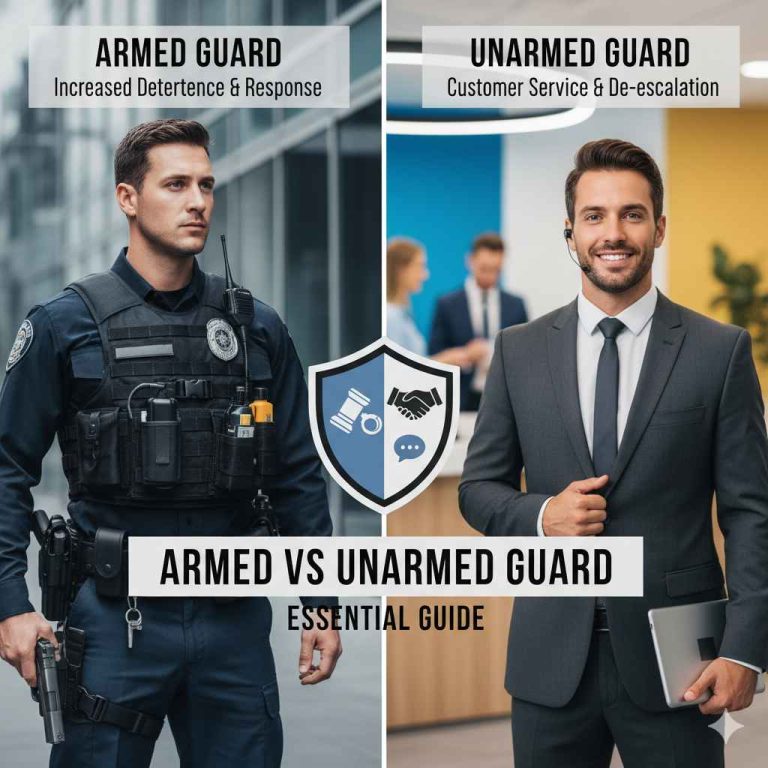
An armed security guard is an employee of a private company hired by a business, institution, or individual. Their primary duty is to protect the property, assets, or specific people they are contracted to watch. They are essentially hired protectors, not public law enforcers.
- Authority Source: Private contract and state licensing regulations.
- Jurisdiction: Limited to the property or person they are hired to protect.
- Primary Goal: Deter crime, protect assets, report incidents, and maintain order on private property.
- Arrest Power: Highly restricted; often limited to citizen’s arrest powers, depending on state regulations.
It is crucial to understand that security guards do not wear the badge to enforce traffic laws or handle domestic disputes unless specifically authorized by local ordinances or if they are deputized in a very rare capacity (which merges them closer to a specialized officer role, but that’s less common).

Training and Education Requirements: A Major Divide
The level and type of training required highlight a significant difference in responsibility. Police work demands extensive, state-mandated academy training, while security guard training focuses heavily on observation, reporting, and the specific use of their assigned equipment.
Police Academy Training
Becoming a police officer involves a rigorous, full-time commitment, often lasting several months to over a year. This training is standardized across the state or jurisdiction.
- Physical and Psychological Screening: Extremely demanding entrance requirements.
- Legal Training: Extensive study of constitutional law, criminal procedure, and evidence handling.
- Firearms Proficiency: High-level, continuous mandatory qualification standards for their department-issued weapon.
- Scenario Training: Realistic simulations covering everything from traffic stops to high-risk entries.
This comprehensive training prepares officers to handle the full spectrum of public safety issues, including emergency medical situations and complex criminal investigations. For more details on the rigorous standards, you can often check the requirements set by state-level peace officer standards and training (POST) commissions, such as those available via US government resources focusing on law enforcement standards.
Armed Security Guard Training
Training for armed security guards varies significantly by state, but it is generally less intensive than police academy training. It is often focused on the specific requirements to obtain the necessary state registration or licensure to carry a firearm while on duty.
- Licensing Course: Focuses on state laws regarding carrying a weapon, the limits of their authority, and proper reporting procedures.
- Firearm Qualification: Guards must typically pass a basic shooting course to satisfy state requirements for licensure, but recertification frequency and rigor may be lower than police standards.
- Post Orders: Training heavily emphasizes understanding the client’s specific rules (post orders) for the location they are guarding.
It’s important to note that while some highly specialized armed guards (like those in armored transport or executive protection) might have training equivalent to or exceeding some police standards, the baseline requirement is distinct from that of a sworn officer.
Authority: What Can They Actually Do?
This is perhaps the most confusing area for the public. When can a guard detain someone? When must you call the police?
Police Officer Authority
Police officers possess general law enforcement authority. They can intervene in any public disturbance, issue citations, conduct full searches incident to a lawful arrest, and detain individuals they have probable cause to suspect have committed a crime.
Their power is broad because they represent the state’s monopoly on legitimate force for public protection.
Armed Security Guard Authority (The Limits)
Generally, armed security guards possess only the authority granted to any private citizen, unless their state laws specifically grant them additional powers related to their employment.
Citizen’s Arrest
In many states, a security guard’s primary “arrest” power is the citizen’s arrest. This power allows any citizen to detain someone who they witness committing a felony, or sometimes a serious misdemeanor, in their presence. The key difference is that the guard must immediately turn the suspect over to the actual police.
Site-Specific Authority
If a guard is working on private property (like a shopping mall or a corporate campus), they can often enforce the rules set by the property owner. If you are trespassing or violating posted rules, they can ask you to leave. If you refuse, you are then potentially trespassing on private property, which gives them firmer ground to detain you until the police arrive.
Table 1 below summarizes the typical differences in authority granted to each role.
| Authority Feature | Police Officer | Armed Security Guard |
|---|---|---|
| Enforce Criminal Law | Yes (Full Power) | No (Only Citizen’s Arrest) |
| Issue Citations/Tickets | Yes (Traffic/Ordinance) | Rarely (Only if specially commissioned) |
| Warrant Execution | Yes | No |
| Use of Force Justification | State Criminal Code | Self-Defense & Citizen’s Arrest Laws |
When to Call Whom: Practical Guidance
Knowing who has the power to handle a situation is essential for safety and getting the right help quickly. If you see a uniformed person, your first thought should be: “Are they here for the public, or are they watching a building?”
Situations Requiring Police (911)
If you witness or are involved in a situation that requires criminal investigation, wide-area response, or immediate enforcement of public law, call the police.
- Witnessing a crime in progress (robbery, assault, vandalism).
- Traffic accidents requiring official reports or citations.
- Domestic disturbances or neighborhood disputes escalating to threats.
- Any situation where you feel public safety is immediately at risk.
- If the person in uniform seems unable or unwilling to handle the public nature of the emergency.
Situations Where Security May Be the First Responder
If you are on private property or near a controlled access area, the armed guard might be the appropriate first point of contact, especially if the issue is localized or related to site policy.
- Reporting suspicious persons loitering near a bank or office building entrance.
- Witnessing someone violating clear “No Trespassing” signs on private land.
- Needing immediate assistance accessing a secured facility (like an industrial plant or gated community).
- Reporting an incident that has already concluded, and you need to file a report with the property management (the guard will log it and contact police if necessary).
If you are ever in doubt, calling 911 is always the safest choice. Police dispatchers are trained to triage the situation and will dispatch the appropriate unit, which might even be a specialized security liaison if the situation warrants it.
Uniforms, Badges, and Deception: Spotting the Difference
Modern security uniforms are often designed to look professional, and sometimes, intentionally authoritative. This can lead to accidental confusion.
Police Uniform Indicators
Police officers typically wear uniforms that clearly denote their agency and sworn status. Look for these identifiers:
- Official Badge: Usually metallic, prominently displayed, and often bears the seal of the city, county, or state.
- Agency Patches: Clearly visible patches identifying the city police department or sheriff’s office.
- Vehicle Markings: Police cars are heavily marked with official seals and lights that are strictly regulated.
- Insignia of Rank: Sergeants, Lieutenants, etc., will have visible rank insignia.
Armed Security Guard Uniform Indicators
Security guard uniforms are highly variable based on the contract. They might wear tactical gear, polo shirts, or even suit jackets. Be vigilant for these clues:
- “Security” Wording: Patches or vests often explicitly say “SECURITY” or identify the private firm (e.g., “ABC Protective Services”).
- Non-Governmental Badges: If they wear a badge, it might be an identification patch rather than a formal shield, or it might clearly state the security company name.
- Lack of Standardized Gear: Their equipment setup (less bulky vests, different sidearms) may not match the standard issue of local law enforcement.
Important Note on Impersonation: In the United States, impersonating a police officer is a serious crime. Security guards are legally prohibited from using official government seals or language that implies they are sworn law enforcement officers unless they are specifically deputized or serving in an auxiliary capacity defined by state law (which is rare for standard armed guards).
The Role of Firearms in Each Profession
Both police officers and armed security guards may carry firearms, but the justification, equipment, and rules of engagement are different.
Police Firearms Use
Police officers are authorized to carry firearms as a primary tool for public protection and enforcement. Their use-of-force continuum is governed by case law and departmental policy, allowing them to deploy lethal force when they reasonably believe it is necessary to prevent death or serious bodily injury.
Armed Security Firearms Use
For an armed guard, carrying a firearm is a privilege granted by their state license, contingent on employment by a licensed firm. Their right to use that weapon is much narrower and is generally governed by the same laws that apply to any private citizen—self-defense or defense of others from imminent serious harm.
Table 2 compares the typical firearm responsibilities.
| Firearm Aspect | Police Officer | Armed Security Guard |
|---|---|---|
| Weapon Ownership | Issued by Department (or approved personal carry) | Usually personal purchase, authorized by employer/license. |
| Training Frequency | Mandatory Quarterly/Monthly Range Time | Varies; often Annual or Bi-Annual Qualification |
| Primary Role of Weapon | Enforcement and Public Protection | Defense of Property/Self-Defense |
Liability and Accountability: Who Answers for Mistakes?
When something goes wrong, the path of accountability diverges sharply between public and private security.
Police Accountability
If a police officer makes an error in judgment or procedure while acting in their official capacity, they are generally covered by “qualified immunity” in civil suits, meaning they can only be sued if they violated a clearly established statutory or constitutional right. However, they are subject to internal affairs investigations and criminal prosecution if they break the law.
Security Guard Liability
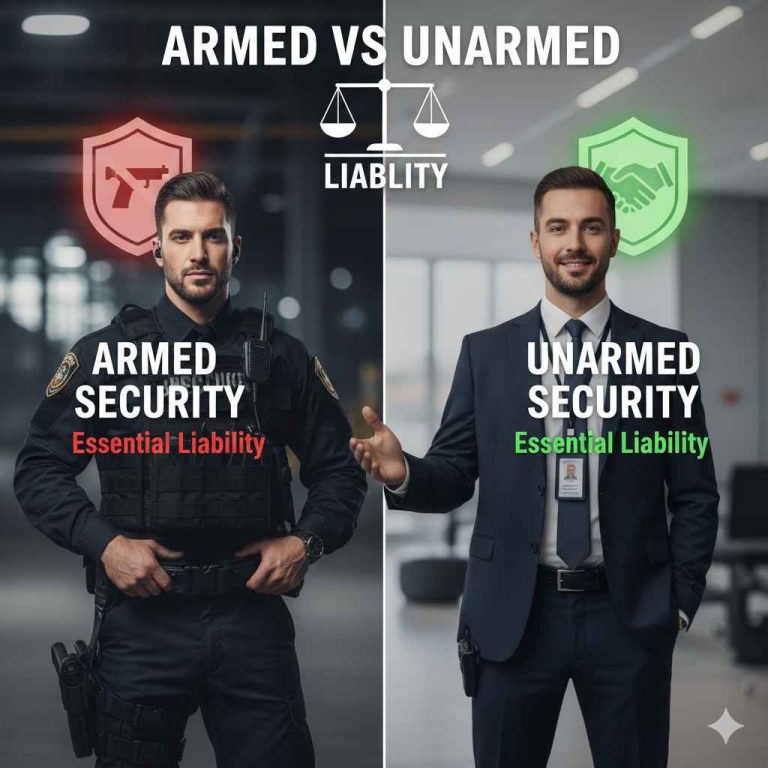
Armed security guards and their employing company carry significant liability. If a guard uses excessive force outside the bounds of justified self-defense or citizen’s arrest, the guard and their company (under vicarious liability) are highly exposed to civil lawsuits from the injured party.
Because their authority is narrower, their actions are often scrutinized more heavily against general civilian use-of-force standards rather than the broader public safety mandate police operate under. Companies often carry large insurance policies precisely because of this increased liability exposure when carrying weapons on a contract.
When Security Guards Gain Police-Like Powers (The Gray Area)
Sometimes, the line blurs slightly, creating what looks like a police officer but isn’t. This usually happens in specific, controlled environments.
Special Patrol Officers (SPOs) or Auxiliary Police
Some local governments authorize certain private security personnel to be commissioned as Special Patrol Officers. This is not common, but it does happen in densely populated areas or large universities. These individuals receive state-sanctioned training and are often granted limited powers beyond standard security—sometimes including the ability to issue traffic citations or make arrests under specific municipal codes.
Campus Police (University Setting)
University police officers are sworn law enforcement officers, even though they work primarily on campus grounds. They are usually employed by the state university system. In contrast, a private security firm contracted by a private university may only have standard guard authority.
Federal Contracted Guards
Guards working on federal property (like an Air Force base) might have specific federal arrest authority granted by the agency (like Department of Defense police), blurring the lines based on the governing federal statute for that installation.
Always ask directly: “Are you a sworn police officer?” If they hesitate or look confused, they are likely a private guard.

Frequently Asked Questions (FAQ) for Beginners
Q1: Can an armed security guard issue me a ticket for speeding?
A: Generally, no. Only sworn police officers or designated traffic enforcement agents (like parking enforcement) have the authority to issue legally binding citations for traffic violations on public roads.
Q2: If a security guard arrests me, is that the same as being arrested by police?
A: Not exactly. If a security guard detains you, it is typically under a citizen’s arrest standard, meaning they believe they witnessed you committing a crime on the property they protect. They must then immediately contact the police to take over. The actual criminal charges, booking, and legal processing are handled by sworn law enforcement officers — not the guard.
Q3: Can an armed security guard investigate crimes like a police officer?
A: No. Security guards can document incidents, collect basic information, and preserve the scene, but they do not have the authority to conduct official criminal investigations. Only sworn law enforcement agencies, such as local police departments operating under standards set by United States Department of Justice, have the authority to formally investigate crimes, gather evidence for prosecution, and file charges through the court system.
Q4: Do armed security guards have to follow the same constitutional rules as police officers?
A: Police officers must strictly follow constitutional protections (such as the Fourth Amendment rules on search and seizure). Armed security guards, as private citizens, are generally not bound in the same way — but they are still subject to criminal law and civil liability. If they violate someone’s rights or use excessive force, they can face lawsuits or criminal charges just like any private citizen.
Q5: Can a police officer work as an armed security guard?
A: Yes. Off-duty police officers often work secondary jobs as private security. In those cases, their authority may depend on department policy and state law. Sometimes they retain full police powers while off-duty; other times they act strictly under private security authority. It varies by jurisdiction and department policy.
Conclusion
While they may look similar in uniform, the difference between an armed security guard and a police officer is fundamental:
- Police officers serve the public, enforce criminal law, and operate with broad legal authority across their jurisdiction.
- Armed security guards protect specific property or individuals under private contract, operating with limited authority primarily based on citizen’s arrest and self-defense laws.
If a situation involves public crime, investigation, or emergency response — call the police.
If it involves access control or protection of private property — security may be your first point of contact.
Understanding this distinction ensures you know exactly who to rely on when it matters most.