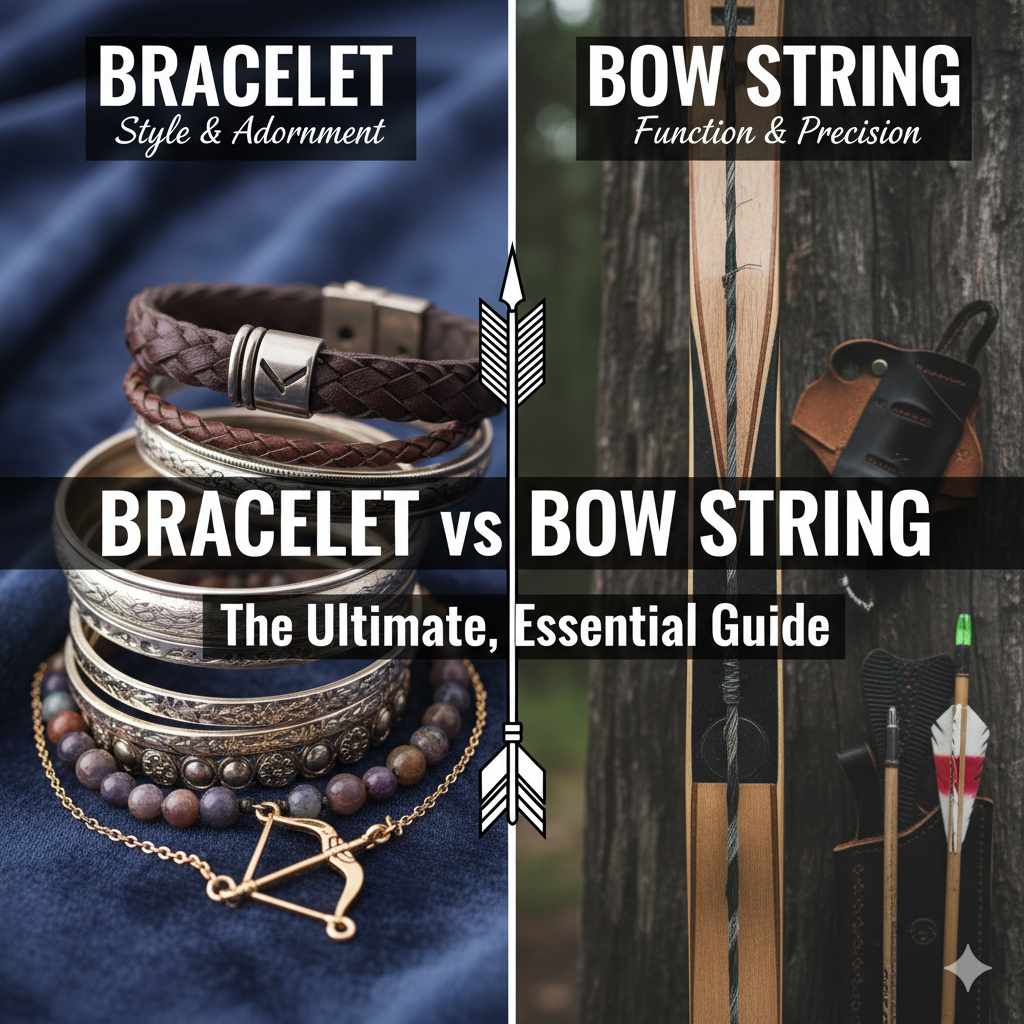
A bracelet cannot fix bow string slap. The painful sting on your arm is caused by improper form, not a lack of protection. The real solution is to correct your grip, stance, and elbow rotation. Use a proper arm guard for safety while you practice, but focus on improving your technique for a permanent fix.
Ouch! That stinging slap of the bow string against your forearm is a frustrating and painful part of learning archery. Many beginners think the answer is to wrap something around their arm, like a thick bracelet or wristband. But this is a common mistake. It only hides the problem; it does not solve it. The truth is, bow string slap is a signal that something is off with your form. Don’t worry, this is a very common issue, and it is easy to fix. In this guide, I’ll walk you through the simple steps to adjust your technique, so you can shoot comfortably and accurately every single time.
Understanding the “Sting”: Why Does the Bow String Hit Your Arm?
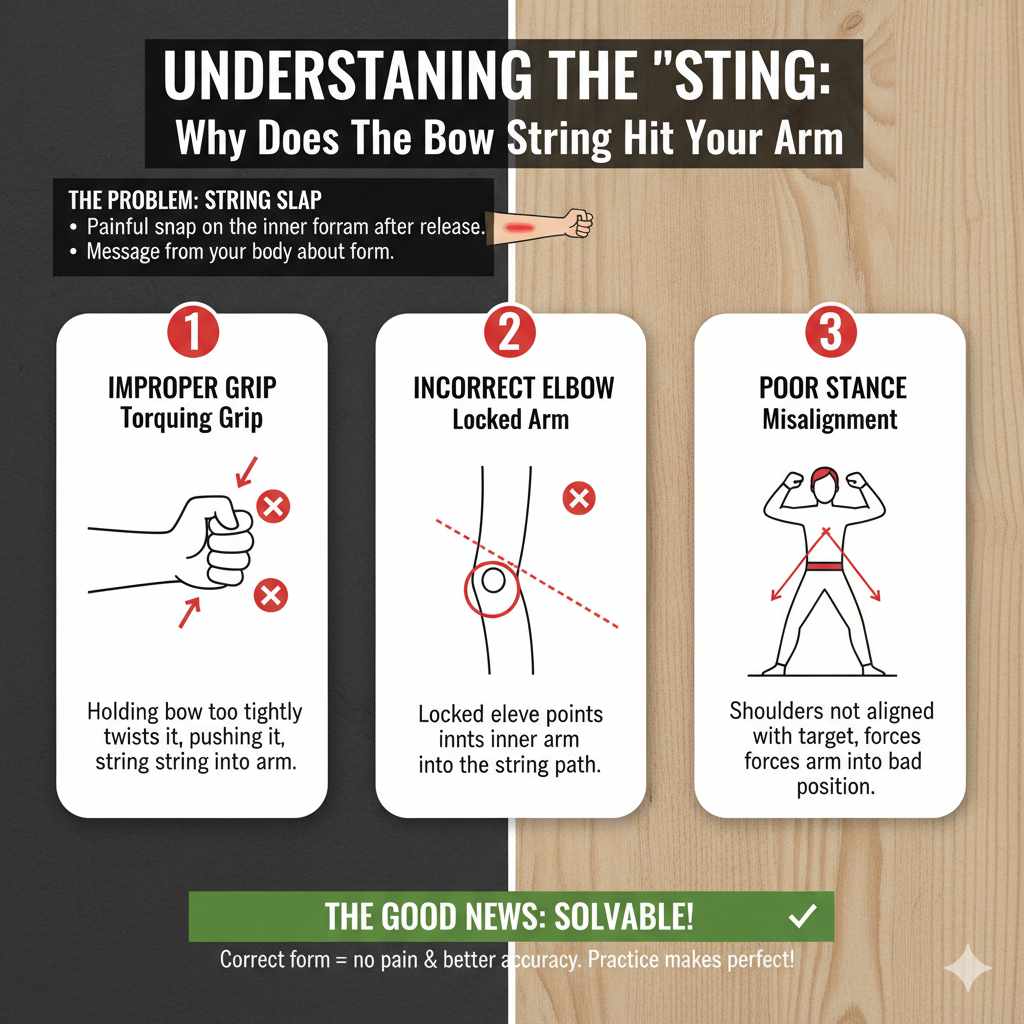
That painful snap against your forearm, often called “string slap” or “string bite,” is a universal experience for new archers. It happens when the bow string travels forward after you release an arrow and collides with your inner arm. While it feels like an attack from the bow, it’s actually a message from your body. It is telling you that part of your shooting form is creating an obstacle in the string’s path.
Think of the bow string’s path as a perfectly straight highway. When you shoot, the string wants to return to its resting position as quickly and cleanly as possible. If any part of your bow arm—your wrist, elbow, or shoulder—is in the way, the string will hit it. This isn’t a random accident; it’s a direct result of a few common form issues. The three primary culprits are:
- Improper Grip: Holding the bow too tightly, often called a “death grip,” can cause you to torque the bow. This changes the angle of the string’s travel and can push it closer to your arm.
- Incorrect Elbow Position: This is the most common cause. If you lock your elbow or have it pointed downward, the fleshy part of your inner arm will stick out directly into the string’s path.
- Poor Stance and Alignment: If your shoulders are not properly aligned with the target, it can force your bow arm into an unnatural position, increasing the risk of string slap.
The good news is that each of these issues can be corrected with a little knowledge and practice. The sting is not a rite of passage you have to endure. It’s a solvable problem, and fixing it will not only eliminate the pain but will also make you a much more accurate and consistent archer.
The “Bracelet” Fix: A Common Myth Debunked
When faced with string slap, it is tempting to look for a quick fix. Many new archers think, “If my arm is getting hit, I should cover it!” This leads them to grab a thick leather bracelet, a sweatband, or even wrap a piece of cloth around their forearm. While this might slightly soften the blow, it is one of the worst things you can do. It is like putting a bucket under a leaky roof instead of fixing the hole.
Using a makeshift bracelet as protection is a myth that needs to be debunked. It fails to address the root cause of the problem, which is your form. By masking the pain, you are essentially ignoring the signal your body is sending you. This allows the bad habit in your form to become more ingrained, making it harder to fix later. More importantly, it can be dangerous. A loose bracelet or cloth can snag the bow string during the shot, causing the arrow to fly wildly off course. This is a serious safety hazard for you and anyone around you.
Let’s break down why this is not a solution.
Table: Bracelet as Protection – Pros vs. Cons
| Pros | Cons |
|---|---|
| Might slightly reduce the sting of the slap. | Does not fix the underlying form issue. |
| Feels like you are doing something to solve the problem. | Creates a false sense of security, allowing bad habits to continue. |
| Can be dangerous if it catches the bow string, causing a misfire. | |
| Can move or shift, offering unreliable protection. | |
| Ultimately hinders your progress as an archer. |
Instead of reaching for a bracelet, let’s focus on the real solution: correcting the technique that causes the string to hit your arm in the first place. This is the path to becoming a better, safer, and more confident archer.
The Real Solution: Fixing Your Form to Avoid Bow String Slap
The secret to a pain-free shot lies entirely in your form. By making a few small, simple adjustments, you can move your arm completely out of the bow string’s path. It might feel a little strange at first, but with practice, it will become natural and automatic. Let’s walk through the four key steps to building a solid, string-slap-proof form.
Step 1: Perfecting Your Grip
How you hold the bow is the foundation of your shot. Many beginners instinctively grip the bow like a baseball bat, with their whole hand wrapped tightly around it. This “death grip” is a major cause of problems. It introduces tension and makes you twist or torque the bow, which pushes the string toward your arm.
The correct grip is relaxed and light. You want the bow to rest in your hand, not be strangled by it. Here’s how to find the perfect grip:
- Hold your bow arm out as if you are about to shoot.
- Open your hand and look at your palm. You will see a “lifeline” crease.
- Place the bow’s grip so the pressure is on the fleshy part of your thumb pad, right along that lifeline.
- Let your fingers relax and lightly curl around the grip. Think of making a “thumbs-up” or an “OK” sign with your hand—your fingers should be loose.
- When you draw the bow, the pressure should push the bow into your hand. Your fingers are just there to keep it from falling.
A great way to practice this is to use a finger sling or a wrist sling. This strap connects your hand to the bow, allowing you to shoot with a completely open and relaxed hand without fear of dropping it.
Grip Dos and Don’ts
- DO: Keep your knuckles at a 30 to 45-degree angle.
- DO: Keep your fingers relaxed.
- DO: Let the bow rest on the thumb pad area of your palm.
- DON’T: Squeeze the grip tightly.
- DON’T: Hold the bow with a vertical “hammer” grip.
- DON’T: Let the grip sit in the center of your palm.
Step 2: Checking Your Stance and Alignment
Your stance provides the stability for your entire shot. A weak or misaligned stance can cause your upper body to compensate in ways that push your arm into the string’s path. The goal is to create a solid, T-shaped alignment with your body and the target.
The simplest and most stable stance for beginners is the “square stance”:
- Stand with your feet shoulder-width apart.
- Imagine a line on the ground pointing directly at the target. Place your feet so the tips of your toes are touching this line, with your body perpendicular to the target.
- Keep your weight balanced evenly between both feet.
- Stand up straight but stay relaxed. Don’t be stiff. Your shoulders should be down and back, not hunched up by your ears.
When you raise your bow, both your shoulders should form a straight line pointing toward the target. If your front shoulder is creeping forward or your back shoulder is collapsing, it can throw off your alignment and contribute to form issues.
Step 3: Correcting Your Bow Arm and Elbow Rotation
This is the most critical step for eliminating string slap. If your bow arm’s elbow is pointed downwards, the soft inner part of your arm is exposed. The key is to rotate your elbow so that it points outwards, away from the bow. This moves your arm out of the way and creates a clear path for the string.
Here’s how to achieve the correct elbow rotation:
- Lift your bow arm without the bow. Hold it straight out in front of you.
- Notice the position of your elbow. For many people, the inner “pit” of the elbow naturally faces upwards.
- Now, without moving your shoulder or hand, consciously rotate your arm so that the elbow pit turns to face outwards, away from your body. It should feel like you are slightly turning a doorknob.
- This rotation should create a slight, natural bend in your elbow. Never lock your elbow straight! A locked elbow is not only a primary cause of string slap, but it can also lead to injury over time.
A great mental cue is to imagine you are a waiter holding a tray of drinks on your forearm. To keep the tray level, you would naturally rotate your elbow outward. Practice this movement without a bow until it feels comfortable and familiar. When you pick up your bow, apply the same rotation. You will see a visible difference in the clearance between your arm and the string.
Step 4: Ensuring the Right Draw Length
Draw length is the distance from the bow’s grip to your anchor point when you are at full draw. If your bow’s draw length is too long for your body, it forces you to overextend your bow arm. This makes it very difficult to maintain proper form, rotate your elbow, and keep your arm out of the string’s path.
While there are methods to measure your draw length at home, the most accurate way is to visit a professional archery shop. An expert can measure you precisely and adjust your bow to fit you perfectly. A bow that fits you correctly is safer, more comfortable, and much more accurate. You can find a local club or shop with certified instructors through resources like the USA Archery Club Locator. Getting your equipment properly fitted is one of the best investments you can make in your archery journey.
Protective Gear: The Smart Way to Protect Your Arm
Even while you are perfecting your form, string slap can happen. That is why every archer, from beginner to expert, should own and use a proper arm guard. Unlike a bracelet, an arm guard is a piece of safety equipment specifically designed for archery. It is made from tough, slick materials like leather or plastic that allow the bow string to slide right off without catching or causing injury.
An arm guard is not a crutch. It is a smart tool. It gives you the confidence to focus on your form without worrying about the pain of a potential mistake. As your form improves, you will find the string hits the guard less and less. Eventually, you may not need it at all, but it is always a good idea to have it, especially when trying new techniques or shooting for long periods when fatigue can cause your form to slip.
Types of Arm Guards
- Full-Length Guards: These offer the most protection, covering your arm from wrist to elbow. They are excellent for new archers.
- Short Guards: These are smaller and just cover the part of the forearm most likely to be hit. Many experienced archers prefer these for their minimal feel.
- Traditional Guards: Often made of leather with straps or laces, these are both functional and stylish.
Table: Arm Guard vs. Bracelet – A Safety Comparison
| Feature | Arm Guard | Makeshift Bracelet |
|---|---|---|
| Primary Purpose | Designed for archery safety; protects arm while allowing string to slide off. | Not designed for archery; meant for decoration or other purposes. |
| Material | Slick, durable materials (plastic, smooth leather) that prevent snagging. | Various materials (cloth, rough leather, beads) that can easily snag the string. |
| Safety | High. Prevents injury and ensures the shot is not obstructed. | Low. Poses a serious risk of snagging the string, causing a dangerous misfire. |
| Effect on Skill | Encourages good form by removing the fear of pain, allowing you to focus. | Hinders skill development by masking a fundamental form error. |
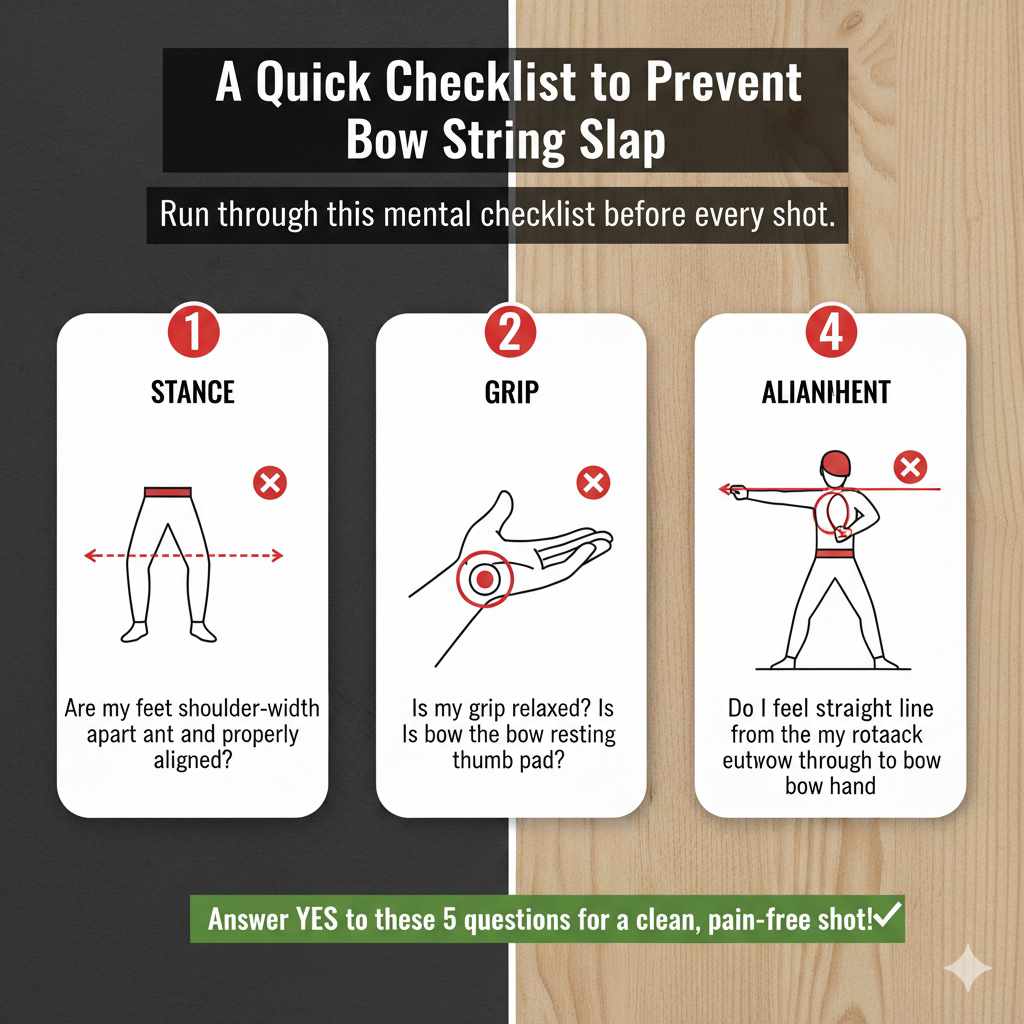
A Quick Checklist to Prevent Bow String Slap
As you practice, run through this mental checklist before every shot. It will help you build muscle memory and make good form second nature.
- Stance: Are my feet shoulder-width apart and properly aligned?
- Grip: Is my grip relaxed? Is the bow resting on my thumb pad?
- Bow Arm: Is my shoulder down and relaxed?
- Elbow: Is my elbow unlocked and rotated outwards?
- Alignment: Do I feel a straight line from my back elbow through to my bow hand?
If you can answer “yes” to these five questions, you are in a great position to make a clean, pain-free shot.
Frequently Asked Questions (FAQ)
Will an arm guard stop the string from hitting me?
An arm guard will not stop the string from hitting your arm, but it will protect you from the pain and bruising when it does. Its main purpose is to keep you safe while you work on fixing the form that causes the string to hit you in the first place.
Does string slap mean my bow is too powerful?
No, string slap is almost always a matter of form, not bow power. It can happen with a 20-pound beginner bow just as easily as with a 60-pound hunting bow. The solution is to adjust your grip and elbow position, not to get a weaker bow.
How do I know if my draw length is wrong?
Signs of a draw length that is too long include having to lean your head back to see through the sight, overextending your bow arm, and difficulty keeping your front shoulder down. The best way to be certain is to have it checked by a professional at an archery shop.
Can I teach myself to fix my form?
Yes, you can absolutely improve your form on your own by following guides like this one and being mindful of your technique. Filming yourself shoot can be very helpful, as it allows you to see what you are doing from an outside perspective. However, a lesson with a certified coach is the fastest way to correct issues.
Is it normal to get bruises from archery?
While it is common for beginners to get bruises from string slap, it is not a normal or necessary part of archery. A bruise is a sign that your form needs adjustment. Once your form is correct, you should not be getting bruises on your arm.
Why does my elbow hurt after shooting?
Elbow pain can be a sign that you are hyperextending or “locking” your elbow. This puts a lot of strain on the joint. Remember to keep a small, micro-bend in your elbow and focus on rotating it outward to engage the proper muscles and protect your joint.
What’s the most important thing to remember to avoid string slap?
Elbow rotation. If you only remember one thing, remember to rotate your bow arm’s elbow so the inner part points away from the bow. This single adjustment provides the most clearance for the bow string and is the number one fix for string slap.
Conclusion: Your Path to a Perfect, Pain-Free Shot
The debate between a bracelet and the bow string is really no debate at all. A bracelet is a dangerous, temporary fix that hides a deeper issue, while understanding the bow string’s path is the key to a permanent solution. That painful slap on the arm is your first lesson as an archer—it teaches you the importance of form, alignment, and respect for your equipment.
By focusing on a relaxed grip, a stable stance, and most importantly, the outward rotation of your elbow, you are not just avoiding pain. You are building the foundation for a lifetime of safe, accurate, and enjoyable shooting. Remember to be patient with yourself. Learning archery is a journey, and every shot is a chance to improve. So, put away the bracelets, grab a proper arm guard for safety, and get to work on your form. Before you know it, string slap will be a distant memory, and your arrows will be flying truer than ever.