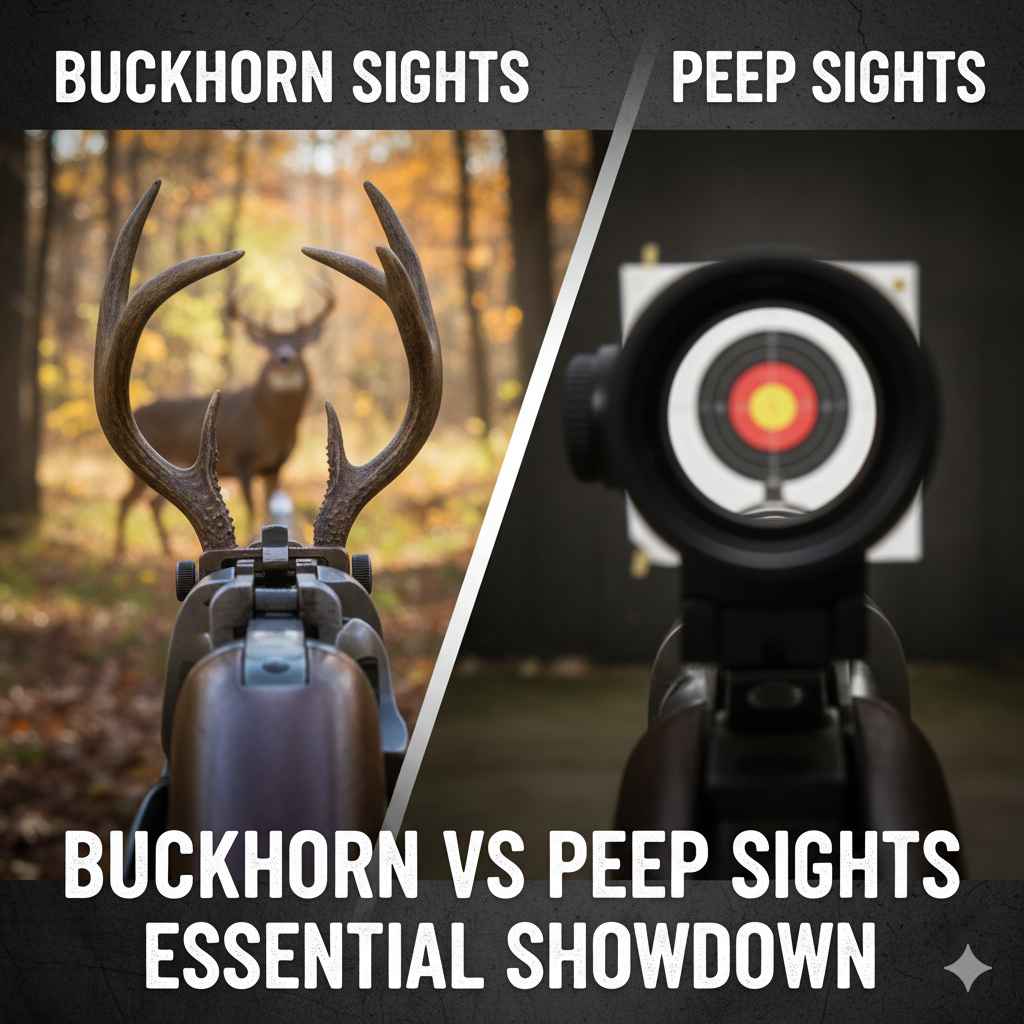
Buckhorn sights vs Peep sights: For beginners, the main difference is clarity and field of view. Buckhorn sights offer a wide view but less precision, while peep sights offer superior precision by naturally centering your focus point but can feel restrictive in low light. Choosing the right one depends on your shooting style and environment.
Welcome to the archery range! Choosing your first set of sights can feel like learning a whole new language. You’ve probably heard the terms “Buckhorn” and “Peep” mentioned, and maybe you wondered which one is right for your bow. Don’t worry; this is a very common sticking point for new archers.
These sights look very different, and understanding that difference is key to hitting your target more consistently. We are going to break down exactly what each sight does, how it helps you aim, and when you should choose one over the other. Stick with me, and by the end of this guide, you will feel confident picking the perfect sights for your journey into better accuracy. Let’s dive into this essential showdown!
Understanding Archery Sights: Why Sights Matter
Before we compare the Buckhorn and the Peep, let’s quickly cover why sights are so important, especially for beginners. Think of it like learning to ride a bicycle. At first, you might just look ahead. But to really master steering and control, you need markers.
On a bow, sights act as those precise markers. They help you align the tip of your arrow with the exact spot on the target you want to hit. Without them, you rely purely on “instinctive” shooting, which is tough to master and even harder to repeat consistently.
Sights help you:
- Establish a consistent anchor point.
- Measure distance more accurately (especially with adjustable sights).
- Build muscle memory for repeatable accuracy.
The two sights we are discussing today—Buckhorn and Peep—are both excellent starting points, but they operate using very different visual principles.

The Buckhorn Sight: Wide Open and Simple
The Buckhorn sight is often found on traditional bows, older hunting setups, or as a very basic, low-profile option for modern bows. It gets its name because the rear sight generally looks like two curved posts or horns pointing toward the front sight pin.
What is a Buckhorn Sight?
Imagine you are looking through two small, open notches. The goal with a Buckhorn sight is to center your front sight pin (the bright dot or ring) perfectly between those two rear “horns.
It’s designed to give you a very wide field of view. This means you can easily see your surroundings, which is great if you are hunting or shooting in varied light conditions where peripheral vision is important.
Pros and Cons of Buckhorn Sights
Like any piece of gear, Buckhorn sights have strengths and weaknesses. Understanding these helps you decide if they fit your needs.
Advantages (Pros) of Buckhorn Sights:
- Wide Field of View: You can see a lot around your target, which is natural for many new shooters.
- Durability: They are usually simple, rugged metal constructions with fewer moving parts to break.
- Low Light Usability: Because the openings are wide, they gather more ambient light than a tiny peep hole.
- Intuitive Alignment: For many beginners, centering a dot between two posts feels more natural than looking through a tiny tunnel.
Disadvantages (Cons) of Buckhorn Sights:
- Less Precise: The openings are large, meaning a slight misalignment of the front sight can cause a bigger miss downrange compared to a peep sight.
- Target Obstruction: The two posts can sometimes partially block your view of the target, especially at longer distances.
- Less Adjustability: Basic models often lack the fine-tuning adjustments found on modern pin sights.
When to Choose a Buckhorn Sight
If you are a beginner focusing primarily on close-range practice (say, under 20 yards), or if you are using a traditional bow where space and complexity are limited, a Buckhorn sight can be a fantastic, hassle-free starting point. They focus on letting you see the woods around your target, which is helpful for hunting situations where you need quick target acquisition.
The Peep Sight: Precision Through Tunnel Vision
The Peep sight is the standard for modern compound and recurve target archers, and increasingly, for serious bowhunters. If you’ve looked at competitive archery photos, you’ve almost certainly seen a peep sight.
What is a Peep Sight?
A peep sight is essentially a tiny hole, usually a small plastic or metal circle, installed into your bowstring near your eye when you draw back. When you aim, your eye looks through this tiny hole, which frames your front sight pin.
The magic of the peep sight lies in a concept called the “tunnel effect.” When you focus on the front sight pin through a small hole, your eye naturally centers that pin inside the hole, making alignment nearly foolproof.
If your pin isn’t perfectly centered, you will immediately see the edge of the peep sight blocking your view, telling you your form is off. This forces excellent consistency.
Pros and Cons of Peep Sights
Peep sights offer major advantages in accuracy but come with a few setup considerations that beginners should know about.
Advantages (Pros) of Peep Sights:
- Superior Precision: Because your eye is naturally guided to the center, achieving perfect alignment is much easier.
- Clarity at Distance: At longer ranges, the peep sight acts like a precise aiming tunnel, reducing the visual clutter of the target face.
- Excellent for Pin-Style Sights: Peeps are designed to work perfectly with multi-pin sights, allowing fine adjustments for yardage.
- Consistency: They enforce a very repeatable anchor point and head position shot after shot.
Disadvantages (Cons) of Peep Sights:
- Low Light Issues: The small hole lets in less light. In deep shade or at dusk, it can be hard to see the pin clearly.
- Installation Required: A peep sight must be properly installed (tied or keyed) into the bowstring, often requiring a bow press.
- Tunnel Vision: Because your focus is so narrow, peripheral awareness is severely limited, which can be a safety concern if you aren’t aware of your surroundings.
- Setup Sensitivity: If the peep rotates slightly out of alignment with your draw, your aim will be thrown off.
When to Choose a Peep Sight
If your goal is to maximize accuracy, especially as you move past 30 yards, or if you are interested in competitive shooting, the Peep sight is the clear winner. It demands better form but rewards you with tighter groups.
The Essential Showdown: Buckhorn Sights Vs Peep Sights
Now, let’s put them head-to-head in a side-by-side comparison. This table highlights the core differences so you can weigh them against your personal shooting goals. Remember, neither is inherently “better”—they are just designed for different priorities.
| Feature | Buckhorn Sight | Peep Sight |
|---|---|---|
| Visual Field | Wide, excellent peripheral view | Narrow, focused tunnel view |
| Precision Potential | Good; alignment relies on eye judgment | Excellent; eye naturally centers the pin |
| Low Light Performance | Better; gathers more ambient light | Worse; small opening reduces light intake |
| Setup Difficulty | Easy (usually mounts directly to riser) | Requires string installation (often needs a bow press) |
| Target Acquisition Speed | Generally faster for close, moving targets | Can be slightly slower initially until form is perfected |
| Best For | Beginners, traditional gear, close-range hunting | Target shooting, long-range accuracy, compound bows |
A Beginner’s Step-by-Step Guide to Choosing Your First Sight
Picking the right sight is one of the most important early decisions you’ll make. Follow these steps to narrow down your choice based on your bow setup and your goals.
Step 1: Assess Your Bow Type and Setup
What kind of bow are you shooting right now?
- Traditional Bow (Longbow/Simple Recurve): These bows rarely accommodate complex sights. A basic fixed sight, which might resemble a Buckhorn setup or just a simple front pin, is usually the limit.
- Beginner Compound Bow: Many entry-level compounds come with mounting holes that allow for simple, adjustable pin sights. A Buckhorn style might be easier to integrate initially, but a small, simple peep sight is often upgradable later.
- Target or Advanced Compound Bow: These bows are built for advanced sights. If you plan to move to multi-pin adjustable sights, a Peep is virtually mandatory for optimal performance.
Step 2: Define Your Primary Use Case
What will you spend most of your time doing?
- Casual Backyard Shooting (Under 25 Yards): Comfort and speed matter more than pinpoint accuracy. A Buckhorn setup might feel less frustrating as you learn to draw and release smoothly.
- Hunting in Varied Terrain: Hunting often requires quick shots in shadowed areas (like deep woods). The wider view of the Buckhorn might be safer and faster in these situations. Always check local regulations regarding sight types if you plan on hunting.
- Bench Rest or Target Shooting (Longer Distances): If you are focused on tightening those groups at 40 yards and beyond, the precision of the Peep sight is essential for fine-tuning your aim.
Step 3: Consider Your Environment and Light Conditions
Think about where you shoot most often. I often remind my students at the range:
If you shoot exclusively outdoors at midday in bright sun, both sights work well. But if you often practice late in the evening, or if you are shooting from a dimly lit ground blind, the small peep hole can become a black void. This darkness can cause aiming frustration until you master the technique of drawing your head perfectly every time.
Step 4: Plan for the Future (Upgradability)
Are you likely to stick with archery for a long time? If the answer is yes, installing a Peep sight early (even a very basic one) sets you up better for future upgrades. Most sight systems are designed around the concept of using a peep sight for consistent reference. Removing a peep later is often easier than trying to adapt a Buckhorn setup to a high-end pin system.
Mastering Form: The Real Secret Behind Sight Success
Here’s a crucial piece of advice that applies whether you choose a Buckhorn or a Peep sight: The sight only works if your body is consistent. A sight is a tool to guide your consistency; it does not create consistency.
When using either sight, focus intensely on these three fundamentals:
- The Anchor Point: Your drawing hand (or release aid) must touch the exact same spot on your face or jawbone every single time. This ensures the sight is positioned the same distance from your eye for every shot.
- Head Position: Your head should remain perfectly upright and still until the arrow strikes the target. Leaning in or craning your neck changes the angle of your eye relative to the sight, leading to consistent misses.
- Breathing and Release: Use your exhale to execute a surprise release. Any tension in your bow arm or drawing hand will throw off your alignment just as you shoot.
For further reading on developing solid shooting form, organizations like the National Archery in the Schools Program (NASP) offer excellent, accessible resources detailing the core mechanics of archery, which are universal regardless of sight type: NASP Archery Manuals.
Troubleshooting Common Sight Issues for Beginners
It’s normal to have issues when you start using a new aiming system. Here are common problems related to Buckhorn and Peep sights and how to fix them simply.
Issue 1: My Pin Keeps Moving in the Buckhorn Notch
The Problem: When using a Buckhorn, you might find your front pin drifting left or right within the two rear posts, causing side-to-side error.
The Fix: This is usually an issue of torque or tension in your grip. Relax your bow hand. Your grip should be firm enough to hold the bow but loose enough that your fingers aren’t squeezing the life out of the grip. Imagine you are gently holding a tube of toothpaste without squeezing out the paste.
Issue 2: I Can’t See Through My Peep Sight
The Problem: You draw back, but the peep sight looks like a small black circle blocking everything, or it’s angled strangely.
The Fix: This means your “peep alignment” is off. You need to adjust the location of the peep on the string, or adjust how you hold your head (your “squint”). Don’t move your anchor point! Instead, slightly tilt your head down or up until the pin snaps into the center of the peep. If tilting your head wildly is required, the peep needs professional adjustment on the string itself.
Issue 3: Arrows are Grouping High or Low (Regardless of Sight)
The Problem: Your shots are consistently hitting above or below the bullseye.
The Fix: This is almost always a vertical sight adjustment issue, or an issue with the distance you are aiming at versus the sight setting.
- Buckhorn: You may need to adjust the physical height of the front sight post, if adjustable.
- Peep: You need to adjust the vertical position of your main sight pin (move it up if you are shooting low, move it down if you are shooting high). Remember to always test at a known, close distance (like 10 yards) when making adjustments. For more on sight adjustment principles, reliable guides often detail this process: Archery Equipment Sight Adjustment.
Maintenance Tips for Both Sight Types
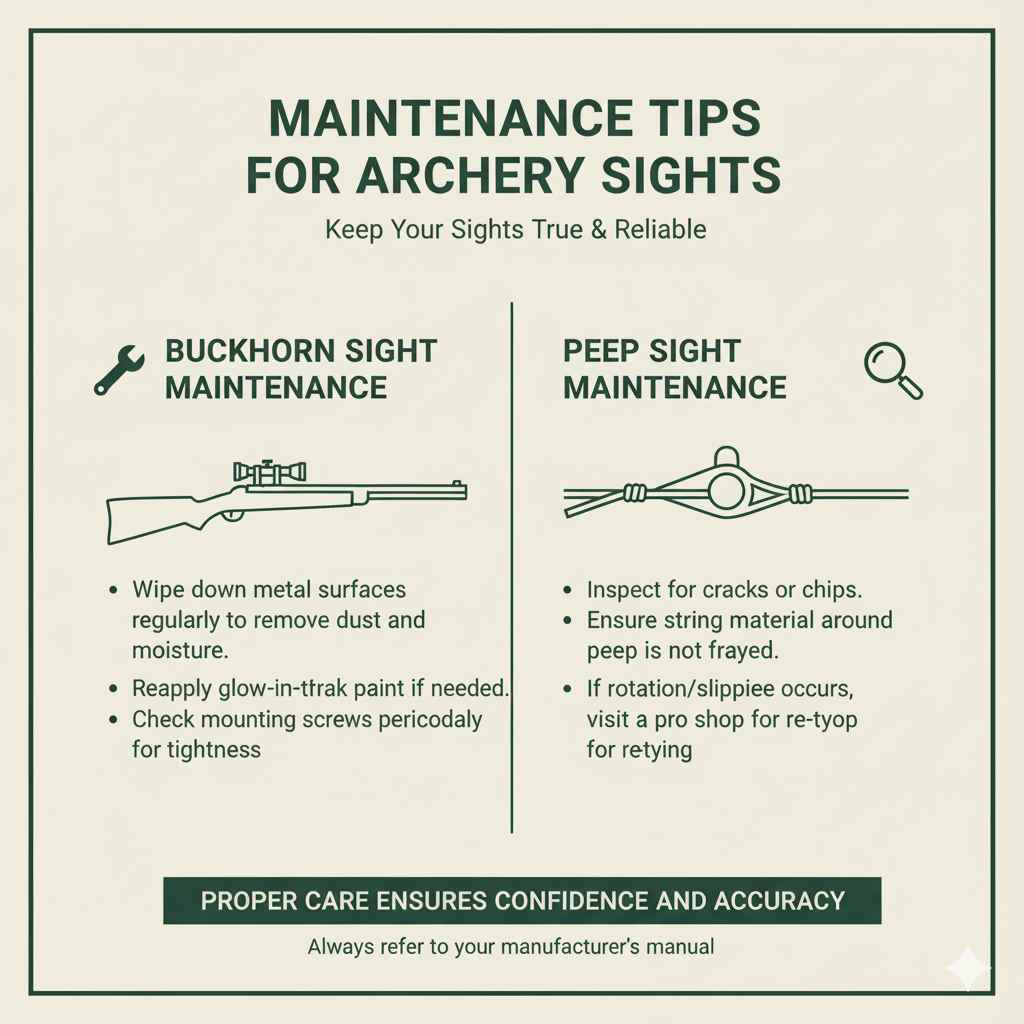
Proper care ensures your sights stay true and reliable. Good maintenance keeps your confidence high when you step up to the line.
Buckhorn Sight Maintenance
Since Buckhorns are simpler, maintenance is usually straightforward:
- Wipe down the metal surfaces regularly with a dry or slightly damp cloth to remove dust and moisture.
- If you use glow-in-the-dark paint or material on the front sight, reapply as needed following the manufacturer’s instructions.
- Check mounting screws periodically to ensure the sight hasn’t loosened from vibration.
Peep Sight Maintenance
The peep requires a little more finesse due to its placement on the string:
- Inspect the peep for cracks or chips, especially if it is plastic. A damaged peep can change your sighting picture instantly.
- Ensure the string material around the peep is not frayed. Fraying can cause the peep to rotate.
- If you notice rotation or slippage, take your bow to a qualified pro shop. They can correctly re-tie or re-key the peep so it stays perfectly vertical.
FAQ: Beginner Questions on Sights
Here are quick answers to the most common questions beginners have when comparing these two aiming methods.
Q1: Which sight is easier for a complete beginner to learn with?
A: Generally, the Buckhorn sight is easier to start with. Its wide view feels less restrictive, and you don’t have to worry about the peep rotating on the string. It allows new archers to focus on the basics of the draw cycle.
Q2: Do I need a sight if I want to shoot instinctively?
A: No, you do not need a sight for instinctive shooting. However, sights like the Buckhorn or Peep are necessary if you plan to use adjustable pins for different yardages or if you are shooting “gap shooting” (where you aim using a reference point based on sight elevation).
Q3: Can I add a peep sight to a simple recurve bow?
A: It is generally not recommended for traditional recurves or longbows. Peeps require a consistent draw length and specific string setup. For traditional bows, a simple fixed sight mounted on the riser (if available) or going truly instinctive is the standard approach.
Q4: Are Buckhorn sights still used in modern archery?
Yes, Buckhorn sights are still used, especially in traditional archery and hunting setups. Many archers prefer them because they are simple, durable, and provide a wide field of view. While modern compound bows often use pin sights with peep alignment, Buckhorn-style sights remain popular among archers who enjoy a classic or minimalist shooting style.
Q5: Can I switch from Buckhorn sights to a Peep sight later?
Absolutely. Many archers start with Buckhorn sights because they are easier to understand and require minimal setup. As you become more comfortable with your bow and want better long-distance accuracy, you can install a Peep sight in the bowstring and switch to a pin-style sight system.
The transition is common and usually only requires:
- Installing the peep in the bowstring
- Adjusting your anchor point slightly
- Re-sighting your bow for proper alignment
A pro shop can complete this upgrade quickly if you are unsure how to install it yourself.
Q6: Which sight is better for hunting situations
For hunting, the answer depends on environment and personal preference:
- Buckhorn sights are often preferred in thick woods because they provide a wider field of view and better performance in low light.
- Peep sights offer greater accuracy, which is useful when shooting at longer distances or when using multi-pin compound bow sights.
Many modern bowhunters actually combine a peep sight with illuminated pins to balance both visibility and precision.
Conclusion: Buckhorn Sights Vs Peep Sights — Which One Wins?
When comparing Buckhorn sights vs Peep sights, there is no single universal winner. Each sight system is designed for a different style of shooting and level of precision.
Buckhorn sights are simple, open, and beginner-friendly. They provide excellent peripheral vision and work well in low-light environments. Because they are easy to understand and durable, they are a solid choice for traditional archers, hunters, or casual shooters practicing at shorter distances.
Peep sights, however, are designed for precision and consistency. By forcing your eye to align perfectly with the front sight pin, they make it easier to repeat the exact same aiming position every shot. This makes them the preferred option for compound bow shooters and target archers who want tight arrow groupings at longer distances.
For most new archers, the best path looks like this:
- Start simple and focus on form, anchor point, and release control.
- Choose the sight that feels most comfortable and natural for your shooting style.
- Upgrade your equipment gradually as your skill and confidence improve.
In the end, the most important factor in archery is not the sight itself—it’s consistent technique and regular practice. When your form becomes repeatable, both Buckhorn and Peep sights can help guide your arrow straight to the center of the target. 🏹