

No, kickers do not receive fantasy points when their field goal attempt is blocked. However, the Defense/Special Teams (DST) unit responsible for the block earns significant points in almost all standard scoring leagues. The specific points awarded depend on your league’s platform rules, usually ranging from 2 to 5 points for the initial block. Understanding this distinction is key to maximizing your weekly score!
Welcome! If you’re new to fantasy football, you quickly find that understanding the rules can feel like trying to sight in a recurve bow for the first time—confusing, frustrating, but entirely necessary for success. One of the most common questions I hear, especially from players just setting up their first leagues, is about blocked field goals. You see the ball get batted down, and immediately you wonder: Did my kicker just cost me the week? Does the defense get credit? Where do those points actually land?
It’s a tense moment, but understanding the rules simplifies everything. Just like learning proper form gives you a consistent shot, knowing fantasy scoring rules gives you a consistent strategy. This guide breaks down the complex mechanics of scoring a blocked kick, ensuring you know exactly where those precious fantasy points are awarded. We will look at both the offensive (kicker) and defensive (DST) perspectives, and show you how to check your specific league settings.
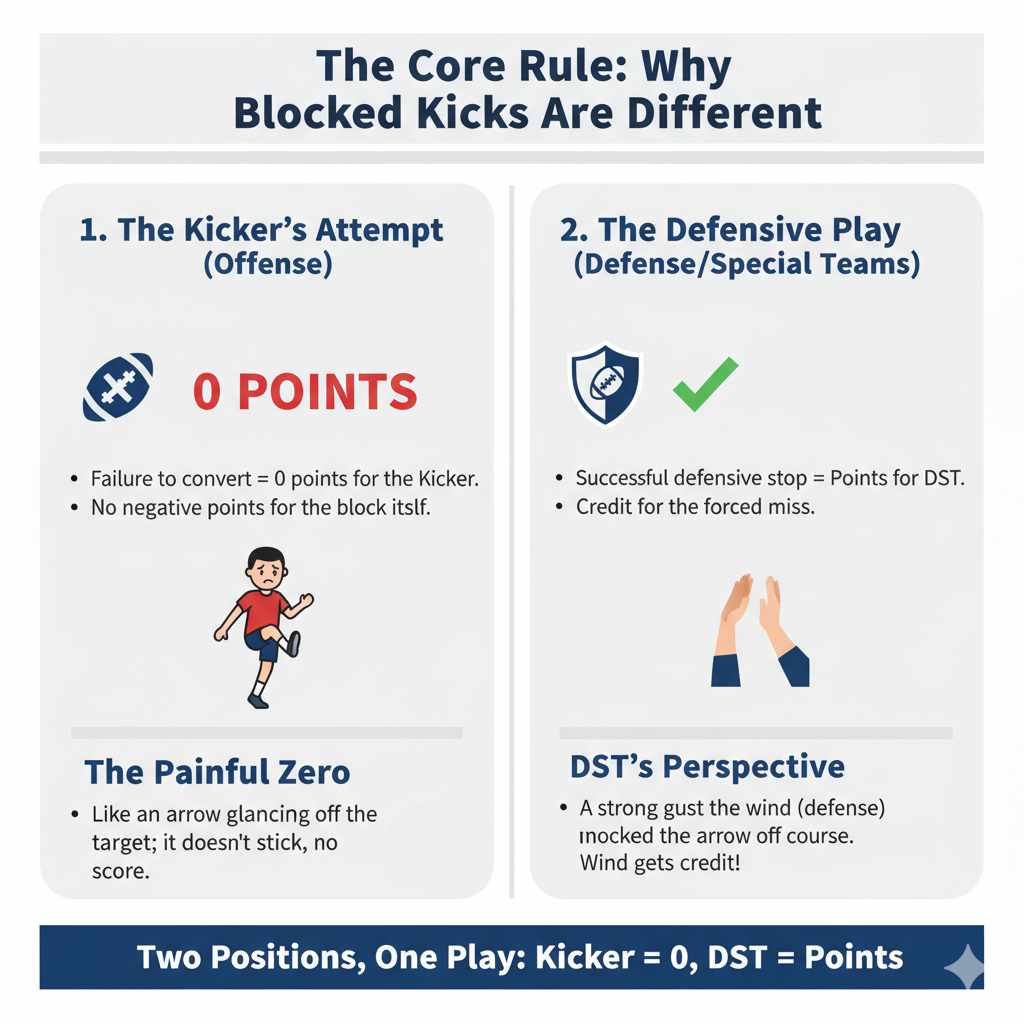
The Core Rule: Why Blocked Kicks Are Different
When you are learning archery, every shot is measured by whether it hits the target in the right place. In fantasy football, a kick is measured by whether it successfully sails through the uprights. If the ball doesn’t go through, the kicker earns zero points for that attempt. The key confusion about blocked field goals is that they involve two different fantasy positions scoring on the same play.
For fantasy scoring purposes, a blocked kick is treated as two distinct events:
- The Kicker’s Attempt (Offense): A failure to convert, resulting in 0 points for the Kicker.
- The Defensive Play (Defense/Special Teams): A successful defensive stop, resulting in points for the DST.
Think of it like this: If your arrow hits the target but glances off the side and doesn’t stick, you don’t score. But if a strong gust of wind (the defense) intentionally knocked your arrow off course, that wind caused the miss. The fantasy rules give credit to the strong defense.
The Painful Zero: The Kicker’s Perspective
When you draft a kicker, you are looking for consistency, accuracy, and opportunity. Kickers score based entirely on successful conversions. If they miss—for any reason—they score nothing on that specific attempt.
A blocked field goal counts as a missed field goal attempt for the kicker. The kicker is not penalized beyond the zero points for the failure, but they do not gain any negative points for the block itself, which is a common misconception.
| Outcome of Kick | Fantasy Points for Kicker (Standard Scoring) | Scoring Event |
|---|---|---|
| Successful Kick (20–29 Yards) | 3 Points | Conversion |
| Successful Kick (50+ Yards) | 5 Points | Conversion (Bonus) |
| Wide Right/Left (Miss) | 0 Points | Failure |
| Blocked Field Goal | 0 Points | Failure (Treated as a Miss) |
This is crucial for beginners: the only thing that matters for the kicker is the final result of the kick itself. The reason it failed (blocked, shanked, or low trajectory) is irrelevant to their fantasy score—it’s always zero if it doesn’t go through.
The Real Winners: Defense/Special Teams (DST) Scoring
If the kicker gets nothing, who gets credit? The Defense/Special Teams unit, or DST. When you roster a DST, you are scoring points on all defensive events (interceptions, sacks, safeties) and special teams plays (punt returns, kick returns, and blocks).
The blocked field goal is one of the highest-value special teams scoring events for a DST. Successfully executing a block takes massive effort, perfect timing, and serious athletic skill, and fantasy leagues reward that effort handsomely.
Standard Points for the Block
Most major fantasy platforms (like Yahoo, ESPN, and Sleeper) award points solely for the act of blocking the kick. This is usually listed under the “Special Teams Events” section of your league settings.
Because every league allows commissioners to customize settings, the exact value can vary. However, we can look at the typical range:
| Fantasy Platform | Standard Points for Blocked Field Goal | Points for Blocked Kick Returned for TD |
|---|---|---|
| ESPN (Standard) | 2 Points | 6 Points (Total for Block + TD) |
| Yahoo (Default) | 3 Points | 6 Points (Total for Block + TD) |
| Sleeper (Standard) | 3 Points | 6 Points (Total for Block + TD) |
| Custom/IDP Leagues | Variable (2–5 Points) | Variable (6–8 Points) |
As you can see, a blocked kick provides an instant injection of 2 to 3 points into your DST score, which is often equivalent to getting two sacks or an interception. These are critical “spike plays” that can win a close matchup.
The Bonus Round: Returning a Blocked Kick for a Touchdown
The points don’t always stop with the initial block. What happens if the DST blocks the kick, recovers the loose ball, and runs it all the way back into the opposing end zone? This is a defensive touchdown, and it’s fantasy gold.
In this scenario, your DST unit receives:
- Points for the initial Block (2–3 points).
- Points for the resulting Touchdown (usually 6 points).
In most platform settings, these two events are often combined, resulting in a total of 6 to 9 points for that single play. If you roster the DST that pulls this off, you’ve hit a huge fantasy jackpot. This is why paying attention to which teams have historically strong special teams (often tracked by sites like Kicking World or official NFL statistic trackers) is a savvy strategy.
Digging Into the Fine Print: IDP vs. DST
As a beginner, you are likely playing in a standard league where you roster one team Defense/Special Teams (DST) unit. But as you advance, you might transition into an Individual Defensive Player (IDP) league. This distinction is vital when discussing blocked kicks.
Standard DST: Simplified Scoring
In standard DST leagues, the entire unit gets credit. It doesn’t matter if the blocker was the massive defensive tackle or the speedy cornerback flying off the edge—the DST gets the points. The fantasy system aggregates the entire team’s defensive and special teams efforts into one score.
IDP (Individual Defensive Player): The Detailed View
In IDP leagues, you roster individual players (like linebackers or defensive ends), not the entire team defense. In these leagues, if a player successfully blocks a field goal, that individual player may receive points specifically for the block.
However, this is less common for just the block. Most IDP leagues award points for tackles, interceptions, and sacks. It is much more likely that the individual player would score IDP points if they recovered the blocked ball and ran it back (resulting in defensive yardage and a defensive touchdown for the player). This is a highly customized setting, so if you join an IDP league, you must check the scoring rules closely.
Coach’s Tip: For most beginners, you are dealing with standard DST scoring. Focus on the fact that if a block happens, your DST gets the credit, and your opponent’s kicker gets nothing. Keep it simple!
How to Check Your Specific League Rules: The Essential Steps
In archery, the first thing you learn is to check your equipment—your bow, your arrows, and your sighting pins. In fantasy football, the first thing you check is the rulebook. Every single league, even on the same platform, can have custom scoring settings that change the value of a blocked kick. Never assume standard scoring.
Step 1: Locate the Scoring Settings Page
Log into your fantasy platform (ESPN, Yahoo, Sleeper, NFL.com). Look for the “League” tab or “My League” section. Within this area, there should be a link titled something like “League Settings,” “Scoring Rules,” or “Customize League.”
- ESPN: Often found under the “LM Tools” (League Manager Tools) or “Rules” tab.
- Yahoo: Usually under “Settings” or “Edit Scoring Rules.”
- Sleeper: Found under the “Settings” gear icon for your specific league.
It sounds basic, but many frustrating scoring disputes arise simply because managers don’t know where the rulebook lives! This is your foundation.
Step 2: Find the Defense/Special Teams Section
Once on the scoring page, you must ignore the offensive rules (QB, RB, WR) and the Kicker rules for a moment. Scroll down until you see the category labeled “Defense/Special Teams Scoring,” “Team Defense,” or sometimes just “DST.”
Step 3: Identify the Blocked Kick Value
Look specifically for line items related to “Special Teams” or “Blocked Kicks.” These lines will clearly state the points awarded for the event:
- “Blocked Field Goal Attempt”
- “Blocked Punt”
- “Blocked Kick (FG or Punt)”
If the value is 0, your league is highly customized and does not award points for the block itself. If the value is 2, 3, or 5, that is the confirmed value of a block in your specific league.
It’s vital to remember that blocked punts and blocked field goals sometimes have different point values, so check the specific description!
Strategic Implications: Drafting for the Special Teams Edge
Now that you know how blocked kicks score, how does this knowledge change your draft or waiver wire strategy? Just as mastering your anchor point improves accuracy, knowing this rule improves your drafting confidence.
In reality, blocked kicks are rare events. An average NFL season might see around 10 to 15 blocked field goals across all 32 teams. They are “boom or bust” plays. However, teams that consistently block kicks are often strong defensively across the board, making them excellent DST choices.
Identifying DST Units with Special Teams Potential
When you are evaluating a DST for your bench or waiver pickup, you are usually looking at expected sacks, interceptions, and overall points allowed. But smart managers look for hidden points from special teams.
How do you spot a DST that excels at blocking kicks?
- Coaching History: Look for coaches or special teams coordinators known for aggressive schemes. These teams often emphasize high-pressure plays on the line of scrimmage during kicks.
- Player Personnel: Teams with large, quick interior linemen (for field goals) or long, athletic edge rushers (for punts) are more likely to get blocks. You can often find this kind of detailed analysis on advanced football metrics sites, helping you gain a predictive edge over typical fantasy managers.
- Prior Year Performance: Teams that ranked high in special teams blocks the previous season often maintain that success, as the coaching and personnel emphasis remains the same.
For example, you might read an analytical breakdown on a reputable sports science site like NFL Research that highlights the defensive scheme’s focus on pressure. If they show a high “pressure rate” on kicking downs, that DST unit holds hidden value.
The Kicker Strategy: Minimizing Risk
Knowing that a blocked kick wipes out a scoring opportunity for your kicker, should you avoid kickers on teams with poor offensive lines? Absolutely.
A weak offensive line not only leads to more sacks (bad for the QB) but also increases the chance of defensive penetration on field goal attempts. Teams that consistently struggle to protect the pocket often struggle to protect the kicker, increasing the chance of a block.
When selecting your kicker, prioritize:
- High-Powered Offense: More scoring opportunities mean more field goal attempts.
- Dome Teams: Consistency is king. Indoor kickers avoid wind and rain, leading to fewer unpredictable misses and blocks (due to perfect footing).
- Strong Offensive Line Rank: A line that protects the quarterback reliably usually protects the kicking unit reliably too. This minimizes the risk of a block, ensuring your kicker maintains a high floor of potential points.
Common Misunderstandings and Fantasy Myth Busting
Let’s address a few persistent myths that often trip up new fantasy managers regarding blocked kicks and special teams scoring.
Myth 1: Kickers Get Negative Points for a Block
Fact: Kickers only get negative points if they miss a kick entirely (shank it, wide left/right), and even then, only if your league specifically penalizes misses. Most standard leagues simply award 0 points for a miss, including a block. The block itself does not carry an extra penalty.
Myth 2: Blocked Field Goals Are Counted as a Turnover
Fact: A blocked field goal is generally not counted as an offensive turnover (like a fumble or interception) unless the defense recovers the ball. If the ball stays in the field of play and the kicking team recovers it, it’s a loss of down or a change of possession, but not typically a fantasy turnover, which usually penalizes the DST.
A turnover is often scored when the offense loses possession to the opposing team—a block just ends the current drive or series. It’s an important distinction because fantasy DSTs often get 2 points taken away for every offensive turnover (if the DST is scored based on the performance of the entire team).
Myth 3: A Blocked Kick Returned Is Just a Defensive TD
Fact: It is a defensive touchdown, but it’s specifically a special teams defensive touchdown. Fantasy platforms carefully separate these. If a defensive lineman intercepts a pass and runs it back, that is a Defensive TD. If the special teams unit blocks a kick and returns it, that is often categorized differently, but the point value (6 points) is almost always the same for the DST.
Understanding these subtle nuances is what elevates you from a beginner archer who just shoots arrows to a master who understands wind, distance, and trajectory. Similarly, it turns a novice fantasy player into a confident league contender.
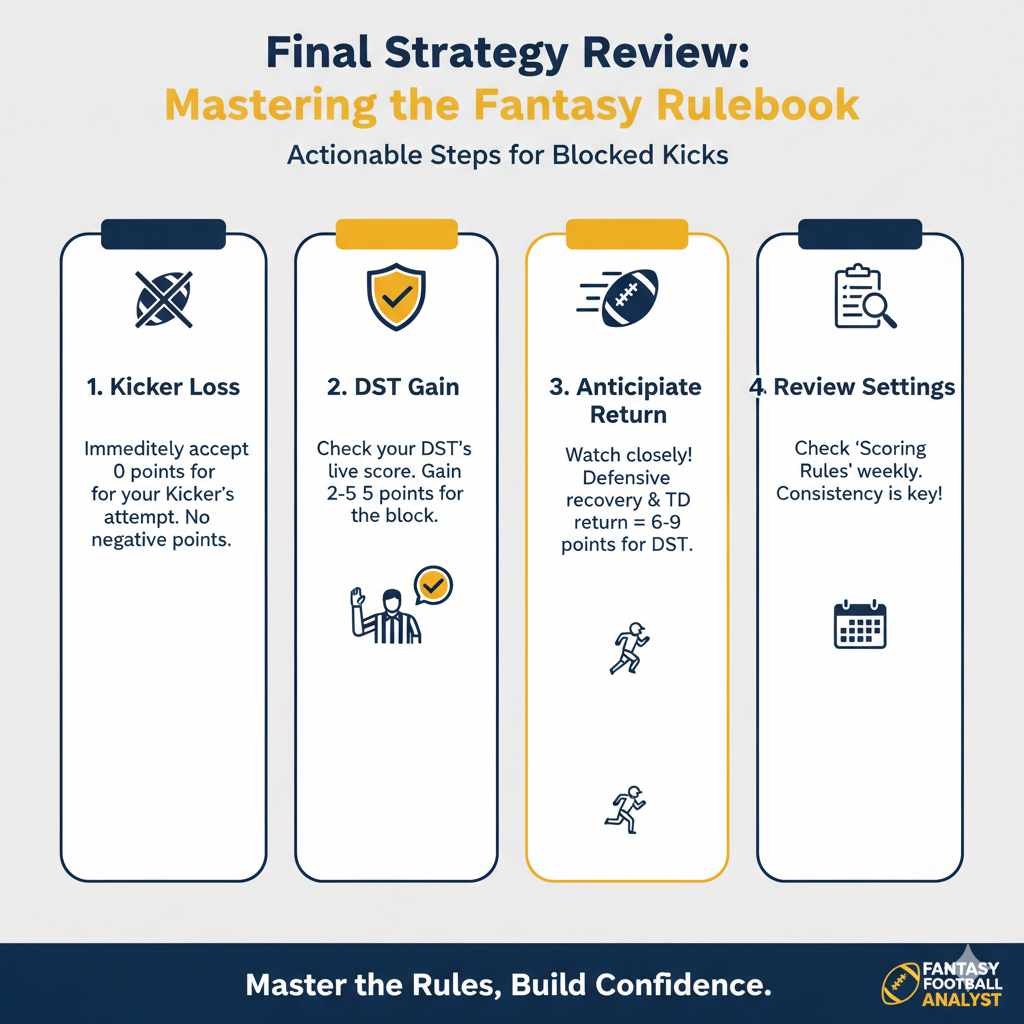
Final Strategy Review: Mastering the Fantasy Rulebook
To pull this all together, remember that the fantasy world rewards specificity. The blocked field goal play is a perfect example of a scoring event that shifts value entirely from one position (Kicker) to another (DST).
Here are your actionable steps moving forward:
- Acknowledge the Kicker Loss: Immediately accept that your kicker is getting 0 points for that attempt.
- Look for the DST Gain: Check your DST’s live scoring immediately. If they are the ones who performed the block, you have gained between 2 and 5 points.
- Anticipate the Return: If the ball is loose, watch closely! A defensive recovery and return for a touchdown means a guaranteed 6-9 points for your DST.
- Review Settings Weekly: Especially if your league uses unique scoring (PPR, custom IDP, etc.), spend five minutes reviewing the “Scoring Rules” before Sunday’s kickoff. Consistency in rule checking is the cornerstone of great fantasy management.
Like achieving perfect consistency in drawing your bow, mastering the fantasy rulebook builds confidence and reduces the emotional volatility of game day. When that block happens, instead of panicking, you’ll be smiling, knowing your DST just earned you crucial bonus points.
Beginner Fantasy FAQ: Blocked Kicks and Scoring
Q1: If a kicker misses a field goal that isn’t blocked, does that cost me negative points?
A: It depends on your league settings, but typically no. In standard scoring, a regular miss (shanking the ball, kicking it too short) simply results in 0 points for that attempt. Some highly competitive or custom leagues might penalize misses (e.g., -1 point for a miss over 40 yards), but you must check your specific league’s scoring rules to confirm.
Q2: Does a blocked punt score the same as a blocked field goal for the DST?
A: Often, yes, but not always. Many platforms lump “Blocked Kick (FG or Punt)” into one category, assigning 2 or 3 points for the event. However, some leagues value a blocked punt higher because it results in better field position (or a touchdown) more frequently than a blocked field goal. Always check the line item description under your DST scoring rules.
Q3: Who gets the points if a blocked field goal is recovered by the offense?
A: Only the DST unit gets the points for the initial block (2-3 points). If the kicking team (offense) recovers the ball, no further points are scored for the DST (like a fumble recovery). The drive usually stalls, and possession changes due to the turnover on downs, but the offense does not gain yardage or points.
Q4: If the blocker is a defensive player in my lineup, do they get points in a standard DST league?
A: No. In a standard league, only the combined Defense/Special Teams (DST) position scores points for the block. The individual defensive player (the actual blocker) does not accrue points unless you are playing in a highly customized Individual Defensive Player (IDP) league that specifically awards points for blocks to individual players.
Q5: Is a blocked extra point attempt scored the same as a blocked field goal?
A: This is a nuanced area. For the kicker, a blocked PAT (Point After Touchdown) results in 0 points. For the DST, a blocked PAT is generally scored the same as a blocked field goal (2-3 points). However, unlike field goals, some leagues only award points for a blocked field goal and ignore the less impactful blocked PAT. Check your platform carefully under the “Blocked Kick” section.
Q6: Are blocked kicks worth more than an interception or a fumble recovery?
A: No. While a block is highly valuable (2-5 points), an interception or a fumble recovery is typically worth more (often 2-4 points). The true value of the block comes when it is paired with a touchdown return, which instantly boosts the total score dramatically. An interception returned for a TD is usually 6 points, identical to a blocked kick returned for a TD.
Q7: Should I ever bench a kicker because they are playing a team known for blocking kicks?
A: Yes, absolutely. If your league is close and you have an alternative option, it is wise to avoid kickers facing defenses with elite special teams units. Consistency is key for kickers. If a defense has a history of high pressure and multiple blocks, it introduces unnecessary risk to your weekly projected score. Always prioritize kickers on offenses that generate points consistently and lines that ensure protection.
Conclusion: Confidence in Your Fantasy Sighting
Understanding the scoring rules around blocked field goals is the perfect example of how small details translate into major fantasy results. Just like a minor adjustment to your nocking point can dramatically improve your arrow flight, knowing the flow of fantasy points from the kicker to the DST can secure a win.
Remember the simple breakdown: the Kicker gets a painful zero, and the Defense/Special Teams unit earns the reward. Use this knowledge to your advantage. Don’t panic the next time you see that unfortunate batting down of the ball. Instead, celebrate the 2 to 5 bonus points you just received for your DST, and confirm that your league settings reward special teams excellence. Now that you have this clear understanding, you can approach the waiver wire and game day scoring with confidence and strategy.