
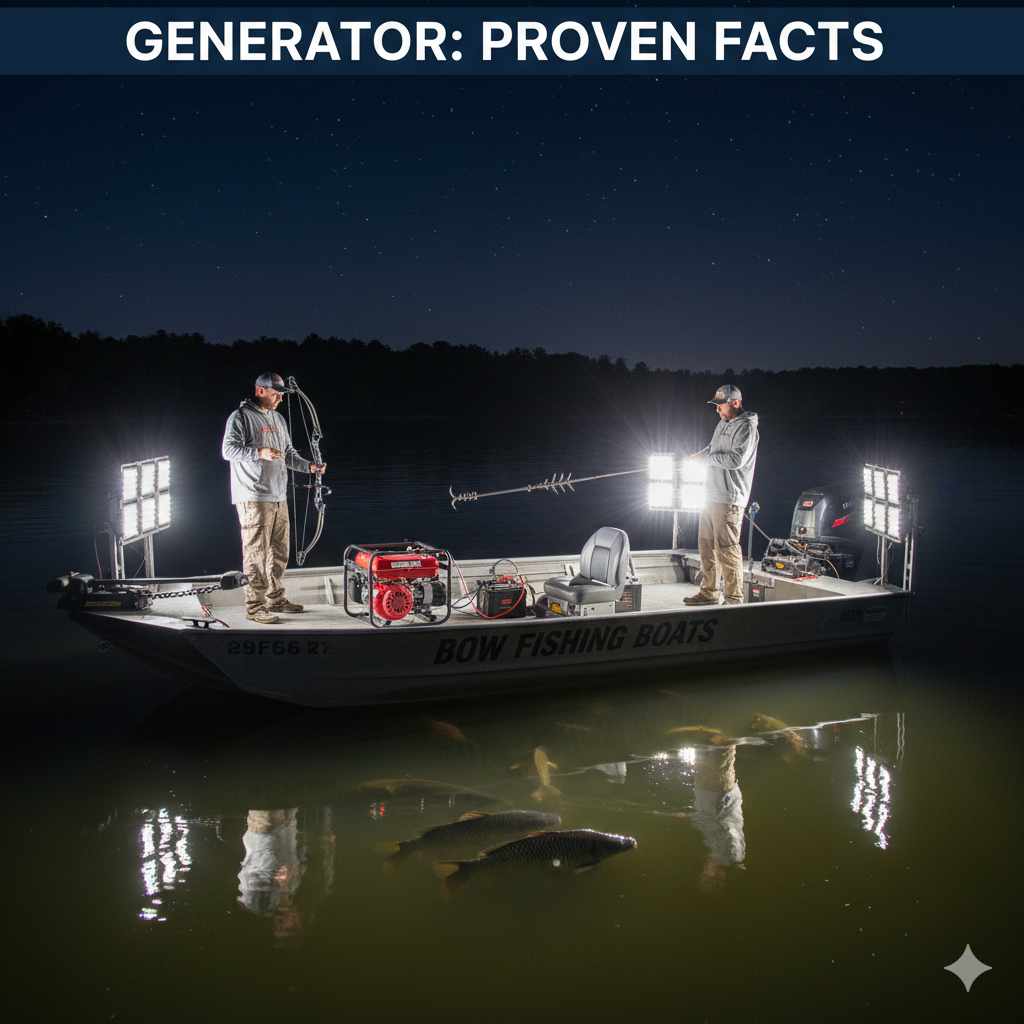
The immediate answer to whether bow fishing boats need a generator is: No, not always. You only need a generator if you run high-wattage lighting systems (like Halogen or HPS lights) or plan on extended nighttime trips. Modern, energy-efficient LED light setups can often run perfectly well for several hours on a robust deep-cycle marine battery system, saving you space, noise, and fuel costs.
Welcome back, fellow archers! If you are thinking about jumping into the exciting world of bowfishing, you have probably started thinking about night trips. Bowfishing after dark is when the action really happens. But as soon as you think about fishing at night, one massive question pops up: How do I light up the water?
The choice between running a generator or relying solely on batteries confuses almost every beginner. It feels complicated because the choice impacts your budget, your boat setup, and the noise level of your trip. Don’t worry, you don’t need an electrical engineering degree to figure this out! I’m here to break down the proven facts so you can choose the safest, simplest, and most effective power setup for your boat and maximize your time on the water.
We are going to walk through exactly what equipment uses power, how to calculate your needs, and the pros and cons of generators versus batteries. Let’s get started!
The Core Need: Why Power is Everything in Bowfishing
Unlike standard hook-and-line fishing, successful bowfishing relies 100% on light. You need to pierce the surface of the water, counteract the refraction (the bending of light through water), and illuminate the fish so you can take a clear shot. Your power source is arguably the most important piece of gear after your bow.
The biggest consumer of power on a bowfishing boat is, by far, the lighting system. Everything else—like the trolling motor or bilge pump—is usually powered separately by the boat’s main battery system. When we talk about needing a generator, we are talking about dedicated power for the lights.
Understanding the Light Setup and Wattage
Before you decide on a generator, you need to know what kind of lights you plan to use. Lights are measured in watts (W), which tells you how much power they consume.
There are three main types of lights bowfishers use:
Halogen/High-Pressure Sodium (HPS) Lights: These are the “old school” high-power lights. They offer excellent penetration and color but use enormous amounts of power. A typical Halogen setup might run 8 to 12 lights, each pulling 300 to 500 watts. This immediately puts you into generator territory.
LED Lights (Light Emitting Diode): This is the modern standard. LEDs require significantly less power for the same amount of illumination. An LED setup might use 8 to 12 lights, each pulling only 50 to 100 watts. This massive reduction in power demand is why batteries are now a viable alternative for many setups.
If your lighting load is high, the runtime of a battery is short. If your lighting load is low (like with LEDs), batteries can handle the job for much longer. This difference is the heart of the “generator versus battery” debate.
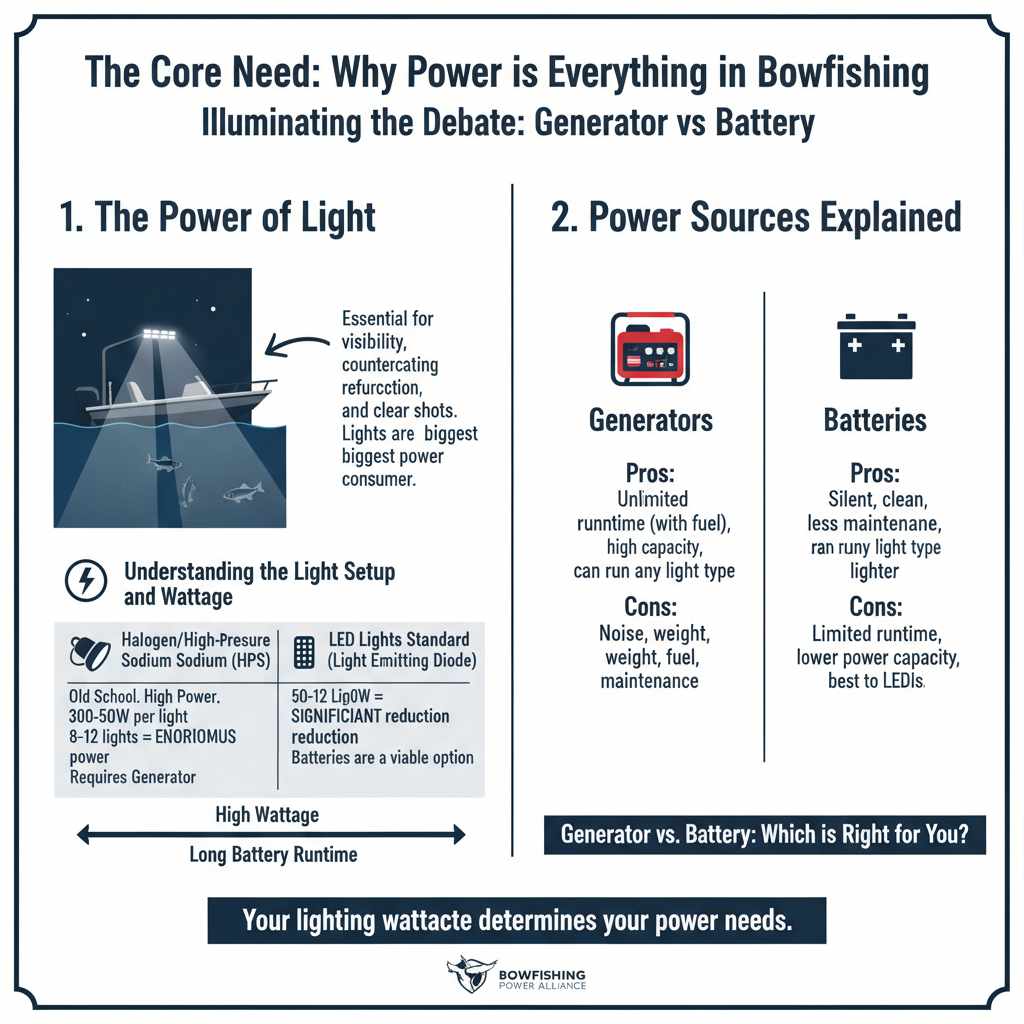
Generator vs. Battery: Deciding on Your Power Source
Choosing the right power system depends on three things: your lighting load, how long you plan to fish, and your budget. Let’s look at a straightforward comparison to help you decide which system fits your beginner setup best.
| Feature | Generator System | Deep-Cycle Battery System (LED Optimized) |
|---|---|---|
| Cost (Initial Setup) | Medium to High (Generator + Fuel) | Low to Medium (Batteries + Charger) |
| Runtime Potential | Very Long (As long as you have fuel) | Limited (Typically 4–8 hours, depending on load) |
| Noise Level | Medium to High (Even “quiet” generators make noise) | Silent |
| Power Output (Watts) | High (2,000W to 4,000W standard) | Low (Limited by inverter size, usually under 1,000W) |
| Maintenance & Fuel | High (Oil changes, fuel handling, winterization) | Low (Charging only) |
| Ideal Use Case | Running HPS/Halogen lights, long tournament fishing | Running high-efficiency LED lights, recreational trips |
The Generator Argument: When You Must Have Unlimited Power
For some bow fishers, especially those targeting tournaments or those who simply prefer the intense light output of HPS bulbs, the generator is mandatory. If your combined light load exceeds 1,500 watts, a generator is the only practical option. Trying to run that many lights off batteries would require dozens of heavy, expensive batteries that would only last an hour or two.
You need a generator if your setup includes:
More than 8 Halogen or HPS lights.
A desire to fish all night long (8+ hours) without stopping.
The need to power other 120V AC household appliances on the boat (like fans, high-powered chargers, or large electronics).
The Battery Argument: The Modern, Silent Approach
If you are a beginner setting up your first boat, I highly recommend exploring the battery route first, especially if you commit to modern LED lighting. Why? Because the experience is vastly improved when you eliminate the noise and exhaust of a generator.
Running a generator for eight hours can be loud and tiring. Bowfishing with batteries and LEDs is quiet, clean, and requires far less technical upkeep. You simply charge the batteries when you get home.
You can skip the generator if your setup includes:
High-efficiency LED light bars or modules (usually under 100W per light).
Standard recreational fishing trips lasting 3 to 6 hours.
A priority for silence and simplicity on the water.
Choosing the Right Generator for Your Bowfishing Boat
If you have crunched the numbers and determined that your light load requires a generator, you cannot just grab any old construction generator. Marine environments demand specific features, especially related to safety and noise.
Inverter is Non-Negotiable
For bowfishing, you must choose an inverter generator. Conventional generators are louder, heavier, and produce “dirty” power that can potentially harm sensitive marine electronics (and your expensive LED drivers, if you use them). Inverter generators are designed to be:
Quiet: Essential for sneaking up on fish and maintaining your sanity.
Fuel Efficient: They regulate engine speed based on the load, saving gas.
Compact: They take up less precious deck space.
Essential Generator Features for Bowfishing
Rated Wattage: The generator must provide 20% more running watts than your total calculated light load. If your lights pull 2,000W, buy a 2,500W unit.
Decibel (dB) Level: Look for units rated 60 dB or lower. The quieter, the better.
Safety Shut-Offs: Low-oil and overload protection are crucial for preventing damage to the generator and electrical system.
Fuel Type: Gasoline is standard, but dual-fuel (gas and propane) options offer flexibility if you want a longer, cleaner burn with propane.
Sizing Up Your Power Requirements: The Bowfishing Wattage Guide
This is the most critical step. Do not buy a generator or batteries until you complete this calculation. Many beginners make the mistake of buying too small, leading to frustration and equipment failure. You need to calculate your total “Running Watts” (the power used constantly).
Step 1: Calculate Your Total Lighting Load
Determine the wattage of every single light bulb or fixture you plan to mount on the boat. Remember, if you use an AC generator, you are powering AC lights (which is common for HPS). If you use a DC battery system, you are powering DC lights (which is common for LEDs).
| Equipment Type | Individual Wattage (Approx.) | Required Power Source |
|---|---|---|
| 12V LED Fixture (Modern Bowfishing) | 50W – 100W | Battery/DC System |
| HPS/Halogen Bulb | 300W – 500W | Generator/AC System |
| Trolling Motor (Max Speed) | 300W – 700W | Separate Deep Cycle Battery (Essential) |
| Fish Finder/GPS | 5W – 15W | Main Boat Battery |
| Bilge Pump | 50W – 75W | Main Boat Battery |
Step 2: Add a 20% Safety Margin
Electrical components never run at 100% efficiency, and you always need a buffer. If you calculate your lights need 1,800 watts, you must multiply that number by 1.20 (or add 20%).
Example Calculation for HPS Lights:
You install 10 HPS lights at 400W each = 4,000 Running Watts.
Add 20% safety margin: 4,000 x 1.20 = 4,800 Watts.
Conclusion: You need a generator that can handle 4,800 running watts. This is a heavy-duty setup.
Example Calculation for LED Lights (Battery System):
You install 10 high-efficiency LED lights at 80W each = 800 Running Watts.
Add 20% safety margin: 800 x 1.20 = 960 Watts.
Conclusion: You need to ensure your battery bank and inverter can safely handle a 960W load for your target runtime (e.g., 6 hours). This load is perfectly manageable with modern battery technology and means you don’t need a generator.
The Alternative: Powering Your Boat with Batteries and an Inverter
The rise of affordable, powerful LED lighting has made the generator optional for most hobbyists. If you opt for the battery route, you are essentially relying on a very large battery bank and an inverter.
Understanding the Inverter
Since your lights are usually 12V DC (Direct Current), and they run off 12V batteries, you might not even need an inverter. But if you want to run any standard 120V AC accessories (like a small charger), you will need a pure sine wave inverter to convert the DC battery power into usable AC power.
Choosing the Right Battery Type
You cannot use a standard car battery (a starting battery) for your light system. You need deep-cycle batteries, which are designed to be repeatedly drained and recharged.
AGM (Absorbed Glass Mat) Batteries: Affordable, zero maintenance, and handle vibration well. They are heavy but reliable.
Lithium (LiFePO4) Batteries: The gold standard. They are incredibly light, last much longer, and can be drained completely without damage. However, they cost significantly more upfront.
How to Determine Your Battery Capacity
Battery capacity is measured in Amp Hours (Ah). To figure out how many Amp Hours you need, use this simple rule:
(Total Watts / Voltage) x Target Run Time = Total Amp Hours Required
If your total load is 960W (from the LED example) and your system is 12V:
960W / 12V = 80 Amps per Hour (A/h)
If you want to fish for 6 hours:
80 A/h x 6 hours = 480 Total Amp Hours needed.
Since you should only drain a deep cycle battery to about 50%, you need a battery bank with a theoretical capacity of about 960Ah (480 Ah x 2). This means you would need four large 240Ah deep cycle batteries to safely power that 960W load for six hours. This is why generator-free bowfishing is only practical when you use high-efficiency LEDs that pull less power.
Safety First: Generator Operation on Water
As your friendly guide, I must emphasize safety, especially when dealing with gasoline and electricity near water. If you choose to use a generator, you must follow strict marine safety guidelines. Improper use of a generator on a boat is dangerous due to the risks of carbon monoxide poisoning, fire, and electrocution.
Always review the safety guidance from organizations like the US Coast Guard regarding safe handling and placement of marine power equipment. The US Coast Guard emphasizes that proper ventilation and placement are key when operating gas engines on a vessel.
Critical Generator Safety Tips
Placement is Key: The generator must be placed far from the main deck or cabin entrance, usually at the stern (rear) of the boat, to prevent carbon monoxide buildup.
Ventilation: Ensure the exhaust pipe is directed away from the boat and crew. Carbon monoxide is odorless and deadly.
Fueling Safety: Never refuel a hot generator on the water. Bring extra fuel in approved marine containers and only refuel on shore or dockside when the generator has cooled completely.
Grounding: Ensure your generator is properly grounded according to the manufacturer’s instructions. While on a boat, you must isolate the generator’s AC ground from the boat’s DC ground, or use a certified marine bonding plate.
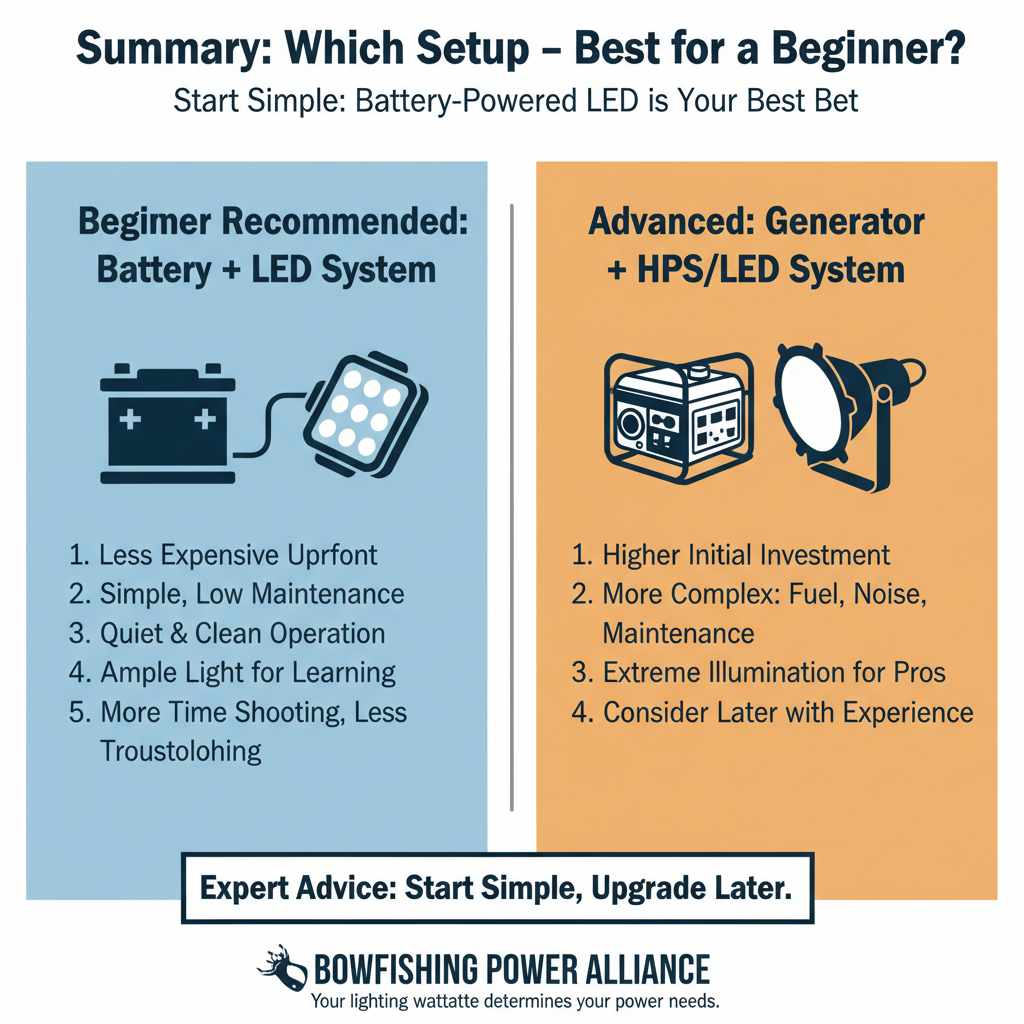
Summary: Which Setup is Best for a Beginner?
If you are just starting, complexity is your enemy. The simpler the setup, the more time you spend shooting and the less time you spend troubleshooting electrical issues.
My advice to 9 out of 10 beginners is to start with a battery-powered LED system. It is less expensive upfront, requires almost no maintenance, and offers quiet, clean operation. Once you master the sport and decide you need the extreme illumination offered by HPS lights, then you can invest in a high-quality inverter generator.
Frequently Asked Questions About Bowfishing Power
FAQ 1: Can I run my trolling motor off the generator, too?
No, you should not rely on the generator for your trolling motor power. Trolling motors require dedicated 12V, 24V, or 36V DC power from deep-cycle batteries. Generators produce 120V AC power. While you can use a small battery charger connected to the generator to recharge your trolling motor batteries, the trolling motor should always run directly from its own separate battery bank.
FAQ 2: What is the biggest advantage of using batteries instead of a generator?
The biggest advantage is the noise level. Batteries allow for silent operation. Silence is important for two reasons: fish are less spooked by a quiet boat, and the experience for the crew is much more enjoyable and less fatiguing over a long night of fishing.
FAQ 3: Do I need a special marine-rated generator, or will a standard inverter work?
You should use a high-quality standard inverter generator (like those made by Honda or Yamaha) as long as it has high safety standards and low noise levels. True “marine generators” are expensive, permanently installed units. A quality, portable inverter generator is fine for bowfishing, provided you follow all safety guidelines for placement and ventilation.
FAQ 4: How many watts do I need for a basic bowfishing setup?
For a basic, functional LED setup (around 8 lights), you should aim for a total running load of approximately 600–800 watts. If you choose the generator route, a 1,500-watt inverter generator provides plenty of headroom for this load.
FAQ 5: What is a pure sine wave inverter, and do I need one?
A pure sine wave inverter provides clean, smooth power that mimics household power. If you are only running 12V LED lights directly from batteries, you do not need one. If you want to convert the battery power to 120V AC power to run sensitive electronics (like phone chargers or laptop chargers), you absolutely need a pure sine wave inverter to prevent damage to those devices.
FAQ 6: Is it safe to store gasoline on my boat?
You must be extremely cautious. Gasoline should only be stored in approved marine fuel tanks or containers that are secured to prevent movement and spillage. They must be stored in well-ventilated areas away from ignition sources. Check with local fire and marine regulations regarding onboard fuel storage limits.
FAQ 7: How often do I need to recharge my deep cycle batteries?
You should recharge your deep cycle batteries immediately after every use. Allowing deep cycle batteries to sit in a partially discharged state greatly shortens their lifespan. For best results, use a quality smart charger to bring them back up to 100% capacity as soon as you return from the water.
Conclusion: Powering Your Passion Safely
When you start bowfishing, the technical details about power can feel overwhelming, but remember that the choice is rooted in simplicity: Are you running big, power-hungry lights, or modern, efficient lights? If you are running high-wattage lights for long periods, then yes, your bowfishing boat needs a generator.
However, if you embrace the latest LED technology, you can enjoy a quieter, lighter, and simpler battery-powered system. No matter which route you choose, always prioritize safety. Understanding your equipment and following proper marine operation guidelines ensures your trips are successful, safe, and fun.
Now that you know the facts about power, you can confidently build your bowfishing setup. See you on the water!