
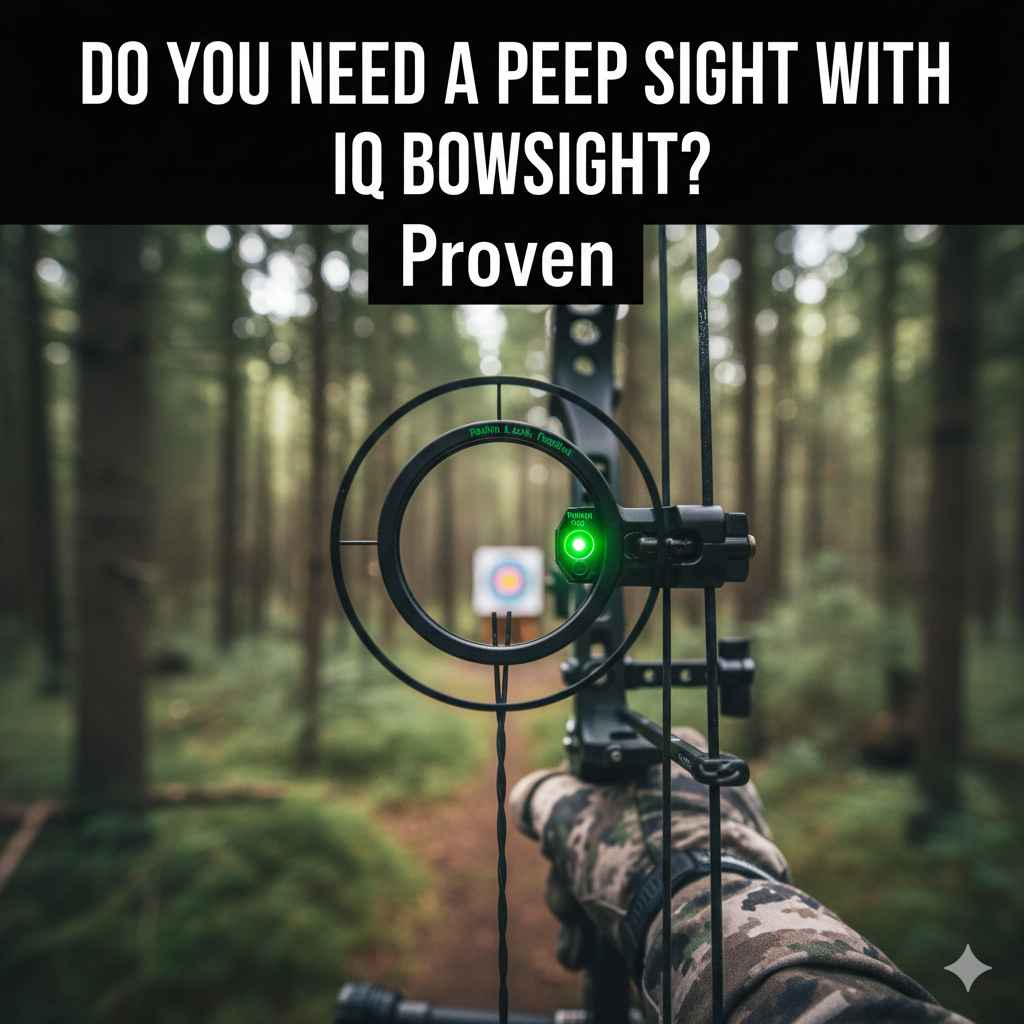
Not necessarily, but it depends on your setup, preference, and the specific IQ model you use. Modern IQ sights often integrate alignment features that make a traditional peep redundant for many archers, especially beginners focusing on simple, consistent aiming.
Welcome, fellow archer! Choosing the right gear can feel confusing, especially when new technology like the IQ Bowsight enters the picture. You might be wondering: “If my fancy new sight has all these aiming dots, do I still need that little circle thing—the peep sight?” This is a very common question, and it causes many new archers unnecessary stress. Don’t worry! We are going to break down exactly what a peep sight is, how the IQ sight works, and whether combining them is helpful or just extra work.
By the end of this guide, you will know precisely what setup works best for your comfort and accuracy. Let’s clear up the confusion so you can focus on what matters most: hitting your target consistently and having fun!
Understanding the Tools: Peep Sight vs. IQ Bowsight
To answer whether you need both, we first need a clear picture of what each piece of equipment does. Think of these two items as different ways to achieve the same goal: perfect alignment.
What Exactly is a Peep Sight?
A peep sight is a small, circular aperture (a hole) installed in your bowstring, usually right where your eye aligns. It acts like a tiny tunnel.
The Goal of the Peep Sight
The primary job of the peep is to force your eye into the exact same position behind the string every single time you draw the bow. When you look through the peep, you see your bow sight pins perfectly centered within the circle. This ensures consistency, which is the bedrock of good shooting.
- Consistency: It locks your head position.
- Clarity: It helps focus your dominant eye on the sight pins.
- Traditional Alignment: It’s the old-school standard for rifle-like accuracy.

What is an IQ Bowsight?
The IQ Bowsight (often called an IQ Retina Lock) is a high-tech alternative that focuses on a different part of the alignment equation. While it has fiber optic pins like most sights, its key feature is the ‘Retina Lock’ technology.
How the IQ Retina Lock Works
The Retina Lock system uses a small, second sight housing that appears in your peripheral vision while you look through your sight pins. This secondary circle stays fixed relative to the bow. If your head moves even slightly off-axis (left, right, up, or down) during the shot process, that peripheral circle will look crooked or misaligned compared to the main sight housing.
In simple terms: The IQ sight forces you to keep your head perfectly still and straight behind the bow, mimicking the alignment you would get from a peep sight, but using your peripheral vision instead of looking directly through a hole.
| Feature | Peep Sight | IQ Bowsight (Retina Lock) |
|---|---|---|
| Primary Function | Ensures consistent eye placement directly behind the sight. | Uses peripheral vision to detect head movement off-axis. |
| Method of Alignment | Looking through a circle on the string. | Seeing a fixed circle in your peripheral view. |
| Dependence on String Position | Highly dependent; if the string is bumped, the sight picture changes. | Independent of string movement once anchored. |
The Core Question: Do You Need A Peep Sight With IQ Bowsight?
The short, direct answer is: Generally, no.
For most archers, especially beginners transitioning to a modern sight system, the IQ Bowsight is designed to replace the function of the peep sight. It offers an alternative, often considered superior, method for achieving head and eye alignment.
Why the IQ Sight Aims to Eliminate the Peep
The IQ system is often chosen precisely because it removes the need for a separate peep installation. Here’s why many archers skip the peep when using IQ:
- Redundancy: Both devices achieve the same goal—consistent head position. Using both can be redundant and potentially confusing, as you end up trying to align two different aiming aids simultaneously.
- Environmental Sensitivity: Peep sights can be a huge issue in low light or bad weather. A peep becomes tiny or invisible when the sun sets or if it’s raining heavily. The IQ Retina Lock, relying on peripheral vision and the main sight housing, is often easier to use in dimmer conditions because you are looking at the target, not through a small hole.
- Installation Complexity: Installing a peep requires a trip to the pro shop, string serving, and precise placement, which adds cost and time. The IQ system is ready to go out of the box (after mounting to the bow).
- Gapping vs. Centering: With a peep, you center the sight housing inside the peep. With IQ, you focus on keeping the sight housing level and the peripheral circle perfectly aligned with the main housing. For beginners, focusing on one primary alignment method (the IQ circle) is often simpler than juggling two.
When Adding a Peep Might Still Make Sense (The Exceptions)
While the IQ sight is built to stand alone, there are a few niche situations where an experienced coach or archer might suggest keeping or adding a peep:
- Extreme Comfort/Habit: If you have shot traditional archery for years and simply cannot adjust to the peripheral vision cue of the IQ sight, sticking to what feels natural is key.
- Specific IQ Models: While most modern IQ sights feature the Retina Lock, older or specialized models might not have the advanced peripheral alignment feature, necessitating a peep for traditional alignment. (Always check your specific model documentation.)
- Low Light Performance Requirement: Some competitive shooters prefer the pinpoint accuracy a perfectly sized peep gives them when shooting in bright sunlight, even if it’s slightly less convenient in the dark. They might use the IQ as a backup alignment check.
Step-by-Step: Setting Up Your IQ Sight for Success (Without a Peep)
If you decide to ditch the peep and rely solely on your IQ Bowsight, the setup process is crucial. Getting this right ensures the Retina Lock feature works perfectly. This process focuses heavily on achieving proper anchor point consistency.
Step 1: Mount and Level Your IQ Sight
Before you do anything else, the main sight body must be perfectly level to the bow riser. If the main sight isn’t level, the alignment check will be flawed.
- Attach the sight securely to your bow’s mounting bracket.
- Use a reliable bow leveling tool (often called a ‘T-level’) placed on the sight body or near the rest.
- Adjust the vertical mount until the bubble is perfectly centered. This is your foundation.
Safety Note: Always ensure all mounting screws are snug but not overtightened to avoid stripping threads or damaging the bow limb/riser. Refer to the Grand National Archery Society (GNAS) guidelines for basic equipment handling, though specific sight installation should follow the manufacturer’s manual.
Step 2: Establish Your Anchor Point
The IQ system relies on your anchor point being consistent so that the sight housing remains in the same relationship to your eye every time.
- Draw your bow to full draw.
- Place your drawing hand firmly where it always goes—this is your anchor. Common anchors include the corner of the mouth or under the jawbone.
- Hold this position.
Step 3: Adjusting the Retina Lock (The Crucial Part)
This is where you teach the IQ sight where “straight” is for your body.
- Aiming: While holding your established anchor point (Step 2), aim your sight pins directly at a target about 10–20 yards away.
- Checking the Lock: Look slightly to the side (into your peripheral vision) at the alignment circle housing of the IQ sight.
- The Alignment Rule: You want the inner circle of the Retina Lock housing to align perfectly with the outer housing of the sight. They should look like one cohesive unit, perfectly concentric circles.
- Making Adjustments: If the inner circle looks shifted (say, too far to the left), you need to adjust the alignment of the entire IQ unit (often requiring slight rotation or adjustment on the sight bracket) until the peripheral circle aligns perfectly with the main housing while you are aimed correctly.
- Lock It Down: Once you achieve perfect concentric alignment at full draw, securely lock the adjustment screws.
Step 4: Practice the “Look-Away” Drill
This drill helps you ingrain the feeling of proper alignment without staring at the lock mechanism.
- Draw your bow and aim at your target (focusing only on the pins).
- Relax your focus slightly, allowing the periphery to come into view.
- If the peripheral circle looks crooked, you know your head is tilted or shifted.
- Correct your head position until the peripheral circle snaps back into alignment with the main housing.
- Repeat this process 20–30 times before shooting an arrow. This builds muscle memory for perfect alignment using the IQ system alone.
Pros and Cons: Peep Sight vs. IQ Only Setup
Deciding which path to take involves weighing the advantages and disadvantages of each system for your personal shooting style.
When Relying Solely on the IQ Bowsight (No Peep)
| Pros of IQ Only | Cons of IQ Only |
|---|---|
| Superior low-light performance (no tiny hole to see through). | Can be distracting for true beginners until muscle memory is built. |
| Eliminates string vibration interference with sight picture. | Requires precise initial setup of the Retina Lock alignment. |
| Often easier to transition to for new compound bow users. | If the sight housing or bracket is bumped, it needs re-zeroing or adjustment. |
| No extra installation cost or time for a peep. | Some archers find the peripheral visual cue less intuitive than looking through a tunnel. |
When Adding a Peep Sight to an IQ Setup (The Hybrid Approach)
Why would someone bother adding a peep if the IQ sight already does the job?
Advantages of the Hybrid Approach:
- Redundancy for Safety: If you accidentally lose your string alignment cue (e.g., forget to check the peripheral lock), the peep acts as a secondary guardrail.
- Visual Tunnel Effect: Some competitive shooters enjoy the way the peep naturally “frames” the sight picture, making the sight pins pop out more distinctly against the background.
- Focusing Power: For archers with astigmatism or vision challenges, looking through a defined hole (the peep) can sometimes help the eye focus better on the front pin, even if the IQ system is also active.
Disadvantages of the Hybrid Approach:
- Visual Clutter: You are now trying to align your eye through the peep and watch the peripheral lock circle. This overcomplicates the aiming process significantly for a beginner.
- Over-Reliance: New shooters might rely too much on the peep and ignore the core benefit of the IQ—checking the head position via peripheral sight.
- Installation and Maintenance: You introduce an extra component that can wear out or need adjustment when replacing strings.
Practical Decision Guide for Beginners
As your coach, my advice for someone starting out with a compound bow equipped with an IQ sight is simple: Start without the peep.
The IQ sight was engineered specifically to address the alignment problems traditionally solved by the peep. By eliminating the peep initially, you are focusing on learning the mechanics of the IQ system, which is highly effective and extremely popular among modern target archers and bowhunters.
Decision Flowchart: Should I Install a Peep?
Use this simple guide to help you decide:
- Are you shooting primarily in low light (dusk/dawn)?
Yes: Stick to IQ Only. (Peeps vanish in the dark.) - Is your primary goal to simplify your setup?
Yes: Stick to IQ Only. (Less hardware means fewer variables.) - Are you an experienced barebow or recurve shooter transitioning?
Maybe: Consider the Hybrid. (You might already have strong visual habits that a peep complements.) - After 10 practice sessions, do you consistently feel like your head position is shifting despite checking the IQ lock?
Yes: Visit a pro shop and ask them to install a peep. (Use the peep as your primary alignment tool, letting the IQ function as a secondary check, or simply ignore the IQ lock until you are comfortable with the peep.)
Remember, archery is deeply personal. If you find the IQ peripheral circle distracting or hard to see, a peep sight is a perfectly valid, time-tested alternative for alignment. But give the technology a fair chance first!

Frequently Asked Questions (FAQ) for New IQ Sight Users
Q1: If I don’t use a peep, how do I know if my sight pins are centered in my vision?
A: With the IQ sight, you focus on the target, and the pins will naturally fall into place. For alignment checking, you watch the peripheral circle. When the inner and outer parts of the Retina Lock housing look perfectly concentric (aligned), your head position is correct, and your sight pins are centered relative to your eye.
Q2: Does using an IQ Bowsight without a peep affect my arrow velocity or tune?
A: No, it will not affect arrow velocity or tune. Velocity is determined by bow poundage and arrow spine/weight. Tune is determined by the arrow rest and nocking point height. The sight system only affects aiming accuracy.
Q3: Is it safe to shoot a bow without a peep sight?
A: Absolutely, it is safe. The only safety concern with sights is if you aim inaccurately. As long as you are confident in your alignment method (whether it’s the peep or the IQ system) and always follow basic range safety rules (like never dry-firing the bow), your equipment setup is safe.
Q4: If I install a peep later, how do I sight in my pins again?
A: If you add a peep, you must re-sight your pins, as the string alignment changes. You would adjust your sight pins until they align perfectly through the peep, then verify that the IQ Retina Lock still aligns correctly when you use the peep as your primary aiming reference.
Q5: What happens if my IQ sight bracket gets knocked out of alignment?
A: If your bow accidentally bumps against something and the IQ sight bracket shifts, the Retina Lock alignment may no longer appear perfectly centered. When this happens:
- First, check if the sight pins are still hitting the target where expected.
- If the Retina Lock circle looks off-center, you will need to re-align the sight housing using the adjustment screws.
- After adjusting, confirm that the inner Retina Lock circle appears perfectly centered inside the outer housing while at full draw.
If you are unsure how to do this, a quick visit to an archery pro shop can restore proper alignment in just a few minutes.
Q6: Can beginners learn faster using an IQ Bowsight instead of a peep sight?
A: Many beginners actually learn faster with an IQ Bowsight because it simplifies the aiming process. Instead of trying to look through a tiny peep hole and align multiple elements, the archer mainly focuses on:
- Keeping the Retina Lock circle aligned
- Holding the sight pin on the target
- Maintaining a steady anchor point
This reduces complexity and helps new archers develop better head positioning and shooting posture early on.
Conclusion: Should You Use a Peep Sight with an IQ Bowsight?
In most situations, you do not need a peep sight when using an IQ Bowsight. The Retina Lock technology was specifically designed to solve the same alignment problem that peep sights traditionally handled. By monitoring head movement through peripheral vision, the IQ system helps maintain consistent form without requiring you to look through a small aperture in the bowstring.
For beginners and many hunters, using only the IQ Bowsight offers several advantages:
- Simpler setup with fewer components
- Better visibility in low-light conditions
- Faster target acquisition
- Less equipment maintenance
However, archery is highly personal, and some experienced shooters still prefer a hybrid setup with both a peep sight and an IQ sight for added visual reference. If you feel more comfortable with the traditional tunnel-style sight picture, adding a peep later is always an option.
The best approach is to start simple. Try shooting with the IQ Bowsight alone and spend time practicing consistent anchor points and steady form. If you later feel that your alignment could benefit from additional guidance, experimenting with a peep sight may help refine your accuracy.
In the end, the most important factor is consistent practice and a comfortable setup. When your equipment feels natural and your alignment becomes repeatable, hitting the target becomes far more satisfying—and far more consistent. 🏹