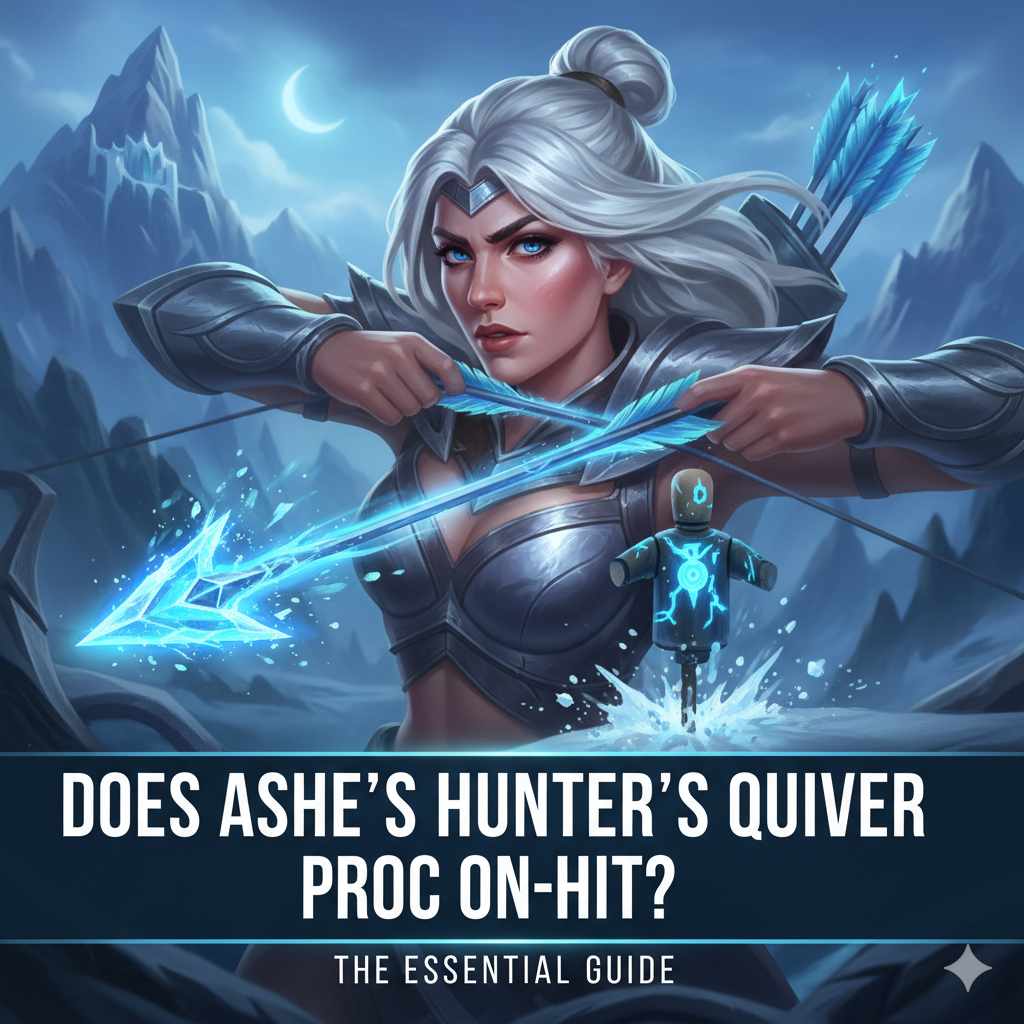
In real-world archery, quivers like the Ashe Hunter Quiver do not “proc on hit.” A quiver’s purpose is to hold arrows securely and provide easy access, not to add any special effect to your shot. The impact of your arrow is determined by the arrowhead, arrow weight, and your shooting technique.
Welcome, fellow archers! If you’re stepping into the wonderful world of archery, you might hear terms that sound a little confusing. One question I’ve seen pop up is about whether a quiver can “proc on hit.” This is a common question, especially for those who also enjoy video games where equipment often has special effects.
It’s easy to wonder if your gear has hidden abilities. But in archery, the magic isn’t in the gear—it’s in your skill and understanding of how everything works together. Don’t worry, it’s not complicated at all! In this guide, we will clear up any confusion and show you what truly makes your arrow fly true and hit with authority. Let’s dive in and separate fact from fiction.
Understanding the Question: What Does “Proc On Hit” Mean in Archery?
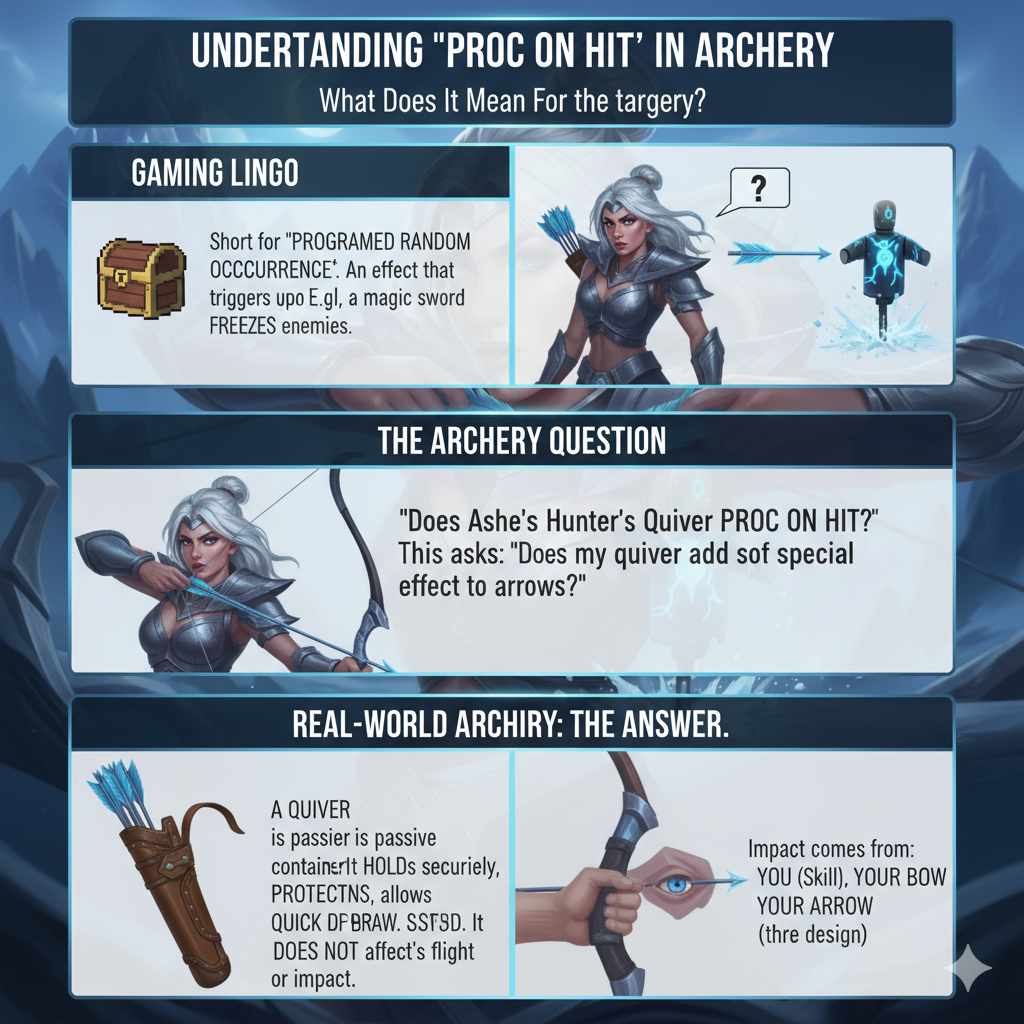
First, let’s break down that phrase. “Proc on hit” is a term that comes from the world of gaming. It’s short for “Programmed Random Occurrence,” which means a piece of equipment has a chance to create a special effect when you hit a target. For example, a magic sword might have a chance to freeze an enemy when it strikes.
So, when we ask, “Does the Ashe Hunter Quiver proc on hit?” we are essentially asking: “Does my quiver add a special effect or change how my arrow hits the target?”
In real-world archery, the answer is simple: No, it does not.
A quiver is a container for your arrows. Its job is incredibly important, but it’s a passive one. It holds your arrows securely, protects their fletching (the feathers or vanes), and allows you to draw a new arrow quickly and safely. It doesn’t interact with the arrow once it has been fired. The power, accuracy, and impact of your shot come from three things: you, your bow, and your arrow.
The Real Job of a Quiver: Your Trusty Arrow Holder
Think of your quiver as your arrow’s home before it goes on its journey. A good quiver does its job so well you almost forget it’s there. It should be comfortable, quiet, and reliable. While it won’t add a magical effect to your shot, choosing the right one can definitely improve your shooting experience.
There are three main types of quivers you’ll see, and each has its own strengths. Choosing one often comes down to personal preference and the type of archery you’re doing.
Types of Quivers for Beginners
| Quiver Type | Best For | Pros | Cons |
|---|---|---|---|
| Hip Quiver | Target archery, field archery, beginners | Easy to see and grab arrows. Doesn’t interfere with your upper body. | Can swing around while walking. Arrows can snag on branches. |
| Back Quiver | Traditional archery, roving, hunting | Keeps arrows completely out of the way. Classic, iconic look. | Harder to grab arrows without practice. Can be noisy if arrows rattle. |
| Bow-Mounted Quiver | Bowhunting, 3D archery | Arrows are always with the bow, very convenient. Keeps arrows secure and quiet. | Adds weight and bulk to the bow, which can affect balance. |
For most beginners starting with target practice, a simple hip quiver is a fantastic choice. It makes grabbing your next arrow feel natural and lets you focus on your form without reaching behind your back.
What Actually Affects Your Arrow’s Impact?
So, if the quiver doesn’t create an “on-hit effect,” what does? The answer lies in the physics of the shot. Several key elements work together to determine how your arrow flies and what happens when it reaches the target. Let’s look at the real factors that control your arrow’s performance.
1. The Arrowhead (The “Business End”)
The single biggest factor determining what happens on impact is the point of your arrow. Different arrowheads are designed for completely different jobs. Using the right one is critical for both safety and success.
- Field Points: These are the simple, bullet-shaped points you’ll use for practice. They are designed to penetrate a foam or bag target easily and be removed without causing much damage. They are perfect for learning and honing your skills.
- Broadheads: These are used for hunting. They have sharp blades designed to cut on impact. They should only be used for hunting and never shot into standard practice targets, as they will destroy the target and are very difficult to remove safely.
- Blunts: These are flat-tipped points used for small game hunting or for specific types of archery games like stump shooting. They are designed to hit with impact force rather than penetration.
As you can see, changing your arrowhead is the closest thing in real archery to changing an “on-hit effect.”
2. Arrow Spine and Weight
Every arrow has two important properties: its spine and its weight. Getting these right is key to achieving accuracy and consistent impact.
Arrow Spine: This refers to the stiffness of the arrow shaft. When you release the bowstring, the arrow flexes as it leaves the bow. For the arrow to fly straight, its stiffness (spine) must match the power of your bow.
- An arrow that is too stiff (over-spined) will veer to one side.
- An arrow that is too weak (under-spined) will veer to the other side and can even be dangerous to shoot.
You can find arrow spine charts from manufacturers that help you match the right arrow to your bow’s draw weight and your draw length. For more detailed information, Archery 360 offers a great beginner’s guide to help you get started.
Arrow Weight: Measured in grains, the total weight of your arrow affects both its speed and its momentum.
- Lighter Arrows: Fly faster and have a flatter trajectory, making it easier to aim at different distances.
- Heavier Arrows: Fly slower but carry more momentum. This means they are less affected by wind and penetrate deeper into a target.
For beginners, a mid-weight arrow is usually the best choice. It offers a good balance of speed and stability, making it forgiving as you learn.
3. Your Bow’s Draw Weight
Draw weight is the amount of force required to pull the bowstring back to your anchor point. It’s measured in pounds (#). A higher draw weight stores more energy in the bow’s limbs, which is then transferred to the arrow upon release.
More draw weight means:
- Faster arrow speed.
- A flatter flight path.
- More kinetic energy and momentum on impact.
However, it is crucial for beginners to start with a low, comfortable draw weight. Trying to pull too much weight will ruin your shooting form and lead to bad habits that are hard to break. Good form with a 25-pound bow will always be more accurate and powerful than bad form with a 50-pound bow. Focus on technique first, and you can increase the weight as you get stronger.
4. Your Shooting Form and Technique
This is the most important factor of all. You can have the best bow and arrows in the world, but without good form, you won’t be able to hit your target consistently. Your technique is the engine that drives the entire shot. A smooth, repeatable shooting process ensures that every arrow leaves the bow in the exact same way.
Here are the key steps to a great shot:
- A Solid Stance: Stand with your feet shoulder-width apart, perpendicular to the target. Your body should be relaxed but stable.
- A Consistent Grip: Hold the bow lightly. A tight “death grip” will twist the bow and throw off your shot.
- A Smooth Draw: Pull the string back in a steady, fluid motion until you reach your anchor point.
- A Firm Anchor Point: This is a spot on your face (like the corner of your mouth or under your chin) that your drawing hand touches every single time. Consistency here is the secret to accuracy.
- A Surprise Release: Don’t pluck the string. Simply relax your fingers and let the string slip away cleanly. It should feel like a surprise.
- Follow-Through: Keep your bow arm pointed at the target and your release hand at your anchor point until the arrow hits the target. This prevents you from moving the bow prematurely.
Choosing Your First Quiver: A Beginner’s Guide
Now that we know the quiver’s true role, how do you pick a good one? For a beginner, the best quiver is one that is simple, safe, and doesn’t get in your way. You don’t need to spend a lot of money to get a great quiver that will serve you well.
Key Features to Look For
- Ease of Use: Can you draw an arrow from it smoothly and quietly without looking? A hip quiver is often the easiest for new archers to master.
- Arrow Security: Does it hold your arrows firmly? You don’t want them rattling around or, worse, falling out while you’re walking. Look for individual arrow grippers or deep pockets.
- Comfort and Fit: The quiver should sit comfortably on your body and not interfere with your draw cycle. An adjustable belt or clip is a great feature.
- Durability: Look for sturdy materials like nylon, canvas, or leather. It doesn’t need to be fancy, just well-made.
Our Top Quiver Recommendations for Beginners
| Quiver Style | Why It’s Great for Beginners | Things to Consider |
|---|---|---|
| Simple Hip Quiver | Very affordable and easy to use. Arrows are always visible and within easy reach, which helps build a smooth rhythm. | Can sometimes feel bulky at your side. Make sure it sits in a comfortable position that doesn’t hinder your movement. |
| Field Quiver | A variation of the hip quiver where arrows point backward. This keeps them out of the way when walking through brush. | Slightly harder to grab arrows than a forward-facing hip quiver, but many find it more comfortable for walking. |
| Ground Quiver | A simple stand you stick in the ground to hold your arrows. Perfect for stationary target practice in your backyard. | Not wearable. You have to stay in one spot, so it’s not suitable for field archery or 3D courses. |
Safety First: How Your Quiver Choice Impacts Safety
Safety is the most important part of archery. While a quiver is simple, your choice can have safety implications. A well-designed quiver protects both you and your equipment.
Here’s how a quiver contributes to safety:
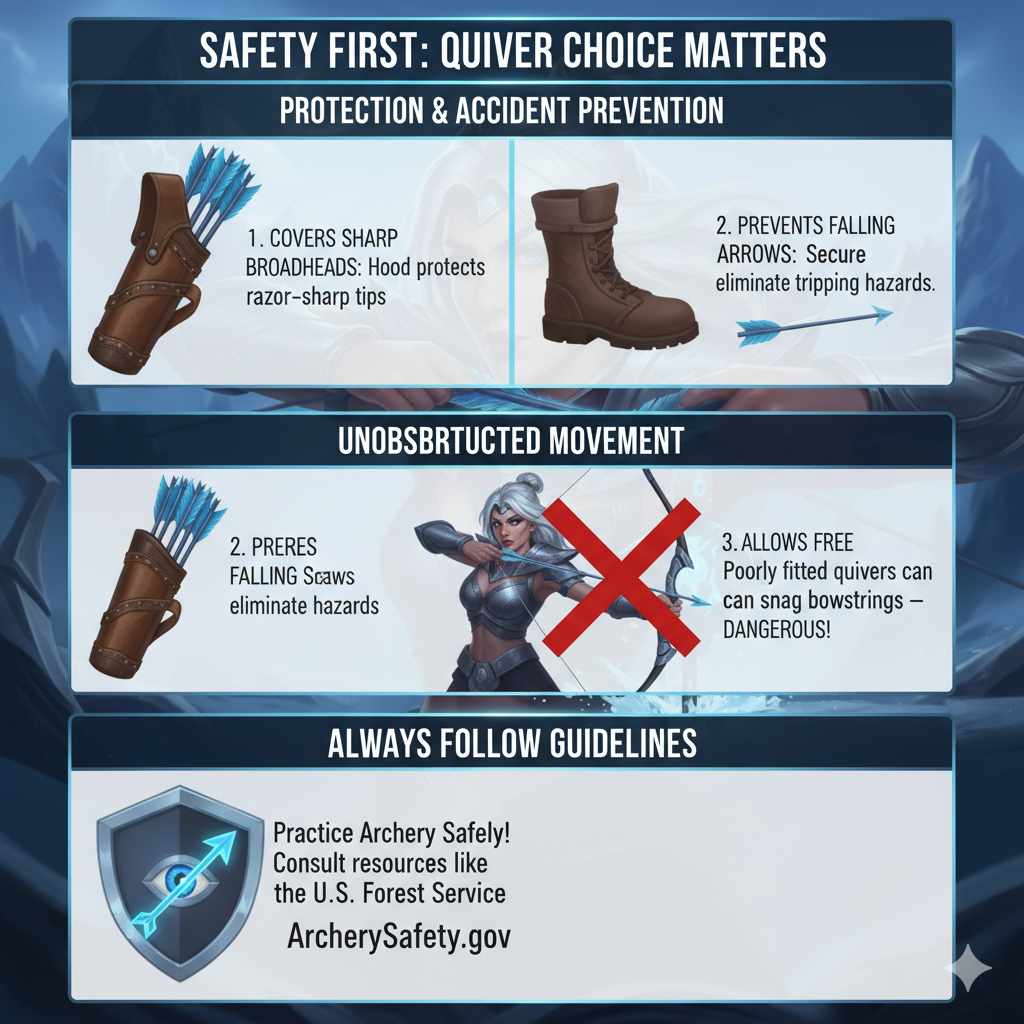
- Covering Arrowheads: If you ever progress to using broadheads for hunting, a good quiver will have a protective hood that completely covers the sharp blades. This is non-negotiable for safety.
- Preventing Accidents: A secure quiver prevents arrows from falling out, where they could be stepped on or create a tripping hazard.
- Allowing Free Movement: Your quiver should never get in the way of your bowstring or your arms during a shot. A poorly fitted quiver can snag on the string, which is extremely dangerous.
Always follow established safety guidelines when practicing archery. Resources like the U.S. Forest Service provide excellent archery safety rules that every archer should know.
Frequently Asked Questions (FAQ)
Does a more expensive quiver make you a better archer?
No, not at all. A more expensive quiver might be made from fancier materials like premium leather or have more pockets, but it won’t improve your accuracy. A simple, functional quiver that holds your arrows securely is all you need. Focus your budget on a good bow and high-quality arrows first.
What’s the difference between a back quiver and a hip quiver?
A back quiver is worn over the shoulder, so the arrows rest on your back, like in the movies. A hip quiver attaches to your belt and holds the arrows at your side. For beginners, hip quivers are generally recommended because it’s much easier to see and grab your arrows.
Can I use a quiver made for broadheads with field points?
Yes, absolutely. A quiver designed for broadheads will have a protective hood and wide foam or grippers inside to hold the blades. It will hold arrows with field points just fine. However, you generally cannot use a simple target quiver with broadheads, as the sharp blades can cut through the material.
How many arrows should I carry in my quiver for practice?
For a round of target practice, carrying 6 to 12 arrows is plenty. This allows you to shoot a decent number of arrows (an “end”) before you have to walk to the target to retrieve them. Carrying too many arrows just adds unnecessary weight.
How do I properly wear a hip quiver?
A hip quiver should be clipped or looped onto your belt. For a right-handed archer, it is typically worn on the right hip, allowing you to grab arrows with your right hand. Adjust it so it sits comfortably and doesn’t swing wildly as you move.
Is a bow-mounted quiver good for beginners?
A bow-mounted quiver can be a good option, but it does add weight to the bow. For a beginner learning form, this extra weight can sometimes cause them to drop their bow arm. It’s often better to start with an off-the-bow quiver (like a hip quiver) to learn the fundamentals with the lightest possible setup.
Can a quiver damage my arrows?
A poorly designed quiver can potentially damage the fletchings (the “feathers”) on your arrows if it’s too tight or doesn’t have enough clearance. Look for quivers with individual arrow slots or tubes that protect the fletchings from being bent or crushed.
Conclusion: Your Quiver is a Tool, You Are the Archer
So, let’s circle back to our original question. Does an Ashe Hunter Quiver, or any quiver, “proc on hit”? The clear answer is no. In the real and rewarding world of archery, there are no secret power-ups or magical effects from your gear.
Your quiver is a humble but essential partner. It holds your arrows, keeps them safe, and makes your shooting session smoother and more enjoyable. The real power behind the arrow comes from you. It comes from your stance, your consistent anchor point, your smooth release, and your focused follow-through. It comes from the time you spend practicing and getting to know your equipment.
Instead of looking for a quiver with special effects, look for one that feels like a natural extension of your body. Find one that does its job quietly so you can focus on yours: aiming true and letting the arrow fly. Happy shooting!