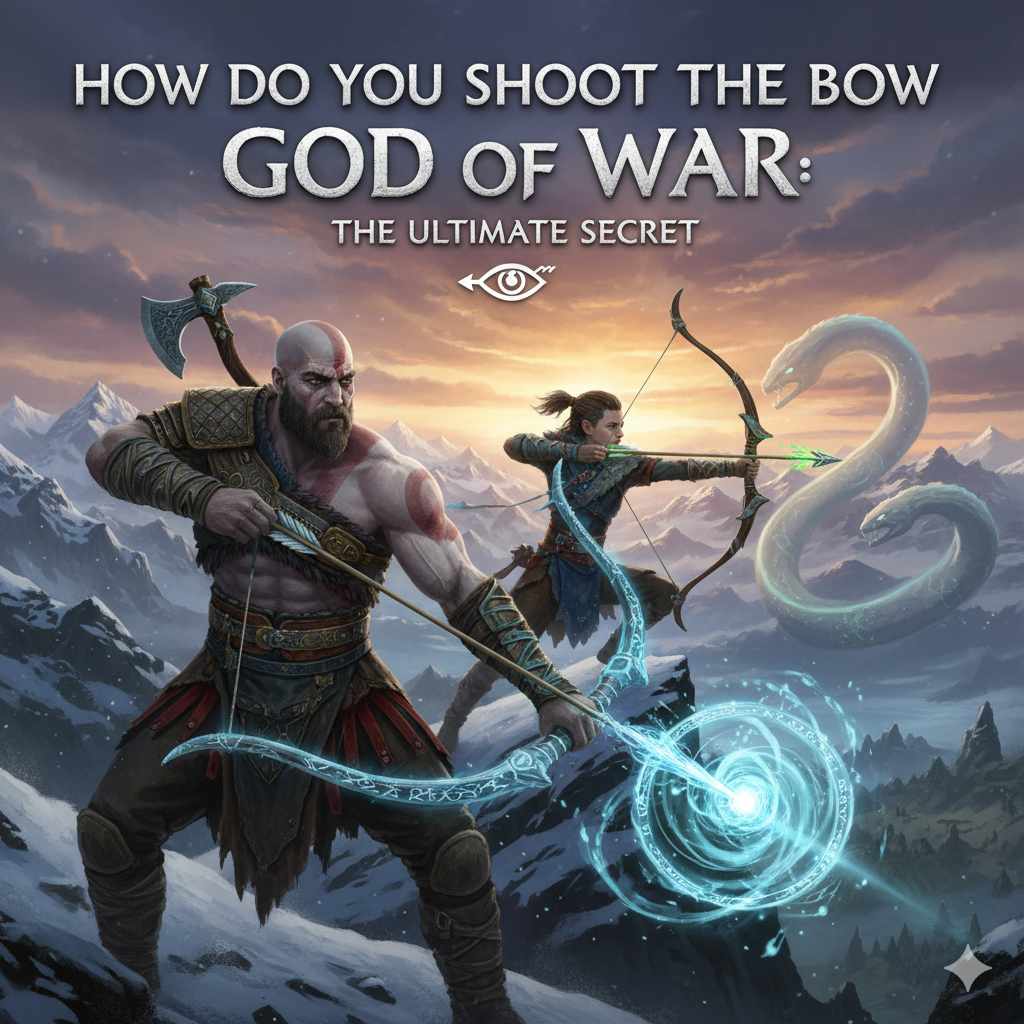
To shoot a bow like a legendary warrior, focus on three things: a solid stance, a consistent anchor point, and a smooth release. Stand sideways to the target, draw the string to the same spot on your face every time, and let your fingers relax to release the arrow. This consistency is the true secret to god-like accuracy.
Have you ever watched a character in a game like God of War and wondered how they make archery look so effortless and powerful? It feels like magic. You might be standing at the range, bow in hand, feeling a bit clumsy. Your arrows might fly everywhere but where you want them to go. It can be frustrating, and it’s a feeling every new archer knows well. But I’m here to tell you a secret: there is no magic trick. The “ultimate secret” is actually a set of simple, powerful steps that anyone can learn. In this guide, I’ll walk you through those exact steps to build your skill, confidence, and accuracy. Let’s unlock your inner archery hero, one arrow at a time.
The Real “Secret”: It’s Not Magic, It’s Technique
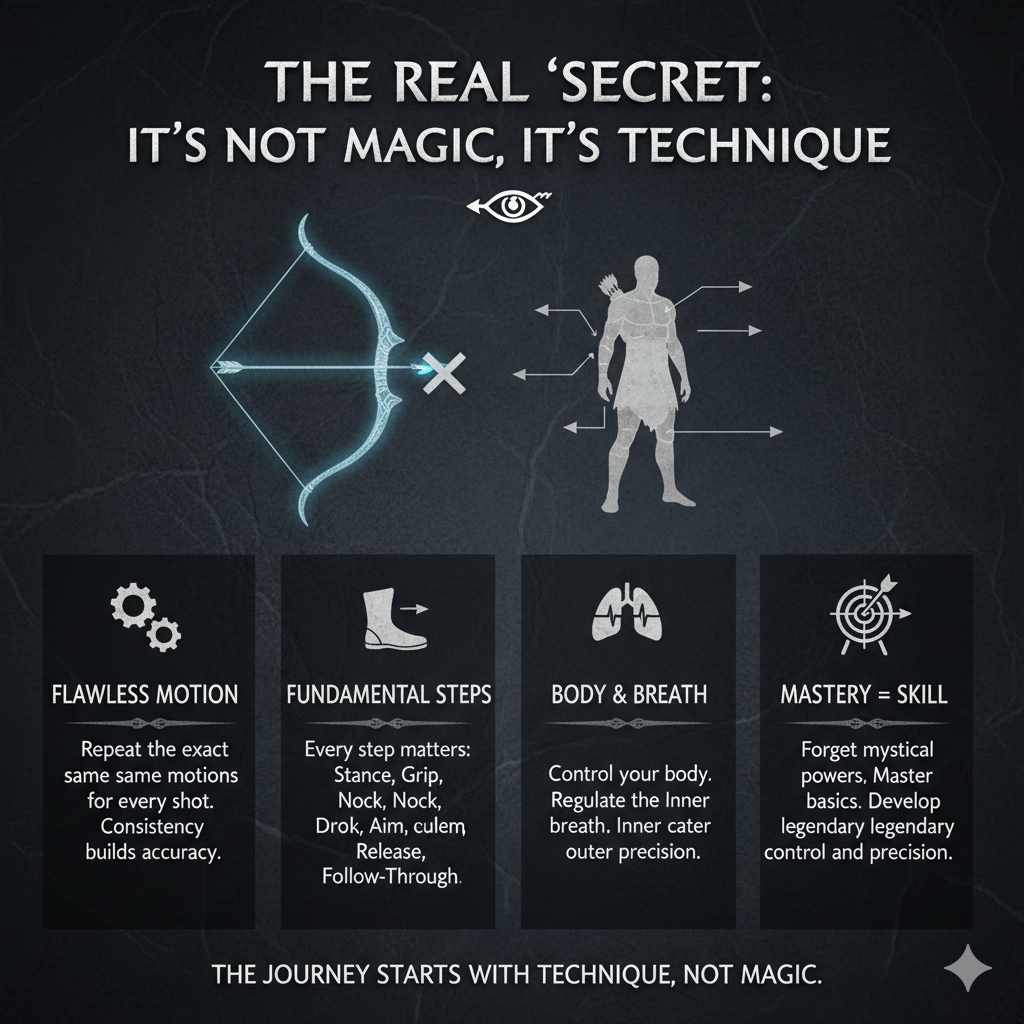
The most impressive archers, both in fiction and in real life, rely on one thing: flawless technique. They repeat the same exact motions for every single shot. This consistency is what builds accuracy. Every step, from how you stand to how you breathe, plays a part in where your arrow lands. Forget about mystical powers or impossible feats. We’re going to focus on the real-world fundamentals that build true skill. By mastering these basics, you’ll develop the kind of control and precision that feels legendary. The journey starts not with a magical bow, but with understanding your own body and how to use the tool in your hands.
Gearing Up: Choosing Your First Bow
Before you can shoot like a warrior, you need the right weapon. Choosing your first bow can feel overwhelming, but it doesn’t have to be. For beginners, the goal is to find a bow that is comfortable, forgiving, and fits your body. You don’t need the most expensive or powerful bow on the market. In fact, starting with a bow that has a lower “draw weight” (the amount of force needed to pull the string back) is much better for learning proper form. A heavy bow will tire you out and cause you to develop bad habits. Focus on a bow that lets you practice without straining.
Types of Bows for Beginners
There are three main types of bows you’ll encounter. Each has its own feel and style. Here’s a quick breakdown to help you decide which path is right for you.
| Bow Type | Pros for Beginners | Cons for Beginners | Best For |
|---|---|---|---|
| Recurve Bow | Great for learning form, versatile, often used in the Olympics, can be taken apart for easy transport. | Less forgiving than a compound bow; requires more practice for accuracy. | Someone who wants to learn the pure fundamentals of archery and enjoys a classic feel. |
| Longbow | Simple and traditional design, very satisfying to shoot, connects you to the history of archery. | Can be difficult to aim without a sight, requires a very consistent technique. | The traditionalist who loves simplicity and a challenge. |
| Compound Bow | Very accurate and powerful due to its pulley system (cams), easier to hold at full draw, highly customizable. | More complex mechanics, can be heavier, and often more expensive. | A beginner focused on hunting or achieving high accuracy quickly. |
My advice for most beginners? Start with a recurve bow. It strikes a perfect balance between simplicity and performance, forcing you to learn the correct form from day one. This foundation will serve you well no matter what type of bow you shoot in the future.
Step 1: The Atreus Stance – Your Foundation for Power
Every great shot starts from the ground up. Your stance is the foundation of your entire shot sequence. An unstable stance will lead to an unstable shot, no matter how well you do everything else. Think of your body as a stable platform for the bow. The goal is to be balanced, relaxed, and strong.
- Find Your Line: Imagine a line on the ground pointing directly at the target.
- Position Your Feet: Stand with your feet straddling that line. Your feet should be about shoulder-width apart. If you’re right-handed, your left side will face the target. If you’re left-handed, your right side will face the target.
- Distribute Your Weight: Keep your weight evenly distributed between both feet. Don’t lean forward or backward. You should feel solid and planted.
- Check Your Alignment: Your shoulders and hips should be in line with your feet, parallel to the arrow’s path. Avoid twisting your body.
- Stay Relaxed: Keep your knees slightly bent, not locked. A rigid stance creates tension, and tension is the enemy of a good shot.
Practice this stance without a bow first. Close your eyes and feel the balance. When you can stand comfortably and solidly without thinking about it, you’ve mastered the foundation.
Step 2: Nocking the Arrow – A Smooth Beginning
Nocking the arrow is the simple act of clipping the arrow onto the bowstring. While it sounds easy, doing it correctly and consistently is important for a clean shot. A poorly nocked arrow can fall off the string or fly erratically. Here’s how to do it smoothly every time.
- Point the Bow Down: For safety, always keep the bow pointed towards the ground when nocking an arrow.
- Identify the Index Vane: Look at the feathers or vanes at the back of your arrow. One will be a different color. This is the “index vane” or “cock feather.”
- Orient the Arrow: When you place the arrow on the arrow rest, the index vane should point away from the bow’s riser (the handle part). For most modern bows, this means it points straight up.
- Find the Nocking Point: Your bowstring will have a small brass or thread marker called a “nocking point.” This shows you exactly where the arrow should go every time.
- Listen for the Click: Slide the slot at the back of the arrow (the “nock”) onto the string under the nocking point. You should feel or hear a soft “click” as it snaps into place. This confirms the arrow is secure.
Take your time with this step. Rushing can lead to mistakes. A smooth, deliberate nocking process helps you get into the right mindset for the shot.
Step 3: The Draw – Building Controlled Strength
Drawing the bow is about using the large muscles of your back, not just your arm. This is one of the biggest secrets to shooting without getting tired quickly and maintaining a steady aim. Think of your arm as just a link between your back and the bowstring.
With your feet set and arrow nocked, raise your bow arm toward the target. Your arm should be straight but not locked at the elbow. As you raise the bow, use your other hand to grip the string with three fingers (index, middle, and ring). The string should rest in the first groove of your fingertips. Now, pull the string back in a smooth, continuous motion. As you pull, focus on squeezing your shoulder blades together. This engages your back muscles and does most of the work.
Finding Your Anchor Point
The “anchor point” is the specific spot on your face where you bring your draw hand every single time. This is arguably the most critical component for consistent accuracy. If your anchor point changes, your shot will change. It’s like the rear sight on a rifle; it must be the same for every shot to be accurate.
A good anchor point is solid and easy to repeat. Common anchor points for beginners include:
- The Corner of Your Mouth: Bring your index finger to the corner of your smile.
- Under Your Chin: Pull the string back until your hand is tucked firmly under your jawbone.
- Your Cheekbone: Align the string with your nose and rest your hand along your cheekbone.
Choose one that feels natural and stick with it. At full draw, you should feel the string lightly touch your nose or chin. This gives you another point of reference to ensure you’re in the same position every time.
Step 4: Aiming – The Art of Focus
With the bow at full draw and your hand at your anchor point, it’s time to aim. For a beginner, the most important part of aiming isn’t being perfectly still—it’s about maintaining focus and trusting your process. A little bit of movement or “float” is completely normal.
Instinctive Aiming vs. Using a Sight
There are two main ways to aim. Instinctive aiming is what you see in many movies. The archer simply looks at the target and shoots, letting their brain subconsciously calculate the shot. It’s incredibly rewarding but takes thousands of arrows to master. For a beginner, this can be frustrating.
Using a sight is a much more beginner-friendly method. A bow sight is a small device with pins that you attach to your bow. You align the correct pin with the target, which takes much of the guesswork out of aiming. If you want to see results and build confidence quickly, I highly recommend starting with a sight.
Here are a few tips to improve your focus while aiming:
- Keep Both Eyes Open: This might feel strange at first, but it improves your depth perception and gives you a wider field of view.
- Focus on the Target, Not the Pin: Your primary focus should be on the smallest possible spot on the target you want to hit. The sight pin should appear blurry in your peripheral vision.
- Accept the Float: Don’t fight the small movements of the sight pin. Trying to hold it perfectly still will create tension. Instead, let it float naturally around the center of the target and execute your shot smoothly when it feels right.
Step 5: The Release – The Moment of Truth
You’ve done all the hard work to get here. The release should be the easiest and most relaxed part of the shot. A common mistake for beginners is to “pluck” the string, yanking their hand away from their face. This sends the arrow off course. A good release is completely passive.
- Hold at Full Draw: Once you are anchored and aimed, take a brief moment to confirm everything feels right.
- Continue to Pull: This sounds strange, but you should continue applying a tiny bit of pulling pressure with your back muscles. This prevents you from creeping forward and keeps the shot tight.
- Just Relax Your Fingers: To release the arrow, simply let your fingers go limp. The tension of the string will do the rest, pulling itself from your relaxed hand. Your hand should move straight back along your jawline as a natural reaction.
Think of it like letting go of a rope in a tug-of-war. You don’t throw the rope; you just open your hand. A clean, surprising release is the final key to unlocking a perfect shot.
Step 6: The Follow-Through – Completing the Shot
The shot isn’t over when the arrow leaves the bow. The follow-through is the act of holding your exact shooting position until the arrow has hit the target. It’s a critical, yet often forgotten, step.
Why is it so important? Because dropping your bow arm or moving your head right after the release can still influence the arrow’s flight. By consciously deciding to hold your form, you ensure that no last-second movements interfere with your shot. Your bow arm should remain pointed at the target, and your release hand should stay near your face. Watch the arrow fly all the way to its destination. This not only improves your current shot but also helps you diagnose any issues by seeing what the arrow does in the air. A good follow-through is the signature of a skilled archer.
Safety First: The Unbreakable Rules of Archery
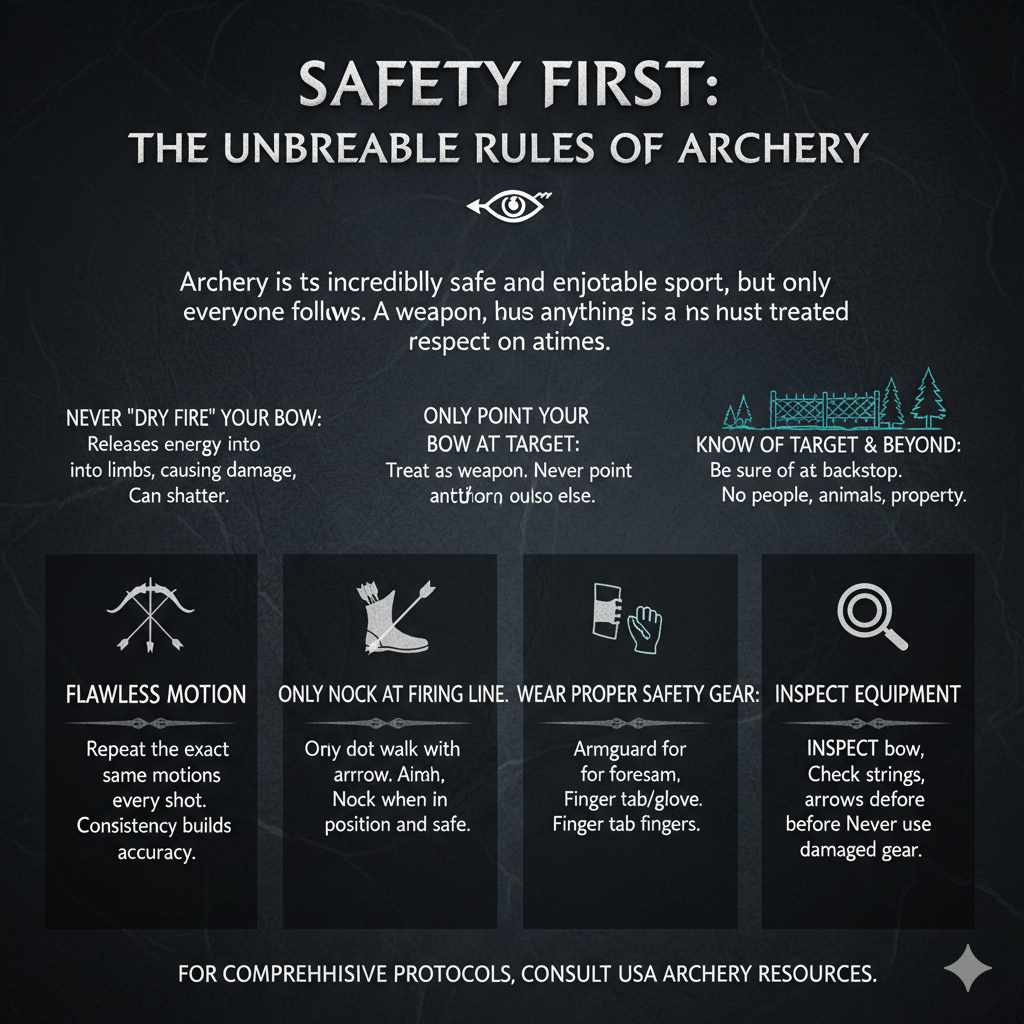
Archery is an incredibly safe and enjoyable sport, but only when everyone follows the rules. A bow and arrow is a weapon, and it must be treated with respect at all times. These are not suggestions; they are the core rules of safe archery.
- Never “Dry Fire” Your Bow: This means drawing and releasing the string without an arrow. The energy that would have gone into the arrow instead goes into the bow’s limbs, which can cause them to crack or shatter, potentially injuring you or others.
- Only Point Your Bow at the Target: Treat your bow like you would any weapon. Never point it at anything you do not intend to shoot.
- Know Your Target and What Is Beyond It: Always be 100% sure of your backstop. Make sure no people, animals, or property are behind the target area.
- Only Nock an Arrow When You Are at the Firing Line: Do not walk around with an arrow nocked on your string. Wait until you are in position and it is safe to shoot.
- Wear Proper Safety Gear: An armguard will protect your forearm from string slap, and a finger tab or glove will protect your fingers.
- Inspect Your Equipment: Before each shooting session, check your bow, strings, and arrows for any signs of damage. Do not shoot with damaged equipment.
For a comprehensive overview of safety protocols, organizations like USA Archery provide excellent resources that are worth reading for every archer, new or experienced.
Common Beginner Mistakes and How to Fix Them
Every archer makes mistakes when they’re starting out. It’s part of the learning process! The key is to recognize them and know how to correct them. Here are some of the most common issues I see with new students.
| Mistake | What It Looks Like | How to Fix It |
|---|---|---|
| Death-Gripping the Bow | Holding the bow handle with a tight, white-knuckled fist. This transfers torque to the bow and sends arrows left or right. | Relax your hand. The bow should rest in the “V” between your thumb and index finger. Use a finger sling or just let your fingers hang loosely. |
| Plucking the String | Yanking your hand away from your face on release, like playing a guitar string. This throws the arrow off-line. | Focus on a passive release. Just relax your fingers and let the string pull itself free. Your hand should move straight back. |
| Inconsistent Anchor Point | Your draw hand ends up in a different spot on your face with each shot, leading to shots landing high or low. | Pick one solid spot (corner of mouth, under chin) and consciously touch it every single time. Make it a non-negotiable part of your shot. |
| Leaning or Hunching | Leaning back to pull a heavy bow or hunching your shoulders. This ruins your alignment and stability. | Stand up straight. Keep your shoulders down and relaxed. If the bow is too heavy to draw this way, switch to a lower draw weight. |
Frequently Asked Questions (FAQ)
What kind of bow is best for a complete beginner?
A recurve bow with a low draw weight (typically 20-30 pounds) is an excellent choice for beginners. It’s simple enough to teach you the fundamentals of good form without being too complex or difficult to draw.
How strong do I need to be to shoot a bow?
You don’t need to be a bodybuilder! Archery is about technique, not brute force. Starting with a low draw weight bow allows you to build the specific muscles needed for archery gradually and safely.
How do I know what size arrow to use?
Arrow length is determined by your “draw length.” The best way to find this is to visit a local archery shop where a professional can measure you properly. Using arrows that are too short is extremely dangerous.
Is archery an expensive hobby?
It can be, but it doesn’t have to be. A good beginner recurve bow kit, including arrows and safety gear, can be purchased for a very reasonable price. You can always upgrade your equipment as your skills grow.
Can I practice archery in my backyard?
This depends entirely on your local laws and the size of your yard. You must have a safe, large area with a reliable backstop (like a large hill or a purpose-built archery backstop). Never practice if there’s any chance of a person or pet wandering into the line of fire. Check your city ordinances first.
How long does it take to get good at archery?
This varies for everyone. You can learn the basics in a single afternoon, but true consistency and accuracy take practice. The key is to enjoy the process of learning and celebrate small improvements along the way.
What does “dry firing” mean and why is it so bad?
Dry firing is releasing the bowstring without an arrow nocked. All the energy stored in the limbs has nowhere to go except back into the bow itself, which can cause it to violently break apart. It is the number one rule of archery safety: never do it.
Conclusion: Your Journey to Legendary Archery Begins
The “ultimate secret” to shooting a bow like a god of war isn’t a secret at all. It’s the dedicated practice of a few simple, fundamental steps. It’s the solid stance that connects you to the earth, the consistent anchor point that guides your aim, and the smooth, relaxed release that sends your arrow flying true. These are the skills that separate a novice from a master.
Don’t be discouraged if your first few arrows don’t hit the bullseye. Every archer, from the weekend hobbyist to the Olympic champion, started exactly where you are now. They built their skill one shot at a time, focusing on their form and learning from every mistake. The journey of archery is one of patience, focus, and incredible reward.
You now have the knowledge and the steps to begin your own legend. So, take a deep breath, trust in the process, and stay safe. Your adventure in archery is just beginning.