

Adding arrows to a PDF is simple and useful for highlighting important information or guiding readers through documents. Most PDF editors allow you to easily insert arrows with just a few clicks, often with customizable colors and styles. We’ll guide you through the best methods so you can mark up your PDFs effectively.
Ever found yourself squinting at a PDF, wishing you could draw a clear line to point something out? Maybe you need to guide someone’s eye to a crucial detail in a report or collaborate on a design by marking specific areas. It’s a common need when working with digital documents, and it used to feel like a big hurdle. Many beginners think you need complex software, but that’s simply not true!
The good news is that adding arrows to your PDF is much easier than you might imagine. It’s a simple skill that can make your documents much clearer and more helpful. We’ll walk you through the most straightforward ways to do it, so you can confidently mark up any PDF like a pro. Get ready to make your documents speak louder and clearer!
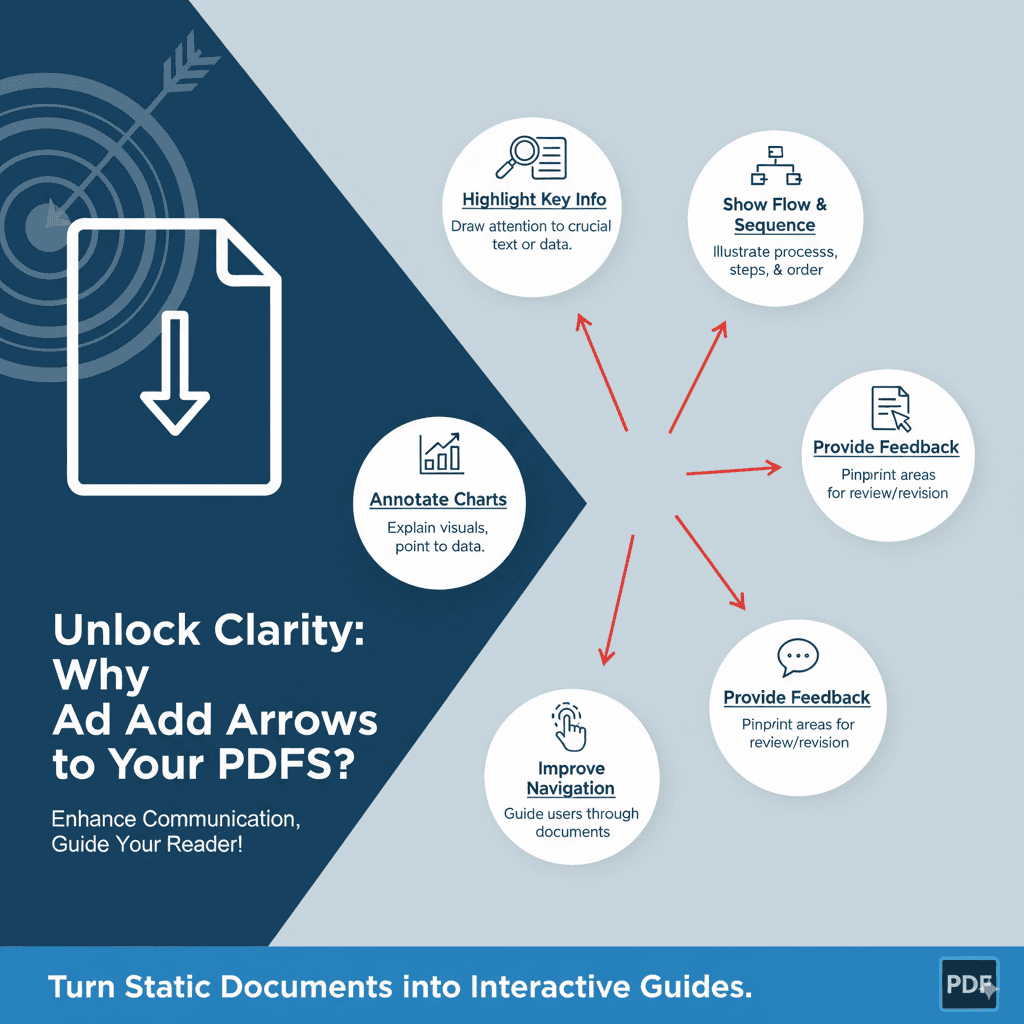
Why Add Arrows to Your PDFs?
Just like adjusting your grip on a bow to hit the bullseye, knowing why you’re doing something helps you do it better. Adding arrows to a PDF isn’t just about decoration; it’s a powerful communication tool. Think of it as drawing a clear line on a map to show the best route. It brings focus, clarifies instructions, and enhances understanding.
Here are a few key reasons why you might want to add arrows:
- Highlighting Key Information: Draw attention to specific text, images, or data points that are most important. This is especially useful in lengthy documents where readers might miss critical sections.
- Showing Flow or Sequence: Illustrate a process, workflow, or step-by-step instructions. Arrows clearly indicate direction and order, preventing confusion.
- Annotating Diagrams or Charts: Point out specific parts of a visual element for explanation or questioning.
- Providing Feedback: When reviewing documents with others, arrows can pinpoint areas needing revision or approval, similar to how an archery coach might point out how to adjust your stance.
- Improving Navigation: Guide users through interactive forms or complex layouts by indicating where they should click or what action to take next.
In essence, adding arrows takes your PDF from a static page to an interactive and guided experience. It helps ensure your message is received exactly as intended.
What You Need: Tools for Adding Arrows to PDFs
Before we start our practical session, let’s talk about the tools. You don’t need a fancy quiver full of specialized equipment, just the right software. Most of these are accessible and user-friendly, perfect for beginners.
The primary tool you’ll need is a PDF editor. These come in various forms, from free online tools to professional software. The choice often depends on your needs and budget.
1. Free Online PDF Editors
These are fantastic for quick edits and don’t require any software installation. You simply upload your PDF, make your changes, and download the edited version. They are often the most accessible option for beginners.
- Examples: Smallpdf, iLovePDF, Sejda, PDFescape.
- Pros: No installation needed, accessible from any device with internet, usually free for basic features, very beginner-friendly.
- Cons: May have file size or usage limits for free versions, require an internet connection, privacy concerns for sensitive documents.
2. Built-in PDF Viewers with Annotation Tools
Many operating systems and web browsers come with basic PDF viewing and annotation capabilities. These are great for simple tasks without needing extra software.
- Examples: Google Chrome (opens PDFs and has annotation features), Microsoft Edge (similar capabilities), Preview on macOS.
- Pros: Already installed on your device, quick and easy for simple markups, free.
- Cons: Limited features compared to dedicated editors, may not save annotations in all cases or in a universally compatible way.
3. Desktop PDF Editing Software
These offer the most robust set of features and are ideal if you work with PDFs frequently or need advanced control.
Free Options:
- Example: LibreOffice Draw (part of the free LibreOffice suite).
- Pros: Powerful features, completely free, offline functionality.
- Cons: Can be complex for absolute beginners, requires installation.
Paid Options:
- Examples: Adobe Acrobat Pro DC, Foxit PhantomPDF.
- Pros: Extensive features, professional-grade tools, excellent support.
- Cons: Can be expensive, may have a steeper learning curve.
For this guide, we’ll focus on the methods that are most accessible to beginners, primarily using free online tools and built-in viewers, as they offer the quickest path to success. Think of these as your basic, reliable recurve bow – perfect for learning the fundamentals.
How to Add Arrows to a PDF: Step-by-Step Guides
Alright, let’s get down to business! Adding arrows is like learning to nock an arrow – it’s a fundamental step that opens up so many possibilities. We’ll cover a couple of the most common and easiest ways.
Method 1: Using Free Online PDF Editors (Recommended for Beginners)
This is often the easiest and quickest way to add arrows without installing anything. We’ll use Smallpdf as an example, but the process is very similar across most free online PDF editors.
Step 1: Go to Your Chosen Online PDF Editor
Open your web browser and navigate to a free online PDF editor like Smallpdf (www.smallpdf.com/edit-pdf). You can also try iLovePDF or Sejda.
Step 2: Upload Your PDF Document
Click on the “Choose Files” button or drag and drop your PDF file into the upload area. The website will process your document.
Step 3: Select Annotation/Drawing Tools
Once your PDF is open in the editor, look for a toolbar, usually at the top or side of the screen. You’ll want to find the “Add” or “Annotate” options. Within these, you should see various drawing tools, including shapes and lines. Click on the “Arrow” tool.
Step 4: Draw Your Arrow
Click and drag your mouse on the PDF where you want to draw the arrow. Start at the point where you want the arrow to begin and drag to where you want the arrowhead to end. Release the mouse button.
Step 5: Customize Your Arrow (Optional)
Most editors allow you to change the appearance of your arrow before or after drawing it. Look for options like:
- Color: Change the arrow’s color to stand out or match your document’s theme.
- Thickness/Width: Make the arrow line thicker or thinner.
- Style: Choose between a solid arrow, dashed arrow, or outline.
- Arrowhead Style: Select the shape and size of the arrowhead.
Some tools might let you select these options before drawing, while others let you click on the drawn arrow and then access a properties panel. If you make a mistake, look for an “Undo” button or a “Delete” option to remove the arrow.
Step 6: Save and Download Your Edited PDF
Once you’re happy with your arrows, find the “Done,” “Save,” or “Download” button. Click it to process your changes. Your edited PDF will be downloaded to your computer.
This method is incredibly straightforward and effective for most common tasks. It’s like using a simple, reliable bow – it gets the job done accurately.
Method 2: Using Built-in PDF Viewers (e.g., Preview on macOS)
If you’re using a Mac, the Preview app makes adding simple arrows quite straightforward.
Step 1: Open Your PDF in Preview
Double-click your PDF file. It should open in Preview by default. If not, right-click your PDF, select “Open With,” and choose “Preview.”
Step 2: Show the Markup Toolbar
In Preview, you need to activate the drawing tools. Click on the toolbox icon that looks like a pen tip in a circle. This will bring up the Markup Toolbar.
Step 3: Select the Shape Tool
In the Markup Toolbar, click on the “Shapes” tool (it looks like a square and a circle). From the dropdown menu, select the arrow shape. You might see different arrow styles; choose the one that suits your needs.
Step 4: Draw and Customize Your Arrow
Click and drag on your PDF to draw the arrow. As with online editors, you can usually customize its color and thickness. Click on the arrow to select it, then use the “Color” and “Border” options in the Markup Toolbar to change its appearance. You can also resize and reposition the arrow by clicking and dragging its edges or center.
Step 5: Save Your Document
Once you’re satisfied, save your PDF. Go to File > Save, or simply close the window, and Preview will prompt you to save changes. Ensure you save it as a PDF if you intend to share it further.
This method is excellent for Mac users who need to make quick annotations without diving into more complex software.
Method 3: Using Adobe Acrobat Reader DC (Free Version)
Even the free version of Adobe Acrobat Reader DC has annotation tools that allow you to add arrows.
Step 1: Open Your PDF in Adobe Acrobat Reader DC
Launch Adobe Acrobat Reader DC and open your PDF document (File > Open).
Step 2: Access the Comment Tools
Look for the “Comment” tool in the right-hand pane, or go to Tools > Comment. This will open the commenting toolbar at the top.
Step 3: Select the Drawing Tools
In the Comment toolbar, find the “Drawing Tools” option. Click on it, and then select “Arrow.”
Step 4: Draw Your Arrow
Click and drag on your PDF to create the arrow. You can draw it in any direction and length you need.
Step 5: Customize Arrow Properties
To change the arrow’s appearance, right-click on the arrow you just drew. Select “Properties” from the context menu. A properties window will pop up where you can change the color, thickness, opacity, and style of the arrow and arrowhead. Make your selections and click “OK.”
Step 6: Save Your PDF
After making your edits, save the document. Go to File > Save or File > Save As to save your annotated PDF.
Adobe Reader’s free version provides a very reliable way to add annotations, making it a great all-around option for many users.
Tips for Adding Effective Arrows
Just like an archery coach showing you how to aim, a few tips can make your arrows more effective. It’s not just about adding them; it’s about adding them where and how they make the most impact. Here’s how to make your arrows truly enhance your PDF:
Keep it Simple
Don’t clutter your PDF with too many arrows. Use them strategically to guide the reader’s eye to the most important points. Overuse can be as confusing as no arrows at all.
Consistent Style
If you’re using multiple arrows in one document, try to keep their size, color, and style consistent. This makes the document look more professional and easier to follow. For example, use red for urgent notes and blue for general pointers.
Placement Matters
Position your arrows so they clearly point to what they are intended to highlight. Avoid placing them too far away or in a way that could be ambiguous. Imagine drawing a line from the arrowtip directly to the feature it’s referencing.
Consider the Audience
Are you creating this document for internal use, or will a client see it? For professional settings, simpler, cleaner arrow styles and placements are usually best. For internal collaboration, you might use more informal or varied styles.
Color Contrast
Ensure the color of your arrow stands out against the background of your PDF. If you have a light background, a dark arrow (like black, blue, or red) will work well. For dark backgrounds, consider white or yellow. Making sure there’s good contrast is like choosing a brightly colored fletching for your arrow so you can see it fly.
Test and Review
Before sending your PDF off, take a moment to look at it from the perspective of someone who hasn’t seen it before. Do the arrows make sense? Are they clear? Do they help or hinder understanding?
Comparison of PDF Editing Tools for Adding Arrows
Choosing the right tool can make all the difference. Let’s compare some of the popular options to help you decide which might be best for your needs. Think of this as choosing the right tool for breaking down a target – different tools have different strengths.
| Tool/Software | Ease of Use (Beginner) | Features for Arrows | Cost | Platform Availability | Best For |
|---|---|---|---|---|---|
| Smallpdf / iLovePDF (Online) | Very High | Basic arrow drawing, color, thickness. | Free (with limits), Paid Subscription | Web-based | Quick, occasional edits. |
| Preview (macOS) | High | Arrow drawing, color, thickness. | Free (built into macOS) | macOS | Mac users needing simple annotations. |
| Adobe Acrobat Reader DC (Free) | High | Arrow drawing tool, extensive customization (color, style, thickness, opacity). | Free | Windows, macOS, Linux | Users needing reliable annotation tools. |
| Adobe Acrobat Pro DC (Paid) | Medium | Advanced drawing tools, custom shapes, markups, stamps, full PDF editing suite. | Paid Subscription | Windows, macOS | Professionals needing comprehensive PDF control. |
| LibreOffice Draw (Free) | Medium | Robust drawing tools, shapes, lines, fills, extensive customization. | Free | Windows, macOS, Linux | Users looking for a free, powerful desktop alternative. |
As you can see, for straightforward arrow additions, most free tools and the free version of Adobe Reader are excellent choices. If you find yourself needing more advanced features, then exploring paid options or LibreOffice Draw might be beneficial. The key is to start with what’s accessible and upgrade if your needs grow.

Frequently Asked Questions (FAQ)
Q1: Can I add arrows to a PDF that’s just an image?
A: Yes, if the PDF contains an image that you can open and annotate with a PDF editor, you can add arrows on top of the image within the PDF. Most tools will treat the image as a layer you can draw on.
Q2: How do I make sure my arrows are visible on all devices?
A: When you use most PDF editors, the arrows are saved as annotations directly within the PDF file. As long as the recipient has a PDF reader that supports annotations (like Adobe Reader, Preview, or most web browsers), your arrows should display correctly. Using standard arrow tools and common colors will ensure the best compatibility.
Q3: What if I draw an arrow by mistake? How do I remove it?
A: Most PDF editors provide an “Undo” button to quickly remove the last action. If that doesn’t work or you need to remove a specific arrow later, simply click on the arrow to select it, and then press the “Delete” key on your keyboard or look for a delete/trash can icon.
Q4: Can I change the arrow after I’ve already drawn it?
A: Yes, in most PDF editors, you can select an existing arrow and then modify its properties. You can usually change its color, size, thickness, and arrowhead style. Sometimes you might need to right-click the arrow or look for a “Properties” or “Format” option in the toolbar.