45 vs 9mm: Choosing the Right Sidearm for Security
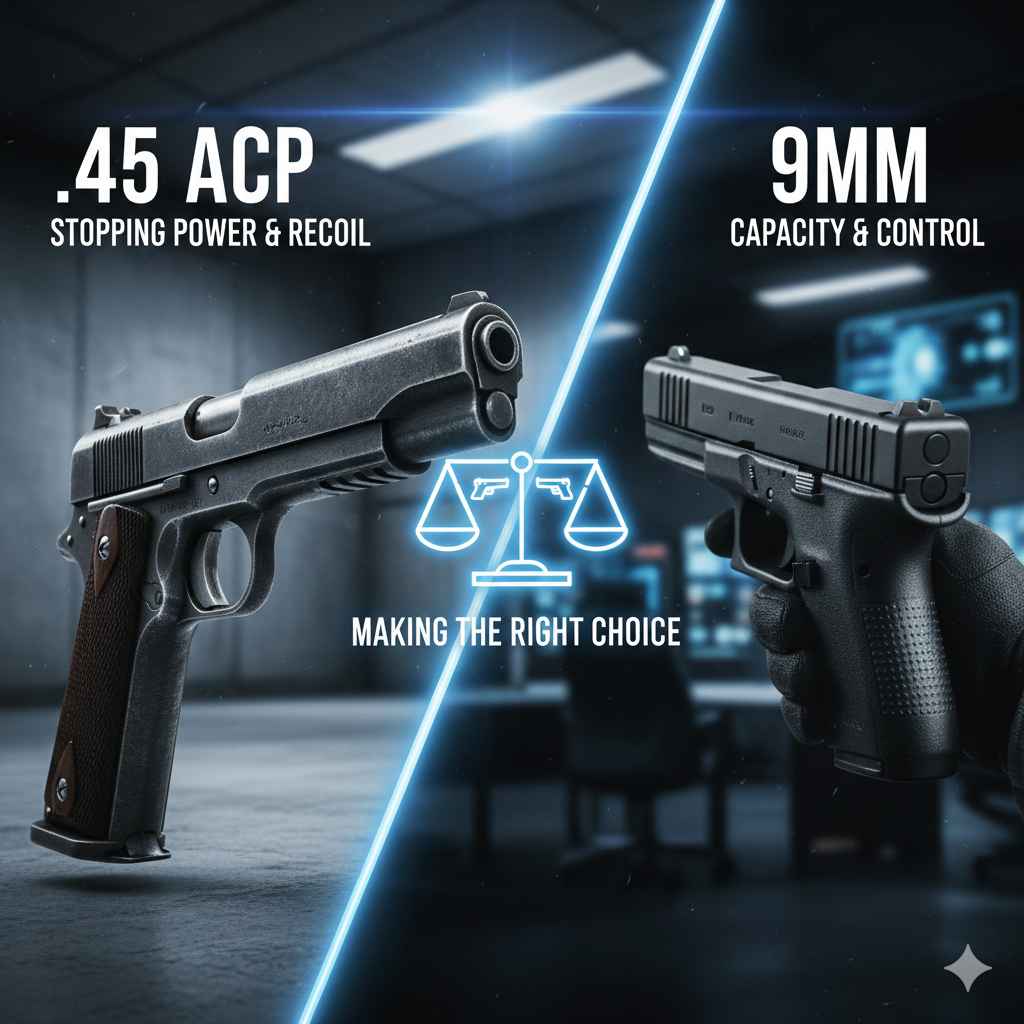
Choosing the right firearm is a big decision, especially for security professionals. The topic of 45 vs 9mm: What Armed Guards Should Know often comes up when discussing sidearms. It can be tricky, since both types have their pros and cons. Many new guards might feel unsure which is best. Don’t worry, we’ll break it down for you. This post is all about making the choice easier. We’ll explore the main differences and help you decide which one suits your needs. Let’s get started!
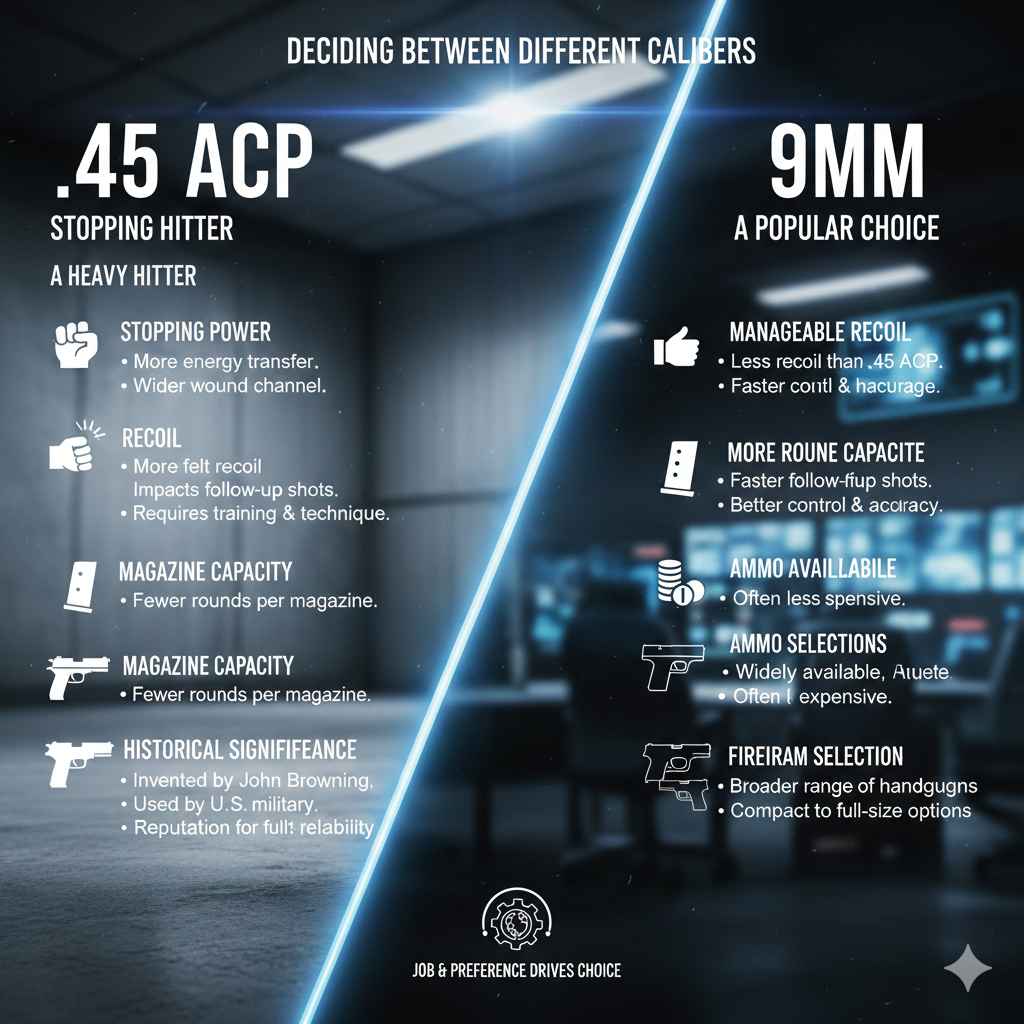
Deciding Between Different Calibers
Selecting the right caliber is a key choice for any armed guard. Caliber refers to the diameter of the bullet. Two of the most common calibers are the .45 ACP (Automatic Colt Pistol) and the 9mm Luger. Each has its own benefits and drawbacks, so the “better” option depends on the specific job and the shooter’s preferences. It’s not a one-size-fits-all situation; it’s about what works best for you and your role. We’ll investigate both options, helping you become better informed. Let’s start with a look at what each caliber brings to the table.
The .45 ACP: A Heavy Hitter
The .45 ACP, invented by John Browning, is known for its stopping power. The .45 ACP fires a larger, heavier bullet than the 9mm. This translates to more energy transfer upon impact, potentially resulting in greater incapacitation of a threat. Its larger size also means it typically creates a wider wound channel. The design of the bullet, its weight, and its velocity all contribute to its effectiveness. The .45 ACP has a long history, initially designed for the U.S. military, which gives it a reputation. However, it also has considerations in terms of recoil and magazine capacity, which we’ll cover.
Stopping Power. The .45 ACP delivers more energy to the target. This can lead to a quicker stop of a threat.
Stopping power is the bullet’s ability to immediately incapacitate a target. It’s often measured by the amount of energy transferred to the target upon impact. A .45 ACP bullet, due to its size and weight, typically transfers more energy. This higher energy transfer can disrupt the target’s ability to function. However, the term “stopping power” is a simplification. Many other factors influence the outcome of a shooting, including shot placement and the target’s build and state of mind.
Recoil. .45 ACP firearms produce more felt recoil than 9mm firearms. This can impact follow-up shot speed and accuracy.
Recoil is the backward movement of a firearm when it’s fired. It’s a result of Newton’s third law of motion: for every action, there’s an equal and opposite reaction. The .45 ACP, with its larger bullet and more powerful load, generates a more significant recoil. This can make it more challenging to control, especially for new shooters. Reduced recoil helps a shooter stay on target and make quicker, more accurate shots. Proper grip, stance, and training can help manage .45 ACP recoil.
Magazine Capacity. Generally, .45 ACP handguns have fewer rounds in the magazine than 9mm handguns of the same size.
Magazine capacity refers to the number of rounds a magazine can hold. The larger size of the .45 ACP cartridges means that the magazines hold fewer rounds compared to 9mm magazines of the same dimensions. A lower magazine capacity necessitates more frequent reloads during a shooting. The trade-off is the extra stopping power that comes with the bigger round. The best choice depends on the security guard’s role, the likely threats, and the importance of a greater number of rounds.
Historical Significance. The .45 ACP has a rich history, widely used by the military.
The .45 ACP’s roots trace back to the early 20th century, primarily through its adoption by the U.S. military. This military use gave the .45 ACP a reputation for reliability and effectiveness, influencing how it’s viewed in the armed security field. This historical legacy can affect the guard’s or the agency’s mindset. It can also shape the kinds of training programs that are offered. The history is a key aspect that security guards can explore.
The 9mm: A Popular Choice
The 9mm Luger is a popular choice for law enforcement and civilians. It fires a smaller, lighter bullet than the .45 ACP. The 9mm is celebrated for its balance of power, accuracy, and manageable recoil. It allows for faster follow-up shots. Modern 9mm ammunition, including those with advanced bullet designs, has made great strides. It often closes the gap in performance compared to other calibers.
The 9mm’s widespread use also leads to a wide range of available firearms, from compact pistols to full-size handguns. Its adoption by many agencies means that training and equipment are readily available. We’ll explore the different aspects of the 9mm to help make your decision.
Manageable Recoil. The 9mm produces less recoil compared to the .45 ACP. This aids in fast follow-up shots and control.
Reduced recoil enables the shooter to keep the weapon on target during rapid firing. Recoil is the backward force created when a gun is fired. The 9mm’s lighter bullet and smaller charge lead to less felt recoil. This helps with better control, allows for faster follow-up shots, and helps maintain accuracy. A security guard can respond to threats more effectively if he/she has quick shot recovery.
Magazine Capacity. The 9mm firearms can typically hold more rounds than .45 ACP firearms, giving an advantage in a sustained gunfight.
Higher magazine capacity means more shots before reloading is needed. The smaller size of the 9mm cartridges allows for more rounds to fit within a magazine of the same size. This can provide a tactical advantage in a situation where sustained firepower may be needed. However, the value of magazine capacity will depend on the situation. The trade-off is often slightly less power per round. The most appropriate choice will be based on situational assessment and individual preference.
Ammo Availability. 9mm ammunition is widely available and often less expensive than .45 ACP.
The widespread use of 9mm means that ammunition is commonly stocked in stores and online. This makes it easier to find and purchase. Due to higher production volumes, 9mm ammo is often less expensive than .45 ACP. This can be a key factor when considering training costs and ammunition needs over time. A security guard can balance this advantage with the potential benefits of the .45 ACP.
Firearm Selection. There is a broader selection of 9mm handguns.
Because of its popularity, the 9mm has a broader selection of firearm types, sizes, and designs. You can find everything from compact concealed-carry pistols to full-size service weapons. This allows security guards to select a weapon that fits their needs. Different guns will have different features, like ergonomics, sight systems, and magazine capacity. These will affect the shooting experience and the guard’s performance.
Factors to Consider
There are several crucial factors that armed guards must consider when choosing between a .45 ACP and a 9mm. The job and the specific environment play a big part. Some jobs might favor the stopping power of the .45 ACP. Others might prioritize the advantages of the 9mm, like easier handling or more rounds. You’ll also need to consider your training and experience, along with your physical build. The goal is to choose the gun that will provide the best protection. Let’s look at the different areas that affect your decision.
Training and Familiarity
Training and familiarity are vital to your safety. Regular training and practice will help you perform better under pressure. You should become comfortable with the handling, recoil, and operation of your chosen firearm. This comfort leads to improved accuracy and confidence. Even the most powerful gun is useless if you can’t aim it properly. We’ll explore why training is important and how to become more comfortable with your firearm.
Recoil Management Training. Proper training is key to controlling recoil. This will improve your shot placement.
You can learn techniques to control the movement of your firearm when it’s fired. This includes grip, stance, and trigger control. Mastering these techniques will lead to faster follow-up shots and better accuracy. A gun that feels hard to handle can hinder your performance. Regular practice with the specific caliber you intend to carry is key. Professional instructors can provide tailored advice and correction.
Dry-Fire Practice. Practice without live ammunition is essential for improving skills.
Dry-fire practice involves practicing the motions of shooting without actually firing a bullet. You can safely practice trigger control, sight alignment, and grip. This type of practice helps build muscle memory and improve the mechanics of shooting. Dry-fire practice allows you to practice at home and at no cost. You can also work on speed and efficiency. Always double-check that your firearm is unloaded and safe before dry-firing.
Live-Fire Drills. Periodic range sessions with live ammo are needed to hone your skills.
Range time lets you practice with live ammunition, which will help you get used to the recoil and noise of your chosen firearm. These drills allow you to evaluate and adjust your shooting skills. It also provides a great way to experience real-world scenarios. Make sure you follow safety protocols and guidelines during live-fire practice. Try different shooting distances, target types, and firing positions to make the drills challenging.
Physical Attributes
Your physical attributes can play a part in your choice. The size of your hands, your grip strength, and how well you handle recoil can affect your choice. Some individuals find the recoil of the .45 ACP more challenging to control, especially if they are smaller or have less experience. A smaller grip might make it tough to handle the larger frame of some .45 ACP handguns. It’s important to select a firearm that you can use quickly and effectively. Knowing your limits will help you choose the best gun.
Hand Size and Grip. Ensure the gun fits your hand comfortably for proper control and handling.
If you have smaller hands, you may find that the larger grip of a .45 ACP handgun is difficult to manage. You will struggle to get a secure and consistent grip. This can affect your ability to control the weapon and shoot accurately. A good fit allows for better control, especially under stress. Try holding different firearms and feel the grip. If possible, fire a few rounds to experience how they feel.
Recoil Tolerance. Consider your ability to manage recoil. Choose the gun you can handle best.
The .45 ACP, with its heavier load, produces more recoil than the 9mm. If you find it hard to control, your follow-up shots could be slower, and your accuracy could drop. If you have less experience, you may prefer a 9mm. Practice is critical to getting used to the recoil, and it can help improve your tolerance. This will let you focus on your target and shoot more effectively. If you’re a newer shooter, start with a 9mm. Build up your skills and then decide about other guns.
Strength. Stronger individuals may handle heavier guns and recoil better.
The weight of the firearm and the recoil generated will require a certain degree of strength. Stronger individuals often have an easier time managing the recoil of a .45 ACP handgun. This will lead to better control, faster follow-up shots, and improved accuracy. Your physical build and strength will affect your ability to use the gun. Training and exercise can help improve your strength. Consider regular exercises that focus on the arms, shoulders, and core.
Duty Requirements and Situational Awareness
Your specific job tasks and the types of situations you are likely to face play a role in your choice. Armed guards in high-threat environments may prioritize stopping power. Guards in roles with a high likelihood of close-quarters encounters might choose a weapon with high maneuverability. Understanding the specific risks you face will help determine the best firearm for your needs. Always check your employer’s policies.
Threat Assessment. Assess the likely threats and select the gun that best addresses them.
Evaluate the type of threats you will most likely face. Consider factors like the potential range of engagement, the type of assailants you might encounter, and the environment. In high-threat situations, stopping power can be very important. If the risk is in a confined space, a smaller, easier-to-handle weapon might be favored. Understanding the threats will allow you to select a gun that can provide the best protection. You can improve your readiness with training.
Close-Quarters Combat. In tight spaces, maneuverability is key.
In close-quarters combat (CQC), maneuverability and rapid target acquisition are important. A smaller, lighter gun can be easier to maneuver in confined spaces. The 9mm offers a good balance of power and capacity, while still being manageable. Make sure you practice your CQC skills, including transitioning from different shooting positions. You should consider the environment, the weapon’s ergonomics, and the ability to move and react quickly.
Legal Considerations. Local laws and regulations may restrict your choices.
Before selecting a firearm, know the laws and regulations in your area. Some jurisdictions might limit the types of handguns you can carry or the capacity of magazines. Always make sure your choice complies with the law. You will need to check your employer’s policies. These policies might have rules on the type of guns, ammunition, and other gear that are allowed. Violating these rules could have legal and professional consequences.
A Comparative Overview
To help in your decision, let’s compare the .45 ACP and the 9mm across different criteria. You will gain a better grasp of the strengths and weaknesses of each caliber. This will help you make a better choice. The table below summarizes key differences in several key areas. This side-by-side comparison will help you evaluate which caliber aligns better with your needs.
| Feature | .45 ACP | 9mm Luger |
|---|---|---|
| Bullet Diameter | .45 inch (11.43 mm) | .355 inch (9 mm) |
| Bullet Weight | Typically 230 grains | Typically 115-147 grains |
| Recoil | Higher | Lower |
| Magazine Capacity | Generally lower | Generally higher |
| Stopping Power | Potentially higher | Good, but may vary |
| Ammo Cost | Often more expensive | Often less expensive |
| Firearm Selection | Wide, but fewer choices than 9mm | Very wide |
The table helps visualize the key differences. This allows for a more straightforward evaluation. For instance, the .45 ACP offers a bigger bullet diameter and potentially more stopping power. It may have a higher recoil. On the other hand, the 9mm generally has a higher magazine capacity and a broader range of firearms. The best choice depends on the specific job requirements, training, and preference.
Real-Life Examples and Scenarios
Let’s look at a few examples and scenarios to better show how the 45 vs 9mm choice plays out. These will show you different situations in which each caliber may be a better option. You’ll see how different factors like the guard’s role, training, and preferences affect the decision-making process. These examples will show you how to apply the information you’ve learned. Here are several scenarios to consider.
Scenario 1: High-Risk Security Detail. An armed guard is assigned to protect a high-profile individual in an area with potential threats. Given the potential for a high-threat encounter, the guard has prioritized stopping power and selects a .45 ACP handgun, feeling more confident with its greater energy transfer. Regular training helps to manage the recoil.
In this scenario, the priority is to stop a threat quickly, and the .45 ACP is a good choice. The guard understands that the larger bullet delivers a significant amount of energy to the target. It increases the chance of immediately incapacitating an attacker. This is critical in a high-stakes environment where there could be multiple threats, or where the guard must protect the client. Proper training will help with managing the recoil, which may be more difficult with the .45 ACP.
Scenario 2: Routine Patrol Duties. A security guard on routine patrol duties, handling security at a local shopping center, chooses a 9mm handgun. They appreciate the higher magazine capacity and the manageable recoil, allowing for fast, accurate follow-up shots. Ammo is available and affordable. The guard receives regular range training.
In this scenario, the guard is looking for a versatile, reliable weapon that balances power and ease of use. The 9mm gives the guard a good balance of power, accuracy, and ammo capacity. The 9mm is easier to manage, so this allows for greater shot control and quicker shots. The affordability and easy access to 9mm ammunition are very convenient. The guard can maintain skills with regular practice and training.
Scenario 3: Close-Quarters Combat. A security professional is part of a close-protection team working in confined spaces. The team decides on the 9mm for its balance of power, control, and magazine capacity. They train extensively in CQB.
In a close-quarters situation, maneuverability is key. The team chooses the 9mm because it can be used in confined spaces. The 9mm’s more manageable recoil allows for faster follow-up shots. The team’s decision is helped by comprehensive CQB training. The team has the training and the tools to respond to threats rapidly and precisely.
Frequently Asked Questions
Question: Is .45 ACP better than 9mm for self-defense?
Answer: It depends on several factors, including your skill level and the specific situation. The .45 ACP has a reputation for more stopping power, but the 9mm offers easier control and higher magazine capacity.
Question: Which caliber is easier to shoot accurately?
Answer: Many people find the 9mm easier to shoot accurately because of its lower recoil. However, proper training can help you master the .45 ACP.
Question: Is 9mm ammo cheaper than .45 ACP ammo?
Answer: Generally, yes. 9mm ammunition is usually less expensive and easier to find. This can be important for frequent practice.
Question: Can I carry either caliber as a security guard?
Answer: This depends on your employer’s policy and local laws. Always check your company’s guidelines and the applicable regulations.
Question: Which caliber is more common in law enforcement?
Answer: The 9mm is more widely used in law enforcement today. However, this may vary depending on the local jurisdiction.
Final Thoughts
Choosing between a .45 ACP and a 9mm for armed security is all about weighing pros and cons. There is no one-size-fits-all answer. The .45 ACP offers potent stopping power and a strong history, which can boost confidence. The 9mm, on the other hand, provides a balance of stopping power, control, and magazine capacity, making it a favorite for many. Ultimately, the best choice hinges on factors like your training, your physical build, your job’s demands, and the legal environment. Remember that training and practice are key, no matter which caliber you pick. Work with a qualified instructor, practice regularly, and get used to your firearm. You are always responsible for your weapon. Stay safe, stay prepared, and always prioritize your training.
Related pick: Check today's price on Amazon