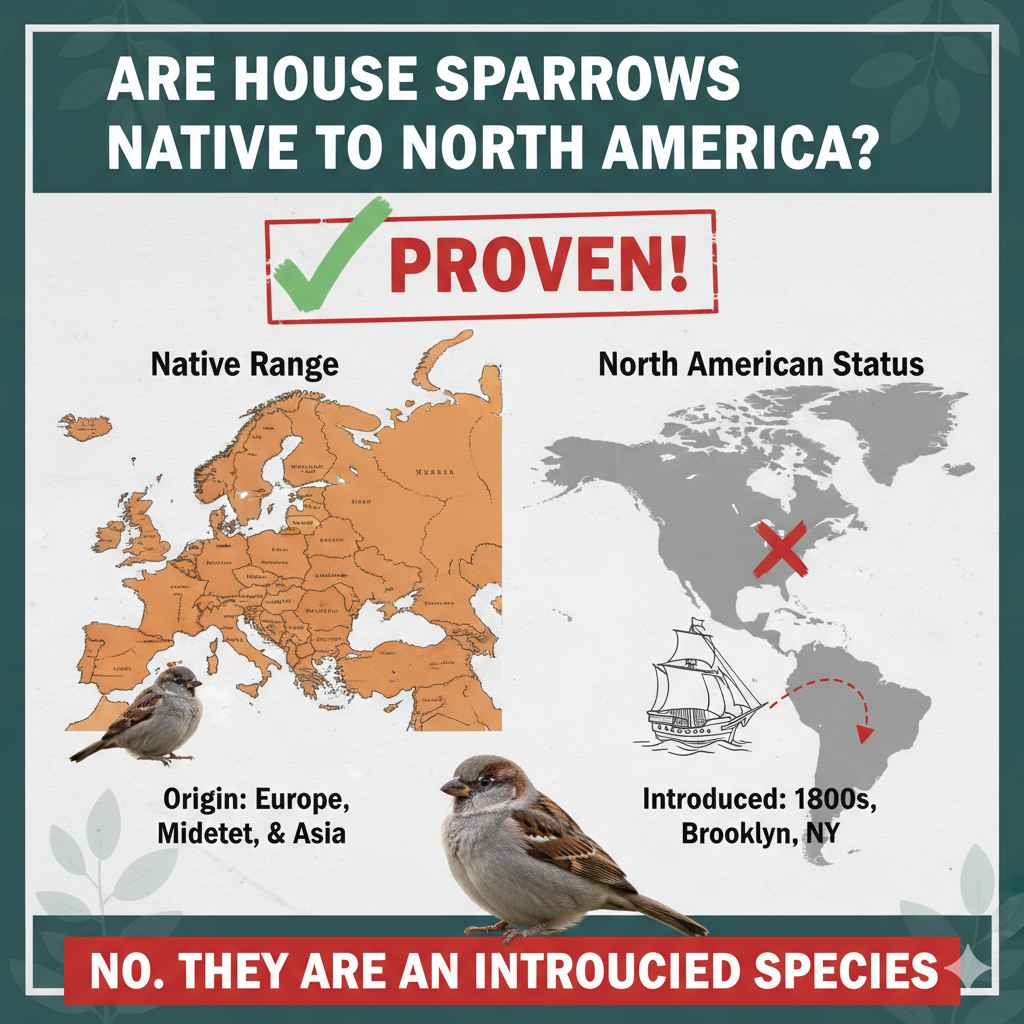
Are House Sparrows Native To North America? Proven!
No, House Sparrows (Passer domesticus) are definitively not native to North America. They are an introduced, non-native species brought from Europe in the mid-19th century. Their introduction was intentional, initially meant to control insect pests and evoke European nostalgia. Since then, they have successfully spread across the continent, becoming one of the most common urban birds, often competing aggressively with native cavity-nesting bird populations, making them a key subject in conservation management. For more on this, see our guide on Is Bow Fishing Carp Illegal in Tennessee? Laws and Regulations Explained. For more on this, see our guide on Is a Peep Hole an Open Sight? Exploring the Key Differences.
As an Amazon Associate I earn from qualifying purchases.
For a related arrow setup, Difference Between Finches and Sparrows: A Birdwatcher’s gives readers another detail to check before shooting.
For a related arrow setup, Are Not Two Sparrows Sold for a Penny: Essential Lessons gives readers another detail to check before shooting.
For a related arrow setup, How Do You Get Rid of House Sparrows: Essential gives readers another detail to check before shooting.
Hey there! Salman here. Just like getting your anchor point right in archery, understanding the fundamentals of your natural environment is key. A common question I hear—not just from folks interested in nature, but everywhere—is about those little brown birds covering every city and barn: the ubiquitous House Sparrow. Are they supposed to be here? Did they fly over naturally?
The answer might surprise you, and it’s critical for anyone interested in backyard wildlife, habitat management, or simply figuring out what birds you’re seeing. This bird is a survivor, but its history here is complex. We are going to clear up the confusion about this tenacious bird, covering the proven facts of its origin, its powerful impact, and how knowing the difference helps us protect our truly native species.
When we talk about whether a species is native, we are essentially asking if it evolved in that location without human intervention. For the House Sparrow in North America, the answer is a straightforward and scientifically proven No.
Think of this like classifying your archery equipment. If you bought a modern compound bow, it’s clearly not native to a historical longbow competition. The House Sparrow, while now utterly common and well-established, is an Old World species. Its ancestral home stretches across Europe, the Mediterranean, and parts of Asia and North Africa.
The fact that they are non-native is not just academic; it has profound ecological consequences, especially when considering conservation efforts aimed at protecting genuine North American birds like Eastern Bluebirds, Purple Martins, and various types of native sparrows (like the Song Sparrow or Chipping Sparrow).
The Proven Facts: Why House Sparrows Are Not Native
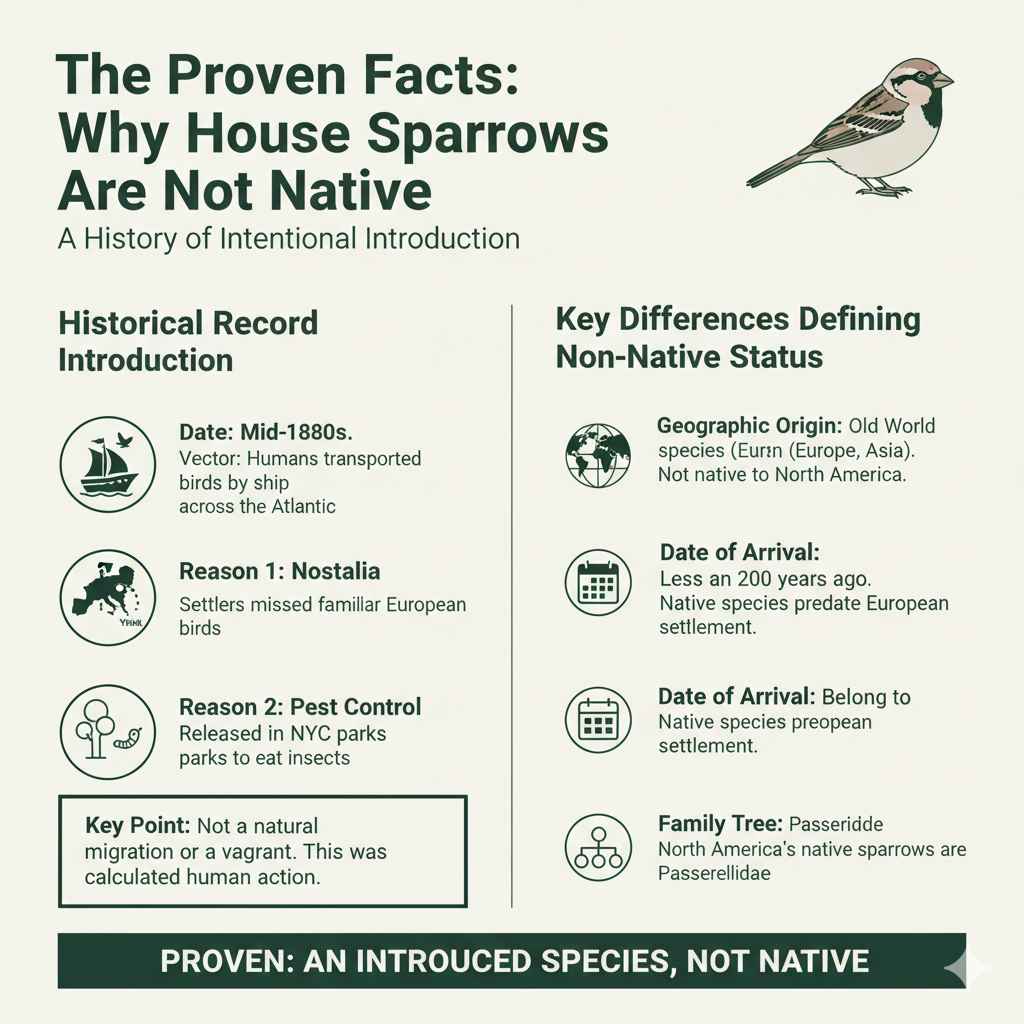
To truly understand the House Sparrow’s status, we need to look back at the historical record. Unlike birds that might occasionally stray off course during migration—known as vagrants—the House Sparrow’s arrival was documented, intentional, and human-aided.
Their introduction was a calculated move driven by nostalgia and an often misguided faith in biological control. Settlers arriving in the rapidly growing American cities missed the familiar sights and sounds of Europe. Furthermore, they were struggling with agricultural pests, especially inchworms, which were defoliating trees in urban parks.
The popular belief was that introducing European birds, which were known for eating insects, would solve these pest problems and beautify the landscape simultaneously. This belief set the stage for one of the most successful biological introductions in history—successful for the sparrow, complex for the continent.
Key Differences Defining Non-Native Status
- Geographic Origin: House Sparrows belong to the family Passeridae, originating in the Old World (Europe, Asia). North America’s native sparrows belong to a different family, Passerellidae.
- Date of Arrival: They arrived less than 200 years ago (mid-1800s). For a species to be considered native, its presence must predate the major impact of European settlement.
- Vector of Introduction: They were intentionally transported and released by humans, primarily sailing across the Atlantic Ocean.
The Journey: How House Sparrows Invaded North America
Understanding the spread of the House Sparrow is like charting the progress of a very successful, aggressive competitor. It shows how quickly a highly adaptable species can dominate an open niche. When you are learning to shoot a bow, you learn to take the easy target first; the House Sparrow took the easy, human-built environment first.
The New York Experiment (1851-1853)
The most famous and successful introduction attempt occurred in New York. The first documented attempt to establish the species took place in 1851, but those birds likely did not survive. The successful introduction is generally attributed to a release in 1853 in Brooklyn, New York, orchestrated by Nicholas Pike, director of the Brooklyn Institute.
These early arrivals were released into parks to combat the destructive Gypsy Moth caterpillar (another non-native species) and other pests. However, the House Sparrow is primarily a seed and grain eater, not an insectivore, so their effectiveness against the intended pests was negligible at best.
“The idea was a quick fix, but it lacked the long-term ecological foresight. It’s like buying the cheapest arrow expecting professional performance—it seldom works out the way you intended.”
Rapid Continental Spread
Once established on the East Coast, the House Sparrow exploded in population. Their expansion was fueled by two critical factors:
- Reliance on Human Infrastructure: Unlike many sensitive native birds, House Sparrows thrive in urban, disturbed environments. They nest in eaves, gutters, streetlights, and ventilation shafts—places native birds generally avoid. The proliferation of wooden structures and barns in the growing nation provided endless nesting sites.
- Transportation and Food Source: The rise of the railroad and, crucially, the use of horses and carriages provided a perfect support system. Horses provided spilled grain and manure (containing undigested seeds), which served as an infinite food supply along every major road and rail line. This allowed the sparrows to literally ride the rails and roads across the entire continent.
By the turn of the 20th century, less than 50 years after the Brooklyn release, House Sparrows had reached California and the far corners of the United States and Canada. This rapid invasion is a textbook example of an invasive species taking advantage of newly available niches.
| Timeline of Sparrow Introduction | Year | Location & Significance |
|---|---|---|
| Early Attempts | 1850 – 1851 | Initial releases in cities like Boston and New York, often unsuccessful or small-scale. |
| Successful Establishment | 1853 | Key release in Brooklyn, New York (N. Pike), leading to sustained population growth. |
| Westward Expansion | 1870s – 1880s | Sparrows rapidly spread west, transported intentionally and unintentionally along rail lines and farmlands. |
| Continental Saturation | 1900 | House Sparrows were established in almost every part of North America where humans lived, particularly in urban and agricultural zones. |
The Impact Assessment: Competition with Native Species
When we talk about aiming accurately in archery, we learn that energy transfer is key. In ecology, when a non-native species arrives, it disrupts the energy balance. The House Sparrow is highly adaptable, aggressive, and prolific. These traits allow it to outcompete many native birds for scarce resources, mainly nesting sites and food.
The primary conflict occurs because the House Sparrow is a cavity nester—it needs a hole or cavity to build its nest. This puts it in direct, often violent, competition with some of North America’s most beloved native species that also rely on cavities.
Case Studies in Displacement
The impact of House Sparrows is clearest when we look at conservation struggles involving specific native birds. They are notoriously territorial and aggressive, often attacking, killing, and displacing native nesters, even before the native birds have laid eggs.
Key native species heavily affected include:
- Eastern and Western Bluebirds: Bluebirds are passive, gentle cavity nesters. House Sparrows will enter bluebird boxes, destroy the existing nest, kill the adult bluebirds, and fill the box with coarse nesting material, effectively taking over the prime real estate.
- Purple Martins: These are communal cavity nesters often relying on complex martin houses. Sparrows quickly colonize the compartments, pushing out the martins, which often abandon the site entirely due to harassment.
- Chickadees and Wrens: Though smaller, they often lose nesting cavities to the more aggressive and physically dominant sparrows.
This aggressive competition is why organizations dedicated to conservation often focus on managing non-native species populations to protect vulnerable native birds. For instance, the North American Bluebird Society (NABS) spends significant time educating people on sparrow control.
Identifying the Target: House Sparrow vs. Native Sparrows
This is where the beginner often gets confused. Many people see a small brown bird and assume it’s just “a sparrow.” But in North America, we have many native sparrow species (like the Vesper, Savannah, and Field Sparrows), none of which are closely related to the House Sparrow. Understanding the identification difference is the first step in responsible habitat management.
The House Sparrow (Passer domesticus) is actually a weaver finch, not a true American sparrow. Knowing this difference is crucial if you are maintaining bird feeders or setting up nest boxes.
| Feature | House Sparrow (Non-Native) | Native American Sparrows (e.g., Song Sparrow) |
|---|---|---|
| Appearance (Male) | Distinct black bib on chest, gray crown, chestnut nape (back of neck). Very chunky bill. | Streaked chest and flanks, often with a central breast spot (Song Sparrow). Less contrast, usually brown and white stripes. |
| Habitat | Almost always near human structures (buildings, barns, gas stations). True urban birds. | Fields, hedgerows, thickets, suburban gardens. Avoids the interior of large cities. |
| Vocalization | Monotonous, harsh chirps and cheeps. No complex song. | Complex, musical songs (e.g., the rhythmic, repeated phrases of the Song Sparrow or the trill of the Chipping Sparrow). |
| Nesting Material | Coarse, messy nest of grass, trash, and feathers, often overflowing the cavity entrance. | Neater cup-shaped nests, often hidden in low shrubs or placed neatly inside a cavity. |
Managing a Non-Native Species: Ethical Considerations
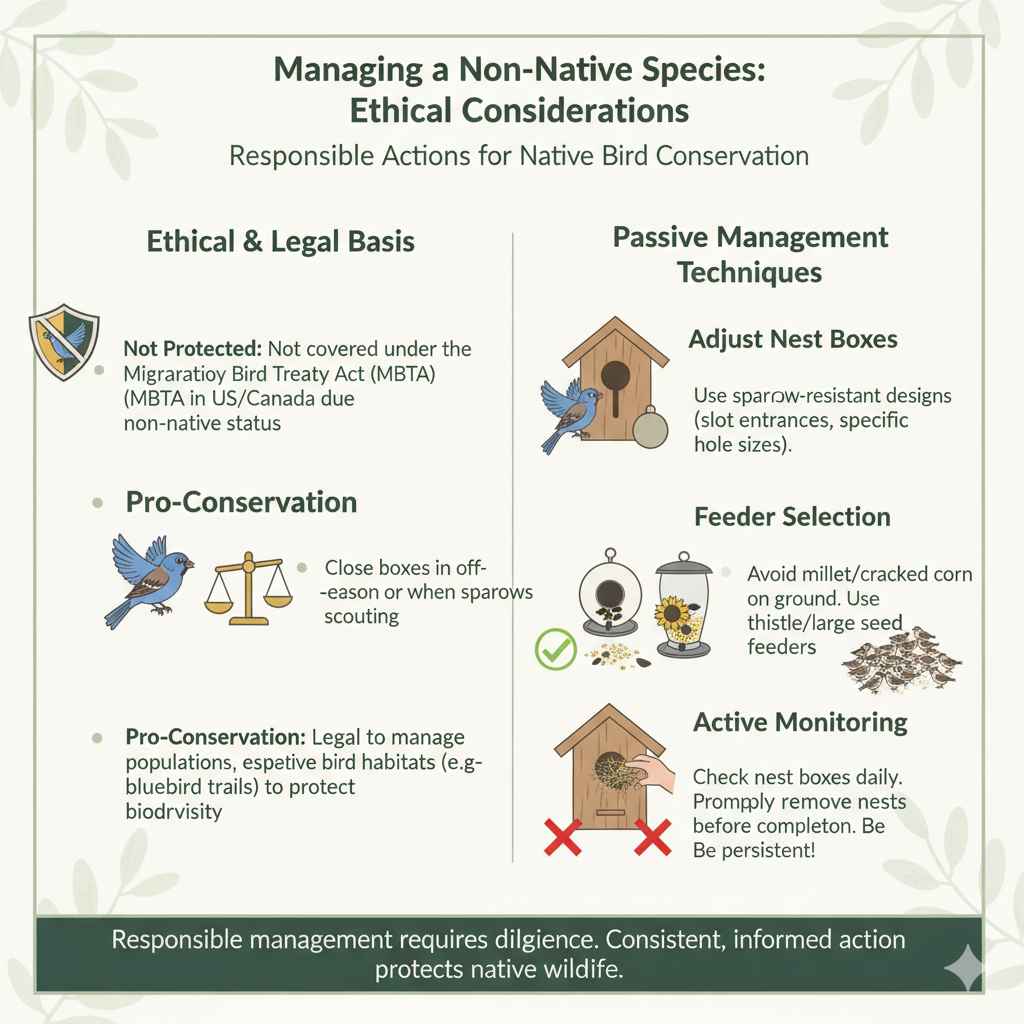
This is where the tough, practical lessons come in. If you are serious about protecting native wildlife, you need to understand the management implications of non-native species. For the House Sparrow, because it is non-native, it is not protected under the Migratory Bird Treaty Act (MBTA) in the United States or Canada.
This lack of protection means that managing their populations through various forms of control is legal, especially in areas dedicated to native bird conservation, like bluebird trails or martin colonies. This is a difficult subject, but necessary for conservationists.
Passive Management Techniques
Before considering removal, start with passive methods to discourage them. This is like working on your stance and fundamentals before introducing heavy weights—you maximize your existing resources first.
- Adjust Nest Boxes: Use nest boxes specifically designed for native birds (e.g., slot entrances for wrens, or slightly larger boxes with specific hole sizes for bluebirds) that House Sparrows may find less appealing.
- Trap Doors/Door Plugs: Keep nest box doors plugged or closed during the non-nesting season or when sparrows are aggressively scouting.
- Feeder Selection: Avoid feeding millet or cracked corn on the ground, as these are House Sparrow favorites. Focus on foods like thistle or large sunflower seeds that favor finches and chickadees, or use specialized feeders that exclude larger birds.
- Active Monitoring: Check nest boxes daily during nesting season. Promptly remove any sparrow nesting material before they finalize their claim on the cavity. Persistence is key.
Responsible management requires diligence. Because the House Sparrow is so determined, half-hearted efforts usually fail. It takes the same consistent practice you’d put into hitting the center of the target, day after day.
Why Does It Matter? The Archery Analogy
You might ask why an archery guide is diving so deep into ornithology. It’s about understanding your environment and focusing your energy correctly. In archery, you don’t waste energy on poor form or bad equipment; you focus on proven methods that guarantee success.
In conservation, we don’t waste limited conservation resources on a species that is thriving everywhere. Instead, we must dedicate our efforts to protecting the vulnerable, native species that evolved here and form the true backbone of our local ecosystems. The House Sparrow’s success is a lesson in adaptability, but their non-native status directs where our preservation efforts must be aimed.
House Sparrow Key Facts Summary (Passer domesticus)
| Status Category | Proven Fact |
|---|---|
| Native Status in N. America | Non-Native (Introduced) |
| Original Range | Europe, Asia, North Africa (Old World) |
| Year of Introduction | Mid-1850s |
| Protection Status (US/Canada) | Not Protected under the Migratory Bird Treaty Act |
| Ecological Role | Aggressive competitor and often a pest to native cavity nesters. |
Frequently Asked Questions (FAQ) About House Sparrows in North America
1. If they have been here for over 150 years, shouldn’t they be considered native now?
No. The definition of a native species relies on whether the organism arrived and established itself through natural means, without human assistance. Since House Sparrows were intentionally transported across an ocean, they remain classified as non-native or exotic, regardless of how long they have lived here. Time does not change the history of their introduction.
2. Are all sparrows in North America non-native?
Absolutely not. The term “sparrow” is confusing because it applies to two different bird families. The House Sparrow is non-native. However, North America is home to dozens of beautiful, native sparrow species like the Savannah Sparrow, Fox Sparrow, and Song Sparrow, which are vital parts of our ecosystem and deserve protection.
3. Do House Sparrows cause harm to agriculture?
Yes, they can be highly problematic in agricultural settings, especially grain production. While originally introduced to control insects, their diet is mostly seeds and grain. They often gather in large flocks, consuming vast amounts of stored grain, feed at feedlots, and can contaminate human food sources.
4. How is the House Sparrow doing in its native range in Europe?
Interestingly, while they are thriving and ubiquitous in North America, House Sparrow populations have been declining significantly in some parts of Western Europe, especially in urban centers like London. Scientists are investigating why they are declining where they are native but flourishing where they were introduced.
5. What is the single easiest way to identify a male House Sparrow?
Look for the distinct pattern: a gray crown (top of the head), a bright chestnut brown patch around the eyes/neck (nape), and a prominent black bib extending down the throat and chest. No native North American sparrow has this combination of markings.
6. Why are House Sparrows able to spread so much faster than native birds?
House Sparrows have incredible reproductive success. They breed multiple times per season, start nesting very early in the spring before many native birds, and are not shy about destroying other nests to secure a prime location. They are also omnivorous and highly flexible in their nesting locations, allowing them to exploit human resources better than specialized native species.
7. Can I legally remove House Sparrow nests from my property?
Because House Sparrows are not covered by the Migratory Bird Treaty Act, yes, their nests, eggs, and adults can be legally removed or deterred in the United States and Canada. However, you must be 100% certain the bird is a House Sparrow and not a native bird protected by law. When in doubt, always confirm identification.
Conclusion: Applying Knowledge for Better Stewardship
Just like in archery, where knowing your arrow’s flight path helps you adjust your aim, knowing the true identity and history of the House Sparrow helps you adjust your ecological stewardship. The proven truth is clear: the House Sparrow is an aggressive, highly successful immigrant from the Old World, not a native North American species.
This fact is crucial. It means that when you see a House Sparrow, you are looking at a species that requires management, especially around nesting sites intended for vulnerable native birds like the beloved Eastern Bluebird. Don’t be discouraged by their dominance. Knowledge is power! By learning the simple identification cues—the black bib, the preference for man-made structures—you can take effective steps to protect the native birds in your yard, ensuring that the natural balance of your local environment remains healthy and strong.
Keep practicing your identification skills, stay consistent in your monitoring, and you will make a real difference for our native wildlife. Happy birding (and shooting)!
Related pick: Check today's price on Amazon