

Concealed carry (CCW) is a personal right for self-defense, while armed security involves a professional duty to protect property or people for a client. The core difference lies in personal choice versus employment mandate, affecting training, legal scope, and daily responsibility.
Choosing the right path for personal defense can feel confusing. You hear terms like “concealed carry” and “armed security,” and they seem similar because both involve carrying a firearm. However, the rules, the training, and the daily job are very different. This often leaves new gun owners scratching their heads about which path fits their goals. Don’t worry; this is a common point of confusion, but we can clear it all up easily.
Think of it like choosing between learning to fish for fun or getting a job as a commercial fisherman. Both involve boats and nets, but the commitment and responsibility are worlds apart! This guide breaks down concealed carry vs armed security guard roles into simple steps so you can understand the essentials.
We will explore the core differences in training, legal requirements, and what it actually means to carry a firearm in each scenario. Let’s get started on making this clear!
Understanding the Core Difference: Purpose and Duty
The biggest difference between carrying a firearm for personal protection (concealed carry) and being an armed security guard boils down to one thing: purpose. Are you protecting yourself, or are you employed to protect someone else’s assets?
Concealed Carry: A Personal Right for Self-Defense
Concealed Carry Weapon (CCW), often called a Concealed Handgun License (CHL) or License to Carry (LTC) depending on your state, is about your personal right to protect yourself and your loved ones. When you carry concealed, you are acting as a private citizen.
- Focus: Immediate personal or family defense.
- Authority: You have no more legal authority than any other citizen unless the situation involves self-defense under the law.
- Scope: You decide when and where you carry, subject to state and local laws about prohibited places (like schools or courthouses).
- Training: Varies widely by state, often requiring a basic safety course and background check.
It’s a responsibility you take on voluntarily. You are responsible for your firearm 100% of the time, whether it’s on your hip or locked in your safe.

Armed Security: Professional Duty and Employment
An armed security guard is an employee hired to protect specific property, assets, or individuals for a client. They are, essentially, a private agent enforcing the rules set by their employer and the law.
- Focus: Protecting property, deterring crime, enforcing contractual guidelines, and acting as a visible deterrent.
- Authority: Limited, defined by state statute and their specific contract. They generally have no more arrest power than a private citizen unless deputized or commissioned under specific state programs.
- Scope: Restricted to their assigned post or patrol route during work hours.
- Training: Much more rigorous, involving state-mandated guard licensing, specific firearm qualifications (often quarterly), and scenario training.
If you are on duty as a security guard, you are “on the clock,” and your actions must align with your employer’s policies and state regulations for armed guards. This isn’t just about personal defense; it’s about your job performance.
Training Requirements: A Tale of Two Paths
The level and focus of training are perhaps the most significant practical difference when comparing concealed carry vs armed security guard positions. Think of it like the difference between getting a driver’s permit and earning a commercial truck license.
CCW Training: The Basics of Safety and Law
For concealed carry, the goal is to ensure you know basic firearm safety and the laws regarding carrying in public. This training is usually introductory.
- Initial Course: Most states require a few hours of classroom time covering local carry laws, safe storage, and fundamental marksmanship.
- Qualification: Often involves shooting a set number of rounds to prove basic proficiency (e.g., 30 to 50 rounds).
- Recertification: Many states do not require annual recertification, though staying proficient is always recommended.
The training is generally focused on the “what if I have to defend myself?” aspect, emphasizing when it is legal to draw your weapon.
Armed Security Training: Job Readiness and Operational Procedures
Armed security training must prepare the individual for employment, which involves constant vigilance and adherence to strict operational standards.
This training goes much deeper into use-of-force continuums and post orders:
- State Licensing: Guards must first pass state requirements to be a security officer, often including fingerprinting and background checks specific to the industry.
- Firearm Endorsement: A separate, more extensive course is required to add the “armed” status to the guard license.
- Scenario-Based Training: Guards practice responding to robbery, medical emergencies, and trespassing, often using role-players.
- Quarterly Requalification: Most states require armed guards to requalify on the range every three to six months to maintain their armed status with their employer.
Furthermore, specialized training might be required based on the post. A guard protecting a bank may have different rules than one patrolling a corporate office park. You can read more about the standards for private security personnel in many jurisdictions by checking state regulatory boards, often housed under the Department of Public Safety or similar agencies.
Legal Scope and Authority Differences
When you carry a weapon, the law dictates what you can and cannot do with it. These legal boundaries are starkly different for a private citizen carrying concealed versus an employed guard.
The Citizen Carrier (CCW Holder)
Your authority stems purely from self-defense law. You are a civilian until you are legally justified in using force to stop an imminent threat of death or serious bodily harm.
Key Legal Considerations:
- Duty to Act: Generally, you have no legal duty to intervene in a crime you witness unless you choose to.
- Arrest Powers: You only have the same citizen’s arrest powers as any other person, which are usually very limited and often discouraged by legal experts due to liability risks.
- Use of Force: Must meet the threshold of reasonable and necessary force to stop the threat.
The Armed Guard (Security Officer)
An armed guard often has specific, limited legal powers granted by the state specifically for their job function. These powers usually relate to the protection of the property they are hired to guard.
Key Legal Considerations:
- Duty to Act: Yes, while on duty, they have a contractual and often statutory duty to act to protect the client’s interest or property.
- Detention/Arrest: Some states allow private security officers to detain individuals who have committed a crime on the property they are guarding for a limited time until local police arrive. This power is strictly defined and varies immensely by state.
- Use of Force: Must follow both self-defense law AND their post orders. If the post order states “Do not confront,” violating that order can result in immediate termination, even if the use of force was technically legal under state self-defense statutes.
For in-depth analysis on the variations in state arrest powers for private security, resources like those provided by national security associations or university law enforcement programs often offer useful comparative studies.
The Gear Factor: Uniformity vs. Personal Preference
What you carry and how you carry it also shifts significantly between these two roles.
CCW Gear: Practicality and Comfort
For concealed carry permit holders, the primary goal is usually comfort, deep concealment, and reliability for personal defense.
Gear Choices:
- Firearm: Often a smaller, lighter handgun optimized for daily carry (EDC).
- Holster: Must meet concealment needs (e.g., appendix carry, strong-side hip).
- Attire: Civilian clothing that effectively covers the firearm without drawing attention.
- Magazines: Usually carry one or two spare magazines, prioritizing capacity that doesn’t print through clothing.
Armed Security Gear: Visibility and Standardization
Armed guards are usually required to adhere to strict standards set by their employer, which emphasizes visibility and standardization.
Gear Requirements Often Include:
- Uniform: A recognizable uniform, often with visible badges or patches indicating their role.
- Firearm: Often a duty-sized firearm (more robust for professional use) mandated by the company policy.
- Gear Belt: Must carry specific equipment like handcuffs, radio, pepper spray, and standardized magazine pouches.
- Visible Carry: While some posts may allow concealed carry, the standard for most security roles is open carry, as the uniform itself serves as the deterrent.
This contrast is clear: CCW is about blending in; armed security is often about standing out as an authority figure on that specific property.
Liability and Insurance: Who Covers the Risk?
Carrying a firearm introduces liability, whether you are protecting yourself or a client’s property. The way this liability is managed is drastically different.
Liability for the CCW Holder
If you use your weapon, you are responsible for the legal aftermath. You will face civil lawsuits and criminal investigation immediately.
- Insurance: You are personally responsible for acquiring liability insurance if you want coverage for self-defense incidents.
- Legal Costs: You hire and pay for your own defense attorney, regardless of the outcome of the incident.
Liability for the Armed Security Guard
When on duty, the primary liability often shifts to the employing agency.
- Employer Coverage: Security companies carry large general liability and professional liability insurance policies precisely to cover their employees’ actions while on the job.
- Workers’ Compensation: If injured while working, the guard is typically covered under workers’ compensation, which is different from standard health insurance.
- Legal Defense: In most incidents arising from job duties, the employing agency provides and pays for legal defense, provided the guard followed all company policies.
This is a significant benefit of the armed security route: professional indemnification while working. However, if a guard uses excessive force or violates company policy, that protection can vanish, leaving the guard personally liable.
A Quick Comparison Table: CCW vs. Armed Security
To make the decision clearer, here is a side-by-side look at the main points we have covered:
| Feature | Concealed Carry (CCW Holder) | Armed Security Guard |
|---|---|---|
| Primary Role | Personal and family defense. | Protecting client property/personnel as employment. |
| Authority | Citizen self-defense rights only. | Statutory powers limited by post orders and contract. |
| Training Frequency | Initial course; often no annual renewal required. | Mandatory state-required training and frequent (e.g., quarterly) requalification. |
| Carry Style | Usually concealed for discretion. | Often openly displayed in uniform for deterrence. |
| Liability Coverage | Personal responsibility; must purchase own insurance. | Covered primarily by employer’s liability insurance while on duty. |
| Compensation | None (it’s a right/responsibility). | Wages paid for security duties. |
When to Choose Concealed Carry
The CCW path is the best fit for most people who want the option of armed self-defense without changing their career or daily routine.
You should consider concealed carry if:
- Your primary concern is protecting yourself and your immediate family while going about your daily life (work, shopping, travel).
- You prefer minimal government oversight beyond the initial licensing process.
- You do not want the obligation or structure of a full-time security job.
- You value deep concealment over visible deterrence.
It is about self-reliance. You train, you get licensed, and then you integrate the responsible carry of a firearm into your civilian life according to the laws of your jurisdiction.
When to Choose Armed Security
The armed security route is a career choice that provides structured employment, specialized training, and a defined scope of legal protection while working.
You should explore armed security if:
- You are seeking employment or a secondary income stream that utilizes firearm skills.
- You thrive in structured environments with clear rules and procedures (post orders).
- You want the employer to provide the primary liability insurance coverage while you are working.
- You are interested in a career path that could potentially lead to law enforcement later on (security experience is sometimes valued).
This path requires a bigger commitment to ongoing training and adherence to rules that might sometimes feel restrictive compared to personal carry.
The Myth of “More Authority” in Security
A common misconception when comparing concealed carry vs armed security guard status is that security guards have police-like powers. This is rarely true.
Police officers have powers derived directly from the State Constitution and criminal codes. Security guards derive their powers from two sources:
- The Law of Citizen’s Arrest: The same limited power any citizen has.
- The Property Owner’s Authority: They act as agents of the property owner who has the right to remove trespassers or detain those committing crimes on their premises.
If a guard steps off their assigned property or acts outside their post orders, they immediately revert to being just a regular citizen with a gun, dramatically increasing their personal legal risk. The authority is tethered strictly to their employment mandate.
The Ongoing Commitment to Proficiency
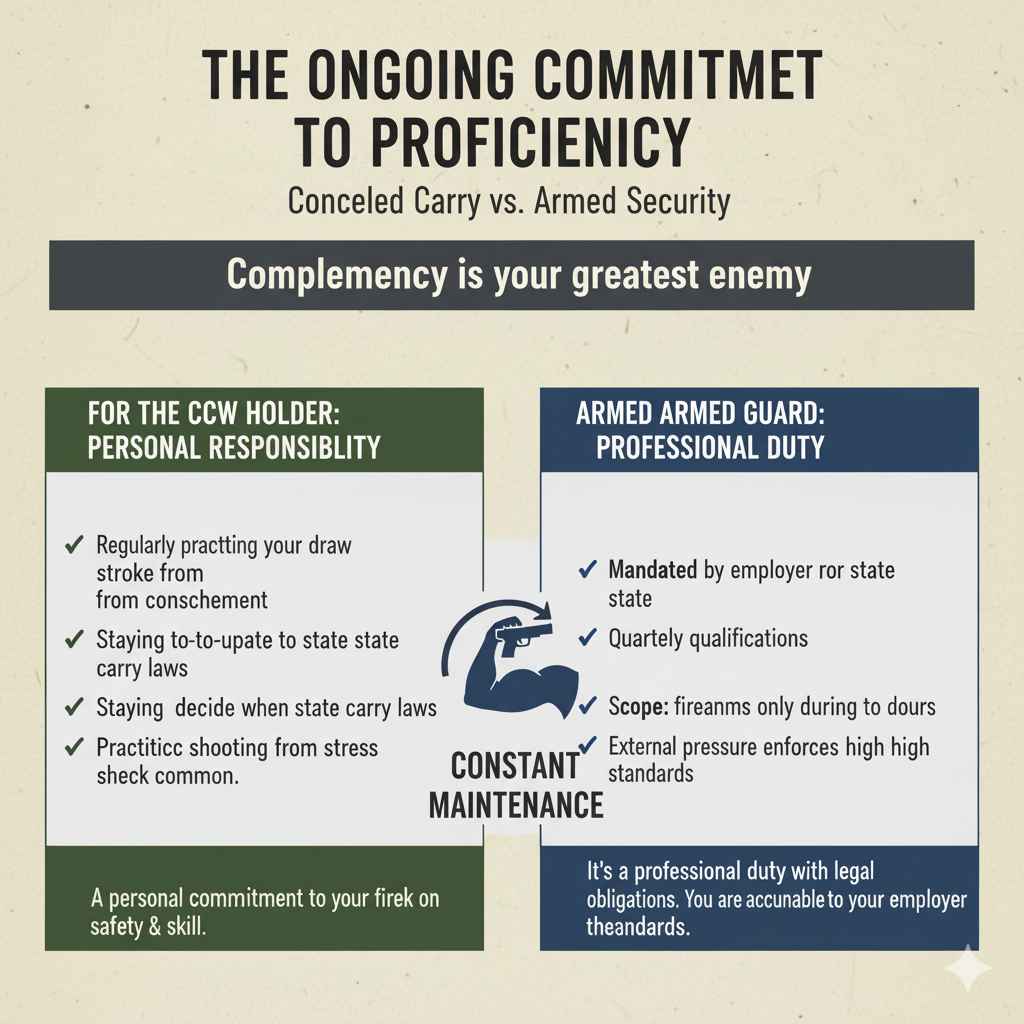
Whether you choose personal carry or professional security, complacency is your greatest enemy. A firearm is a tool that requires constant maintenance—both physical and mental.
For the CCW holder, proficiency means:
- Regularly practicing your draw stroke from concealment.
- Staying up-to-date on any changes to state carry laws.
- Practicing shooting from positions that mimic real-life stress.
For the armed guard, proficiency is mandated by the employer and the state licensing board. Missing a quarterly qualification often means being immediately removed from armed duty until you requalify. This external pressure helps enforce the necessary high standard, but personal commitment is still key to safe performance.
Frequently Asked Questions (FAQ) for Beginners
Q1: Can a person with a standard CCW license work armed security?
A: No. A CCW permit only authorizes personal carry. To work armed security, you must meet the specific training, licensing, and insurance requirements set by your state for private security officers, which are usually much stricter than a basic CCW course.
Q2: Do armed security guards have to carry a gun at all times?
A: Only while they are “on duty” or actively performing assigned security tasks. When their shift ends, they are typically governed by standard concealed or open carry laws, just like any other citizen, unless their employer mandates otherwise for transit.
Q3: Is the training for armed security harder than CCW training?
A: Yes, significantly. CCW training focuses on basic safety and law. Armed security training involves much more rigorous firearm qualification standards, situational awareness drills, legal use-of-force scenarios, and often requires ongoing practice sessions throughout the year.
Q4: If I use my gun while working armed security, do I need my own lawyer?
A: Usually, no. If the use of force was within the scope of your employment and followed company policy, the security agency’s legal team and insurance should provide your defense. This is a major difference in employment benefits.
Q5: Can a CCW holder legally stop a crime they witness?
A: Yes, under the same laws allowing any citizen to make a citizen’s arrest or use force in self-defense. However, unlike an armed guard, the CCW holder has no contractual duty to intervene and carries 100% of the resulting personal liability.
Q6: Which path generally pays more?
A: Armed security is a paid job, so it provides regular compensation. CCW carry is a personal choice that costs money (licensing fees, training, gear) and does not provide income.
Conclusion: Making Your Informed Choice
Deciding between concealed carry and armed security ultimately comes down to purpose, responsibility, and lifestyle. While both involve carrying a firearm, the intention behind each role is fundamentally different.
Concealed carry is about personal protection and individual responsibility. It allows law-abiding citizens to legally carry a firearm for self-defense while going about their normal daily lives. The training requirements are typically basic, and the responsibility for legal protection, insurance, and safe firearm use rests entirely on the individual.
Armed security, on the other hand, is a professional role with structured duties. Security officers carry firearms as part of their employment to protect property, people, or assets for a client or organization. This path requires more extensive training, licensing, regular firearm qualification, and strict adherence to company policies and post orders. However, it also provides benefits such as employer liability coverage and regular income.
In simple terms:
- Concealed Carry: Personal defense, voluntary responsibility, civilian authority.
- Armed Security: Professional duty, employment structure, client protection.
Understanding these differences helps you choose the path that aligns with your goals, level of commitment, and desired responsibilities. Whether you decide to carry for personal protection or pursue a career in armed security, responsible firearm handling, ongoing training, and respect for the law are essential for safety and effectiveness. 🔒