are illuminated scopes legal for hunting: Proven, Essential
Illuminated scopes are generally legal for hunting across the United States and Canada, provided the illumination is limited to the internal reticle (the crosshairs) and does not project an external laser or light onto the target. However, legality depends entirely on your specific state or provincial regulations, the game animal you are pursuing, and strict restrictions concerning night hunting. Always check your local Department of Fish and Wildlife rules before heading into the field. For more on this, see our guide on Is Arrow Getting a Spin Off? Latest Updates and Rumors. For more on this, see our guide on Are Rainbows Actually Circles? Discover the Science Behind the Arc.

theOpticGuru
ATN X-Sight 5 Smart Day/Night Hunting Scope…
- ULTRA HD 4K+ RESOLUTION WITH BRAND NEW SENSOR - Creating a visual experience like never before. With true tones and vivid colors g…
- VIDEO RECORD IN ULTRA HD 4K RESOLUTION - ATN makes capturing once in a lifetime moments in 4K the benchmark!
- BALLISTIC CALCULATOR - Dominance Through Technology. Obsidian 5 advancements make ballistics a breeze.
As an Amazon Associate I earn from qualifying purchases.
Welcome, fellow hunter! If you’ve been looking into upgrading your rifle setup, chances are you’ve encountered the modern convenience of an illuminated scope. These powerful tools help turn challenging low-light shots into confident, accurate placements. But before you invest, a huge question pops up: Are illuminated scopes legal for hunting?
It’s an incredibly common and sometimes frustrating question because the answer isn’t a simple yes or no. Hunting regulations are designed to ensure fair chase, safety, and ethical practice, and they change dramatically depending on where you hunt. Don’t worry, we are going to break down this confusing topic step-by-step. We will cover the specific legal lines you cannot cross, why those rules exist, and exactly how to check your local laws with confidence. Let’s get started on understanding this essential piece of hunting knowledge.
The Core Question: Are Illuminated Scopes Legal for Hunting?
For most North American hunters, using a scope with an illuminated reticle is perfectly acceptable. The confusion often stems from misunderstanding the difference between an internally illuminated scope and an externally projecting aiming device.
Think of your illuminated reticle like the digital dashboard on your car. It glows faintly so you can see the critical information (your aiming point) in the dark. It doesn’t project anything onto the road outside.
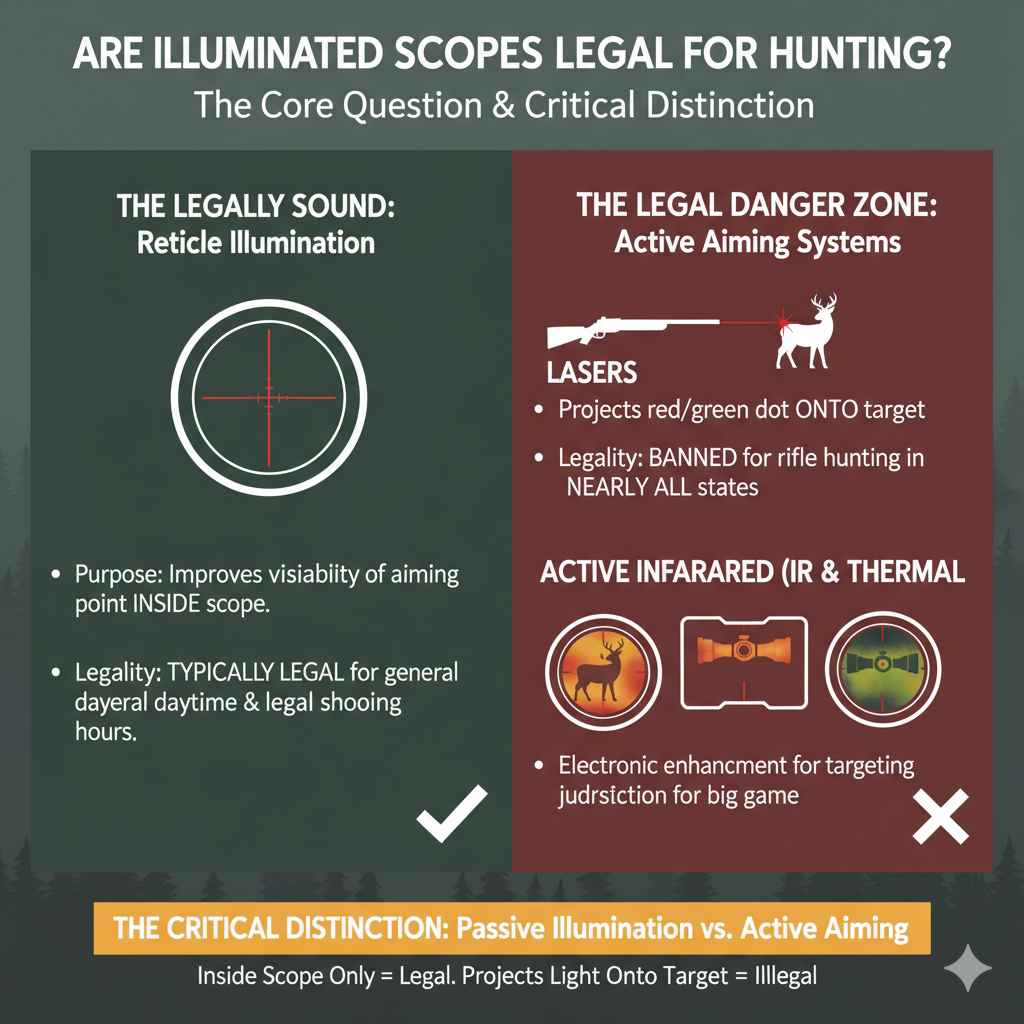
The Critical Legal Distinction: Passive Illumination vs. Active Aiming
The vast majority of hunting regulations focus on prohibiting “active aiming systems.” These are devices that physically project light or a beam onto the target, helping the hunter acquire the animal under conditions where it would otherwise be impossible or unethical. Illuminated reticles do not fall into this category because they do not project light outside the scope.
Here is the breakdown of what is usually legal versus what is almost always illegal:
The Legally Sound: Reticle Illumination
An illuminated reticle is simply a crosshair or aiming point inside the scope that lights up, often in red, green, or orange. This feature is crucial when hunting during legal shooting hours (dawn and dusk) because ambient light is very low. The illumination prevents the thin black crosshairs from washing out against a dark background (like a dark tree line or the hide of a deer).
- Purpose: Improves visibility of the aiming point within the scope.
- Legality Status: Typically legal for general daytime and legal shooting hour hunting in most states and provinces.
The Legal Danger Zone: Active Aiming Systems
Active systems are the ones that get restricted. These include any device that casts a visible beam or spot onto the target, or uses technology designed to give the hunter an unfair advantage by eliminating the darkness entirely.
- Lasers: Devices that project a red or green dot onto the animal. These are banned for rifle hunting in nearly all states, though some allow them for certain specialty weapons (like crossbows or firearms for disabled hunters).
- Active Infrared (IR) or Thermal Imaging: Systems that use electronic enhancement to locate and target animals after legal shooting hours. Using these for identification or targeting during prohibited times is illegal in almost every jurisdiction for big game.
The principle of “Fair Chase” is why these restrictions exist. Hunting laws want to ensure the animal has a sporting chance, and eliminating the challenge of low light or darkness using sophisticated electronic aids is generally viewed as unethical and illegal for traditional hunting methods.
State-by-State Variations: Why Research Is Your Best Scope
While the general rule is favorable toward illuminated reticles, you absolutely must verify the specifics in your hunting location. Regulations are not static; they change yearly, often driven by shifts in population management or legislative initiatives.
What is legal for whitetail deer in Texas might be illegal for elk in Montana or small game in New York. There are four primary regulatory areas that affect the legality of your scope choice:
1. Time Restrictions (The Dusk/Dawn Rule)
Most states define “legal shooting hours” as 30 minutes before sunrise until 30 minutes after sunset. Illuminated scopes are designed to be used exactly within these low-light periods. The moment you are hunting outside of those legal hours, your equipment (including the illuminated reticle) can come under intense scrutiny.
2. Game Type and Weapon Type
Some states make specific exceptions based on what you are hunting or what you are shooting. For example:
- Bows/Crossbows: Some jurisdictions that ban laser sights on firearms allow them on crossbows (due to different velocity profiles or for accessibility reasons).
- Furbearers/Varmints: Night hunting for animals like coyotes, raccoons, or hogs often has separate rules. Many states permit the use of artificial lights or electronic sights (including active IR or thermal) for pest control or non-game animals, but strictly prohibit them for big game (deer, bear, elk).
3. Battery Use Restrictions
A few regulations (though becoming rarer) may place blanket restrictions on electronics that require batteries being attached to the weapon. While illuminated reticles are generally exempt because the battery is powering only the aiming point, it’s worth a quick check. This specific type of regulation usually targets old laws aimed at completely electronic sights or rangefinding scopes, which have since become more accepted.
4. Definition of “Artificial Light”
This is the trickiest part. Regulations often ban the use of “artificial light” while hunting game animals. An illuminated reticle draws battery power to create light, but since the light is contained within the optic and does not illuminate the target, it is typically not considered an illegal artificial light source. However, if you attach a flashlight to your scope or gun to see the animal, that is undeniably illegal for big game hunting.
To give you a clearer picture, let’s look at how the general rules stack up against potential restrictions:
| Scope Feature/Usage | Typical Legality Status (General Rule) | Common Restriction/Exception to Check |
|---|---|---|
| Illuminated Reticle (Internal Glow) | Generally LEGAL | Must not be used outside of legal shooting hours; check if restricted for specific rifle types (e.g., muzzleloaders). |
| Red Dot/Holographic Sight (Internal) | Generally LEGAL | Similar to illuminated reticles; legal during legal shooting hours. |
| Laser Sights (External Beam) | Generally ILLEGAL | Often prohibited for big game; sometimes legal for small game or specific pest hunting (e.g., feral hogs). |
| Active Thermal/Night Vision | Generally ILLEGAL | Strictly prohibited for big game; often permitted for predators, furbearers, or nuisance animals (requires specific permit or license). |
Remember, the burden of proof rests entirely on you, the hunter. You need to be able to show a game warden that your equipment meets all current regulations.
Step-by-Step Guide: How to Verify Your Scope Legality
Never assume your friend’s setup is legal in your location. When dealing with law enforcement and regulations, confidence comes from official documentation. Here is the proven, three-step process for confirming the legality of your illuminated scope.
Step 1: Identify Your Scope and Accessory Type
Before checking the law, you must know exactly what technology you are using. A warden will ask for specifics.
- Internal Illumination: Does the scope only illuminate the crosshairs? (Example: Trijicon AccuPoint, Leupold VX-5HD).
- External Projection: Does the scope or attachment project any light (laser, visible beam, or infrared floodlight) outside the muzzle end of the rifle? (Example: A separate laser module, or an IR illuminator coupled with digital night vision).
- Digital Enhancement: Does the scope electronically enhance ambient light or use thermal signatures? (Example: ATN X-Sight, Pulsar Thermal Scopes).
If your answer to step 1 is only “Internal Illumination,” you are highly likely to be legal. If you answer “External Projection” or “Digital Enhancement,” proceed very carefully to the next steps.
Step 2: Determine Your Hunting Location and Species
Legality hinges on location and target. Write down the following details:
- State/Province and specific county or management area.
- Targeted game species (e.g., Whitetail Deer, Raccoon, Elk).
- Anticipated hunting time (Daylight only, or potentially legal shooting hours close to dawn/dusk).
Step 3: Consult Official Government Resources
This is the most critical step. You must consult the specific, written regulations published by your state’s wildlife agency. Do not rely on forum posts, articles (even this one!), or anecdotes from other hunters. Regulations change annually.
First, go to the U.S. Fish & Wildlife Service website or the equivalent provincial Canadian resource. From there, navigate to your state or province’s specific wildlife department (e.g., Texas Parks and Wildlife, Pennsylvania Game Commission). Look specifically for sections titled:
- Prohibited Methods (or Unlawful Devices/Methods).
- General Regulations for Firearms and Archery.
- Night Hunting and Furbearer Regulations.
Search the document for keywords like “illuminated sight,” “electronic,” “laser,” “artificial light,” or “night vision.” If the regulation prohibits “any sight that casts a visible light upon the animal,” your simple illuminated reticle is usually safe, but a mounted laser is not.
State Regulation Snapshot (Illustrative Examples)
To show you how specific these regulations can be, here is a snapshot of common rules:
| Category of Regulation | Example State Rule (General Interpretation) | Impact on Illuminated Reticles |
|---|---|---|
| General Rifle Hunting | “It is unlawful to hunt big game using any electronic device that casts a beam of light onto the animal.” (Vast Majority of States) | Illuminated reticle is LEGAL, as the internal light does not cast a beam onto the animal. |
| Night Hunting (Predator/Varmint) | “The use of artificial light or night vision equipment is permitted for coyote and feral hog hunting.” (Many Southern/Western States) | Illuminated reticle is LEGAL, and external illumination (lasers, night vision) is also permitted under specific permits/times. |
| Muzzleloader/Archery Season | “Muzzleloaders may not be equipped with any electronic sighting devices.” (Some Northeast/Midwest States) | Illuminated reticle is ILLEGAL during this specific season, as the battery power qualifies as an electronic device. You must switch to traditional iron sights or a non-illuminated scope. |
If you read the regulations and still feel uncertain—which happens often—your final resource should be a direct phone call. Call the local game warden office or the regional headquarters for your wildlife department. A simple, polite question will often give you the authoritative answer you need, saving you potential fines or loss of equipment.
Choosing the Right Scope for Legal, Ethical Hunting
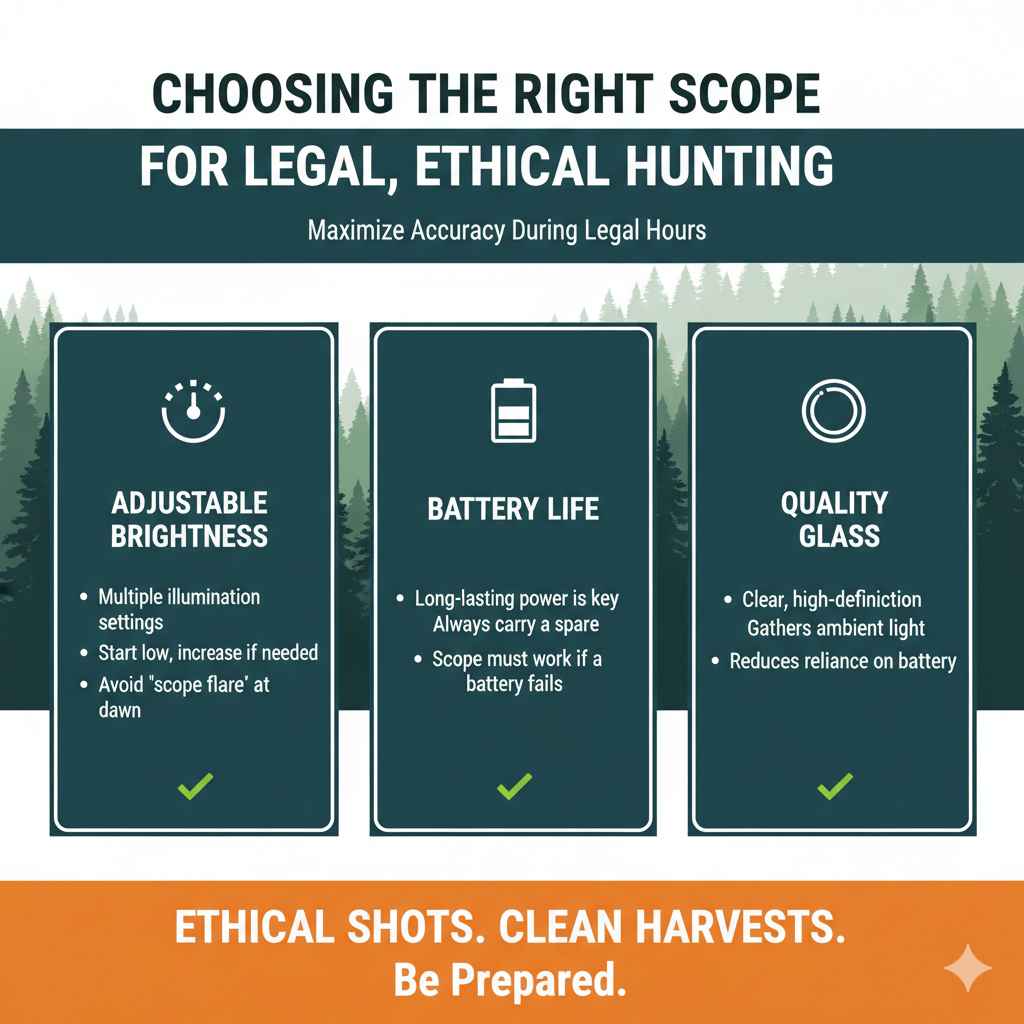
When selecting your new illuminated scope, keep ethical and legal concerns front and center. The goal is accuracy and visibility during legal shooting hours, not extending your hours illegally.
Features to Prioritize
- Adjustable Brightness: Look for scopes that offer many illumination settings. You rarely need the brightest setting. High settings can cause “scope flare” or wash out your vision, especially at dawn. Start low and only increase if absolutely necessary.
- Battery Life: Illumination relies on power. Ensure your scope has long battery life and always carry a spare battery. If your illumination fails, your scope must still function perfectly as a standard scope.
- Quality Glass: No amount of illumination can compensate for poor-quality glass. Invest in clear, high-definition glass that gathers as much ambient light as possible. This reduces your reliance on the battery-powered reticle.
A high-quality illuminated scope, used correctly, dramatically increases your ability to make a clean, ethical shot during challenging low-light conditions. It reduces the chance of misjudging the crosshair placement against a dark target, which is key to ensuring the fastest possible harvest.
FAQ: Illuminated Scopes and Hunting Regulations
We know this topic brings up many specific questions, especially for beginners. Here are the clear answers to the most common queries about electronic sights and hunting law.
1. Is an illuminated reticle considered an “artificial light” source by game wardens?
No, generally it is not. An illuminated reticle is internal to the sight and designed only to help the hunter visualize the aiming point. Game regulations banning “artificial light” usually refer to devices that project light externally onto the animal (like a flashlight or projector) for the purpose of locating or targeting the game.
2. Are red dot sights or holographic sights legal for hunting big game?
Yes, in most states, red dot and holographic sights (which are electronic sights but do not project a beam externally) are legal for big game during standard legal shooting hours. They function similarly to an illuminated reticle by simply providing a battery-powered aiming point within the optic.
3. Can I use my illuminated scope for night hunting of coyotes or hogs?
This depends entirely on the state and the animal. Many states allow night hunting for predators (coyotes, bobcats) and invasive species (feral hogs). Often, for these specific animals, regulations are relaxed to allow the use of artificial lights, active night vision, and thermal scopes. You must confirm that your target animal is specifically listed under the relaxed night hunting regulations.
4. If my state bans “electronic devices” on firearms, does that include my illuminated scope?
In most modern regulations, a scope with internal illumination is not restricted unless the rule specifies “any device that requires battery power.” However, this older, stricter wording is often still found in rules for specific seasons, like traditional muzzleloader seasons. If you see this ban, assume your illuminated scope is illegal for that season and switch to mechanical sights.
5. What is the difference between an illuminated reticle and a laser sight, legally speaking?
An illuminated reticle only lights up the crosshair inside the scope, visible only to the hunter. A laser sight projects a visible beam or dot (usually red or green) onto the target animal itself. Laser sights are almost universally illegal for hunting big game because they are seen as giving the hunter an unsporting advantage and violating fair chase rules.
6. What should I do if a game warden approaches me and questions my illuminated scope?
Be polite, cooperative, and calm. Confidently explain that your scope uses internal reticle illumination only, which is legal for hunting during daylight and legal shooting hours in that area. If possible, show them that the scope does not project any light beam externally onto the ground or the animal.
7. Can rangefinding scopes (with built-in distance calculation) be used legally?
Yes, most states now allow scopes with built-in rangefinders, as they do not aid in target acquisition or night hunting—they simply provide data. However, as always, check your specific state regulations, particularly in areas or seasons with very strict gear restrictions.
Confidence in the Field
As your trusted guide, I want to emphasize that illuminated scopes are fantastic tools that greatly improve accuracy during those crucial low-light minutes of dawn and dusk. They are a significant aid to ethical hunting because they reduce the chance of poor shot placement caused by an invisible reticle.
The key to using them legally boils down to recognizing the line between helpful aiming and unfair advantage. If the light source leaves the scope and touches the animal, it is almost certainly illegal for general hunting. If the light stays inside to brighten your crosshair, you are typically good to go.
Take the time to do your homework—check the official regulations from your state wildlife department. By doing so, you ensure you are hunting safely, legally, and ethically, allowing you to focus on the joy of the pursuit and the precision of your shot.
Related pick: Check today's price on Amazon