Are IR Scopes Legal For Hunting: Essential Guide
IR scopes (Infrared and Thermal Imaging scopes) are legal for hunting in some U.S. states and for specific game, but they are strictly prohibited in many others, especially for big game like deer and elk. The legality hinges entirely on local state regulations, which change frequently. Always check your state’s current Department of Natural Resources (DNR) or Fish and Wildlife regulations before using any IR device for hunting. Failure to comply can result in heavy fines and license loss. For more on this, see our guide on Is a Hunting Rifle a Scoped Weapon Fortnite.

theOpticGuru
ATN X-Sight 5 Smart Day/Night Hunting Scope…
- ULTRA HD 4K+ RESOLUTION WITH BRAND NEW SENSOR - Creating a visual experience like never before. With true tones and vivid colors g…
- VIDEO RECORD IN ULTRA HD 4K RESOLUTION - ATN makes capturing once in a lifetime moments in 4K the benchmark!
- BALLISTIC CALCULATOR - Dominance Through Technology. Obsidian 5 advancements make ballistics a breeze.
As an Amazon Associate I earn from qualifying purchases.
Welcome, fellow archers and hunters! As you look to improve your gear and accuracy, you’ve likely come across advanced optics like IR scopes—Infrared or thermal imaging devices. These tools can turn night into day, but they also bring up a huge, confusing question: Can you actually use them legally while hunting?
This is one of the most common and frustrating equipment questions beginners face. The technology is amazing, but the laws surrounding it are complex, state-specific, and change often. Don’t worry! I’m Salman Arfeen, and I’m here to simplify this tricky topic. We will break down exactly what IR scopes are, why the rules exist, and how to make sure your setup is 100% legal before you step into the field. Let’s build your confidence and keep your hunting legal and fun!
What Exactly Are IR Scopes and How Do They Work?
Before diving into the legal side, we need a clear understanding of what we are talking about. When hunters discuss “IR scopes,” they usually mean two types of devices: Infrared (IR) scopes (or Digital Night Vision) and Thermal Imaging scopes.
Digital Night Vision (IR Scopes)
These devices use low levels of ambient light (like starlight or moonlight) and often require a separate, active infrared illuminator (an IR flashlight). The illuminator shines a beam of infrared light that is invisible to the human eye but visible to the scope’s sensor, lighting up the target area. The image you see is typically a greenish or black and white digital rendering.
Thermal Imaging Scopes
Thermal scopes are different; they don’t need any light source at all. Instead, they detect tiny differences in heat (thermal energy) radiating from objects. Warm objects, like animals, stand out vividly against cooler backgrounds, regardless of vegetation or darkness. This is a crucial distinction, as some states treat these two technologies differently in their hunting laws.
It’s important to know that these technologies give hunters a huge advantage, particularly at night or in dense cover. This advantage is precisely why regulatory bodies tightly control their use.

The Core Legal Question: Why Are IR Scopes Restricted?
The rules governing IR scopes and hunting legality are based primarily on the principle of Fair Chase. Fair Chase is an ethical code that ensures the hunted animal has a reasonable chance of escape. Most wildlife agencies argue that using technology that negates the natural advantage of darkness violates this principle, creating an unfair balance between hunter and quarry.
Key Reasons for Restrictions:
- Night Hunting Advantage: Darkness is a natural defense for many game animals. IR scopes eliminate this defense, making nocturnal hunting almost too easy, which can lead to overharvesting.
- Conservation Efforts: Strict regulations help wildlife managers control population numbers and ensure sustainability.
- Safety Concerns: Hunting at night, even with advanced optics, introduces significant safety risks, as visibility around the target area remains low.
Because the interpretation of “Fair Chase” varies, the laws are not uniform across the United States. This variability is why the legal status of your IR scope depends entirely on where you plan to hunt.
State-by-State Legality: The Rules Are Not Consistent
The legality of using IR scopes for hunting is a state-level issue, managed by state game commissions (like the Texas Parks and Wildlife Department or the California Department of Fish and Wildlife). There is no single federal rule that covers all hunting of non-migratory game.
Where IR Scopes Are Generally Legal
In certain states, and almost always only for specific animals considered nuisance or invasive, IR or thermal scopes are permitted. The most common targets are feral hogs (wild pigs) and sometimes predators like coyotes.
For example, in Texas, the booming feral hog population is damaging agriculture, so the state encourages their elimination. Texas allows the use of thermal and night vision equipment for hunting feral hogs and exotic animals on private land, often 24 hours a day. Many southern and western states with large feral populations have similar rules.
Where IR Scopes Are Strictly Prohibited
Most states strictly prohibit the use of any artificial light or enhanced visibility optics (including IR and thermal) for hunting game animals like whitetail deer, mule deer, elk, and turkey. In these jurisdictions, possessing the device while hunting protected game can lead to severe penalties, even if you weren’t actively using it.
Checking the Official Source
I cannot stress this enough: Do not rely on forums, manufacturer claims, or hearsay for legal advice. Laws change yearly, sometimes mid-season. You must consult the specific, current hunting proclamation published by your state’s wildlife agency. A quick search for your state’s name plus “DNR hunting regulations” is the best first step. For example, check the U.S. Fish and Wildlife Service for general guidelines, but remember local laws always apply first.
Deciphering the Regulations: Game, Location, and Time
To determine if your IR scope is legal, you need to ask yourself three critical questions that state regulations address:
- What Am I Hunting? (The Game)
- Where Am I Hunting? (Public vs. Private Land)
- When Am I Hunting? (Day vs. Night)
Let’s break down how these factors interact, often determining legality.
1. The Game: Nuisance vs. Protected Species
The single biggest factor is the target species. If the animal is designated as a protected game animal (like deer, bear, or waterfowl), night hunting and advanced optics are almost certainly illegal. If the animal is an invasive or nuisance species (like hogs or often coyotes), laws are much more relaxed.
| Game Type | Typical Legality for IR Scopes | Reasoning |
|---|---|---|
| Deer, Elk, Moose | Illegal in almost all states. | Conservation, Fair Chase principle, and population management. |
| Feral Hogs (Wild Pigs) | Legal in many southern states. | Population control due to agricultural damage and invasive status. |
| Coyotes and Predators | Varies greatly by state; often legal at night. | Management of predator populations; fewer restrictions than big game. |
| Waterfowl (Ducks, Geese) | Always illegal. | Federal regulations prohibit the use of artificial lights for migratory birds. |
2. The Location: Public vs. Private Land
Even if a state allows thermal hog hunting, the rules may be different depending on the land. Hunting on public land (National Forests, State Parks) usually comes with stricter regulations regarding equipment and time than hunting on private land, where the landowner has more authority, subject to state law. Always check the rules specific to the public land management agency.
3. The Time: Day vs. Night Hunting
IR and thermal scopes are designed for low light or darkness. While some states permit predator or hog hunting at night, they may explicitly ban the use of certain optics during legal daylight hours for regular game, even if they aren’t infrared. This seems counterintuitive, but some jurisdictions ban the possession of the device while hunting specific game, regardless of the time of day.
Focusing on Archery: Do the Rules Change for Bow Hunters?
As an archery enthusiast, you might wonder if the rules change when hunting with a bow instead of a firearm. The answer is generally no, but the context matters.
Scope Restrictions Apply Across Weapons
State regulations usually focus on the act of taking game and the type of optic used, not just the weapon. If a state bans thermal imaging for hunting deer, that prohibition applies whether you are using a rifle, shotgun, or compound bow. The goal is to prevent the unfair advantage the optic provides.
However, many states have specific regulations about what kind of scope can be mounted on a bow, regardless of IR capability. For instance, some states restrict magnification or the use of batteries (which power IR scopes) on bow scopes during traditional archery seasons. It’s critical to review the “Bow and Arrow” or “Archery Equipment” section of your state’s guide.
IR Rangefinders vs. IR Scopes
Another common piece of IR gear is the rangefinder. An IR laser rangefinder measures distance by emitting a small, eye-safe infrared laser. Many jurisdictions permit the use of IR rangefinders, as they are considered an aid to shot placement and accuracy, not a means of locating or identifying game in the dark. Always confirm this, but generally, a device used only for ranging is less restricted than a full scope used for aiming.
Step-by-Step Guide to Confirming IR Scope Legality
To keep your hunting ethical and legal, follow this simple checklist every time you cross a state line or before the start of a new season:
Phase 1: Research and Documentation
- Identify Your Target Game: Determine the exact species you intend to hunt (e.g., Feral Hog, Whitetail Deer, Coyote).
- Identify Your Hunting Location: Note the state and whether the land is public or private.
- Find the Official Source: Go directly to the state’s Department of Natural Resources (DNR), Fish and Wildlife (F&W), or Game and Fish website. Look for the current year’s “Hunting Proclamation” or “Regulations Booklet.”
- Search Key Terms: Use the search function within the PDF or website for terms like:
- “Artificial light”
- “Thermal imaging”
- “Infrared”
- “Night vision”
- “Hog hunting equipment”
Phase 2: Interpreting the Regulation Language
Regulations often use specific legal language. Look for explicit allowances or prohibitions:
- “Prohibited Methods”: If the regulation states that thermal imaging is a “prohibited method of take” for deer, it’s illegal, period.
- “Exceptions”: Look for exceptions listed right after a prohibition. For example, “Night vision is prohibited, EXCEPT for the taking of feral swine on private lands.”
- Definition of “Game”: Ensure you know how the state defines your target. Is a coyote a “furbearer” or a “predator,” and does that classification change the equipment rules?
Phase 3: Final Verification (The Safety Net)
If the written regulations are confusing—and they often are—take the final step:
Call the local game warden or the regional office of the Fish and Wildlife Department. They are the ultimate authority and can provide clarity on local enforcement. Document the date, time, and name of the officer you spoke with. This layer of due diligence is essential for staying safe and legal.
Table of Typical IR Scope Penalties
Violating hunting equipment rules, especially regarding night vision and thermal optics, is taken very seriously by law enforcement. The consequences are often classified as a major misdemeanor or a felony, depending on the severity and state law.
| Violation Type | Typical Consequence | Severe Consequence |
|---|---|---|
| Minor (Possession without intent) | Heavy financial fine (often $500–$2,500). | Confiscation of equipment (scope, rifle, vehicle). |
| Major (Taking game illegally) | Mandatory court appearance and larger fines ($2,000+). | Suspension or permanent revocation of hunting license across multiple states (via the Wildlife Violator Compact). |
| Felony (Commercial or repeated violation) | Significant jail time (30 days to 1 year). | Restitution fees for the value of illegally harvested game. |
Because the risk is so high—losing your license and thousands of dollars—it truly pays to be 100% sure of the legality before you purchase or use an IR scope for hunting purposes.
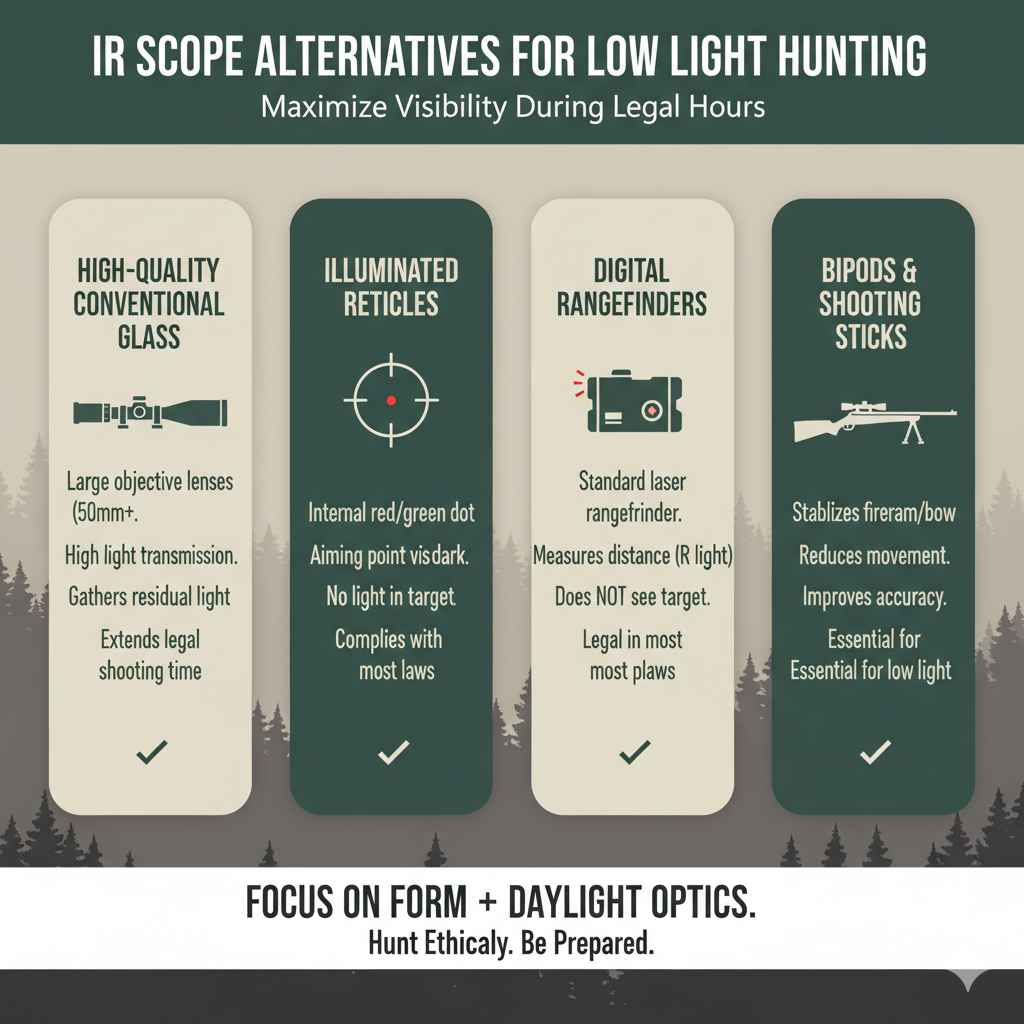
IR Scope Alternatives for Low Light Hunting
If your state bans IR scopes for the game you pursue, you still have options for improving accuracy and visibility during legal shooting hours (dusk and dawn). These alternatives comply with far more regulations:
- High-Quality Conventional Glass: Look for scopes with very large objective lenses (50mm+) and high light transmission rates. Quality glass gathers residual light much more effectively than budget scopes, extending legal shooting time.
- Illuminated Reticles: A simple illuminated red or green dot inside a traditional scope helps you see your aiming point against a dark background without violating artificial light restrictions (as the light is internal and doesn’t project onto the target).
- Digital Rangefinders: As mentioned, using a standard laser rangefinder (which uses IR light to measure distance but not to see the target) is legal in most places and essential for ethical shot placement.
- Bipods and Shooting Sticks: Low light conditions amplify minor movements. Stabilizing your bow or firearm is one of the best ways to improve accuracy when light fades.
Remember, most traditional hunting seasons require you to stop hunting 30 minutes after sunset, well before true darkness sets in. Focusing on improving your form and using high-quality daylight optics is usually the most effective and safest route for ethical big game hunting.
Frequently Asked Questions About IR Scope Legality
Here are clear answers to the most common questions beginners have about IR scopes and the law:
Q1: Is night hunting legal if I only use moonlight and no special equipment?
A: Generally, no. Most states prohibit hunting big game (like deer) between sunset and sunrise, regardless of the equipment used. Night hunting is usually only permitted for certain species (like hogs or coyotes) that have specific nighttime seasons.
Q2: If thermal scopes don’t use infrared light, are they legal where IR scopes are banned?
A: Highly unlikely. Most state regulations now specifically group thermal imaging (which detects heat) and traditional digital night vision (which uses IR light) together under broad terms like “artificial light source,” “image intensification,” or “electronic viewing devices.” If one is banned for a specific game, the other usually is too.
Q3: Can I carry an IR scope in my vehicle while hunting legal game?
A: This is a tricky area, and it varies by state. In some jurisdictions, mere possession of a device capable of enhancing visibility in the dark while afield or traveling to/from a hunt is illegal if that device is prohibited for the game you are pursuing. To be safe, leave prohibited equipment at home or securely locked away outside the hunting area.
Q4: Are IR rangefinders banned like IR scopes are?
A: Usually not. Most states permit the use of laser or infrared rangefinders because they only measure distance and do not help locate or identify the target animal in the dark. Always confirm this in your local regulations, but rangefinders are rarely classified with thermal scopes.
Q5: If I am hunting invasive hogs in a state where it is legal, does it matter if I spot a deer with the thermal scope?
A: Yes, it matters greatly. If you are licensed only for hogs, and you are using equipment prohibited for deer, you must cease all activity until the deer is gone. Many game wardens consider “searching for” or “shining” a protected game animal with prohibited equipment a violation, even if you don’t shoot. Stay focused only on your legal target.
Q6: Where can I find the official rules for hunting in my state?
A: Search for your state’s name plus “Fish and Wildlife” or “Department of Natural Resources.” Look specifically for the “Hunting Regulations” or “Proclamations” PDF for the current season. This is the only document that matters.
Q7: Why do manufacturers sell IR scopes marketed as “hunting scopes” if they are often illegal?
A: Manufacturers market globally and nationally. They sell these scopes for legal uses such as hunting predators/hogs in permissive states, varmint control, surveillance, or tactical applications. The legality depends on the buyer’s location and intended use, not the seller’s marketing.
Final Thoughts on Staying Legal and Ethical
Navigating the rules around advanced optics like IR scopes can feel overwhelming, but the guiding principle is simple: Respect the law and respect the tradition of Fair Chase.
If you are planning to hunt big game like deer or elk, you can almost guarantee that IR and thermal scopes are strictly illegal. Focus instead on maximizing your skill with traditional optics and high-quality gear during legal shooting hours. This approach improves your form, confidence, and overall success rate far more than relying on tech that might put you on the wrong side of the law.
For those interested in managing invasive species like feral hogs, IR scopes can be a game-changer, provided you have verified the legality down to the specific county and land type. Always prioritize checking the current state regulations—it’s the only way to ensure your next hunting trip is safe, fun, and completely legal. Good luck, and happy hunting!
Related pick: Check today's price on Amazon