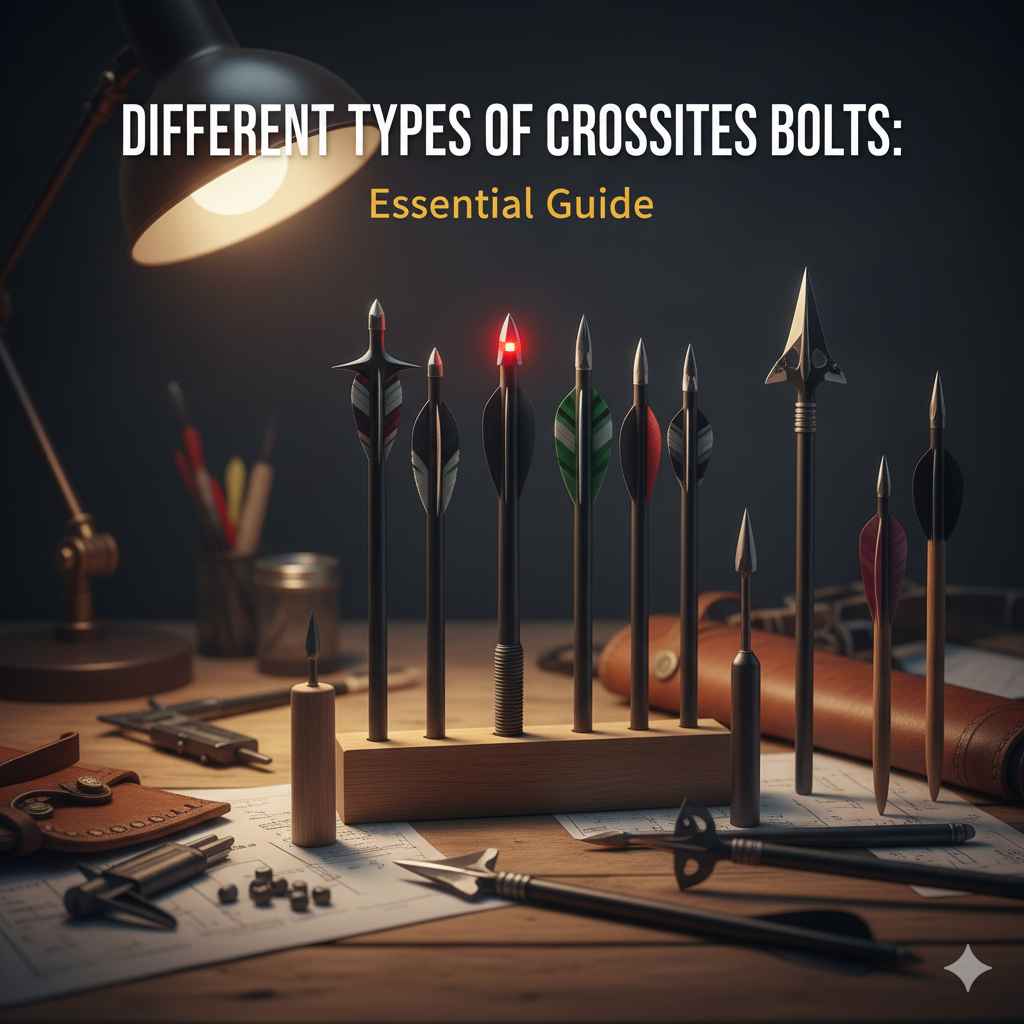
Understanding the different types of crossbow bolts means knowing materials (carbon, aluminum, wood), spine stiffness, and tip type. This guide helps beginners choose the perfect, safest bolt for accuracy and success in shooting, ensuring you match your bolt to your crossbow’s power.
Welcome to the exciting world of crossbow shooting! If you’re new here, you might look at a pile of bolts and think they all look the same. That’s where the confusion starts! Choosing the wrong bolt is like putting the wrong shoes on for a marathon—it makes everything harder. Luckily, the differences are simple once you know what to look for. We are going to break down the main types of crossbow bolts so you can choose the right gear with total confidence. Get ready to improve your accuracy and enjoy every shot!
For archers, the arrow (or bolt, for a crossbow) is the link between your power and the target. For beginners, it’s easy to overlook just how much the bolt’s structure affects where it lands. A bolt that is too weak or too heavy for your specific crossbow will fly inconsistently, causing frustration and poor grouping. We need consistency for accuracy. We’ll cover the three main areas that define a bolt: its material, its spine, and its components. Getting these right is the foundation of great shooting.
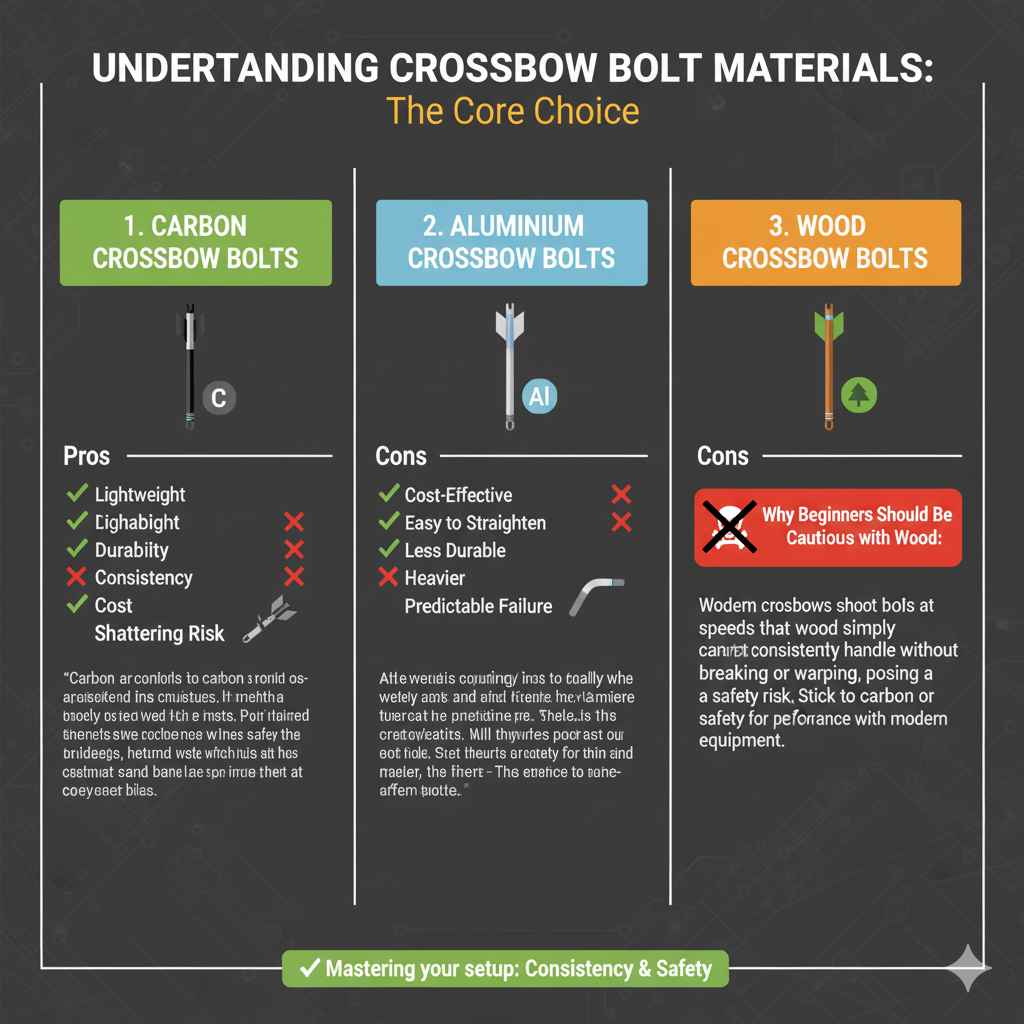
Understanding Crossbow Bolt Materials: The Core Choice
The material your bolt is made from is the biggest factor in its durability, weight, and cost. Think of it like choosing between a sturdy plastic cup and a fancy glass—they both hold liquid, but they handle stress differently! Here are the three primary materials you will see when shopping for the different types of crossbow bolts.
1. Carbon Crossbow Bolts
Carbon is the undisputed champion in modern crossbow shooting, especially for speed and consistency.
Pros of Carbon Bolts:
- Lightweight: Carbon allows for a lighter bolt, which generally means faster speeds from your crossbow.
- Durability: They are very tough and resist cracking better than aluminum.
- Consistency: Modern manufacturing makes carbon bolts incredibly uniform from one to the next.
Cons of Carbon Bolts:
- Cost: They are often the most expensive option upfront.
- Shattering Risk: If carbon fibers fail internally (often from hitting a hard surface or a bad shot), they can shatter into sharp pieces. Always inspect carbon bolts carefully!
2. Aluminum Crossbow Bolts
Aluminum bolts were the standard for many years and are still very popular, especially for target practice where budget matters.
Pros of Aluminum Bolts:
- Cost-Effective: Generally cheaper than high-end carbon models, making them great for high-volume target shooting.
- Easy to Straighten: If an aluminum bolt bends slightly, you can often carefully heat and straighten it back into usable shape.
- Predictable Failure: When they fail, they usually bend, which is safer than shattering.
Cons of Aluminum Bolts:
- Heavier: They are typically heavier than comparable carbon bolts, slightly reducing potential speed.
- Less Durable: They dent and bend more easily than carbon.
3. Wood Crossbow Bolts (Historical and Traditional Use)
You usually won’t find wood bolts recommended for modern, high-powered compound crossbows. They are mostly used in traditional archery or historical reproductions.
Why Beginners Should Be Cautious with Wood:
Modern crossbows shoot bolts at speeds that wood simply cannot consistently handle without breaking or warping, posing a safety risk. Stick to carbon or aluminum for safety and performance with modern equipment.
Understanding Bolt Spine: The Invisible Strength
If you hear experienced archers talking about “spine,” they are referring to the bolt’s stiffness. This is perhaps the most technical, yet most crucial, aspect of bolt selection. Think of spine as how much the bolt bends when force is applied.
What is Bolt Spine?
Spine rating measures the stiffness of the shaft. A high number means a stiffer shaft, and a low number means a more flexible shaft. Why does this matter?
When the crossbow string releases the bolt, it pushes it forward. The bolt must bend slightly during the launch, then spring back straight to fly true. If the bolt is too flexible for the crossbow’s power (draw weight), it will flex too much, leading to inaccurate shots.
Spine Matching is Key
Every crossbow has a required spine range printed in its manual. Always check your owner’s manual! Shooting a bolt with the wrong spine is dangerous and ruins accuracy.
- Too Soft (Low Spine) for a Powerful Bow: The bolt will flex too much, potentially causing it to strike the rail or cage, leading to breakage and dangerous vibration.
- Too Stiff (High Spine) for a Weak Bow: The bolt will not flex enough to absorb the energy properly, resulting in erratic flight.
For beginners, simply follow the manufacturer’s recommendation for your specific crossbow model. For example, a typical modern crossbow might require bolts rated between 300 and 450 spine.
Crossbow Bolt Components: Fins, Tips, and Nocks
Once you choose the material and check the spine, you need to look at what holds the bolt together and what makes it fly straight—the vanes (or fletching), the tip, and the nock.
1. Vanes (Fletching)
Vanes are the plastic fins at the back of the bolt. Their job is to stabilize the bolt in flight, just like the feathers on an arrow. They are typically made of durable plastic.
- Number of Vanes: Most crossbow bolts use three or four vanes. Four vanes offer slightly more stability but can cause a tiny bit more drag than three.
- Offset/Helical: Some vanes are set at a slight angle (helical or offset). This makes the bolt spin in flight, which dramatically improves stability and accuracy over longer distances. Beginners often benefit from helical vanes.
2. Nocks (The Tail End)
The nock is the small plastic piece that snaps onto the crossbow string. It must fit snugly but release smoothly.
Crucial Safety Note: Always use the nock type recommended by your crossbow manufacturer. Some crossbows require a flat-backed nock, while others require a concave (cup-shaped) nock. Using the wrong nock can cause the bolt to stick or release improperly, leading to a dangerous misfire or a cracked crossbow limb.
Look for reinforced polymer nocks for the best performance and safety on modern crossbows.
3. Tips and Points
The tip, or point, is what hits the target. This choice depends entirely on what you plan to do with the bolt.
Target Tips (Field Points)
These are smooth, blunt, or pointed tips used for practice. They are designed to penetrate paper or foam targets easily and are often reusable.
- Practice: Essential for developing muscle memory without the stress of damaging expensive hunting tips.
- Weight: Field points come in various weights (e.g., 100 grain, 125 grain). Consistency in point weight is vital for accuracy. If you use 100-grain tips for practice, always use 100-grain tips for hunting.
Broadheads (Hunting Tips)
These are specialized tips with sharp blades used only for hunting game. They are designed to cause maximum hemorrhage upon impact.
Warning for Beginners: Never practice shooting broadheads into standard foam targets unless the broadhead packaging specifically states it is safe. The sharp blades can destroy foam targets or get permanently stuck.
Broadheads are categorized by blade style (fixed or mechanical). Always check local hunting regulations regarding broadhead size and type before using them in the field, as rules vary by state or region (for example, check resources from state wildlife agencies like those found at the U.S. Fish and Wildlife Service for general guidance, though local rules apply).
Comparing Common Crossbow Bolt Specs: A Quick Reference
To help you visualize how these factors combine, here is a table summarizing the typical components and where you might use them.
| Bolt Type Focus | Primary Material | Typical Spine Range | Best Use Case | Key Feature |
|---|---|---|---|---|
| High-Speed Target Practice | Carbon | 300–400 | Competitive target shooting, speed testing | Lightweight, excellent straightness |
| Budget/Volume Practice | Aluminum | 400–500 | Backyard plinking, learning form | Affordable, easy to inspect for bends |
| Hunting/Field Use | Carbon (often reinforced) | 300–350 | Actual big game hunting | Durability under high kinetic energy |
| Traditional/Historical | Wood | N/A (based on arrow type) | Display or traditional bows only | Authentic look and feel |
How to Measure Bolt Length: A Critical Step
Bolt length is determined by your crossbow’s design, not by personal preference. Using a bolt that is too short can be extremely dangerous.
The Danger of Short Bolts
If a bolt is too short, the nock might not stay securely on the string when fired, or worse, the front part of the bolt could fall off the rail and strike the bow’s components (like the riser or cage) as it moves forward. This is called a “dry-fire” scenario for the bolt, leading to catastrophic equipment failure and potential injury.
Measuring Bolt Length Correctly
You should always measure from the inside of the nock groove to the exact center of the shaft where the tip screws in (this is the point where the spine is measured). However, for beginners, the easiest method is to:
- Check your crossbow manual for the required bolt length (usually listed in inches, e.g., 20 inches).
- Purchase bolts matching that exact length.
- If you must measure an existing bolt, use a tape measure from the very end of the nock to the base of the point threads.
When in doubt, err on the side of slightly longer bolts, provided they still fit safely within the crossbow’s flight groove.
Choosing the Right Bolt Weight (Grain)
Weight, measured in grains (gr), affects how fast the bolt travels and how much energy it retains.
Understanding Grain Weight
Grain weight is determined by the total weight of the shaft plus the tip (point) and any added inserts. For example, a bolt might be listed as a 400-grain bolt.
Impact on Performance:
- Lighter Bolts (Lower Grain): Travel faster but lose speed more quickly over distance. They transfer less kinetic energy to the target, which is fine for small targets but insufficient for large game.
- Heavier Bolts (Higher Grain): Travel slightly slower but retain more kinetic energy downrange, meaning they hit harder and are less affected by wind.
Your crossbow manufacturer provides a minimum recommended bolt weight. You must never use a bolt lighter than this minimum weight. Doing so puts too much stress on the bow limbs and can cause them to break.
A common practice is to match the practice tip weight (field point) to the hunting tip weight (broadhead) so that your point of impact does not change when you switch from practice to hunting mode.
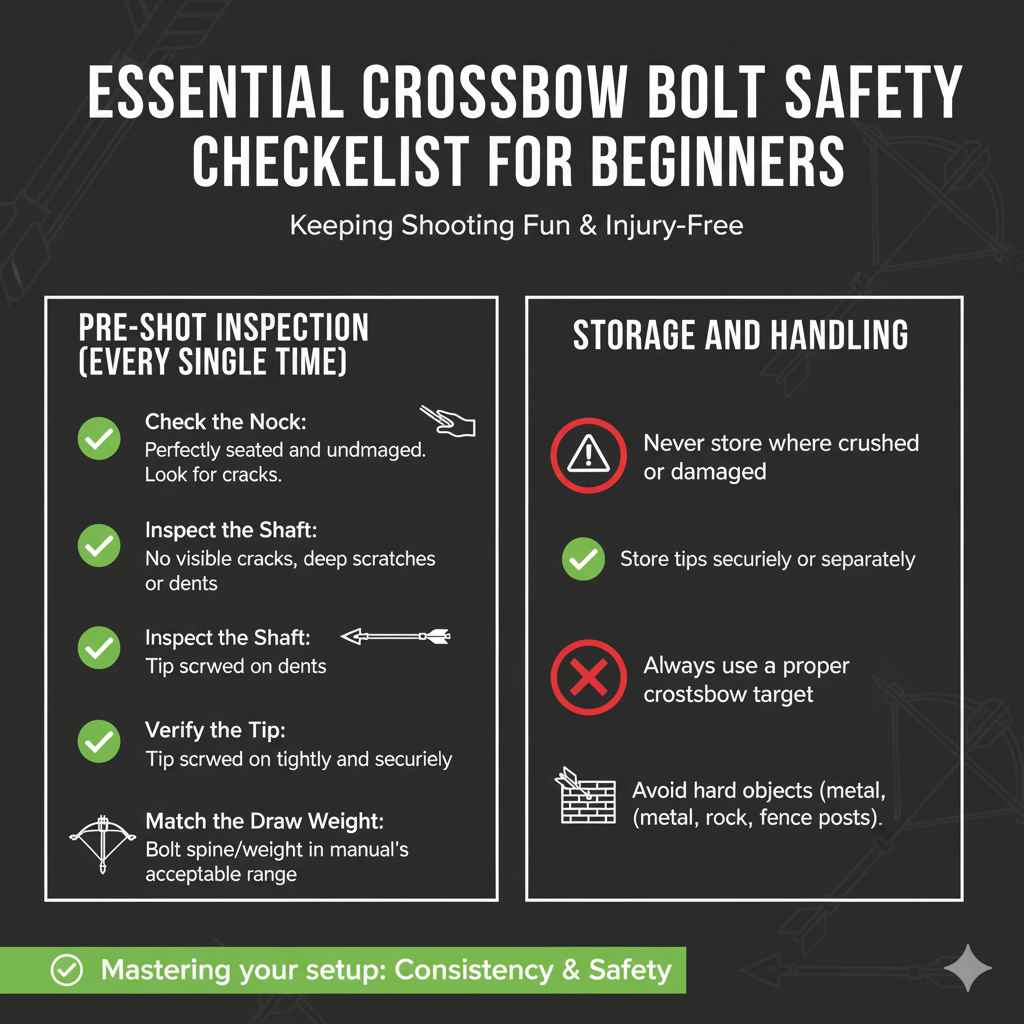
Essential Crossbow Bolt Safety Checklist for Beginners
Safety is step one, always. Crossbows are powerful machines, and treating the ammunition with respect keeps shooting fun and injury-free.
Pre-Shot Inspection (Every Single Time)
- Check the Nock: Ensure the nock is perfectly seated on the string and undamaged. Look for cracks around the seating area.
- Inspect the Shaft: Run your fingers carefully down the entire length of the bolt. Do not use bolts that have visible cracks, deep scratches, or significant dents (especially carbon bolts).
- Verify the Tip: Make sure the field point or broadhead is screwed on tightly and securely.
- Match the Draw Weight: Confirm that the spine and weight of the bolt fall within the acceptable range listed in your crossbow manual. For reliable performance data on crossbow safety standards, reviewing published guidance from recognized sporting organizations can be helpful.
Storage and Handling
- Never store crossbow bolts where they can be crushed or damaged (e.g., leaning loosely in a trunk).
- Store field points and broadheads separately or ensure broadheads are securely covered to prevent accidental cuts.
- Always use a proper crossbow target. Shooting into hard objects (metal, rock, fence posts) will destroy your bolts and can cause dangerous internal damage to the shaft structure.
Frequently Asked Questions About Crossbow Bolts
Q1: Can I use my old compound bow arrows for my new crossbow?
No, generally you cannot. Crossbow arrows (bolts) are much shorter, heavier, and often have a different spine requirement than traditional compound bow arrows. Using a traditional arrow in a crossbow is unsafe and likely to cause equipment damage.
Q2: What is the difference between vanes and feathers on a crossbow bolt?
Vanes are made of plastic and are more durable and weather-resistant, making them standard on modern crossbows. Feathers (fletching) are softer and used mainly on traditional arrows or very low-speed crossbows for better grouping, but they degrade quickly when wet.
Q3: How often should I replace my crossbow bolts?
This depends on how much you shoot. For carbon bolts used heavily in target practice, replace any bolt that shows hairline cracks or internal separation. For casual shooting, replace them every season or immediately if you notice a sharp drop in accuracy.
Q4: What does “grain” mean when talking about bolt weight?
Grain (gr) is the unit of weight used for measuring small items like gunpowder, bullets, and arrows/bolts. A higher grain number means a heavier bolt, which affects speed and energy transfer.
Q5: Do I have to buy bolts made by the same company as my crossbow?
Not necessarily, but you MUST buy bolts that match the specifications (length, spine, and minimum weight) listed in your crossbow’s manual. Many high-quality third-party manufacturers make excellent bolts that are perfectly safe for your crossbow.
Q6: Which is better for a beginner: carbon or aluminum?
For beginners focusing on learning form and shooting frequently, aluminum can be more forgiving on the wallet. However, if you plan to advance quickly or hunt soon, starting with quality carbon bolts often provides better long-term consistency.
Conclusion: Confidence in Your Choice
Learning about the different types of crossbow bolts** doesn’t have to be complicated. Remember the core points: choose the material (carbon or aluminum) based on your budget and durability needs, ensure the spine matches your crossbow’s power exactly, and always verify the length. By paying attention to these simple specifications, you move past guesswork and step into consistent, safe, and enjoyable shooting. Every time you select a bolt, you’re making a choice that supports accuracy. Now, head to the range, inspect your gear carefully, and focus on enjoying the satisfying thud of a well-placed shot! Happy shooting!