Choosing the right hunting scope can seem tricky. Many hunters, especially beginners, find it difficult to sort through all the options. Figuring out all the models can feel like learning a whole new language. Don’t worry, though! We’re here to help you get the hang of it. This guide will break down Different Types of Hunting Scopes Explained in a way that’s easy to understand. We’ll look at the different features and what they mean for your hunts. Now, let’s get started.
What Are Hunting Scopes? A Basic Overview
Hunting scopes are optical devices that hunters use to get a better view of their target. They make distant objects appear closer and clearer than you could see with just your eyes. Scopes help hunters aim more accurately by using a reticle, which is a pattern of lines or dots, to show where the bullet will hit. These instruments boost your accuracy, allowing for more ethical and successful hunts. They also help in low-light conditions, as some models gather light to create a brighter image.
Picking the correct type is important, since each scope is built with specific features. Consider the type of hunting you plan to do, the distances you’ll be shooting, and the lighting conditions.
Magnification Explained
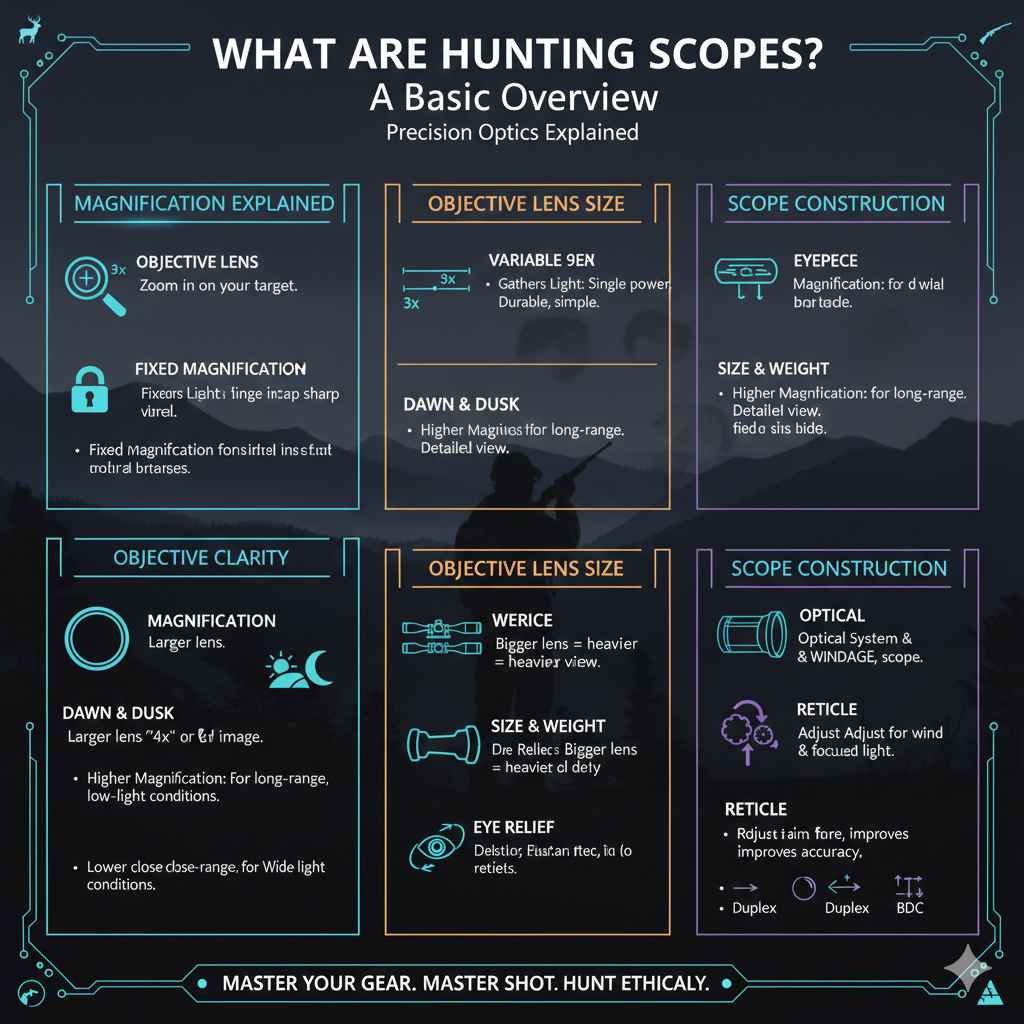
Magnification is a core specification of hunting scopes. It tells you how much larger an object will appear through the scope compared to what you can see with your naked eye. For instance, a scope with 4x magnification makes an object look four times closer and larger. Scopes often have a range of magnification levels. This is frequently represented as a range (e.g., 3-9×40), the first number being the lowest and the second being the highest magnification level. Higher magnification levels help with long-range shots. However, they can also make it harder to find your target and hold steady, especially at close ranges.
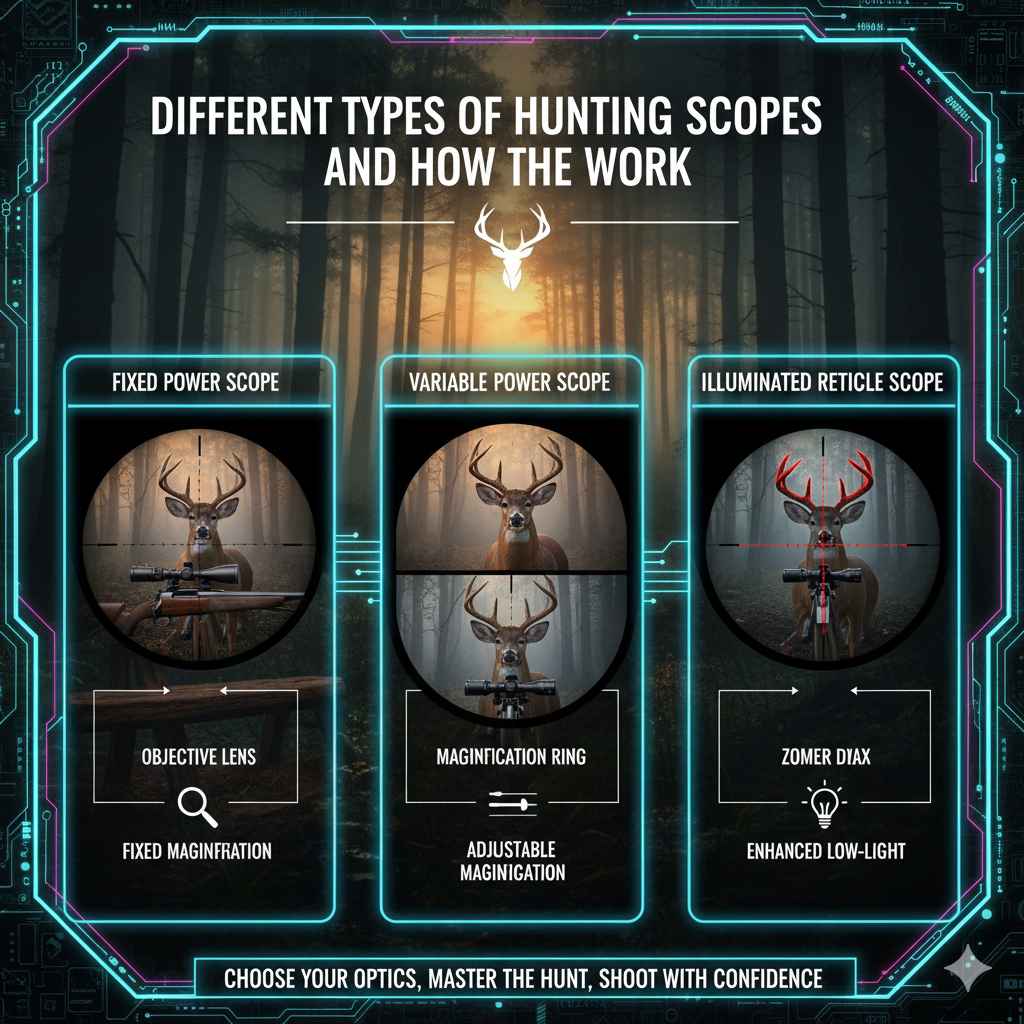
- Fixed Magnification: These scopes have a single magnification level. They are often more durable and generally simpler to use than variable scopes.
Their simplicity is valued for reliability. These are often used when the shooter has a specific, consistent shooting situation. - Variable Magnification: These scopes allow you to adjust the magnification within a set range, offering flexibility for different shooting distances.
The ability to change magnification levels is a significant benefit when the hunter encounters various situations and distances. - Magnification Power: This is described with a number followed by an “x,” e.g., 4x or 3-9x. The number indicates how many times closer the object will appear.
Higher magnification is beneficial for long-distance shooting, giving a more detailed view of the target.
Objective Lens Size
The objective lens is the front lens of the scope, the one farthest from your eye. Its size, measured in millimeters, impacts how much light the scope gathers. A larger objective lens lets in more light. This results in a brighter image, especially in low-light conditions like dawn or dusk. However, a bigger lens also means a bulkier and heavier scope. You’ll often see the objective lens size as the second number in a scope’s description, like in a 3-9×40, where 40 mm is the objective lens size. The best choice depends on your hunting style and conditions.
- Light Gathering: A larger objective lens allows more light to enter, creating a brighter image.
This feature is especially helpful in early mornings or late evenings when light is low. This provides a clearer view of the target. - Size and Weight: Bigger objective lenses make scopes heavier and bulkier.
This will be something to consider when selecting a scope, especially if you plan on carrying it for long periods. - Field of View: While a larger objective lens doesn’t directly impact the field of view, it often goes with increased magnification, which can slightly reduce it.
Balance is important. You want enough magnification for accuracy, but also a field of view that allows for easy target acquisition. - Objective Lens Coating: Coatings on the objective lens reduce glare and improve light transmission.
These coatings enhance the clarity and brightness of the image, contributing to the scope’s overall performance.
Different Types of Hunting Scopes Explained: Scope Styles
Several scope styles exist, each suited to different hunting situations and preferences. The main options include riflescopes, red dot sights, and thermal scopes. Riflescopes are the most common, offering magnification and a reticle for precise aiming at varying distances. Red dot sights are quicker for close-range targeting. Thermal scopes detect heat signatures. The perfect style depends on factors like the type of game, terrain, and time of day. Knowing the strengths of each style is important to choosing the right tool.
Riflescopes
Riflescopes are the workhorses of hunting optics, offering magnification and a reticle for precise aiming. They are versatile and can be used for various hunting activities. Riflescopes often have variable magnification, allowing you to adjust the power as needed. Key features include the reticle design, which helps with aiming, and the quality of the glass, which affects image clarity. Proper scope mounting is very important for accurate shooting. Consider the magnification range, objective lens size, and reticle style to select the best one.
- Variable Power Riflescopes: These scopes provide a range of magnification, such as 3-9x or 4-16x.
This flexibility is useful for hunters who engage in both short-range and long-range shooting. - Fixed Power Riflescopes: Fixed power scopes have a set magnification level, like 4x or 6x.
They are generally more durable and reliable due to the simpler design, making them a great option for hunters looking for a straightforward solution. - Reticle Styles: Reticles vary widely, from simple crosshairs to complex designs with ballistic drop compensation.
Consider your shooting style and the ranges you typically engage to determine which reticle is best for you. - Scope Construction: Riflescopes are usually built with durable materials and sealed to be water-resistant and fog-proof.
These features ensure that the scope can handle harsh weather conditions and maintain performance.
Red Dot Sights
Red dot sights are popular for close-range and fast-action hunting. They use a red dot projected onto a lens, allowing for quick target acquisition. There is no magnification, so both eyes are open, giving a wide field of view. These sights are perfect for shotguns, rifles used in close quarters, and situations where speed is important. The simplicity and speed of red dot sights make them useful for hunting in thick brush or in moving-target situations. They’re also lightweight and easy to mount.
- Ease of Use: Red dot sights are very easy to use, with no need to focus on a reticle.
The simple design allows shooters to quickly acquire the target. This is very beneficial in fast-paced scenarios. - Field of View: Because there’s no magnification, red dot sights provide a wide field of view.
This is perfect for tracking moving targets and maintaining awareness of the surroundings. - Battery Life: Battery life is a consideration since red dots require power to operate.
Some models offer very efficient power usage, while others have features like auto-off to preserve battery life. - Applications: They work well for tactical shooting and hunting in dense environments.
This is due to the sight’s ability to help a hunter quickly target and acquire a target, making them suitable for many scenarios.
Understanding Reticles and Adjustments in Scopes
The reticle is the aiming point inside the scope. It’s the pattern you see when you look through the lens, used to aim your rifle. Reticles come in many designs, each with features to help hunters. Besides the reticle, a scope has adjustment dials for windage (left/right) and elevation (up/down). These adjustments allow you to align the reticle with your bullet’s trajectory at different ranges. Learning how to use these adjustments is an important skill to master.
Reticle Types and Their Uses
Reticles come in a variety of styles. Each is designed to help with specific shooting scenarios. The simplest design is a crosshair, which is good for basic aiming. More complex reticles have additional markings for estimating range, compensating for bullet drop, and calculating wind drift. Some reticles use illuminated dots or lines, which are helpful in low-light conditions. Choosing the right reticle depends on your shooting style and the type of hunting you do.
- Crosshair: A simple, classic reticle with horizontal and vertical lines crossing at the center.
Best for general hunting when distances are known or predictable, it’s easy to use and master. - Duplex: A crosshair reticle that thickens towards the edges and thins toward the center.
Allows for easy target acquisition in various conditions. Hunters prefer this when quick target acquisition is a priority. - Mil-Dot: A reticle with dots that help with range estimation and bullet drop compensation.
The Mil-Dot reticle is a common choice for long-range shooting. Many hunters also use this type in tactical scenarios. - BDC (Bullet Drop Compensation): Reticles with markings that correspond to specific distances, allowing for quick aiming at different ranges.
Ideal for situations where distances may vary. This allows the shooter to compensate for bullet drop.
Windage and Elevation Adjustments
Windage and elevation adjustments are used to fine-tune a scope. Elevation adjusts the point of impact up or down. Windage adjusts the point of impact left or right. These adjustments are usually made using dials or turrets on the scope. Most scopes have markings on the dials that show the amount of adjustment, often in MOA (Minute of Angle) or MRAD (Milliradian). Learning to zero your scope—adjusting it so that your bullet hits where the crosshair is aimed—is crucial for accuracy.
- MOA (Minute of Angle): A unit of measurement that equates to roughly 1 inch at 100 yards.
One click on an MOA scope often moves the point of impact by 1/4 or 1/2 inch at 100 yards. - MRAD (Milliradian): A unit of measurement where one click on the scope moves the point of impact by 1 cm at 100 meters.
Used by many hunters to zero their scopes at a certain distance. This assists in making precise adjustments for long-range shooting. - Zeroing Your Scope: The process of adjusting the scope so the bullet hits the same spot as the crosshairs at a specific distance.
The hunter has to adjust the elevation and windage settings until they get the desired impact. This leads to greater accuracy. - Turret Types: Scopes can have different turret styles, including capped, exposed, and tactical turrets.
Each style is designed for different levels of adjustment and ease of use in the field.
Exploring Scope Features and Technologies
Modern hunting scopes include various features and technologies to boost performance. These range from high-quality glass to advanced coatings and illumination systems. The glass quality directly affects image clarity and light transmission, critical in low-light conditions. Coatings reduce glare and improve contrast. Illumination systems brighten the reticle, improving visibility in dark environments. These features combine to improve accuracy and make hunting more effective.
Glass Quality and Coatings
The quality of the glass used in a scope, along with its coatings, is a major factor in performance. High-quality glass provides a clearer, brighter image, making it easier to see your target. Coatings are applied to the lenses to reduce glare, increase light transmission, and improve contrast. Fully multi-coated scopes have the best performance, with multiple layers of coatings on all lens surfaces. These features are very important for making accurate shots.
- Glass Types: High-end scopes use premium glass, such as ED (Extra-low Dispersion) or HD (High Definition) glass.
These glasses reduce chromatic aberration, providing sharper, clearer images. This is very helpful when shooting at long ranges. - Coating Types: Coatings range from coated to fully multi-coated.
Fully multi-coated scopes offer the best light transmission and image quality. This is a must-have for low-light hunting. - Light Transmission: Higher light transmission means a brighter image, particularly useful at dawn and dusk.
The ability to see well in low light is important. This helps to make ethical shots. - Image Clarity: Good glass and coatings give a clear and sharp image, critical for identifying targets and making accurate shots.
Good image clarity improves overall hunting experience. This allows the hunter to shoot with greater confidence.
Illumination and Reticle Features
Illuminated reticles are a useful feature. They add a glowing dot or pattern to the scope. This improves visibility in low-light conditions. The brightness level is often adjustable. This allows hunters to adapt to changing light levels. Some scopes have features like auto-off to conserve battery life. Reticle features can include range-finding capabilities or windage and elevation marks, to boost long-range accuracy.
- Adjustable Brightness: Illuminated reticles typically offer adjustable brightness settings.
This provides the hunter the ability to adapt to varying light levels. This ensures the reticle is easy to see without being overwhelming. - Battery Life: Battery life is a consideration for illuminated scopes.
Many scopes include features like auto-off to conserve power. This ensures the hunter can use the scope for a long period. - Reticle Design: Illuminated reticles come in many designs, from simple dots to complex patterns for range estimation and bullet drop compensation.
Choose a design that matches your shooting needs. This adds to the scope’s effectiveness. - Low-Light Visibility: The illumination feature improves visibility in low-light conditions, such as dawn and dusk.
This feature assists in making accurate shots. This increases the chance of a successful hunt.
Choosing the Right Hunting Scope for Your Needs
Picking the correct hunting scope involves balancing your hunting style, the type of game you pursue, and the environment. Consider the typical distances of your shots, the expected light conditions, and any special features you might need. Think about magnification levels, objective lens size, and reticle types. Weigh the pros and cons of fixed versus variable magnification, and determine whether you need features like illuminated reticles or ballistic compensation. Taking the time to evaluate these aspects makes a difference.
Matching the Scope to Your Hunting Style
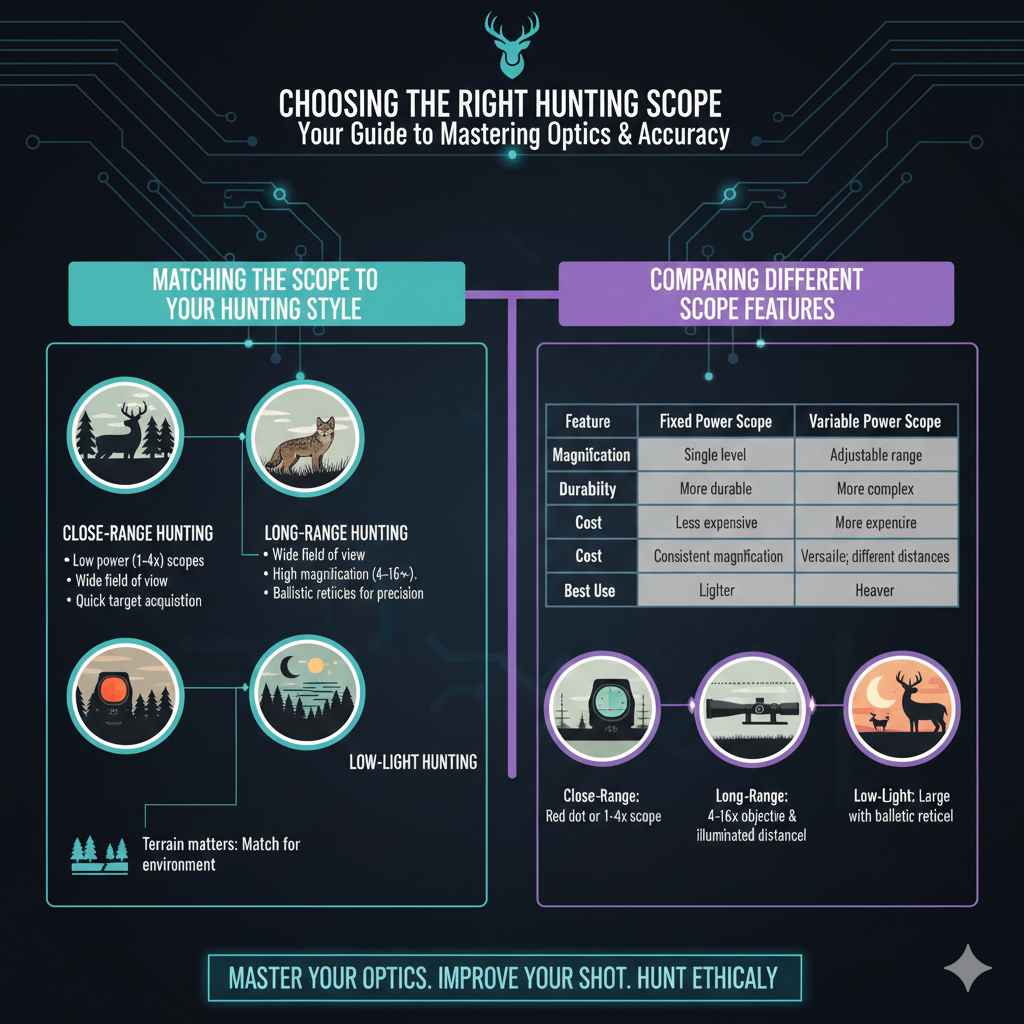
The best scope is one that matches your specific hunting needs. For close-range hunting in dense environments, a red dot sight or a low-magnification scope might be ideal. For long-range hunting in open areas, a scope with a higher magnification and a ballistic reticle may be better. If you hunt in low-light conditions, an illuminated reticle and a scope with a large objective lens can improve your ability to see. Think about the terrain you hunt in. This will help you choose a scope that fits your hunting style.
- Close-Range Hunting: Red dot sights or scopes with low magnification (e.g., 1-4x) are often preferred for close-range hunting.
These options provide a wide field of view and quick target acquisition, perfect for fast-moving targets. - Long-Range Hunting: Scopes with higher magnification (e.g., 4-16x or higher) and ballistic reticles are very beneficial for long-range hunting.
These features help the hunter to make precise shots at long distances. - Low-Light Hunting: Scopes with large objective lenses, high-quality glass, and illuminated reticles are key for hunting in low light.
These scopes assist with improving visibility at dawn and dusk. This adds to the accuracy of the shot. - Terrain Considerations: Choosing a scope that is practical for the terrain is important.
The choice can be the difference between a successful hunt and a wasted one.
Comparing Different Scope Features
Compare the features of different scopes to find the best fit for your needs. Consider the magnification range, the size of the objective lens, the type of reticle, and any special features like illumination or ballistic compensation. Read reviews from other hunters. This is a very helpful tool when deciding. Compare different brands and models. This will allow you to make an informed choice.
| Feature | Fixed Power Scope | Variable Power Scope |
|---|---|---|
| Magnification | Single level (e.g., 4x) | Adjustable range (e.g., 3-9x) |
| Durability | Generally more durable due to simpler design | Can be more sensitive due to the moving parts |
| Cost | Often less expensive | Usually more expensive due to added complexity |
| Best Use | Situations where a consistent magnification level is needed. | Versatile; good for different distances and hunting environments |
| Weight | Lighter | Generally heavier due to added components |
Here are some examples:
- If you often hunt in dense forests at short distances, a red dot sight or a low-magnification scope would be suitable. These allow fast target acquisition and a wide field of view.
- If you hunt in open fields or mountains, a scope with higher magnification (like 4-16x) and a ballistic reticle will assist you with making precise shots.
- For hunting during dawn or dusk, or in heavily shaded areas, a scope with a large objective lens and an illuminated reticle is crucial. This will help with the light-gathering capability.
Frequently Asked Questions
Question: What do the numbers on a scope mean, like 3-9×40?
Answer: The first two numbers represent the magnification range (3x to 9x), and the third number (40) is the diameter of the objective lens in millimeters.
Question: What is a reticle, and why is it important?
Answer: A reticle is the aiming pattern inside the scope (crosshairs, dots, etc.) It helps you aim. The correct reticle is key for precision.
Question: What is the difference between MOA and MRAD?
Answer: Both are units of measurement for adjusting your scope. MOA (Minute of Angle) is roughly 1 inch at 100 yards. MRAD (Milliradian) is about 1 cm at 100 meters.
Question: Are illuminated reticles worth it?
Answer: Yes, especially in low-light conditions. Illuminated reticles make it easier to see your aiming point.
Question: How do I zero my hunting scope?
Answer: Zeroing is the process of adjusting your scope so that your bullet hits where the crosshairs are aimed at a specific distance. This typically involves making adjustments to the windage and elevation turrets on the scope.
Final Thoughts
Understanding Different Types of Hunting Scopes Explained will assist you in making a good choice for your hunting needs. We looked at the various scope styles, from the standard riflescope to the fast-action red dot. This information will help you select the best scope for your hunting style. Remember that the right scope helps you with accuracy and ethical hunting. Consider your hunting environment, the typical distances you shoot, and your light conditions. Explore different options and compare features like magnification, lens size, and reticle types. You’ll soon see how the right scope can make your hunts more accurate and enjoyable.