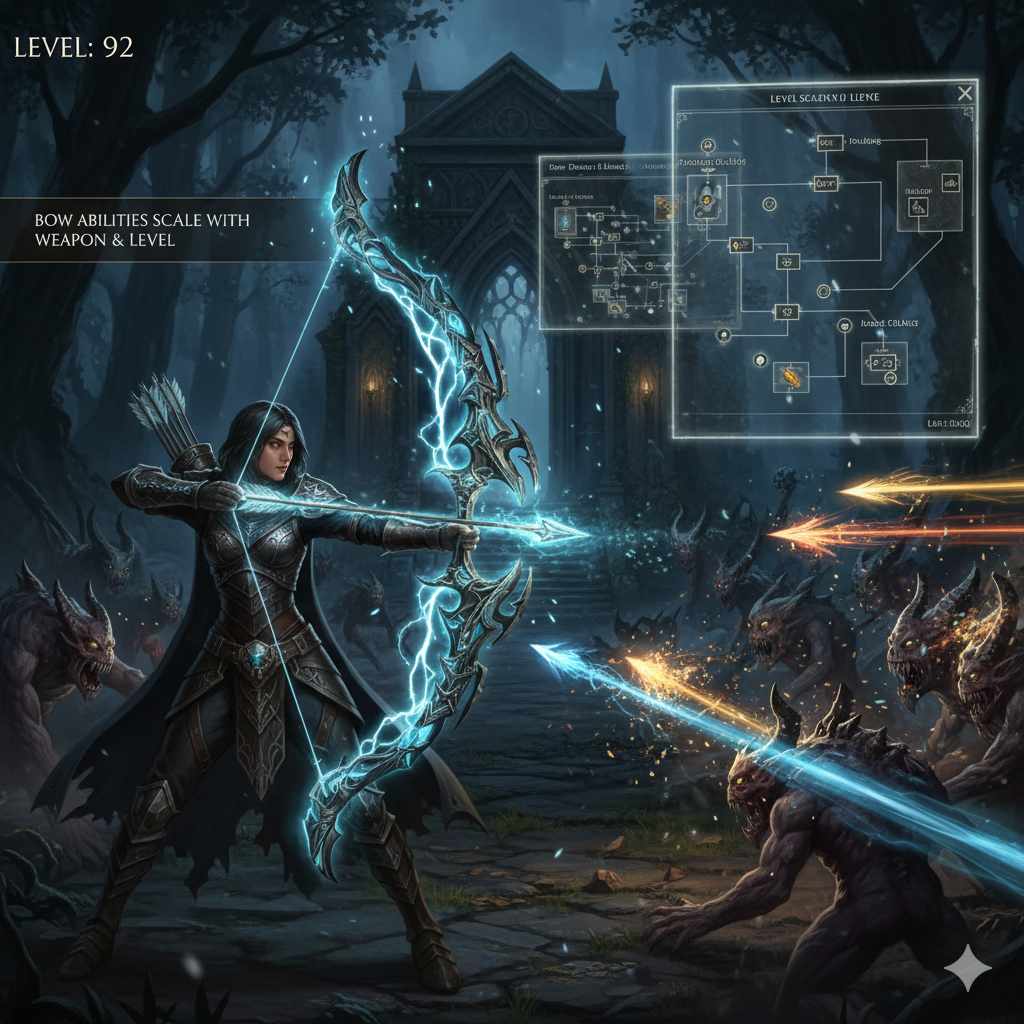
Bow abilities in Path of Exile scale using a blend of both your weapon’s raw power (damage, speed) and the skill gem’s level. For most Attack Skills (like Tornado Shot), the weapon is the foundation, providing the base damage. However, all skills, including attacks and spells, gain significant power and effectiveness from the level of the associated Skill Gem. To maximize damage, you must prioritize both excellent bow stats and high gem levels.
Hello! I’m Salman Arfeen, and I’m glad you’re here. When you start playing Path of Exile (PoE) with a bow, you quickly hit a confusing question. Where does your damage actually come from? Does a super expensive bow make your arrows hit harder? Or is it your character’s experience and skill levels?
It can feel like hitting a target blindfolded when you first look at PoE’s scaling system. Many beginners struggle to understand if they should spend all their currency on a new bow or focus on leveling up their skill gems. This confusion often leads to frustratingly low damage, even late in the game.
But don’t worry. Just like learning to hold a bow correctly, understanding scaling is about breaking down the basics. We are going to simplify this complex system. By the time we are done, you will know exactly what knobs to turn to make your bow character powerful and effective. Let’s dive in and clear up this mystery!
In the world of Path of Exile, every single piece of gear, every passive node, and every gem contributes to your final damage output. When we talk about bow abilities, we are talking about your specific Skill Gems—like Lightning Arrow or Caustic Arrow. These abilities are the technique you use.
To truly understand scaling, you need to think of it as two separate, but connected, engines. The first engine is your weapon. The second engine is your skill gem’s level and support gems. Both must be running efficiently for maximum impact.
Engine One: The Role of Your Bow (Weapon Scaling Explained)
For most primary bow abilities, your bow is the fundamental base of your damage. It sets the stage for how much damage your skills can potentially do. Think of your bow like the draw weight on a real bow. A heavier draw weight (higher base damage) means the arrow (your skill) starts with more power.
When an ability is tagged as an “Attack” skill (which most bow skills are), it performs an attack using your equipped weapon. This means the ability uses the raw stats found directly on the bow itself.
Key Bow Stats and Their Impact on Scaling
What exactly on your bow matters? It’s not just the big number you see. You must look at the specific modifiers that dictate the bow’s overall quality and effectiveness.
- Base Damage (Physical or Elemental): This is the most crucial stat for physical attack skills. When you fire an arrow using an ability like Split Arrow, the damage calculation starts with the damage range listed on the bow (e.g., 50–150 Physical Damage). All subsequent multipliers (from the skill tree, support gems, and other gear) apply to this base number.
- Attack Speed: This determines how quickly you can shoot. More attacks per second means more damage per second (DPS). A fast bow allows you to apply damage, critical strikes, and status effects much faster.
- Critical Strike Chance: This dictates how often your arrows land a devastating hit. High base Critical Strike Chance on a bow is highly desirable, as it scales with all your passive tree modifiers.

If you are running a Physical damage build (like one using Puncture or Bleed), a bow with high raw Physical Damage is non-negotiable. If you are running an Elemental build (like Lightning Arrow), you will look for bows with high Attack Speed and perhaps modifiers that explicitly add flat elemental damage.
| Stat | Impact on Scaling | Priority for Attack Builds |
|---|---|---|
| Base Physical Damage | Provides the raw numerical foundation for physical attacks. Multipliers use this number. | Highest (Especially for Pure Physical or Bleed builds) |
| Attack Speed | Increases DPS by allowing more attacks per second. Crucial for Elemental hits and status effects. | Very High (Always) |
| Critical Strike Chance | Determines the frequency of high damage spikes. High base value scales better with passive tree investments. | High (Especially for Crit builds) |
| Explicit Added Elemental Damage | Adds flat elemental damage directly to the attack before multipliers. | High (For Elemental builds) |
Engine Two: The Power of the Gem (Level Scaling Explained)
If the bow is the hardware, the Skill Gem is the software. Even if you have the best bow in the game, a low-level Skill Gem will feel weak. This is because every active Skill Gem in PoE gains monumental power when it levels up.
This is where the idea of “Level Scaling” comes into play. Skill gems scale in two primary ways through leveling:
- Increased Base Damage (Spell Skills): For skills categorized as Spells (though few bows use pure spells), the gem level directly increases the base damage numbers the skill deals.
- Improved Effectiveness (Attack Skills): For Attack skills, gem level primarily increases the “Damage Effectiveness” or the numerical percentage of base damage the skill applies. It also improves utility stats, like area of effect (AoE) or the number of projectiles.
- Added Flat Damage: Many attack gems also gain a small amount of added flat damage (usually physical or elemental) per level.
The maximum level for most gems is 20, but dedicated players often push this higher using specific gear like Empower Support Gems, unique items, or modifiers that grant +X to Skill Gem Levels.
Why Gem Level is King for All Abilities
For any build—bow or otherwise—maximizing gem level is critical because the scaling offered by gem levels is often a “more” multiplier, meaning it scales multiplicatively, leading to massive increases in power that are hard to replicate through just gear alone.
Consider the difference between a Level 1 and a Level 20 Skill Gem. The Level 20 gem might have 300% more base damage or effectiveness than the Level 1 version. This increase is foundational to your entire damage calculation.
Factors That Boost Skill Gem Power
- Character Experience: The simplest way to level gems is to gain experience while the gem is socketed.
- Support Gems: Linking the active Skill Gem to Support Gems (like Multistrike, Added Cold Damage, or Elemental Damage with Attacks) provides substantial multiplicative boosts. A level 20 Support Gem is just as important as a level 20 Active Skill Gem.
- +1 to Level of Socketed Gems: Modifiers found on chests, amulets, and specific unique items. These are crucial for late-game damage optimization.
- Awakened/Alternative Quality Gems: These versions offer enhanced scaling and unique effects that standard gems do not.
If you’re unsure how much a gem level changes your specific skill, you can always check the official Path of Exile Wiki for the detailed numerical breakdown of scaling per gem level for every ability. Knowing these numbers helps you prioritize (for example, see the comprehensive PoE Wiki here).
The Crucial Distinction: Attack Skills vs. Spell Skills
The difference between an Attack skill and a Spell skill is the single biggest factor determining whether your bow’s weapon stats or your gem level stats matter more.
Attack Skills (Weapon Dependent)
If a Skill Gem has the “Attack” tag, it uses your bow’s base damage. These skills are heavily dependent on having a high-damage bow. Even if you convert the damage to elemental (e.g., 100% of Physical damage converted to Lightning), the initial calculation still uses the bow’s Physical Damage number before the conversion happens.
Examples of Common Bow Attack Gems:
- Tornado Shot
- Split Arrow
- Lightning Arrow
- Frenzy
- Explosive Arrow (Though the secondary explosion scales differently, the initial hit is an attack)
- Barrage
Scaling Priority for Attack Skills: You must prioritize getting the best possible bow first. Then, maximize the level of your active and support gems. The two work together: a strong bow gives a high base, and high-level gems apply massive multipliers to that base.
Spell Skills (Less Weapon Dependent)
Spells are skills that do not use your weapon’s base damage. They use the base damage explicitly listed on the Skill Gem itself. If you use a bow spell, the damage scaling comes almost entirely from the Gem Level and the modifiers on your passive tree and gear that grant “Spell Damage.”
Wait, why would you use a spell with a bow? You generally only do this if the gem requires a Bow, Sceptre, or Staff, or if you are specifically running a build that benefits from the implicit modifiers on the bow base, like generic attack speed or specific unique effects.
Examples of Bow-Compatible Spells (Rare but exist):
- Burning Arrow Trap/Mine setups (Focuses on the Ignite/Burn damage which scales often with gem level and fire damage modifiers)
- Specific utility spells socketed in the bow for utility (e.g., Flame Dash for movement).
Scaling Priority for Spell Skills: For spells, the level of the gem is paramount. The quality of your bow primarily matters for its utility stats (like sockets, resistances, or attack speed if the build incorporates attack/trigger mechanics), not its raw base damage.
Practical Steps: How to Optimize Your Bow Scaling
As your friendly archery coach, I want to give you a clear, actionable plan. You don’t need to be an expert in every line of code. You just need to follow these steps to ensure you are maximizing both scaling mechanisms.
Step 1: Identify Your Primary Damage Source
Before spending a single Chaos Orb, look at your main Skill Gem. Is it an Attack skill? (Tornado Shot, Rain of Arrows, etc.) If yes, your bow damage is key. If it’s a Spell/DoT (Damage over Time) focus (like Caustic Arrow’s ground effect or a pure Ignite build), gem level and quality matter more.
Step 2: Prioritize the Bow (For Attack Builds)
If you are using an Attack skill, you must invest heavily in your bow early and often. Aim for high “Physical Damage per Second” (P-DPS) or high “Elemental Damage per Second” (E-DPS). Use an external tool like Craft of Exile to help evaluate potential bow crafting bases and upgrades.
The Rule of Thumb for Attack Bows:
- Aim for a DPS increase of at least 20% over your current bow before purchasing or crafting a new one.
- If running Physical damage, prioritize “Flat Physical Damage” and “% Increased Physical Damage.”
- If running Elemental damage, prioritize “Attack Speed” and “Flat Added Elemental Damage” (Cold, Fire, Lightning).
Step 3: Maximize Gem Levels (Universally)
Regardless of your build type, your Active Skill Gem and all linked Support Gems should be Level 20 (or higher, using corruptions or +Level gear). Never neglect this step! It is often the cheapest way to gain massive damage increases.
- Always keep your main skill gems socketed and gaining experience.
- Once your gem reaches Level 20, use a Gemcutter’s Prism to add Quality (up to 20%). Quality provides secondary scaling benefits (e.g., increased projectile speed, more area).
- Look for gear that adds +1 or +2 to your specific type of gem (e.g., ‘+1 to Level of Socketed Attack Gems’ on an amulet).
Step 4: Focus on Multipliers, Not Just Base Damage
PoE damage is all about multiplicative stacking. You take your bow’s base damage (Engine One), and then you apply the Skill Gem’s Effectiveness (Engine Two). After that, you apply all your passive tree, support gem, and aura multipliers.
Scaling Checklist:
| Source | Type of Boost | Scaling Impact |
|---|---|---|
| Bow Item (Weapon) | Base Physical/Elemental Damage | High (The foundation of the calculation) |
| Skill Gem Level | Base Effectiveness / Added Damage | Very High (Massive power curve) |
| Passive Skill Tree | % Increased Damage / More Multipliers | High (Broad boosts to all damage) |
| Support Gems | Multiplicative ‘More’ Damage | Extremely High (Essential links) |
| Jewels | Specific damage modifiers / Critical Multiplier | Moderate to High (Finishing touches) |
If you only focus on getting a powerful bow but ignore gem levels, your multipliers won’t have enough base damage to work with. If you only level your gems but use a weak bow, the multipliers will boost a tiny base number, resulting in low damage.
Common Beginner Scaling Mistakes to Avoid
As a coach, I see a few traps that new bow players fall into repeatedly. These simple mistakes can dramatically decrease your effectiveness and make the game feel much harder than it should be.
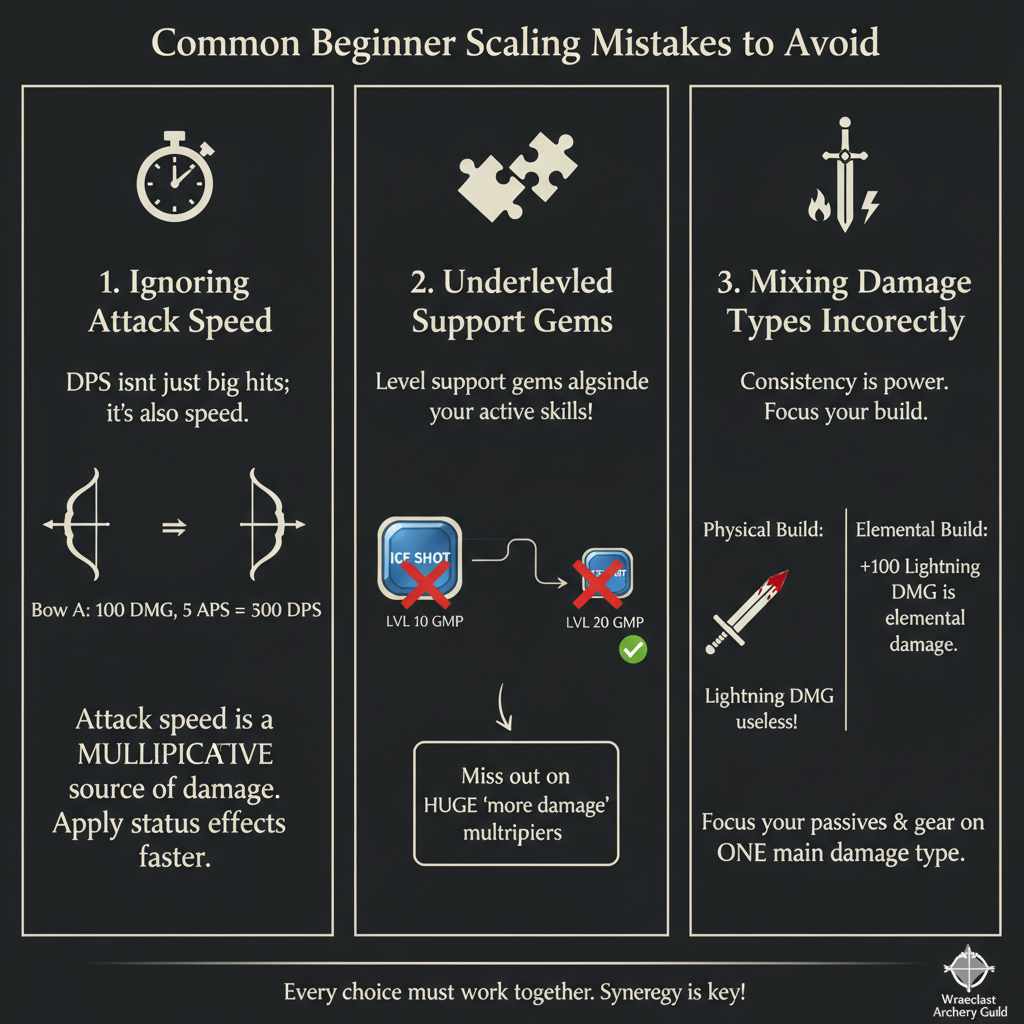
Mistake 1: Ignoring Attack Speed
Damage Per Second (DPS) is not just about big hits; it’s about speed. Attack speed is a multiplicative source of damage. If your bow hits 100 damage but 3 times per second, that’s 300 DPS. If you boost your attack speed to 5 times per second, that’s 500 DPS, assuming the same base damage. Attack speed is essential for mitigating damage spikes and applying status effects quickly.
Mistake 2: Underleveled Support Gems
Many beginners focus solely on their main active skill gem (like Ice Shot) and forget about the support gems linked to it (like Greater Multiple Projectiles or Inspiration). If your Level 20 Ice Shot is linked to a Level 10 GMP, you are missing out on enormous “more damage” multipliers. Always level your supports alongside your active skills.
Mistake 3: Mixing Damage Types Incorrectly
New players often pick up gear with random damage types. If you are running a pure physical build, picking up gear that grants “+100 Lightning Damage” is usually useless unless you have specific conversion mechanics set up. Focus your passive tree and gear on boosting the damage type (Physical, Fire, Cold, Lightning, Chaos) that your main skill primarily deals. Consistency is power in PoE.
Remember, the goal is always synergy. Every choice—from the type of bow base you pick to the level of your gem—must work together. By recognizing that both the weapon (base damage) and the level (multipliers/effectiveness) are essential, you stop hitting roadblocks and start building confidence in your character’s power.
FAQ: Common Bow Scaling Questions Answered
Is a bow with high Physical Damage better for Elemental builds?
It depends on conversion. If your elemental skill (like Lightning Arrow) converts a high percentage (often 100%) of Physical Damage to Elemental Damage, then yes, a high Physical Damage bow is better. The skill takes the high Physical number, converts it to Lightning, and then applies Lightning multipliers. If your build relies on pure added elemental damage (from rings, jewels, etc.) without conversion, then attack speed and critical strike chance become more important than the physical base damage.
What is more important: Gem Level or Quality on a Skill Gem?
Gem Level is always more important than Quality. Leveling a gem from 19 to 20 provides a significantly larger damage boost than adding 1% Quality. Quality (up to 20%) is a bonus optimization you should add after your main skill gems and crucial support gems are already Level 20.
Do bows scale spell damage?
No, the base damage of your bow (the physical or elemental numbers listed on the weapon) does not increase the damage of a Spell Skill Gem. Spell damage scales primarily from the Gem Level itself and modifiers on gear, passive tree, and unique items that specifically grant “increased Spell Damage” or “+ to Level of Socketed Spell Gems.”
How do I know if a skill is an Attack or a Spell?
Look at the Skill Gem tags. Every gem has tags listed at the top. If the gem has the “Attack” tag, it uses your weapon’s base damage. If it has the “Spell” tag, it does not. Most bow-firing skills (Tornado Shot, Rain of Arrows, etc.) are Attack gems.
Should I use a faster, low-damage bow or a slower, high-damage bow?
For beginners, the total DPS (Damage Per Second) is the easiest metric. Always aim for the bow with the higher DPS number. However, very fast bows are often preferred for critical strike builds (because you hit more often, leading to more critical strikes) and elemental ailment builds (to apply shock/ignite/chill faster).
What is “Damage Effectiveness” and why does it matter?
Damage Effectiveness is a stat listed on Skill Gems that tells you how much of the added flat damage from other sources (like rings or support gems) the skill applies. For example, if a skill has 50% Damage Effectiveness, it only uses half of the flat damage added by your gear. Damage Effectiveness typically increases as the Skill Gem levels up, which is one reason why high gem level is so important.
I am using Caustic Arrow. Which scaling method is best?
Caustic Arrow is a hybrid. The initial arrow hit is an Attack and scales off your bow’s base damage and attack speed. However, the majority of the damage comes from the green cloud’s Damage Over Time (DoT) effect. This DoT damage scales heavily off Skill Gem Level, DoT multipliers, and Chaos Damage multipliers, making Gem Level and specific chaos affixes on gear far more important than the bow’s raw physical damage.
Final Shot: Building Confidence in Your PoE Bow Character
You’ve seen that the answer to “Do bow abilities scale with weapon or level?” is a confident, “Both!” Path of Exile is not about choosing one or the other. It’s about ensuring both engines—the power of your bow and the effectiveness of your skill gems—are maximized together.
Think of it this way: your bow is the foundation of your power. It’s the strong draw and smooth riser. Your Skill Gem level and supports are your technique and precision—the fine-tuning that makes every shot count. You can have the strongest bow in the world, but if your technique (low gem levels) is poor, your arrows will fall short.
Now that you know how the damage calculations work, you can approach gear upgrades and passive tree choices with confidence. Prioritize a high-DPS bow for attack skills, and always keep those skill gems leveling up. With the right focus and consistent practice (or grinding!), you’ll soon be hitting monsters in Wraeclast with devastating power. Good luck, Exile, and happy hunting!