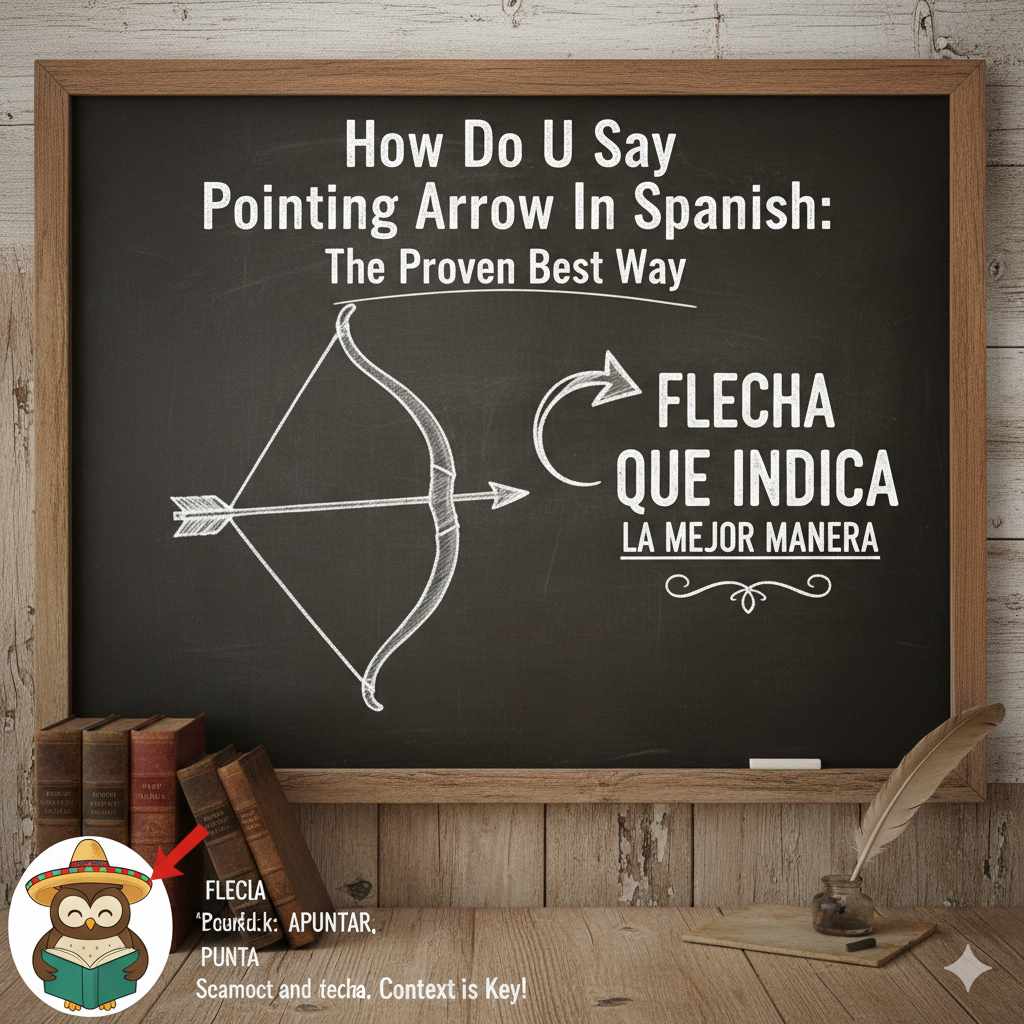
The proven best way to say “pointing arrow” in Spanish is “flecha que apunta” for a literal description. However, in most situations, simply saying “flecha” (arrow) is correct and more natural. For a graphical symbol, like on a sign or website, you would use “símbolo de flecha” or “señal de flecha.”
Hello, fellow archers! Salman Arfeen here. Have you ever wondered how to talk about your gear with Spanish-speaking friends? Or maybe you’re shopping for archery equipment online and hit a language barrier. It’s a common hurdle, especially with a term like “pointing arrow.” You want to get it right without sounding clumsy.
Don’t worry, it’s much simpler than you think. Getting the right word is all about context, just like choosing the right arrow for your bow. I’m here to guide you through the exact Spanish words to use, so you can speak clearly and confidently. We’ll break down the simple translations and explore other useful archery terms to build your vocabulary.
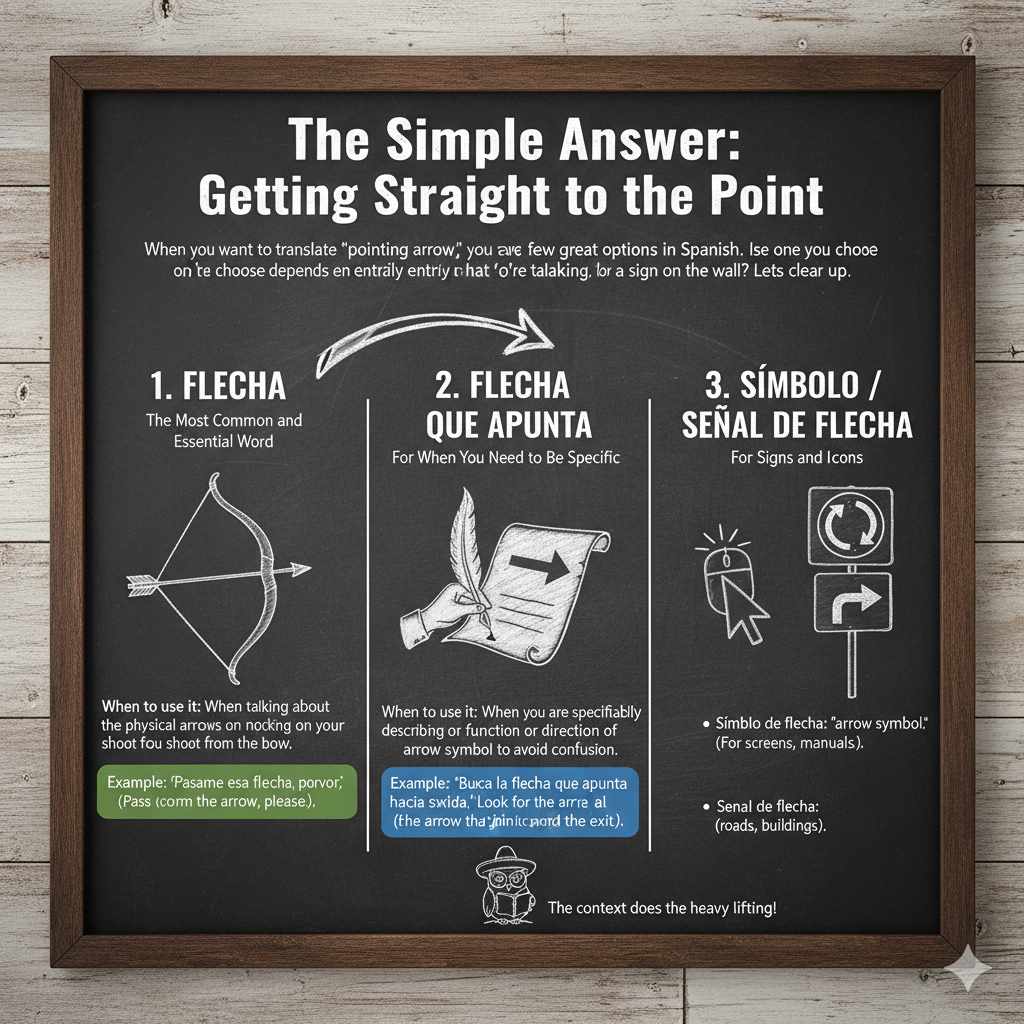
The Simple Answer: Getting Straight to the Point
When you want to translate “pointing arrow,” you have a few great options in Spanish. The one you choose depends entirely on what you’re talking about. Is it the arrow you’re nocking on your bow, an icon on a screen, or a sign on the wall? Let’s clear it up.
1. “Flecha”: The Most Common and Essential Word
In the vast majority of cases, the word you need is simply flecha (pronounced FLEH-chah). This is the direct translation for “arrow.” Whether you are at the archery range or discussing your equipment, this is your go-to term. If someone is holding an arrow, it’s clear that it points. You don’t need to add extra words.
- When to use it: When talking about the physical arrows you shoot from a bow.
- Example: “Pasame esa flecha, por favor.” (Pass me that arrow, please.)
Think of it this way: in English, you wouldn’t normally say, “I am shooting a pointing arrow.” You’d just say, “I am shooting an arrow.” Spanish works the same way. The context does the heavy lifting.
2. “Flecha que apunta”: For When You Need to Be Specific
What if you really need to describe the action of the arrow pointing? In that case, you can use the more literal phrase flecha que apunta (FLEH-chah keh ah-POON-tah). This translates directly to “arrow that points.”
This phrase is less common in everyday conversation but is useful if you need to be very clear and descriptive, perhaps when giving instructions.
- When to use it: When you are specifically describing the function or direction of an arrow symbol to avoid confusion.
- Example: “Busca la flecha que apunta hacia la salida.” (Look for the arrow that points toward the exit.)
3. “Símbolo de flecha” or “Señal de flecha”: For Signs and Icons
Now, let’s step away from the archery range. What about the arrows you see on websites, in documents, or on street signs? These are not physical arrows, but symbols. For these, you would use:
- Símbolo de flecha (SEEM-boh-loh deh FLEH-chah): This means “arrow symbol.” It’s perfect for describing an icon on a computer screen or in a manual.
- Señal de flecha (seh-NYAL deh FLEH-chah): This means “arrow sign.” This is the best term for directional arrows on roads, in buildings, or on trails.
Using these terms shows a deeper understanding of the language and helps you communicate with perfect clarity in non-archery situations.
Understanding Context: Your Guide to Using the Right Term
Just like selecting the right fletching for windy conditions, choosing the right Spanish word depends on the situation. Using the wrong term might get your point across, but using the right one makes you sound like you know what you’re talking about. Here is a simple breakdown.
In Archery: Talking About Your Gear and Sport
When you are in your element—at the club, in a shop, or talking with other archers—your world revolves around the physical equipment. In this context, “flecha” is king.
You would use “flecha” to talk about:
- The arrows in your quiver.
- Buying new arrows.
- Describing the flight of an arrow.
- The arrow on the target.
It’s simple, direct, and universally understood among Spanish-speaking archers. Adding extra words like “que apunta” would sound redundant and unnatural.
On a Website or Document: Navigating Digital Spaces
Imagine you are reading instructions online that say, “Click the pointing arrow to download.” Here, the arrow is a digital icon. The best term is “símbolo de flecha.” However, many people will still colloquially shorten this to just “flecha.”
- Formal/Clear: “Haz clic en el símbolo de flecha.” (Click on the arrow symbol.)
- Informal/Common: “Haz clic en la flecha.” (Click on the arrow.)
Both are correct, but the first is more precise. If you are writing instructions, being more specific is always better.
Giving or Receiving Directions: Following the Signs
If you’re hiking a trail or navigating a building, you’ll likely follow signs. An arrow on a sign is a “señal de flecha.” You can also describe what the arrow is doing using the verb “indicar” (to indicate).
- “Sigue la señal de flecha.” (Follow the arrow sign.)
- “La flecha indica el camino correcto.” (The arrow indicates the correct path.)
To make it even easier, here is a table that summarizes everything we’ve covered. Keep this handy as a quick reference!
| Spanish Term | Literal English Meaning | Best Context for Use |
|---|---|---|
| Flecha | Arrow | General use, especially for physical archery arrows. |
| Flecha que apunta | Arrow that points | When you need to be very descriptive about an arrow’s direction. |
| Símbolo de flecha | Arrow symbol | For digital icons on websites, apps, or in documents. |
| Señal de flecha | Arrow sign | For physical signs used for directions (roads, buildings, trails). |
Beyond the Basics: Expanding Your Spanish Archery Vocabulary
Now that you’ve mastered “pointing arrow,” why stop there? Knowing a few extra key terms can make any conversation about archery in Spanish much smoother and more enjoyable. Let’s build your confidence with some essential vocabulary.
Parts of an Arrow in Spanish
Knowing the anatomy of your arrow in Spanish can be incredibly helpful, especially if you’re shopping for components or discussing equipment specifics. Here are the main parts:
- Arrowhead/Point: Punta de flecha
- Shaft: Tubo or vástago
- Fletching/Vanes: Plumas
- Nock: Culatín
Imagine being able to say, “Necesito un culatín nuevo para esta flecha.” (I need a new nock for this arrow.) It’s empowering!
Common Archery Actions and Gear in Spanish
Let’s round out your knowledge with a vocabulary table covering common gear and actions. I’ve included a simple pronunciation guide to help you say them with confidence.
| English Term | Spanish Term | Simple Pronunciation Guide |
|---|---|---|
| Bow | Arco | AR-koh |
| Bow and Arrow | Arco y flecha | AR-koh ee FLEH-chah |
| Archer | Arquero / Arquera | ar-KEH-roh / ar-KEH-rah |
| Target | Diana | dee-AH-nah |
| Quiver | Carcaj | kar-KAHJ |
| To shoot | Disparar / Tirar | dees-pah-RAR / tee-RAR |
| To aim | Apuntar | ah-poon-TAR |
| To draw (the bow) | Tensar (el arco) | ten-SAR (el AR-koh) |
Practical Examples: Seeing “Flecha” in Action
Theory is great, but seeing these words in full sentences is where it all clicks. Here are some practical examples that show how these terms are used naturally in conversation.
At the Archery Range
Spanish: “Mi arco es nuevo, pero mis flechas son viejas.”English: “My bow is new, but my arrows are old.”
Spanish: “El arquero necesita apuntar con cuidado a la diana.”English: “The archer needs to aim carefully at the target.”
Spanish: “Voy a disparar mi última flecha.”English: “I am going to shoot my last arrow.”
In Everyday Situations
Spanish (Giving directions): “Para la oficina, sigue la señal de flecha a la derecha.”English: “For the office, follow the arrow sign to the right.”
Spanish (Using a computer): “Haz clic en la flecha verde para descargar el archivo.”English: “Click the green arrow to download the file.”
Spanish (Assembling furniture): “El manual muestra una flecha que apunta a la ranura B.”English: “The manual shows an arrow that points to slot B.”
Common Mistakes to Avoid
As you start using these new words, there are a couple of common mix-ups that are easy to make. Let’s get ahead of them so you can communicate like a pro from day one.
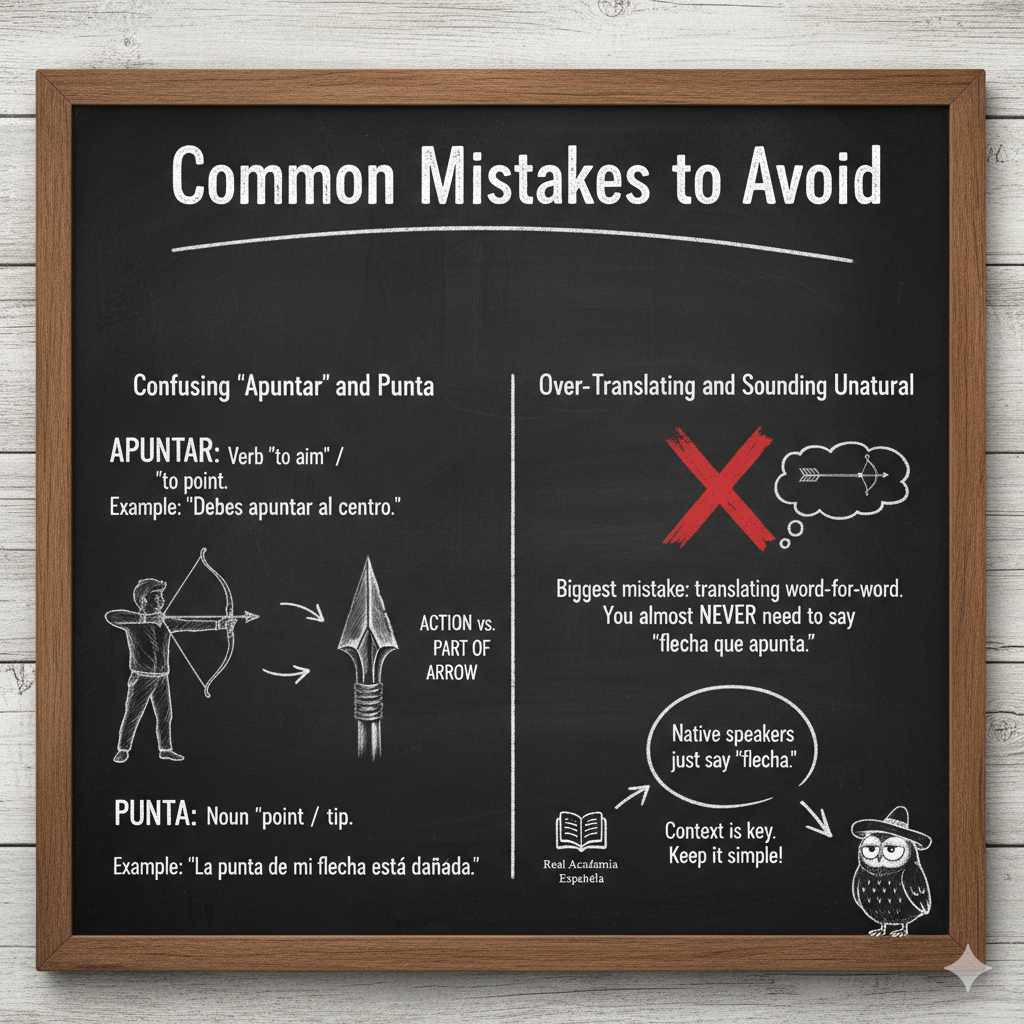
Confusing “Apuntar” and “Punta”
These two words look and sound similar, but they have very different meanings. This is a crucial distinction for any archer!
- Apuntar: This is the verb “to aim” or “to point.” It’s an action. Example: “Debes apuntar al centro.” (You must aim at the center.)
- Punta: This is the noun “point” or “tip,” as in the tip of your arrow. Example: “La punta de mi flecha está dañada.” (The point of my arrow is damaged.)
Remember: one is what you do (apuntar), and the other is a part of your arrow (punta).
Over-Translating and Sounding Unnatural
The biggest mistake beginners make is trying to translate everything word-for-word from English. As we discussed, you almost never need to say “flecha que apunta.” In 99% of archery contexts, “flecha” is all you need. Insisting on the literal translation is a dead giveaway that you’re not a native speaker.
When in doubt, keep it simple. The goal of language is to be understood, not to be overly complex. You can see the official definition and uses of “flecha” in the Real Academia Española dictionary, the official authority on the Spanish language, which confirms its primary meaning as the projectile for a bow.
Frequently Asked Questions
What is the most common way to say “arrow” in Spanish?
The most common and direct way to say “arrow” in Spanish is “flecha.” This word covers almost every situation, especially when talking about the arrows used in archery.
How do I say “arrowhead” in Spanish?
“Arrowhead” in Spanish is “punta de flecha.” “Punta” means “point” or “tip,” and “de flecha” means “of the arrow.”
What’s the Spanish word for “to aim” an arrow?
The Spanish verb for “to aim” is “apuntar.” For example, you would say, “apuntar la flecha” which means “to aim the arrow.”
If I see an arrow on a sign, what is it called in Spanish?
An arrow on a sign is called a “señal de flecha” (arrow sign). You can also just refer to it as “la flecha” if the context is clear, such as, “sigue la flecha” (follow the arrow).
Is there a difference between “flecha” and “saeta”?
Yes, there is a difference. “Flecha” is the modern, standard word for an arrow. “Saeta” is an older, more poetic or archaic term. You might see it in historical texts or literature, but you would not use it in a regular conversation about archery today.
How do you say “bow and arrow” in Spanish?
The phrase for “bow and arrow” in Spanish is “arco y flecha.” It’s a direct and simple translation that is universally understood.
Can I just use “flecha” for a computer cursor arrow?
Yes, absolutely. While “símbolo de flecha” or “cursor” are more technical, it’s very common and natural for people to simply call the cursor “la flecha.” For example, “Mueve la flecha sobre el ícono.” (Move the arrow over the icon.)
You’re Ready to Talk Arrows in Spanish!
And there you have it! What started as a simple question about a “pointing arrow” has opened up a whole new vocabulary for you to use. The key takeaway is that context is everything. For your archery passion, “flecha” will be your best friend. For signs and symbols, you now have “señal de flecha” and “símbolo de flecha” in your quiver.
Learning these terms does more than just help you find the right gear online; it connects you to a global community of archers. It allows you to share your passion, learn from others, and feel more confident no matter where your archery journey takes you.
So next time you’re talking about our favorite sport, I hope you feel proud and prepared to use these words. Keep practicing, stay safe, and have fun on the range!