Difference Between Crossbow & Bow Arrows: Guide
The main difference between crossbow and bow arrows lies in their size, construction, and how they’re launched. Crossbow bolts are shorter and typically fatter, designed for the immense power of a crossbow. Bow arrows are longer and thinner, matched to the draw weight of a traditional or compound bow. Choosing the right arrow is crucial for accuracy and safety.

BARNETT
Barnett Explorer XP370 - Compact and Lightweight…
- Crossbow package for adults: The Explorer XP370 is an ideal choice for hunters seeking a compact, lightweight, and affordable cros…
- Hunting Crossbow with Crank: The Explorer XP370 hunting crossbow is equipped with a cocking assist crank for easy loading. Its pow…
- Exceptional Speed: Features a blazing speed of 370fps, allowing you to track and aim at your target swiftly and accurately. Get th…
As an Amazon Associate I earn from qualifying purchases.
For a closely related bow or archery topic, Difference Between Swhacker and Swhacker Crossbow: Essential gives readers a useful next step.
Hey there, fellow archery enthusiasts! Are you just starting out and wondering about all the different gear? It’s totally normal to get a little confused when you see equipment labeled for “bows” and other bits for “crossbows.” They both shoot projectiles, right? So what’s the big deal with the arrows themselves? Don’t worry, it’s a common question, and understanding this is a key step in making sure you’re set up for success. We’ll break down the differences clearly so you can feel confident choosing the right arrows for your archery adventures. Stick around, and let’s clear things up!
Understanding the Core Difference: Size and Purpose
At first glance, you might think an arrow is just an arrow. But when it comes to bows and crossbows, they are distinctly different. This difference isn’t just about looks; it’s about physics, engineering, and what makes each projectile fly accurately and safely. Think of it like using the right tool for the job – you wouldn’t use a tiny screwdriver to hammer a nail, and you wouldn’t use a massive sledgehammer to tighten a screw. The same applies here.
The fundamental distinction boils down to how much force the projectile needs to withstand and how it is propelled. Crossbows generally have much higher draw weights and a mechanical release system, which means their projectiles, often called “bolts,” are built to handle incredible power. Traditional and compound bows, while powerful, operate a bit differently, and their “arrows” are designed to match that specific type of energy transfer.
Crossbow Bolts: Built for Power
Crossbow bolts are designed to be shot from a crossbow, which is essentially a bow mounted horizontally on a stock. These machines are known for their immense power and the mechanical trigger mechanism that releases the string. Because of this, crossbow bolts are typically:
- Shorter: They don’t need to be as long as bow arrows because the crossbow’s power stroke is very efficient, and the bolt is supported by the rail for most of its length until it’s fired.
- Wider/Fatter: Often, crossbow bolts have a larger outside diameter. This can contribute to their stability and durability when shot at the high speeds a crossbow generates.
- Heavier: Generally, crossbow bolts can be heavier to absorb and transfer the significant energy from the crossbow.
- Specific Nocks: They usually have a flat or half-moon nock at the back to interface with the crossbow’s string and trigger mechanism.
The purpose of these design features is to harness the extreme force of the crossbow safely and effectively, ensuring the bolt is stable during launch and flies true to its target. Trying to shoot a crossbow bolt from a regular bow would be inefficient and likely inaccurate, and attempting to shoot a traditional bow arrow from a crossbow could be dangerous due to the mismatch in forces and dimensions.
Bow Arrows: Tuned for Flight
Bow arrows, on the other hand, are designed for use with traditional recurve bows, longbows, and modern compound bows. These arrows are longer and more slender than crossbow bolts. Their design considers the archer’s draw length, the bow’s draw weight, and the physics of arrow flight as it flexes and straightens during the shot. Key characteristics include:
- Longer Shafts: The length of a bow arrow is critical and is often matched to the archer’s draw length to ensure proper acceleration and stability.
- Thinner Diameters: Generally, bow arrows have a smaller outside diameter compared to crossbow bolts, allowing them to fly more efficiently through the air.
- Lighter Weight: While varying based on the bow and intended use, bow arrows are often lighter than crossbow bolts to achieve higher speeds.
- Traditional Nocks: They feature a distinct nock at the rear that clips securely onto the bowstring, designed to release cleanly as the archer follows through with their shot.
Bow arrows are engineered to work in harmony with the archer and the bow. They flex and whip around the riser (the central part of the bow) during the shot – a phenomenon known as “arrow flex” or “Archers paradox.” This is a crucial part of achieving accuracy. The arrow’s spine (its stiffness) must be perfectly matched to the bow’s draw weight and the archer’s draw length to ensure this flexing and straightening is controlled, leading to a straight flight path.

Key Differences at a Glance: A Comparative Table
To help visualize the distinctions, let’s look at a side-by-side comparison of typical crossbow bolts and bow arrows. This table highlights the main physical and functional differences.
| Feature | Crossbow Bolt | Bow Arrow |
|---|---|---|
| Typical Length | Shorter (e.g., 16-22 inches) | Longer (e.g., 26-32 inches, depends on draw length) |
| Shaft Diameter | Generally Wider (e.g., .30-0.45 inches typically) | Generally Thinner (e.g., .165-.300 inches typically) |
| Weight | Can be Heavier, designed for high energy transfer | Varies widely, often lighter for speed |
| Nock Type | Flat or Half-Moon (for mechanical release) | Traditional Capture Nock (for bowstring) |
| Purpose | High-speed launch from powerful, mechanical crossbows | Propelled by archer’s strength from bows, relies on flex for accuracy |
| Flexibility (Spine) | Less critical for archer to match; designed for rigidity in rail | Crucial: Must match bow’s draw weight & draw length for controlled flex |
| Fletching | Often shorter, stiffer vanes (smaller surface area) | Can be vanes or feathers, longer for stability |
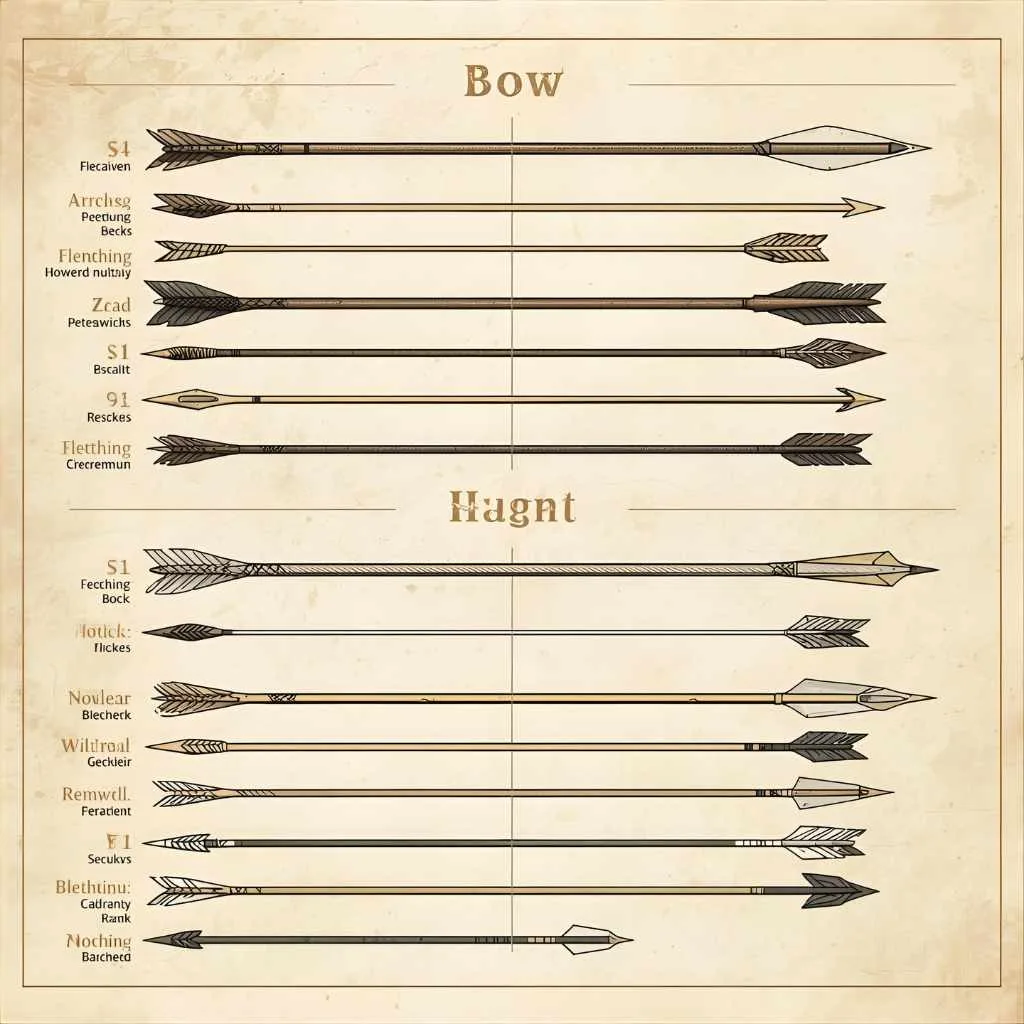
Anatomy of an Arrow (and Bolt): What Makes Them Tick?
Both crossbow bolts and bow arrows share some common components, but the specifics and their importance can differ. Understanding these parts helps in appreciating why they are not interchangeable.
1. The Shaft: The Backbone
This is the long, cylindrical body of the projectile.
- Crossbow Bolts: Often made of aluminum, carbon, or composite materials. Their shorter, thicker design is built for durability under high stress.
- Bow Arrows: Also made from aluminum, carbon, or wood (though wood is less common for modern hunting and target shooting). The crucial property here is the “spine.” Spine refers to the stiffness of the arrow shaft. An arrow that’s too stiff or too flexy for the bow will fly erratically. Finding the correct spine is essential for accuracy. You can learn more about spine selection from resources like Bowhunting.com’s guide to arrow spine.
2. The Nock: The Connection Point
The nock is the small piece at the rear of the arrow that attaches to the bowstring or crossbow string.
- Crossbow Bolts: Typically have a flat or a half-moon shaped nock. This design helps them seat properly against the crossbow string and rail, ensuring a secure lock until released by the trigger.
- Bow Arrows: Feature a distinct nock that grips the bowstring. When the bow is drawn, the nock holds the arrow firmly. As the string is released, the nock allows the arrow to pivot and fly off the string, a key part of the Archers Paradox.
3. The Fletching: The Stabilizers
These are the small fins or feathers attached to the rear of the shaft that help stabilize the projectile in flight.
- Crossbow Bolts: Usually have shorter, stiffer plastic vanes. Because crossbows are inherently more stable due to their design and shorter flight path, less fletching surface is needed.
- Bow Arrows: Can use either vanes or feathers. Feathers are traditional and perform very well, while modern plastic vanes offer durability and wind resistance. The length and angle of fletching are carefully designed to provide stability without causing excessive drag.
4. The Point: The Business End
This is the tip of the arrow or bolt.
- Crossbow Bolts: Use broadheads (for hunting) or field points (for practice and target shooting). Broadheads for crossbows are often designed to be more robust to withstand the higher speeds.
- Bow Arrows: Also use field points for practice and broadheads for hunting. The type of point must be matched to the arrow shaft and the intended use. For example, hunting broadheads are designed to cut and expand for an ethical kill.
Why Using the Wrong Arrow is a Problem
It’s really important to use the right kind of arrow for your specific bow or crossbow. Using the wrong type can lead to several issues, ranging from poor performance to potential safety hazards.
Accuracy Issues
The most immediate problem you’ll notice is a lack of accuracy.
- If you try to shoot a crossbow bolt from a bow, it’s unlikely to sit correctly on the string and might not even fire straight. If it does fire, its weight and stiffness won’t be matched to the bow, leading to wild shots.
- If you shoot a bow arrow from a crossbow, it might be too light, too short, or have a nock that doesn’t seat correctly. This can result in the arrow slipping off the string prematurely, impacting its trajectory and velocity significantly. In some cases, it could even cause damage to the crossbow.
Equipment Damage
An incompatible arrow can stress your equipment in ways it wasn’t designed for.
- A bow arrow fired from a crossbow might not sustain the forces, leading to shaft breakage or damage to the string or trigger mechanism.
- While less common, a very heavy or stiff crossbow bolt fired from a bow could potentially damage the bow’s limbs or riser due to the unexpected forces.
Safety Hazards
This is the most critical concern. Using the wrong arrow can be dangerous.
- Arrow Breakage: Damaged or mis-matched arrows, especially under the high stress of a crossbow, can break upon firing. Fragments can fly back towards the shooter or bystanders, causing serious injury. The U.S. Consumer Product Safety Commission often provides guidelines on the safe use of sporting equipment, which implicitly includes using compatible accessories. You can find related safety information on their website, CPSC.gov.
- String or Cable Damage: An arrow that doesn’t release cleanly from a bowstring, or a nock that fails on a crossbow string, can cause the string or cables to snap back improperly, potentially damaging the bow itself or even causing injury.
- Misfires: Incompatibility can lead to a partial or complete misfire, where the arrow doesn’t leave the bow/crossbow as intended, creating an unpredictable and dangerous situation.
Choosing the Right Arrow for Your Gear: A Simple Checklist
To ensure you’re always safe and getting the best performance, follow these simple steps when selecting arrows.
1. Identify Your Equipment Type
Are you using a traditional recurve bow, a compound bow, or a crossbow? This is the first and most important question. They each require completely different types of projectiles. There’s no overlap!
2. Check Your Equipment’s Manual
Manufacturers provide specific recommendations for the types of arrows or bolts suitable for their products. This manual is your best friend.
- For Bows: It will tell you the recommended “spine” (stiffness) range, straightness tolerance, and minimum/maximum shaft length and weight for your specific bow model.
- For Crossbows: It will specify the required bolt length, diameter (often referred to by internal or external measurements), weight range, and nock type.
3. Consider Your Draw Length (for Bows)
For bow arrows, your draw length – how far you pull the string back – is critical for determining the correct arrow length. Many archery shops can measure this for you. An arrow that is too short or too long will affect your shooting.
4. Match Spine to Bow (for Bows)
This is where it gets a bit technical, but it’s vital. Arrow spine is like the arrow’s flexibility. It needs to match your bow’s draw weight and your draw length.
- Too Stiff (Strong Spine): The arrow will tend to hit left (for right-handed archers) and feel stiff on release.
- Too Weak (Weak Spine): The arrow will tend to hit right (for right-handed archers) and feel “whippy” or wobbly in flight.
Many arrow manufacturers provide spine charts that help you find the right arrow based on your bow’s draw weight, your draw length, and even the weight of the mũi you plan to use. For example, Easton Archery, a leading manufacturer, offers excellent resources like their spine calculator to help users find the perfect match.
5. Consider Your Intended Use
Are you just practicing at the range, or are you planning to hunt?
- Target Shooting: Lighter, less expensive arrows are often fine. Field points are used.
- Hunting: You’ll need stronger, more durable arrows and specialized broadheads. The weight and energy transfer become more important.
Frequently Asked Questions (FAQ) About Bow and Crossbow Arrows
Q1: Can I use the same arrows for my compound bow and my recurve bow?
It depends. While both are “bow arrows,” their lengths, spines, and sometimes even their flex characteristics might differ based on the specific draw weight, draw length, and shooting style of each bow. Always check the recommendations for each bow.
Q2: Are crossbow bolts always heavier than bow arrows?
Not necessarily. While crossbow bolts tend to be shorter and can be stout, lighter-weight carbon arrows for bows can sometimes be comparable in weight to some heavier bolts. It’s more about the overall package – the bolt is designed to handle the crossbow’s immense force, whereas bow arrows are tuned for the bow’s specific power and release.
Q3: What is “spine” and why is it important for bow arrows?
Spine is a measure of an arrow shaft’s stiffness. It’s crucial for bow arrows because as the string is released, the arrow flexes like a spring. For accuracy, this flex must be controlled so the arrow flies straight. The spine needs to match the bow’s draw weight and the archer’s draw length to ensure this controlled flex.
Q4: Can I shoot a crossbow bolt with vanes or feathers?
Crossbow bolts usually use shorter, stiffer vanes. While some very specialized bolts might differ, they are not typically fletched with full-length feathers like many traditional bow arrows. The design is optimized for the crossbow’s mechanics and speed.
Q5: What happens if I use a field point on a hunting broadhead arrow for target practice?
Generally, this is fine and often recommended! Field points are practice points that fly similarly to broadheads but are less expensive and safer. Using them helps you tune your bow and practice without dulling or damaging your hunting broadheads. However, always ensure the weight of the field point matches your broadhead’s weight for consistent tuning.
Q6: Where can I get help with selecting the right arrows?
The best place to get expert advice is at your local archery shop. The staff there are experienced and can help you measure your draw length, assess your bow, and recommend the perfect arrows. Online resources and archery forums are also helpful, but nothing beats hands-on guidance from a pro.
Related pick: Check today's price on Amazon