Medieval Crossbow Types: 7 Styles From Prod to Arbalest
I sort medieval crossbows into seven types by two visible clues: the stock shape and the spanning system, from simple belt-hook bows to heavy arbalests worked with a windlass or cranequin. Mix those terms up, and museum labels, reenactment kits, and battlefield comparisons get sloppy fast. I’ll separate prod, arbalest, windlass, and cranequin, then show how each style looks, spans, and was used.
What counts as a medieval crossbow type?
A medieval crossbow type can mean three different things: the overall build, the way it is spanned, or the material of the prod. Those categories overlap, so I identify a piece by visible features first, then by loading method, then by role. That keeps “prod,” “crossbow,” and “arbalest” from collapsing into one vague label.
Type, spanning system, and prod material are different things
A medieval crossbow is the parent category, a stock or tiller with a bow fixed across the front and a lock to hold the string. An arbalest is usually a heavier later medieval member of that family, though some sources use the word loosely for crossbows in general.
Likewise, windlass and cranequin are spanning systems, not whole weapon families by themselves. Composite and steel prod describe the bow assembly material, which can appear on more than one build.
The parts that matter when you identify one
The prod is the bow assembly fixed across the front of the tiller or stock. In some older writing, “prod” also gets used loosely for a simple early crossbow, which is one reason labels drift.
The string sits in a retaining mechanism. The earliest European crossbow designs used a transverse slot in the top surface. Later designs used a rolling cylindrical pawl called a nut. That nut retained the string and was often made from materials such as wood, antler, ivory, bone, or metal, depending on the maker and period.
The projectile is a bolt, also called a quarrel. Crossbows shoot short, stiff bolts or quarrels, usually much shorter than full-length hand-bow arrows and built to ride the stock cleanly.
Fit matters. So does classification.
According to Arbalest — The arbalest came into use in Europe around the 12th century. (source)
The 7 medieval crossbow types at a glance
These seven types make the most sense when read as an identification guide, not a rigid family tree. Some are full build classes, some are material classes, and some are heavy forms separated by spanning method because that method tells you a lot about force, speed, and role.
Identification table
| Type | Prod material | Cocking method | Typical use case | Relative power | How to recognize it |
|---|---|---|---|---|---|
| Gastraphetes | Wood or composite-like ancient bow forms | Belly-braced loading against the body | Ancient predecessor, technical precursor | Low to moderate | Long stock meant to brace against the belly, no medieval nut form expected |
| Early prod crossbow | Usually wood, sometimes reinforced | Hand draw or belt-hook style | Early military use, local defense, hunting | Low to moderate | Simple stock, simple lock, light build, little external spanning hardware |
| Stirrup crossbow | Wood or composite | Foot stirrup with hand draw | Field use and hunting | Moderate | Metal or wooden stirrup fixed at the front for bracing with the foot |
| Goat’s foot lever crossbow | Usually composite, sometimes strong wood builds | Detachable or fitted goat’s foot lever | Military crossbow needing more force without a full winch | Moderate to high | Lever engagement points on the stock, more compact than windlass gear |
| Composite prod crossbow | Wood, horn, and sinew layers | Varies by build | Power-focused designs before steel became common | Moderate to high | Thicker laminated prod with material build more complex than plain wood |
| Windlass or cranequin heavy crossbow | Composite or steel | Windlass or cranequin | Heavy military use, defense, armor-focused shooting | High to very high | Separate gearing device, hooks or cords, long reload cycle, heavy stock |
| Arbalest or pistol crossbow | Steel prod for arbalest; lighter prod on pistol crossbow | Mechanical aid for arbalest; simple hand or small aid on pistol type | Heavy battlefield crossbow at one end, compact specialist sidearm at the other | Very high for arbalest; low for pistol type | Arbalest is large with steel prod; pistol crossbow is short enough to shoot under the arm |
How to read the table without mixing labels
- Look at the prod first: wood, composite, or steel.
- Look for a stirrup, lever fittings, windlass hooks, or cranequin teeth.
- Check the lock area for a simple slot or later nut.
- Then ask what the weapon was built to do: hunt, skirmish, defend walls, or hit harder at the cost of speed.

1) Gastraphetes: the belly-braced predecessor
The gastraphetes is best treated as an ancient predecessor rather than a standard medieval field crossbow. It matters because later crossbow discussions often pull it into the family tree, especially when explaining body-braced loading and early mechanical release ideas.
Why it appears on medieval crossbow lists
Heron of Alexandria describes the gastraphetes with a belly-braced loading method. The shooter set the long stock against the abdomen, leaned body weight into it, and drove the string back by pressing the frame forward until it caught.
That does not make it a medieval battlefield norm. It does make it a useful starting point if you want to understand where the idea of a stock-mounted bow with a retaining system came from.
2) Early prod crossbows: simple hand-drawn forms
Early prod crossbows are the low-complexity forms that keep showing up under broad labels. They are easiest to spot by their plain wooden prods, simpler locks, and lack of major spanning hardware. These were real working weapons, but their power ceiling was lower.
What “prod” means here
Strictly speaking, the prod is the bow assembly. In looser use, “prod crossbow” can mean an early simple crossbow before the heavier steel-prod military forms took over the conversation.
The crossbow dates back to the 11th century on Medieval Britain. On the earliest European examples, the lock area may show that old transverse slot rather than the later nut system.
Why these existed
Short draw length limits energy transfer. If your prod is modest and your lock is simple, you get a weapon that is easier to carry and faster to span, but you give up force.
That tradeoff is familiar to any archer. More draw force only helps if the shooter and the system can use it well.
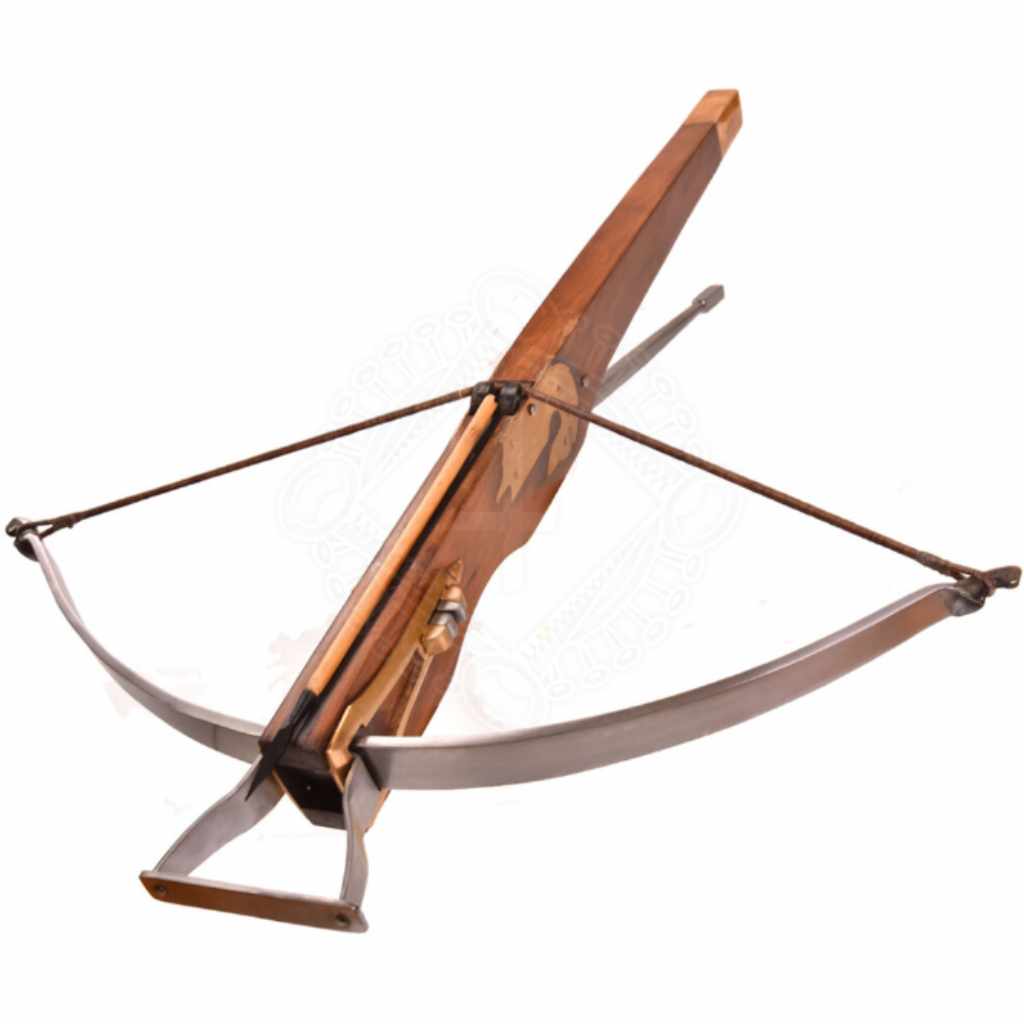
3) Stirrup crossbows: the practical field standard
Stirrup crossbows are the practical middle ground many readers picture when they hear “medieval crossbow.” The foot stirrup lets the shooter brace the bow solidly while drawing, which raises manageable draw force without adding full mechanical gear.
Why the stirrup mattered
You plant a foot, lean back, and pull. That sounds simple because it is simple.
The stirrup changed the weapon from a hand-drawn bow-on-a-stock into something more efficient for repeated use in the field. It also gives you one of the easiest visual markers to identify from art, reconstructions, and surviving pieces.
Where the limit shows up
Once the prod gets too strong, body strength stops being enough. That is the point where lever systems and winches stop being luxuries and start being necessary.
4) Goat’s foot lever crossbows: more power without a full winch
Goat’s foot lever crossbows sit between stirrup bows and the heavy winched class. They add a compact mechanical advantage to the stock, giving more force than a simple foot draw while staying quicker and lighter than a windlass setup.
How the lever works
The lever engages the string and folds through an arc that multiplies the user’s effort. On surviving depictions, I look for the lever itself or the engagement points that tell me the bow was meant to use one.
That matters because many modern summaries treat every mechanical aid as basically the same. It is not. A goat’s foot is still a field-friendly solution. A windlass is a heavier commitment.
Why this type existed
It bought more power without turning every reload into a winching job. That made sense for soldiers who needed force, but still needed to move and reload at a workable pace.
5) Composite prod crossbows: material matters
Composite prod crossbows are better understood as a material class than a single standalone shape. A composite prod uses layered materials, usually wood, horn, and sinew, to store more energy than a plain wooden prod of similar size.
Why composite mattered before steel became common
Horn handles compression well. Sinew handles tension well. Put them together over a core, and you get a prod that can store more force in a compact package.
That does not mean every composite crossbow was heavy or late. Composite prods overlap with several builds, including stirrup and lever-spanned forms.
How I would identify one
If I cannot inspect the layers directly, I look at prod thickness, shape, and period context. Museum labels often flatten this step, but the material tells you a lot about the design logic.
6) Windlass and cranequin crossbows: the heavy military class
Windlass- and cranequin-spanned crossbows belong to the heavy military class because the spanning gear signals strong prods and slow reloads. By the 13th century, European crossbows used windlasses and cranequins, and those tools tell you the weapon had moved beyond simple body-powered spanning.
Windlass crossbows
A windlass uses cords, hooks, and a geared pull to drag the string back. If I see separate winch hardware, I expect a slow cycle and a serious prod.
The strongest windlass-pulled arbalests could have up to 22 kN of force. That sounds immense because it was. The price was speed.
Cranequin crossbows
A cranequin is a geared rack-and-pinion style device associated with heavy late medieval crossbows, often arbalests. It is more compact than a windlass, but it still belongs to the same idea: stronger prod, mechanical span, slower shooting.
This is one place naming gets messy. Some catalogs label the bow by the spanning device. Others reserve the bigger identity label for arbalest.
7) Arbalests and pistol crossbows: the heavy end and the small end
Arbalests and pistol crossbows sit at opposite ends of the spectrum. The arbalest is the heavy later medieval form, usually large and steel-prodded. The pistol crossbow is compact, can be shot from under the arm, and is weaker because its draw length is short.
What makes an arbalest different
The arbalest came into use in Europe around the 12th century. It was a large weapon with a steel prod, or bow assembly.
Steel prods gave high force, but steel also came with a shorter draw length than many bows people imagine. That matters. Higher force does not erase the energy cost of a short power stroke, so these weapons leaned hard on mechanical spanning to compensate.
A skilled arbalestier could loose two bolts per minute. Another medieval source notes a crossbowman averaged two or three shots per minute. Those figures tell you exactly why heavier crossbows were feared and also why they could become tactically inefficient if the fight demanded constant rapid shooting.
Why pistol crossbows stayed small
The pistol crossbow can be shot from under the arm and is generally a specialist form rather than a battlefield equal of the arbalest. It is smaller than regular crossbows, can be shot from under the arm, and gives up power because the draw length is shorter.
Smaller designs were useful where portability mattered more than force. That is the kind of practical detail most broad histories skip.
How powerful were medieval crossbows, and why did type matter?
Medieval crossbows ranged from modest hand-drawn forms to very strong arbalests, and type mattered because short draw length forced designers to chase force through prod material and spanning gear. Power was never just “more is better.” It had to match reload speed, target, and tactical role.
Draw length versus draw force
A bow stores energy across its draw cycle. Crossbows tend to have shorter draw lengths than hand bows, so designers pushed force higher through composite construction, steel prods, and winched spanning systems.
That works, but only up to a point. Heavy crossbows hit harder, yet they ask more time, more hardware, and often more specialized handling in return.
Range, accuracy, and the limits of simple claims
The strongest windlass-drawn arbalests were described as accurate up to 100 m. A medieval source also gives a crossbowman a range of 320 to 360 meters. I separate those claims into practical aimed range and maximum flight range, because they are not the same question.
If you ask how far a medieval crossbow could shoot, you need three answers: useful battlefield distance, aimed accuracy, and farthest flight. Most pages mash those together and leave readers with a number that sounds firm but explains nothing.
Why heavier crossbows could become inefficient
If a fight rewarded quick volume of fire, the heaviest arbalests were a poor fit. If the job was defense, deliberate shooting, or a hard hit from cover, the slow reload made more sense.
That is why classification by role helps. Lightweight, hunting, field, and heavy military variants existed for different jobs.
Were medieval crossbows easier to use than longbows?
Medieval crossbows were generally easier to train to baseline proficiency than war longbows, but they were not effortless weapons. The lock let a shooter hold at full draw and aim, yet reload speed, spanning tools, and gear management made heavy crossbows slower and more equipment-dependent.
What “easier to use” really means
You do not need to hold full draw with your back and shoulders while aiming. The lock does that for you. That removes one major skill barrier.
Still, a good crossbowman needed routine, strength for the chosen spanning system, and consistency. Longbows demanded deeper physical adaptation and years of practice. Crossbows demanded less of that, but more hardware and more time between shots.
Why commanders accepted the slower reload
Because ease of aiming and strong impact still had value. On defense, behind cover, or in roles where a single well-placed quarrel mattered, slower reload did not erase the weapon’s worth.
Frequently asked questions
What were the main types of medieval crossbows?
I group them into seven: gastraphetes, early prod crossbows, stirrup crossbows, goat’s foot lever crossbows, composite prod crossbows, windlass or cranequin heavy crossbows, and arbalests with pistol crossbows as the compact outlier. That mix covers build, spanning method, and battlefield role without pretending the terminology was perfectly tidy.
What is the difference between a prod crossbow and an arbalest?
A prod crossbow usually points to a simpler or earlier crossbow identified mainly by its bow assembly, while an arbalest usually means a heavier later medieval weapon, often with a steel prod and mechanical spanning aid. In short, “crossbow” is broad; “arbalest” is a stronger, narrower label.
How powerful was a medieval arbalest?
Power varied, but the heavy end was serious. The strongest windlass-pulled arbalests could have up to 22 kN of force, and some were described as accurate up to 100 m. That came with a slow cycle, with a skilled arbalestier able to loose two bolts per minute.
What spanning tools were used on heavy crossbows?
Heavy crossbows used mechanical aids, especially windlasses and cranequins. By the 13th century, European crossbows used windlasses and cranequins, and that usually signals a strong prod and a slower reload. Goat’s foot levers sit below that class as a lighter mechanical option.
Why were some crossbows banned by the Church?
The ban shows the weapon’s social and moral controversy in Christian warfare. The Second Lateran Council banned crossbows against Christians in 1139. That did not erase their use, but it tells you medieval people saw crossbows as more than technical gear; they were politically and religiously charged weapons.
What were crossbow bolts called?
They were called bolts or quarrels. “Quarrel” is the common alternate term, and it usually refers to the shorter projectile fired from a crossbow rather than a full-length arrow. Crossbows shoot bolts or quarrels, and that wording shows up constantly in medieval weapon descriptions.