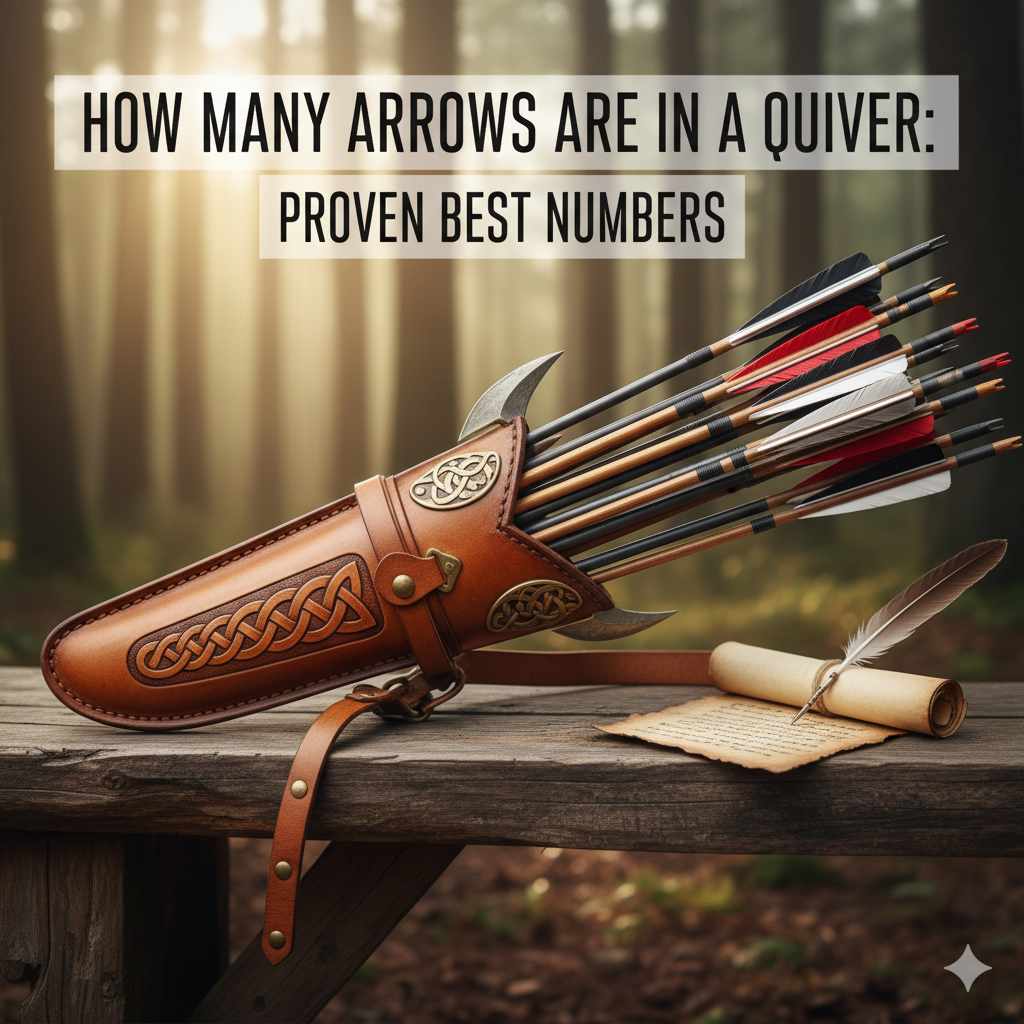
A quiver’s capacity depends on your activity. Target archers usually carry 6-12 arrows, while bowhunters prefer a lighter load of 3-6 specialized arrows. Traditional archers might carry a dozen or more. The best number balances weight with preparedness, ensuring you have enough arrows for your specific archery goal.
Welcome, fellow archer! If you’re just starting, you’ve probably asked yourself, “How many arrows should I actually put in my quiver?” It’s a great question, and the answer isn’t as simple as one single number. Packing too few can cut your practice session short, while carrying too many can weigh you down and make you clumsy.
Don’t worry, I’ve got you covered. This is one of the most common puzzles for new archers, but it’s easy to solve once you know the basics. In this guide, I’ll walk you through everything you need to know, step-by-step. We’ll look at different archery styles and find the perfect number of arrows for you, so you can head to the range or the field with confidence. Let’s get started!
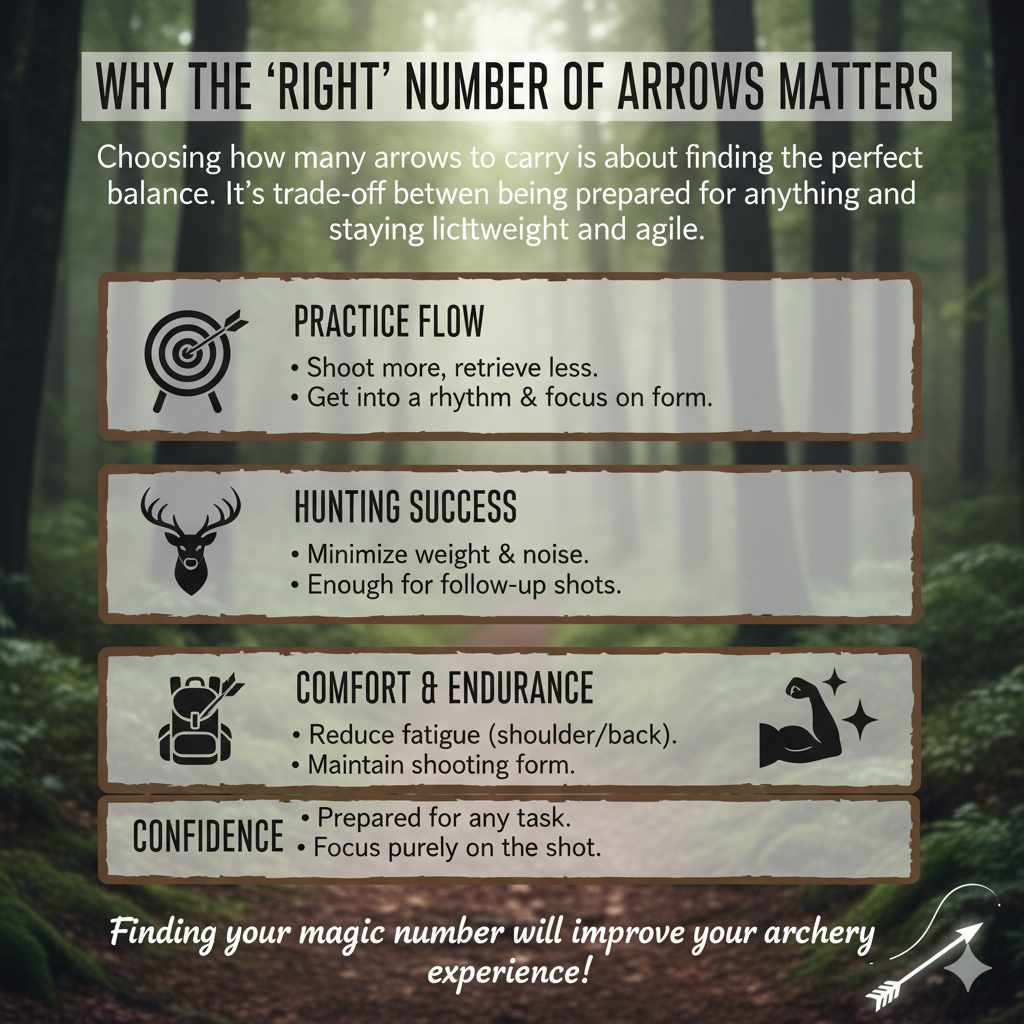
Why the “Right” Number of Arrows Matters
Choosing how many arrows to carry is about finding the perfect balance. It’s a trade-off between being prepared for anything and staying lightweight and agile. Think of it like packing a backpack for a hike; you need the essentials, but every extra pound makes the journey harder.
Here’s why getting it right is so important:
- Practice Flow: If you’re practicing at the range, having enough arrows lets you shoot a good number of times before you have to walk to the target to retrieve them. This helps you get into a rhythm and focus on your form without constant interruptions.
- Hunting Success: In bowhunting, weight and noise are critical. Too many arrows can rattle in your quiver, alerting animals to your presence. You need enough for a potential follow-up shot, but not so many that they become a burden on a long trek.
- Comfort and Endurance: Arrows add up in weight. Carrying a heavy quiver all day can tire out your shoulder and back, which can negatively affect your shooting form and overall enjoyment.
- Confidence: Knowing you have the right amount of equipment for the task at hand is a huge confidence booster. You won’t be worried about running out of arrows or feeling overloaded. You can just focus on the shot.
Finding your magic number will make your archery experience safer, more comfortable, and a lot more fun.
Quiver Types and Their Arrow Capacity
Before we decide how many arrows to carry, let’s look at where you’ll carry them. The type of quiver you use has a big impact on its capacity and is often designed for a specific style of archery. Here are the most common types you’ll see.
Hip Quivers (or Belt Quivers)
These are the most popular quivers for beginners and target archers. As the name suggests, they attach to your belt and rest on your hip. They are easy to use, offer quick access to your arrows, and keep them out of your way while you shoot.
- Typical Capacity: 6 to 24 arrows.
- Best For: Target archery, backyard practice, and competitions.
- Pros: Easy to see and grab your arrows. Comfortable for long periods of standing. Often have extra pockets for gear.
- Cons: Arrows can rattle or fall out if you’re moving through thick brush.
Back Quivers
This is the classic “Robin Hood” style quiver, worn over the shoulder and resting on your back. It’s favored by many traditional archers for its large capacity and nostalgic feel. Drawing an arrow from a back quiver looks cool, but it does take some practice to master.
- Typical Capacity: 12 to 30+ arrows.
- Best For: Traditional archery, roving, and long practice sessions.
- Pros: Holds a lot of arrows. Keeps arrows completely out of the way of your arms and bow.
- Cons: Can be hard to grab an arrow without looking. Arrows may fall out if you bend over too far. Not ideal for bowhunting in dense woods.
Bow-Mounted Quivers
These quivers attach directly to the riser of your compound or recurve bow. They are compact, secure, and designed to keep your arrows within immediate reach. This is the top choice for bowhunters who need to move silently and react quickly.
- Typical Capacity: 3 to 8 arrows.
- Best For: Bowhunting and 3D archery.
- Pros: Arrows are held securely and silently. Super-fast access for a follow-up shot. Keeps everything in one compact unit.
- Cons: Adds weight directly to your bow, which can affect balance. Limited capacity.
Ground Quivers
A ground quiver isn’t worn at all. It’s a simple stand that you stick into the ground next to you. It’s perfect when you’re shooting from a single spot and don’t need to move around much.
- Typical Capacity: 6 to 12 arrows.
- Best For: Backyard practice, teaching new archers, or shooting in a fixed location.
- Pros: Keeps your arrows clean and organized. No weight on your body or bow.
- Cons: You can’t move with it. Only useful for stationary shooting.
Here’s a simple table to help you compare them at a glance:
| Quiver Type | Typical Capacity | Best Use Case |
|---|---|---|
| Hip Quiver | 6 – 24 Arrows | Target Archery, Practice |
| Back Quiver | 12 – 30+ Arrows | Traditional Archery, Roving |
| Bow-Mounted Quiver | 3 – 8 Arrows | Bowhunting, 3D Archery |
| Ground Quiver | 6 – 12 Arrows | Backyard Practice |
How Many Arrows for Different Archery Styles? (Proven Numbers)
Now for the main event! The number of arrows you need depends entirely on what you’re doing. Let’s break it down by activity to find the proven number that works best for each scenario.
For Target Archery (Indoor & Outdoor)
In target archery, you shoot in sets called “ends” or “rounds.” For most competitions, an end consists of 3 to 6 arrows. After everyone in your group has shot their arrows, you all walk to the target to score and retrieve them.
- Indoor Archery: An indoor end is usually 3 arrows. While you only need 3, it’s smart to carry 5 or 6 arrows in your quiver. This gives you spares in case you drop one or a nock breaks. You won’t have to hold up the line to fix your equipment.
- Outdoor Archery: Outdoor rounds often involve longer distances and more arrows per end (typically 6). Because you’re outside, there’s a higher chance of losing or damaging an arrow. A good number to carry is 8 to 12 arrows. This ensures you have plenty of perfectly matched arrows for the entire competition.
Always check the rules for any competition you enter. Organizations like World Archery have specific regulations about equipment you should be aware of.
For Bowhunting
Bowhunting is a different game entirely. Here, the philosophy is “less is more.” The goal is a quick, ethical harvest, which ideally requires only one arrow. However, you must be prepared for the unexpected.
The proven best number for most bowhunters is 3 to 6 arrows.
- Why this number? It’s the perfect balance of preparedness and practicality. A 3 to 5 arrow bow-mounted quiver is lightweight, silent, and keeps your arrows secure.
- One Primary Arrow: Your first shot is the most important.
- A Follow-Up Arrow: In case your first shot doesn’t result in a quick recovery.
- A Spare Arrow: In case you damage or lose an arrow while moving.
- A Small Game Arrow: Some hunters carry an arrow with a blunt or judo point for small game opportunities.
Carrying more than 6 arrows often adds unnecessary weight and bulk, making it harder to move quietly through the woods.
For 3D Archery
3D archery involves walking a course and shooting at life-sized foam animal targets at varying distances. It’s a great way to practice for hunting, but it’s also a fun sport in its own right. On a 3D course, you might lose or break an arrow on a tree or rock.
A good number of arrows for a 3D archery shoot is 6 to 12 arrows. This gives you enough ammunition to complete a full course of 20 to 30 targets, even if you have a few mishaps along the way. Most 3D archers use a hip quiver or a compact bow-mounted quiver for easy access.
For Traditional Archery & Roving
Roving is the simple joy of walking through fields and forests, picking random targets like stumps or leaves, and shooting at them. It’s an instinctive, fun way to practice. For this style, volume is key. You’ll be taking a lot of shots without walking back and forth to a single target.
Traditional archers often prefer a back quiver and will carry 12 to 24 arrows, or even more. This allows for a long, enjoyable session of shooting without having to constantly stop to gather arrows.
For Backyard Practice & Fun
When you’re just having fun in the backyard, the rules are much more relaxed. The goal is to shoot enough arrows to get into a good rhythm before having to retrieve them.
A comfortable number for casual practice is 6 to 12 arrows. This is a common pack size when buying new arrows, and it’s enough to let you focus on your form for several shots in a row. A simple ground quiver or a hip quiver is perfect for this.
Here’s a quick-reference table for all the archery styles:
| Archery Style | Recommended Number of Arrows | Common Quiver Type |
|---|---|---|
| Indoor Target Archery | 5 – 6 | Hip Quiver |
| Outdoor Target Archery | 8 – 12 | Hip Quiver |
| Bowhunting | 3 – 6 | Bow-Mounted Quiver |
| 3D Archery | 6 – 12 | Hip or Bow-Mounted Quiver |
| Traditional / Roving | 12 – 24+ | Back Quiver |
| Backyard Practice | 6 – 12 | Ground or Hip Quiver |
Factors That Influence Your Choice
As you can see, your archery style is the biggest factor. But a few other things can influence your decision:
- Your Physical Comfort: If you’re a smaller person or new to carrying gear, start with fewer arrows. You can always add more as you get stronger and more comfortable. Don’t let a heavy quiver ruin your form or your fun.
- The Environment: Are you walking through thick, dense forest? A compact, bow-mounted quiver with just a few arrows is best to avoid snagging on branches. If you’re in an open field, a larger hip or back quiver is perfectly fine.
- Personal Preference: As you shoot more, you’ll develop your own style and rhythm. Some people hate the interruption of retrieving arrows and prefer to carry more. Others like the break and prefer a lighter load. Experiment and see what feels right for you!
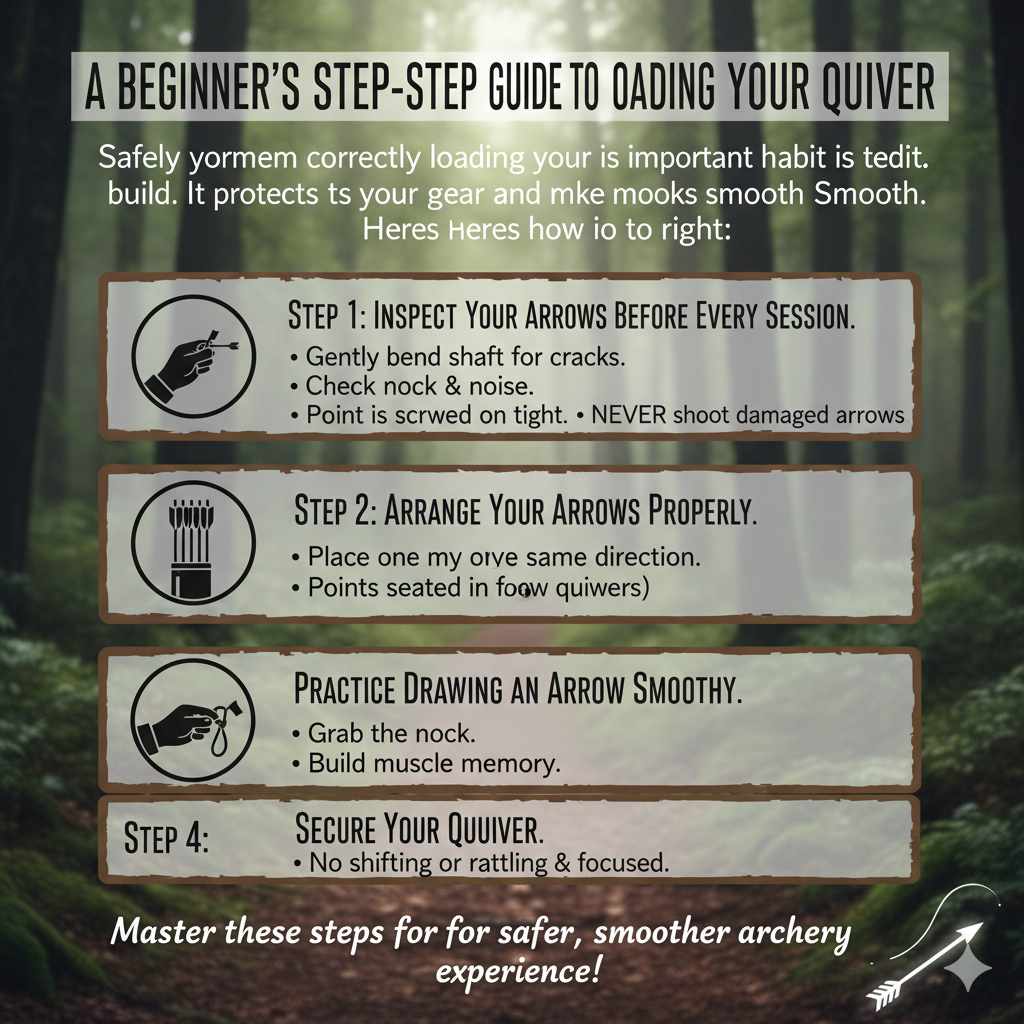
A Beginner’s Step-by-Step Guide to Loading Your Quiver
Safely and correctly loading your quiver is an important habit to build. It protects your gear and makes drawing an arrow smooth and predictable. Here’s how to do it right:
- Step 1: Inspect Your Arrows Before Every Session. This is the most important safety step. Before an arrow ever goes into your quiver, check it carefully. Gently bend and twist the shaft to check for cracks or splinters. Check that the nock is not cracked and is glued on securely. Make sure the fletchings are intact and the point is screwed on tight. Never, ever shoot a damaged arrow.
- Step 2: Arrange Your Arrows Properly. Place arrows into your quiver one by one. For hip and back quivers, make sure the fletchings (feathers or vanes) are all facing the same direction. This prevents them from damaging each other. In a bow-mounted quiver, carefully place each arrow into its gripper and ensure the broadheads or points are seated safely in the foam hood.
- Step 3: Practice Drawing an Arrow Smoothly. With your quiver on, practice drawing an arrow. Do it slowly at first. The goal is to be able to grab the nock and pull the arrow out cleanly without looking. This builds muscle memory, which is crucial when you need to focus on your target.
- Step 4: Secure Your Quiver. Double-check that your quiver is attached securely to your belt, body, or bow. A loose quiver is noisy and distracting. Make sure it doesn’t shift or rattle as you move.
Frequently Asked Questions (FAQ)
How many arrows did medieval archers carry?
Historians believe medieval longbowmen, like those at the Battle of Agincourt, carried a “sheaf” of 24 arrows. They would often be resupplied with more arrows during a battle, allowing them to fire at an incredible rate.
Is it bad to store arrows in a quiver long-term?
Yes, it can be. Storing arrows in a tight quiver for months can compress and warp the fletchings, especially natural feathers. For long-term storage, it’s better to use an arrow box or a rack that keeps the fletchings from touching anything.
What’s the difference between a quiver and a scabbard?
It’s simple: a quiver holds arrows, and a scabbard holds a sword. Both are carriers, but they are designed for very different tools.
Do I really need a quiver for backyard practice?
You don’t absolutely need one, but it’s highly recommended. A quiver keeps your arrows organized, safe, and off the damp ground. A simple ground quiver is inexpensive and makes practice sessions much more convenient and enjoyable.
How many arrows come in a pack when you buy them?
Arrows are most commonly sold in packs of 6 or 12. Buying a dozen is often more cost-effective and gives you plenty of arrows to start with.
Can I carry too many arrows?
Definitely. Carrying too many arrows adds unnecessary weight, which can cause fatigue and hurt your shooting form. It can also create more noise, which is especially bad for hunting. It’s always better to carry the right number than the maximum number.
What is an “end” in archery?
An “end” is a set number of arrows shot in a round of target archery before archers go to the target to score and retrieve them. For example, an archer might shoot an end of three arrows in an indoor competition.
Conclusion: Finding Your Perfect Number
So, how many arrows are in a quiver? As you’ve learned, the answer is: it depends! There is no single “right” number for every archer in every situation. The proven best numbers come from years of experience in each style of archery—from the disciplined target shooter to the stealthy bowhunter.
For a beginner, the key is to start with the recommendations we’ve covered. If you’re practicing in the backyard, 6 to 12 arrows is perfect. If you’re heading into the woods to hunt, 3 to 5 is all you need. Use these numbers as your starting point, and don’t be afraid to adjust.
Pay attention to what feels comfortable and what works for you. Does a full quiver feel too heavy? Take a few arrows out. Do you find yourself wishing you had more arrows at the range? Add a few more. The goal is to build a setup that gives you confidence and lets you focus completely on the pure joy of sending an arrow perfectly to its target.
Now you have the knowledge to load up your quiver like a pro. Go have fun, stay safe, and enjoy every shot!