Shot Angle Calculator
Use a shot angle calculator to convert line-of-sight distance into horizontal distance: corrected distance = range × cos(angle). Steep uphill or downhill shots can make you aim too high or too low, and small errors can turn into missed lung hits or pass-throughs. This guide shows when angle correction matters, how to estimate it fast in the field, and how to decide whether to correct, verify, or pass.
How is this calculated?
Press Calculate to see the math with your numbers.
What a shot angle calculator does


A shot angle calculator turns the distance your rangefinder sees into the distance your pin should follow. That matters because line-of-sight distance is the slanted reading to the animal, while horizontal distance is the flat-ground number gravity effectively acts on for pin or sight selection.
The calculator accepts ranged distance and angle, then returns corrected distance in yards or metres. It is meant for treestand, uphill, and downhill bowhunting shots, where a standard rangefinder reading is not the same thing as pin distance.
Line-of-sight distance versus horizontal distance
Line-of-sight distance is the raw number a standard rangefinder returns. Horizontal distance is the number you should use to choose the pin or sight mark. On angled shots, that difference is the whole problem.
A bowhunter can stand on flat ground and still need correction if the deer is lower or higher than the shot lane. As the shot angle gets steeper, the corrected distance gets smaller compared with the laser reading.
Corrected distance in yards and metres
The same correction works in yards or metres, as long as the units stay consistent through the whole calculation. A calculator that offers both makes it easier to match the sight tape or pin chart already on the bow.
The page math also shows the practical effect clearly: a 30° angle at 35 yards becomes 30.3 yards, and a 40° uphill shot at 40 yards is 30.6 yards horizontal. Those are not tiny differences if the aim point is small.
Who needs the calculator most
Treestand hunters, steep-mountain hunters, and anyone shooting hard uphill or downhill lanes need the calculator most. Beginners benefit too, because they are more likely to confuse the rangefinder reading with the distance that should drive pin choice.
It also helps recurve and compound archers for different reasons. Compound shooters often rely on fixed pins or a single spot on a slider, while recurve archers need clean anchor and sight-picture discipline because there is less room to save a bad angle with equipment.
When angle correction matters
Angle correction starts to matter around 15–18 degrees. That is the point where a normal aim-the-rangefinder-number habit can push a shot outside the center of the vitals, especially on whitetail-sized targets.
It matters most over 20 degrees and 25 yards. That combination can shrink the corrected distance enough to change the pin, the holdover, or the decision to take the shot at all.
Why whitetail vital zone size matters
A whitetail’s vitals are not large enough to ignore a few yards of error when the angle is steep. A common first-timer mistake is to trust a 35-yard laser reading on a hard downhill lane, then hold with the 35-yard pin when the corrected distance is several yards shorter.
That kind of miss can move the impact high or low enough to clip the edge of the lung area instead of centering it. The steeper the shot and the closer the animal, the less margin there is for guessing.
When to shoot and when to pass
Use a simple rule: estimate the angle, correct the distance, then verify that the corrected pin still leaves enough margin on the vitals. If the angle is steep enough that the correction is uncertain and the corrected distance may change your hold by more than one pin gap, pass the shot unless you can verify it.
Suppose a deer is quartering below a stand and the angle looks near 25 degrees at only 12 yards. The math may be easy, but the field decision is not. If the corrected distance is close to a pin transition and the animal will not stand still, passing is safer than guessing.
How to calculate corrected distance
The calculation is simple: horizontal distance equals slant distance × cosine(angle). That is the Rifleman’s Rule for archery, and it applies equally to uphill and downhill shots. The same cosine correction works in both directions.
If the line-of-sight range is 40 yards and the angle is 40 degrees, the horizontal distance is 30.6 yards. The rangefinder reading does not change, but the pin choice should.
The cosine formula
Cosine is the trigonometric function used to scale the slanted reading down to a true aim distance. In formula form: corrected distance = line-of-sight distance × cos(angle).
That is why a shot-angle calculator asks for two inputs: the ranged distance and the angle in degrees. Without both, the calculator cannot return the corrected distance you actually need.
Rifleman’s Rule for archery
Rifleman’s Rule means horizontal distance equals slant distance multiplied by the cosine of the angle. It is a field shortcut for turning the laser reading into pin distance, and it works for both uphill and downhill bow shots.
The key point is simple: steepness changes the math, not the direction of the slope. Uphill and downhill do not use different correction logic.
Uphill and downhill examples
Picture a downhill shot from a treestand where the rangefinder says 35 yards and the angle is 30 degrees. The corrected distance is 30.3 yards, so a 30-yard pin or hold may be more honest than a 35-yard pin.
Now picture an uphill lane at 40 yards with a 40-degree angle. The horizontal distance is 30.6 yards, which again shows why the raw reading should not be used as the pin distance.
How do you estimate shot angle in the field?
Estimate angle by combining stand height, horizontal distance, and a simple reference table when the rangefinder does not show angle. A treestand helper can derive angle from stand height and horizontal distance, which gives a fast field estimate before you ever touch the calculator.
If the setup looks steep enough to be near the 15–18 degree threshold, verify the angle with a device that shows it or use a conservative pin plan. Guessing is the weak option.
Treestand height to angle clues
A 20 ft stand and 30 yards out is shown as about 12 degrees. A 15 ft stand and 10 yards out is shown as 27 degrees. Those two examples show why short horizontal distance under a stand can create a much steeper shot than many beginners expect.
Stand height alone does not tell the whole story. Horizontal distance to the animal matters just as much, because a tall stand with a deer far out can be a mild angle while a lower stand with a deer close in can be very steep.
Using a rangefinder without angle display
If the rangefinder does not show angle, use the stand position, the animal’s height relative to you, and a quick look at lane steepness. Compare the scene with a reference table before drawing.
Do not treat the raw number as a safe pin distance on an angled shot. That reading is the line-of-sight distance, not the horizontal distance used for aiming.
A quick reference for common angles
For a fast field check, angle starts to get meaningful around 15 degrees, becomes worth a careful correction around 18 to 20 degrees, and should trigger a slower verify-or-pass mindset when it is over 20 degrees and the shot is inside 25 yards.
- Read the line-of-sight distance.
- Estimate the angle from stand height and horizontal spacing.
- Correct with cosine or ARC.
- Check the corrected distance against your pin gaps.
- Shoot only if the hold is clean and the vitals margin is clear.
Whitetail angle table
This table gives common bowhunting setups from 15 to 60 yards so you can compare stand height, horizontal distance, estimated angle, corrected distance, and a quick pass-or-shoot call. The values are meant for field verification, not for guessing around steep shots.
| Stand height | Horizontal distance | Estimated angle | Corrected distance | Pass-or-shoot recommendation |
|---|---|---|---|---|
| 12 ft | 15 yds | 16° | 14.4 yds | Shoot if your 15-yard pin is steady |
| 15 ft | 15 yds | 18° | 14.3 yds | Verify pin gap before release |
| 15 ft | 20 yds | 14° | 19.4 yds | Shoot if the lane is calm |
| 20 ft | 20 yds | 19° | 18.9 yds | Verify, then shoot only with a clean hold |
| 20 ft | 25 yds | 15° | 24.1 yds | Shoot if your 25-yard pin is exact |
| 20 ft | 30 yds | 12° | 29.3 yds | Shoot; this is a mild correction |
| 25 ft | 25 yds | 22° | 23.2 yds | Verify or pass if pin gaps are tight |
| 25 ft | 30 yds | 18° | 28.6 yds | Verify before using the 30-yard pin |
| 25 ft | 40 yds | 14° | 39.0 yds | Shoot if the shot lane is open |
| 30 ft | 35 yds | 21° | 32.7 yds | Pass if the deer will not stop |
| 30 ft | 45 yds | 16° | 43.4 yds | Shoot only with a verified pin hold |
| 30 ft | 60 yds | 12° | 58.7 yds | Verify carefully; long shots leave less error room |
Do you need an ARC rangefinder?
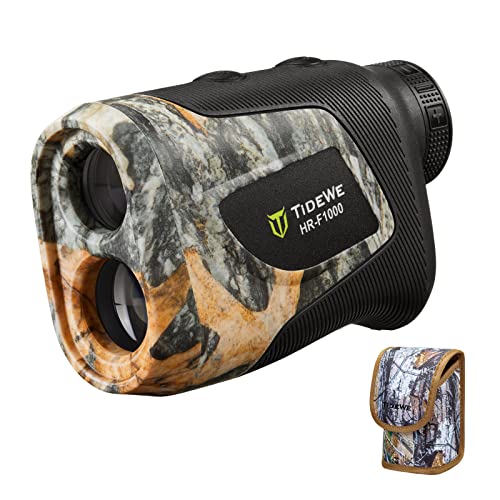
An ARC rangefinder, or Angle Range Compensation rangefinder, displays the corrected horizontal distance instead of only the slant reading. Many units also show the angle in degrees, and bow mode applies the cosine correction across typical archery distances.
You do not need ARC for every shot, but it is safer when angles change fast, lanes are steep, or the shot happens in low light and the estimate has little room for error.
What ARC and bow mode do
Bow mode is built for archery-specific distances and usually gives a fast first reading in about 1–2 seconds. That speed matters when a deer is moving through a lane and there is no time to do math by hand.
ARC helps by taking the guesswork out of the correction. The display gives the horizontal number directly, which is easier than converting a raw laser reading after the animal steps into range.
When a standard rangefinder is enough
A standard rangefinder can be enough on moderate angles if the shooter already knows how to estimate the angle and apply the cosine correction without delay. It is also workable when the corrected distance clearly stays on the same pin.
If the shot is mild, the range is familiar, and the corrected distance lands far from a pin change, a separate ARC unit is less necessary. The decision gets harder as the angle rises past the practical threshold.
What to check before season
Before season, range the actual stand lanes, not just the trail below the tree. Check where the deer will likely enter, where the rangefinder can get a clean return, and which pins will cover the corrected distances you are most likely to see.
Pre-ranging lanes before season also helps the beginner build a simple plan: range, estimate angle, correct, then shoot only when the hold is clear.
How should beginners use angle correction?
Beginners should keep the workflow simple: set the sight pins, keep the anchor consistent, and make the angle decision before drawing. That sequence prevents a rushed guess after the deer steps into a steep lane.
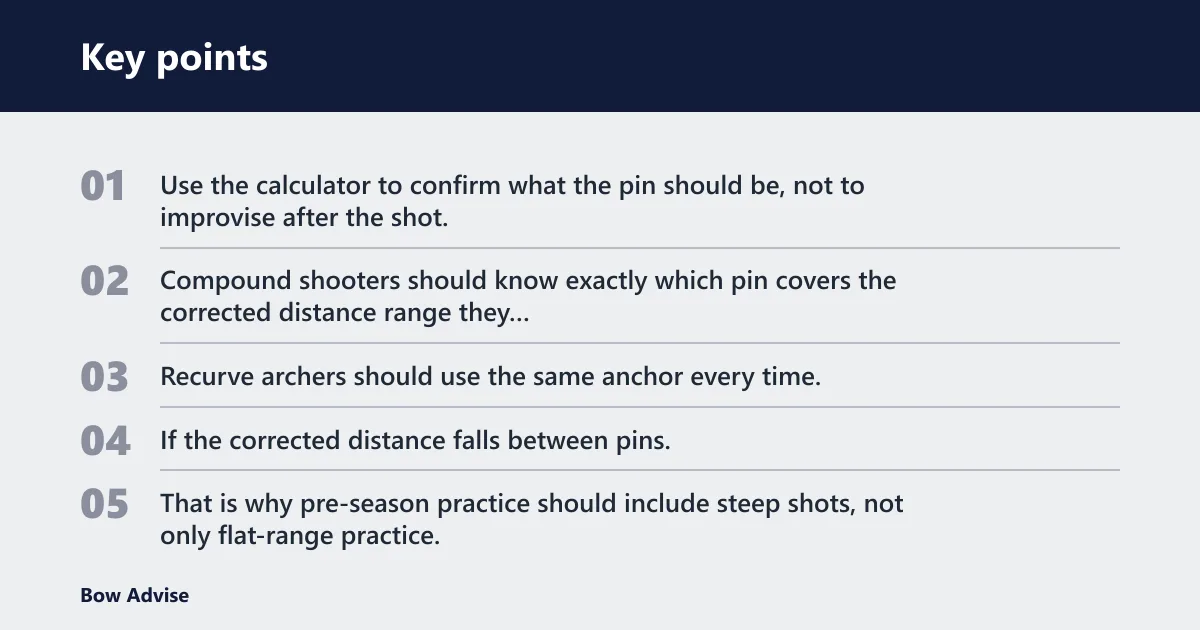
Use the calculator to confirm what the pin should be, not to improvise after the shot. A clean process beats a fast guess.
Sight pins and anchor consistency
Compound shooters should know exactly which pin covers the corrected distance range they expect from the stand. Recurve archers should use the same anchor every time, because anchor drift changes the sight picture and compounds the angle problem.
If the corrected distance falls between pins, the better choice is to know in advance how that gap will be handled. That is why pre-season practice should include steep shots, not only flat-range practice.
Pre-ranging lanes and tree positions
Mark likely lanes, then note the stand height and the horizontal distance to the common shot windows. Those numbers make it easier to estimate angle when the animal steps out and the rangefinder does not show degrees.
Say your stand is 20 feet high and the deer stops 30 yards away. The angle reference says about 12 degrees, which is a mild correction. That is a very different call from a 15-foot stand with a deer only 10 yards out, which is shown as 27 degrees.
Practice with steep shots before opening day
Practice from a stand or a bank with known yardages so the correction feels routine. The goal is not to memorize every number. The goal is to avoid treating a slanted reading as a pin distance.
A simple drill is enough: range the target, estimate the angle, correct the distance, and say which pin you would use before drawing. If the answer changes every time, the setup needs more work before opening day.
Frequently asked questions
How do I calculate shot angle for a treestand shot?
Use stand height and horizontal distance to estimate the angle, then confirm with a rangefinder that shows degrees if available. A 20 ft stand and 30 yds out is shown as 12°, while a 15 ft stand and 10 yds out is shown as 27°. The steeper the lane, the more the correction matters.
What is the corrected distance for an uphill bow shot?
Corrected distance is the horizontal distance, found with line-of-sight distance × cosine(angle). For example, a 40° uphill shot at 40 yards is 30.6 yards horizontal. That is the number to use for the pin or sight mark, not the raw laser reading.
Does uphill or downhill change the pin I use?
No. Uphill and downhill are corrected the same way because the math is based on angle, not direction. The rangefinder reading is still line-of-sight distance, and the pin should follow the horizontal distance after cosine correction.
At what angle does shot correction start to matter?
It starts to matter around 15–18 degrees. Around that point, a raw rangefinder reading can start to push a shot outside the center of the whitetail vitals. Above 20 degrees, and especially inside 25 yards, the correction deserves a careful verify-or-pass decision.
How do I estimate angle if my rangefinder doesn’t show it?
Use treestand height, the deer’s horizontal distance, and a reference table. A 20 ft stand at 30 yards is about 12 degrees, and a 15 ft stand at 10 yards is about 27 degrees. If the angle feels steep enough to be uncertain, verify with another device or pass.
Do I need an ARC rangefinder for bowhunting?
Not always, but ARC is helpful when steep angles, low light, or fast movement leave little room for error. ARC displays the corrected horizontal distance, and bow mode applies cosine correction across typical archery distances. A standard rangefinder can still work if the shooter can correct quickly and confidently.