Momentum Calculator: Arrow Setup
Momentum is mass × velocity: p = mv. For arrows, keep units consistent, and a heavier arrow moving slower can carry more momentum than a lighter one moving faster. Use the wrong units and you can misread arrow performance, choose a poor hunting setup, or compare numbers that do not mean the same thing. This guide explains what momentum means, how to calculate it, and how to compare arrow setups with a momentum calculator.
How is this calculated?
Press Calculate to see the math with your numbers.
What is momentum in archery?



In archery, linear momentum is the product of arrow mass and arrow velocity. It is a vector quantity, so direction matters as much as size, and its common units are kg·m/s or N·s. For a calculator, that means the arrow’s travel direction belongs in the result, not only the number.
That direction matches the velocity direction. If an arrow is moving forward, its momentum points forward. Calculator tools often describe this as linear momentum, the translational kind used for straight-line motion. Calctool notes the same idea by tying momentum to the “strength of movement in a body,” while also treating it as a vector.
Units you will see in calculators
Calculator tools usually accept mass in kg, g, lb, and oz, and velocity in m/s, ft/s, km/h, and mi/h. CalculatorSoup also lists significant figures from auto to 9, which matters when you want a rounded display for a quick archery check or a more exact classroom-style result.
For archers, the main trap is mixing units mid-calculation. If the calculator wants mass in pounds and speed in feet per second, it can still solve momentum correctly when it converts internally. But if you copy a number from one unit system and paste it into another without conversion, the result will be wrong.
How do you calculate arrow momentum?
Use p = mv: multiply arrow mass by arrow velocity. The inverse forms are p/v = m and p/m = v, so the same equation can solve for mass or speed when one value is missing. That is why a momentum calculator can solve momentum, mass, or velocity from the other two values.
Worked example
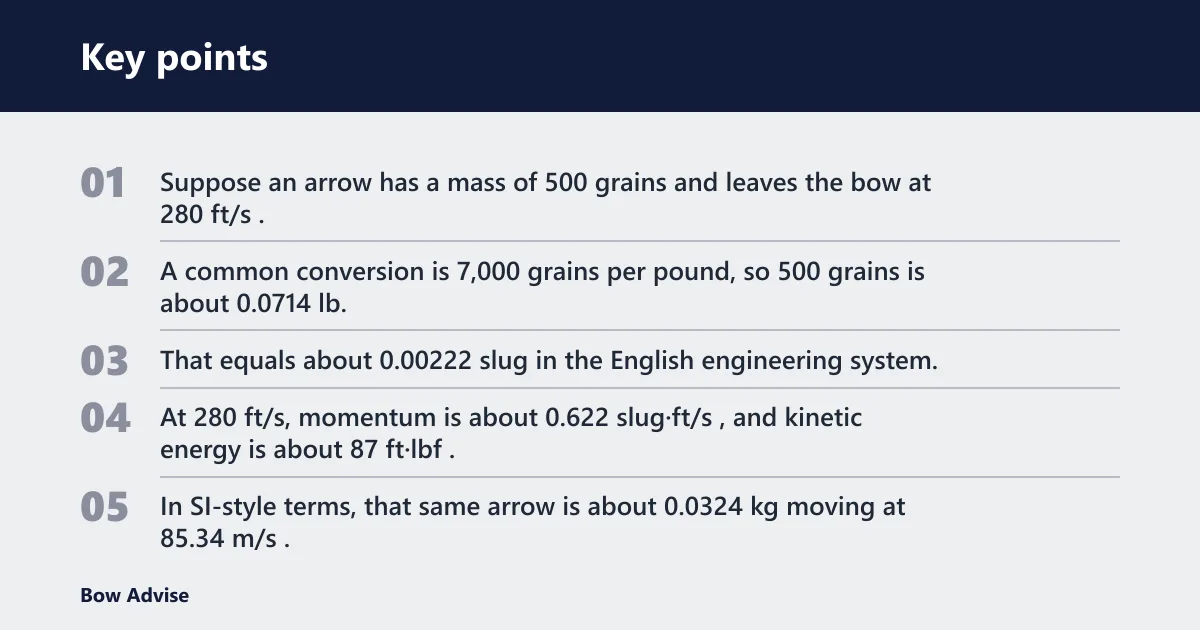
Suppose an arrow has a mass of 500 grains and leaves the bow at 280 ft/s. A common conversion is 7,000 grains per pound, so 500 grains is about 0.0714 lb. That equals about 0.00222 slug in the English engineering system. At 280 ft/s, momentum is about 0.622 slug·ft/s, and kinetic energy is about 87 ft·lbf.
In SI-style terms, that same arrow is about 0.0324 kg moving at 85.34 m/s. Its momentum is about 2.77 kg·m/s, and its kinetic energy is about 118 J. The numbers change with units, but the physical result does not. The converter only changes the way the answer is written.
Quick unit conversion notes
Archery calculators often mix grains, feet per second, and metric units. That is fine if the conversion is handled before the final number is displayed. A practical check is simple: momentum should rise when mass rises, and it should also rise when speed rises. If a setup with a heavier shaft and similar speed shows less momentum, the inputs are probably mismatched.
Momentum vs kinetic energy for arrow setup
Momentum and kinetic energy answer different questions. Momentum tracks how much forward motion an arrow carries, while kinetic energy tracks how much work a moving arrow can do in a collision model. For arrow selection, momentum often matters more when the goal is a heavier hunting arrow with steady push-through.
Kinetic energy is proportional to speed squared, so fast light arrows can post strong energy numbers even when momentum stays modest. That is the common setup mistake: choosing an arrow only because the energy value looks high. A light arrow can look impressive on paper and still give up momentum compared with a heavier shaft at moderate speed.
Say your bow sends a 350-grain arrow at 310 ft/s, while a second setup uses 475 grains at 275 ft/s. The lighter arrow shows more kinetic energy, but the heavier one can carry more momentum. For bowhunting, that trade-off matters when deciding whether to favor speed, penetration potential, or a balance of both.
A common first-timer mistake is to compare two arrows by only one number. If the broadhead choice, draw weight, and brace height change at the same time, the result is no longer a clean speed-versus-mass comparison. Keep one variable fixed when you are checking momentum.
Arrow momentum comparison table
| Arrow mass | Speed | Momentum | Kinetic energy | Best fit |
|---|---|---|---|---|
| 300 gr | 330 ft/s | 0.422 slug·ft/s | 72.5 ft·lbf | Target, flat trajectory practice |
| 350 gr | 310 ft/s | 0.478 slug·ft/s | 74.7 ft·lbf | 3D, mixed practice use |
| 400 gr | 290 ft/s | 0.514 slug·ft/s | 74.8 ft·lbf | 3D, balanced setup |
| 450 gr | 280 ft/s | 0.552 slug·ft/s | 78.1 ft·lbf | 3D, broadhead tuning |
| 500 gr | 280 ft/s | 0.614 slug·ft/s | 86.7 ft·lbf | Bowhunting, deeper drive |
| 525 gr | 270 ft/s | 0.625 slug·ft/s | 85.1 ft·lbf | Bowhunting, steady push |
| 575 gr | 255 ft/s | 0.656 slug·ft/s | 83.0 ft·lbf | Bowhunting, heavier setup |
| 650 gr | 240 ft/s | 0.687 slug·ft/s | 83.3 ft·lbf | Bowhunting, high-mass arrow |
This table shows a pattern that archers often miss: momentum can rise even when kinetic energy stays close. That is why a 575-grain arrow at 255 ft/s and a 650-grain arrow at 240 ft/s can look similar in energy, yet still differ in the way they carry force through a target. The best fit depends on the rest of the setup, not one number alone.
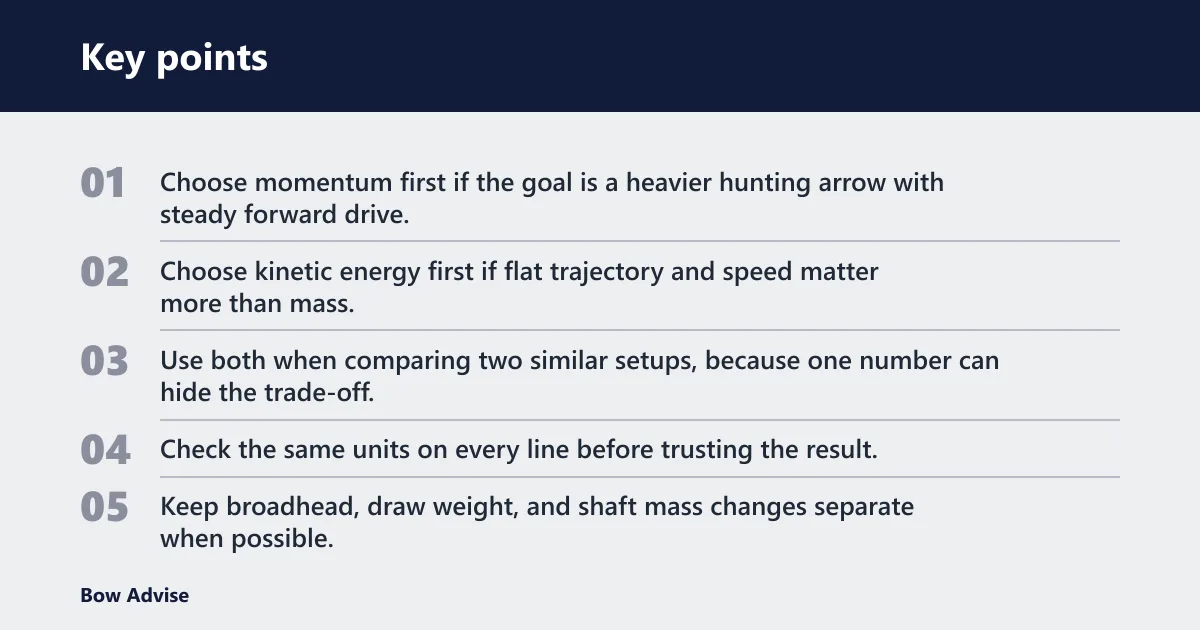
- Choose momentum first if the goal is a heavier hunting arrow with steady forward drive.
- Choose kinetic energy first if flat trajectory and speed matter more than mass.
- Use both when comparing two similar setups, because one number can hide the trade-off.
- Check the same units on every line before trusting the result.
- Keep broadhead, draw weight, and shaft mass changes separate when possible.
How do impulse and conservation of momentum apply?
Impulse is J = F·Δt, and it equals the change in momentum. In archery terms, that means the string, bow, and target all act through force over a short time window. Calculator tools that mention force and time are pointing to that collision-style change, even if the setup is still an arrow in flight.
Conservation of momentum applies in a closed system, where the total momentum before an event equals the total after it: p_initial = p_final. In real archery, the bow-arrow-target system is not fully closed, but the idea still helps explain why a heavier arrow changes how momentum is transferred during launch and impact.
For arrow penetration questions, the useful takeaway is simple. A setup with more arrow momentum can keep moving forward after the target begins resisting it, while a low-mass, high-speed arrow may lose motion faster in the same resistance field. That does not make one setup automatically better, but it does change what you should compare.
Linear vs angular momentum
Linear momentum is the straight-line version used for arrows. Angular momentum is different; it applies to rotational motion and is described by mass moment of inertia times angular velocity. A momentum calculator for arrows is usually solving the linear case, not the rotational one, because the arrow’s main motion is translational.
Two- and three-dimensional momentum
Some calculators, including Omni Calculator, support momentum in one, two, or three dimensions. In 2D or 3D, the calculator uses x, y, and z components, then combines them into a vector magnitude. The direction still matches velocity, so component input matters when the motion is not perfectly straight.
For normal arrow setup work, one-dimensional input is usually enough because the main question is forward motion downrange. Still, the vector idea matters if you are studying side drift, angled launch, or component breakdown in a physics context. That is also why a scalar-only shortcut can hide direction changes that a vector calculation would show.
Frequently asked questions
How calculate momentum?
Use the momentum formula p = mv. Multiply mass by velocity, keeping units consistent. If you need mass or velocity instead, use the inverse forms p/v = m and p/m = v. For arrow work, that means matching grains, pounds, or kilograms with the speed unit you enter.
What is the formula for calculating momentum?
The core momentum equation is p = mv. It is a vector form, so the direction of motion matters as well as the size of the result. In calculator output, momentum is often reported in kg·m/s or N·s, which are equivalent ways to express the same quantity.
What units are used for momentum?
Common momentum units are kg·m/s and N·s. Some tools also show English-system results such as slug·ft/s when the inputs are in pounds and feet per second. The key is consistency: the unit should match the system used for both mass and velocity.
What is the difference between momentum and kinetic energy?
Momentum tracks mass times velocity, while kinetic energy tracks mass times velocity squared, with a one-half factor. That means speed changes affect kinetic energy more strongly than momentum. For arrow setup, momentum often gives a better sense of how a heavier arrow carries motion through resistance.
How does impulse relate to momentum?
Impulse equals force times time, written J = F·Δt, and it equals the change in momentum. That relationship matters when an arrow leaves the bow or hits a target because force acts over a short time. A larger impulse can produce a larger change in momentum.