Is a Flying Arrow in Motion Or at Rest? The Physics Explained
A flying arrow slices through the air. We watch it leave the bow, move across the sky, and hit its mark. But is the arrow really in motion, or is it, in some sense, at rest at every instant? This simple question puzzled ancient philosophers and still raises debate among scientists, mathematicians, and thinkers today. Understanding this puzzle goes beyond arrows, it helps us see how humans think about time, movement, and the very nature of reality.
The question comes from Zeno’s paradoxes, a set of ancient Greek puzzles that seem to challenge our basic beliefs about motion. If you’ve ever wondered how something can move if, at every moment, it seems to stand still, you’re not alone. This article explores why the flying arrow’s motion is such a tricky concept, what science and philosophy say about it, and how our modern understanding can help clear up the confusion. Along the way, you’ll discover surprising facts about how we measure movement and why this question still matters today.
Zeno’s Arrow Paradox: The Ancient Puzzle
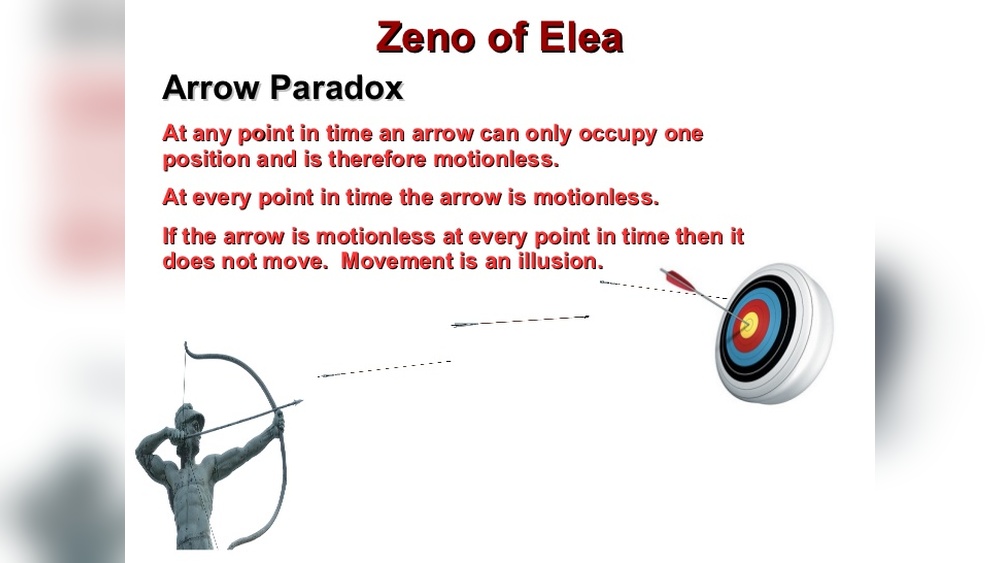
In the 5th century BCE, the Greek philosopher Zeno of Elea created several paradoxes to show that common ideas about time and space might be wrong. One of his most famous is the Arrow Paradox. Here’s how it goes:
Suppose an arrow is flying through the air. At any single instant in time, Zeno argued, the arrow occupies a space exactly equal to its own size. In that instant, the arrow cannot be moving, because time does not pass.
If every instant is like this, frozen and still, then, Zeno claimed, motion is impossible. But we see arrows fly all the time, so what is really happening?
Zeno’s paradoxes were meant to show that our everyday understanding of the world leads to strange results. With the arrow, he questioned the idea that motion is just a series of still moments. For Zeno, this idea did not make sense.
Why Was This A Problem?
Zeno’s paradox was not just a clever trick. It forced people to think about what motion truly means. If at every instant the arrow is at rest, how does it ever move? Ancient Greeks did not have the mathematical tools we use today. They did not understand how infinite small pieces could add up to something real. This made Zeno’s puzzle very hard to solve for centuries.
The Nature Of Motion: What Does It Mean To Move?
To understand the flying arrow, we need to ask: What does it really mean for something to be in motion? Is it just changing position? Or is there more to it?
Motion As Change Of Place
The simplest answer is that motion means change of place over time. An arrow starts at the bow and ends at the target. We can measure the distance it travels and the time it takes. In everyday life, this works well. But Zeno’s paradox asks us to look closer, what about at a single instant?
Instant Vs. Interval
Here’s the tricky part: Instant means a single point in time, with no duration at all. Interval means a period with some length, even if very small.
- At an instant, does the arrow have a speed? Ancient Greeks said no: Speed needs time, and an instant has none.
- Over an interval, we can measure average speed: Distance divided by time.
So, is motion only real over intervals, not instants? This question lies at the heart of the debate.
The Role Of Perception
Pro Tip: Our eyes and brains cannot see or measure a true instant. We always see motion as a smooth flow, never as frozen moments. This makes Zeno’s paradox a puzzle of thought, not of direct experience.

Credit: reviewonphilosophy.wordpress.com
How Mathematics Changed The Debate
For more than a thousand years, Zeno’s paradox seemed impossible to solve. But in the 17th century, new ideas from mathematics started to offer answers.
Calculus: Adding Up Instants
Isaac Newton and Gottfried Wilhelm Leibniz invented calculus, a system that allows us to add up infinite small changes. With calculus, we can talk about “instantaneous velocity”, the speed of an object at a single moment.
Instantaneous Velocity
Calculus defines velocity as the limit of the average speed as the time interval gets smaller and smaller, approaching zero. This is written as:
*v = lim(Δt→0) Δx/Δt*
This means: look at how far the arrow travels in smaller and smaller bits of time. As those bits shrink, the ratio gives the speed at a single instant.
What This Means For The Arrow
With calculus, we can say that even at an instant, the arrow has a velocity. It does not need to move during that instant, but its velocity tells us how it will move if time continues. This idea solved Zeno’s paradox for most scientists and mathematicians.
Comparing Ancient And Modern Views
Here’s how the old and new views compare:
| View | Motion at an Instant | Key Concept |
|---|---|---|
| Zeno/Ancient | No motion at an instant | Motion as sum of rests |
| Modern (Calculus) | Velocity at an instant | Instantaneous rate of change |
This shift in thinking allowed science to move forward, but the deep question remains: What is motion, really?
Physics Looks At The Flying Arrow
Let’s move from philosophy to science. How do physicists describe the flying arrow?
Measuring Motion
Physics uses tools like position, velocity, and acceleration to describe motion:
- Position: Where is the arrow at a given time?
- Velocity: How fast and in what direction is it moving?
- Acceleration: How is its velocity changing?
Using high-speed cameras, scientists can track an arrow’s path to a fraction of a millimeter and a tiny fraction of a second.
Example: High-speed Tracking
In archery competitions, cameras record arrows flying at speeds over 60 meters per second. These measurements show continuous movement, matching what calculus predicts.
The Arrow In Modern Physics
In classical (Newtonian) physics, the answer is clear: the arrow is in motion. At any instant, it has a position and a velocity.
But in quantum physics, things get stranger. At the smallest scales, the Heisenberg Uncertainty Principle says we cannot know both the position and the velocity of a particle (like an atom in the arrow) with perfect accuracy at the same time. This shows that, deep down, reality is not as simple as it looks.
Motion And Time: A Physics Table
Let’s compare how physics sees motion at different scales:
| Scale | Way Motion Is Measured | Are Instants Meaningful? |
|---|---|---|
| Everyday (Classical) | Position and velocity at any time | Yes |
| Atomic (Quantum) | Probability of location/velocity | No (Uncertainty rules) |
Philosophers Still Ask: Is Motion Real?
Even after calculus, some philosophers kept asking: Is motion just an idea, or is it something real? Let’s look at a few modern views.
The “at-at” Theory
This view says: An object is in motion if it is at different places at different times. There is no need for extra explanation. This matches how most scientists think today.
Process Philosophy
Some philosophers, like Alfred North Whitehead, argue that reality is not made of things (like arrows) but of processes (like flying). In this view, motion is not just a series of places but a real happening.
The Problem Of The Instant
A key point: If time is made of points (instants), how do these points join to make a flow? Some say the flow is an illusion, like a movie made of still frames. Others say the flow is real, and instants are just a way of thinking.
Non-obvious Insight: The Arrow’s Path Depends On How We See Time
If time is truly made of instants, Zeno’s problem stays. But if time is continuous, a flow, not a stack of points, the arrow can be moving even if each instant looks still. This subtle difference shapes how we answer the question.
How Do We Experience Motion?
While all these ideas are interesting, most people experience motion as something smooth and obvious. When you watch an arrow fly, it never looks frozen. Why is that?
Human Perception
Our brains collect signals from our eyes many times per second and blend them into a single, flowing image. Movies and videos use this trick: they show still pictures 24 or more times per second, and our brain fills in the gaps.
- Persistence of vision: Our eyes hold an image for a fraction of a second, making motion seem smooth.
- Motion detection: The brain is wired to notice movement, not stillness.
So, for humans, the flying arrow is always in motion, never at rest.
Practical Example: Watching Sports
When I watched a slow-motion replay of an arrow shot in an archery contest, the movement was clear. Even when broken down frame by frame, each still image showed the arrow in a new position. This experience matches the modern scientific view, not Zeno’s paradox.

Credit: www.etftrends.com
The Arrow In Mathematics: Limits And Infinity
Zeno’s paradox is really about infinity, can you add up an infinite number of small things to get something big? Here’s how mathematics answers.
Sums Of Infinite Parts
Calculus lets us add up infinite tiny pieces. For example, the area under a curve (like the arrow’s path) is found by slicing it into more and more pieces and adding them up.
- Infinite series: 1/2 + 1/4 + 1/8 + … adds up to 1, not infinity.
- Limits: As intervals shrink to zero, the sum can reach a real value.
Non-obvious Insight: The Arrow’s Motion Is The Limit
Modern math says: The arrow’s motion is not a sum of rests, but the limit of a sum of small motions. This key idea lets us measure things that seem impossible, like the speed at an instant.
Is The Arrow At Rest At Any Time?
Let’s answer the main question directly: Is the flying arrow in motion or at rest at any instant?
- At an instant, the arrow has a position and a velocity (if we use calculus).
- The arrow is not moving during the instant, but its velocity tells us it is in motion.
- So, in physics, the arrow is in motion even at a single instant, because velocity exists at that point.
But this answer depends on our tools and definitions. If you believe only in positions, not velocities, you might say the arrow is at rest in each instant. Most scientists today, though, accept the calculus view.
Why Does This Question Still Matter?
You might wonder why anyone still cares about Zeno’s arrow. Here’s why this debate is important:
Science And Technology
- Physics: Understanding motion is key to building machines, rockets, and electronics.
- Computer graphics: Animators and game designers must show smooth motion using frames and code.
- Robotics: Robots use models of motion to move accurately.
Philosophy And Mind
- Free will: If motion is an illusion, what about our choices and actions?
- Time and change: How we see motion shapes our ideas of time itself.
Everyday Curiosity
Questions like this show that even simple things (like an arrow flying) hide deep mysteries. Thinking about them sharpens our minds and sometimes leads to new science.
Practical Lessons: What Can We Learn?
If you’re not a philosopher or scientist, does this puzzle matter? Yes, in a few ways:
- Precision matters: Small details in how we define things can change answers.
- Tools shape answers: New math (like calculus) can solve old problems.
- Reality vs. models: Our ideas are models; reality can be stranger.
Pro Tip: When solving problems, check if your tools or definitions are limiting your thinking. Sometimes, a new way of looking at things makes all the difference.

Credit: extremeoutfitters.com
Frequently Asked Questions
Why Did Zeno Create The Arrow Paradox?
Zeno used the Arrow Paradox to challenge the idea that motion and change are simple and obvious. He wanted to support his teacher Parmenides, who believed that real change is impossible. By showing that common ideas of motion lead to logical problems, Zeno made people question their basic beliefs.
Has Science Completely Solved Zeno’s Paradox?
Science has given strong answers using calculus and physics, but some philosophers think the deep questions remain. The paradox pushes us to ask what time and motion really are, questions that science and philosophy still discuss today.
Do Any Modern Problems Use Ideas From Zeno’s Paradox?
Yes. In computer science, digital images and animations are made from many still frames, similar to Zeno’s idea. In quantum physics, the limits of measuring position and speed echo Zeno’s questions about instants and intervals. These ideas help design better technology and understand nature.
Is There Any Experiment That Shows The Arrow Is Not At Rest At An Instant?
High-speed cameras can measure an arrow’s position many times per second, and physics models predict its velocity at each point. While no experiment can measure a true “instant,” the results match the idea that motion is real and continuous, not just a sum of still moments.
Where Can I Read More About Zeno’s Paradoxes?
For more in-depth information, you can visit the Wikipedia page on Zeno’s paradoxes, which covers the history, different solutions, and ongoing debates about these ancient puzzles.
As we’ve seen, the flying arrow is more than a simple object in the air, it opens doors to deep questions about movement, time, and how we understand the world. Whether you see the arrow as truly moving or always at rest in each instant, the search for answers continues to inspire science and philosophy today.