Do Arrows Spin In Flight: Proven Secrets
Yes, arrows generally spin or rotate in flight, and this spin is crucial for their stability and accuracy. This controlled rotation, often called “fletching induced gyroscopic stabilization,” helps correct wobbles and keeps the arrow flying true towards its target. Understanding this phenomenon is key to becoming a more consistent archer. For more on this, see our guide on Do Real Christmas Trees Come With a Stand? Essential Facts. For more on this, see our guide on Do Cats Have Elbows.

Linkboy Archery
Linkboy Archery Spin Vanes 1.8inch Arrow Vanes…
- 1.8” spin vane with unparalleled performances, lightweight and more forgiving to extend long range use
- Spin wing vanes feature a unique rear sloping hook to traps additional air at the beginning of the shot
- Faster inner vortex stream design, reduce the entire vortex structure resulting into low drag coefficient
As an Amazon Associate I earn from qualifying purchases.
Have you ever watched an arrow fly and wondered if it’s perfectly straight, or if it has a little wobble? It’s a common question, and the answer might surprise you! Many beginners notice that arrows seem to move a bit in the air. This movement isn’t usually a sign of a problem; in fact, it’s often a good thing! This gentle, consistent spin is what helps your arrow fly straight and hit your target. Don’t worry if it looks a little wobbly at first; we’re going to break down why this happens and how it helps you shoot better. Get ready to understand the magic behind a stable arrow flight, and you’ll be hitting the bullseye with more confidence in no time!
The Secret Spin: Why Arrows Rotate in Flight
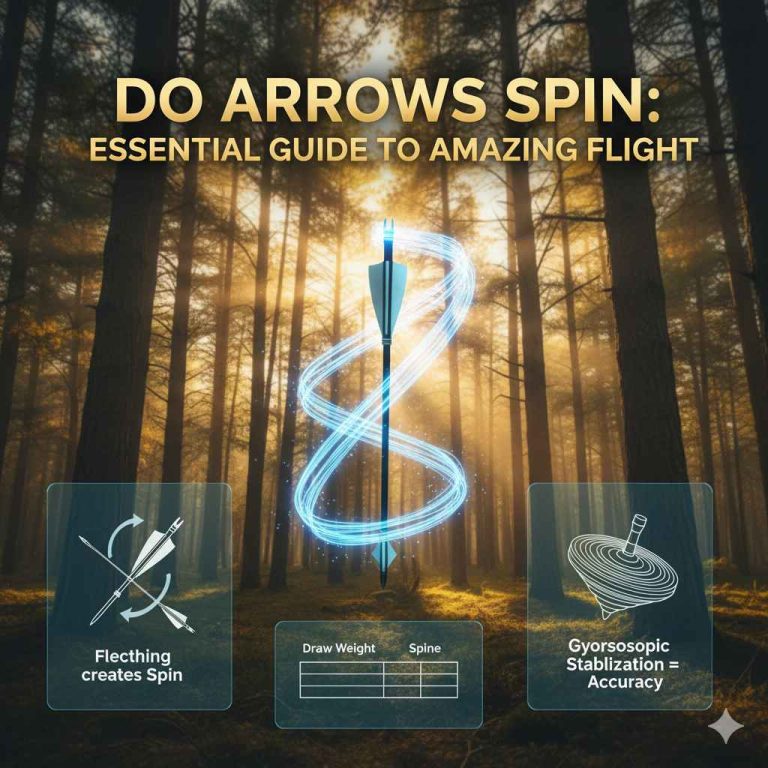
So, do arrows spin in flight? The short answer is: yes, they do, and it’s a vital part of their journey from your bow to the target. This isn’t just a random wobble; it’s a carefully engineered phenomenon that enhances accuracy. Think of it like a well-thrown football or a spinning top – the rotation adds stability.
How the Spin Happens: A Gentle Push
When you release an arrow, it’s propelled forward with incredible force. As it leaves the bow, the air interacting with the fletching (the vanes or feathers on the back of the arrow) creates a slight force. This force, combined with the arrow’s design and the way it’s nocked onto the string, encourages a rotational motion. It’s a subtle push, but it’s enough to set the arrow spinning.
The Magic of Gyroscopic Stabilization
This spin is the arrow’s secret weapon for accuracy. It works on the same principle as a spinning top or a gyroscope. When an object spins, it resists changes in its orientation. For an arrow, this means any slight imbalance or wobble it might develop is corrected by the gyroscopic effect. The faster and more consistently it spins, the straighter it will fly.
Imagine trying to balance a pencil upright – it’s nearly impossible. Now, imagine spinning that pencil rapidly. It stands much taller and is far more stable, right? That’s exactly what the spin does for your arrow. It smooths out its flight path.
The Role of Fletching
The bits at the back of your arrow, called fletching (which can be feathers or vanes), are the primary drivers of this spin. Their angled surfaces catch the air. As the arrow moves forward, the air pushing against these angled surfaces not only steers the arrow but also imparts a gentle rotation. The design and angle of your fletching are carefully calculated by arrow manufacturers to provide optimal spin for stability. Most modern arrows use vanes made of plastic, while traditional archery often uses natural feathers. Both serve the same purpose: to stabilize and induce spin.

Why Arrow Spin Matters for Your Accuracy
Understanding that arrows spin in flight is more than just cool trivia; it has direct implications for your archery success. A well-spinning arrow means a more predictable and accurate shot.
Improving Straightness and Reducing Wobble
Without this spin, arrows would be much more prone to side-to-side wobbling, often called “porpoising” or “fishtailing.” These wobbles are caused by inconsistencies when the arrow leaves the bow, or small imperfections in the arrow itself. The spin acts like a built-in gyroscopic stabilizer, minimizing these erratic movements and keeping the arrow pointed precisely where you want it.
Consistency is Key
The goal for any archer is consistency. You want to be able to replicate your shots, and a spinning arrow helps immensely with that. When your arrows are spinning correctly, they fly more predictably, meaning that even if your release isn’t absolutely perfect every single time, the arrow’s stabilization can compensate. This allows for tighter groupings of shots on your target.
The Bare Shaft Test: A Simple Demonstration
A classic archery diagnostic technique, known as the “bare shaft test,” indirectly shows the importance of fletching in stabilizing an arrow. In this test, you shoot a fletched arrow and then an unfletched “bare shaft” arrow from the same bow and same height. If your arrow spine (the stiffness of the arrow) and bow tuning are correct, the bare shaft arrow will often strike the target lower and to the left (for a right-handed shooter) compared to the fletched arrow. This happens because the bare shaft arrow lacks the stabilizing fletching to correct its flight path. The fletched arrow, with its stabilizing spin, flies straighter.
Factors Influencing Arrow Spin
Several elements contribute to how much and how consistently your arrow spins. Understanding these can help you troubleshoot your shooting and ensure your arrows are flying their best.
1. Fletching Design and Quantity
Number of Fletchings: Most arrows have three fletchings, spaced 120 degrees apart. Some may have four fletchings, spaced 90 degrees apart. Three fletchings are generally sufficient for stability and spin, and they also allow for easier clearance from the arrow rest. Four fletchings can offer extra stability but might be more prone to rest contact.
Fletching Size and Shape: Larger fletchings or fletchings with more surface area can impart a stronger spin. Different shapes (like shield-cut or parabolic) also influence aerodynamics and spin.
Fletching Material: Both feathers and vanes work. Feathers are lighter and conform to the arrow shaft better, potentially leading to a more natural spin. Vanes are more durable and less affected by wind and moisture but can be stiffer.
2. Arrow Spine (Stiffness)
Arrow spine is crucial. It refers to how much an arrow bends when a certain amount of weight is applied to its center. An arrow that is too stiff (“stiff spine”) or too weak (“weak spine”) for your bow will not fly straight off the rest. When an arrow is close to the correct spine, it will leave the bow cleanly, allowing the fletching to do its job effectively and stabilize the arrow with proper spin. An incorrectly spined arrow will often oscillate wildly as it leaves the bow, and the fletching won’t be able to correct it immediately, leading to poor accuracy.
3. Archer’s Paradox
This is the fascinating phenomenon where the arrow momentarily bends around the bow’s riser (the main body of the bow) as it’s released. This bending and subsequent straightening motion influences the arrow’s initial departure and can contribute to imparting spin. The degree to which an arrow bends depends on its spine stiffness and the bow’s draw weight. Proper arrow spine ensures the arrow bends correctly for a clean release, which is essential for establishing a stable spin.
4. Arrow Rest and Release Technique
The arrow rest is where the arrow sits before and during the shot. How the arrow leaves the rest significantly impacts initial flight and spin. A well-tuned rest ensures the arrow is supported and then leaves the rest cleanly.
Your release technique also plays a huge role. A smooth, consistent release allows the arrow to leave the string cleanly without imparting unnecessary torque or wobble. A jerky release can disrupt the arrow’s initial trajectory and its ability to gain stable spin.
5. Arrow Straightness and Weight Distribution
Even minor imperfections in the arrow shaft or uneven weight distribution can affect its flight. A perfectly straight arrow with balanced weight will spin more predictably than a slightly bent one.
How Arrow Spin Affects Your Shooting Goals
Whether you’re aiming for accuracy, hunting, or just enjoying a day at the range, understanding arrow spin helps you achieve better results.
Target Archery: Precision is Paramount
In target archery, even the slightest deviation can mean the difference between a bullseye and a miss. Arrow spin is your ally here. When your arrows are spinning correctly, they will group tightly. This allows you to diagnose issues with your bow or shooting form more effectively. If your arrows are flying erratically, it might indicate a tuning problem or an issue with your arrow setup, as the spin isn’t stabilizing them sufficiently.
3D Archery and Hunting: Predictable Flight
For 3D archery (shooting at life-sized animal targets) and hunting, predictable arrow flight is critical. You need your arrow to hit where you aim, even at varying distances. The gyroscopic stability provided by arrow spin ensures that your arrow’s trajectory is as consistent as possible, even with external factors like slight winds.
Beginner Archery: Building Confidence
For beginners, seeing that arrow fly relatively straight is incredibly encouraging. Understanding that the spin is what helps it do that can demystify some of the perceived complexities of archery. It helps build confidence because you learn that even with minor imperfections in technique, the arrow has built-in stabilization.
Troubleshooting Common Arrow Flight Issues Related to Spin
Sometimes, you might notice your arrows aren’t flying as well as they should. This could be a sign that the spin isn’t optimized. Here are a few things to check:
Wobbly Flight: If your arrows are visibly wobbling side-to-side in flight, it could be a sign that your fletching isn’t providing enough stabilization, or the arrow spine is incorrect for your bow.
Inconsistent Groups: If your arrows are hitting all over the place, and you’ve ruled out significant form issues, consider your arrow setup. Are your fletchings intact? Are the shafts straight?
Bare Shaft Tuning: This is a great way to test your arrow spine and bow tune. If the bare shaft and fletched shafts aren’t grouping together, it’s a strong indicator that your arrows aren’t flying out of the bow cleanly enough for the fletching’s stabilizing spin to take over effectively. Resources on proper bow tuning, like those from the USA Archery website, can be invaluable here.
Checking Your Fletching
Take a close look at your fletching:
Damage: Are any of the vanes or feathers bent, torn, or peeling away from the shaft? Even minor damage can disrupt airflow and spin.
Adhesion: Are they securely glued to the arrow shaft? A loose fletching will definitely cause flight problems.
Alignment: Are they straight or have a slight helical (spiral) twist? Most modern fletchings have a slight helical twist to help induce spin. While straight fletching can stabilize, helical fletching is generally better at imparting spin.
Ensuring Correct Arrow Spine
This is perhaps the most critical factor for clean arrow flight and effective spin. An arrow that is too stiff or too weak for your bow will fly erratically.
Here’s a general idea of how arrow spine. This is a simplified table, and exact spine charts will vary by arrow manufacturer and model. Always consult the manufacturer’s specific guidelines.
| Bow Draw Weight (lbs) | Typical Arrow Spine Range (e.g., for common aluminum or carbon arrows) |
|---|---|
| 30-40 | 1916 to 2117 (aluminum), 340 to 400 (carbon) |
| 40-50 | 2213 to 2413 (aluminum), 300 to 340 (carbon) |
| 50-60 | 2315 to 2512 (aluminum), 250 to 300 (carbon) |
| 60-70 | 2412 to 2613 (aluminum), 200 to 250 (carbon) |
Note: These are illustrative spine range examples. Modern carbon arrows use a different numbering system that indicates the outer diameter and wall thickness, whereas aluminum arrows use a system indicating outer diameter and wall thickness. Always refer to the specific spine charts provided by your arrow manufacturer for the most accurate selection. Websites like Easton Archery provide detailed charts and resources for selecting the correct arrow spine.
What if My Arrows Don’t Seem to Spin?
If you suspect your arrows aren’t spinning, what can you do?
1. Inspect Fletching: Ensure all fletchings are present, undamaged, and securely attached.
2. Check for Helical: Most modern fletchings have a slight twist (helical) designed to induce spin. If yours are perfectly straight, you might not be getting optimal spin, though they can still stabilize.
3. Observe the Release: A clean, smooth release is crucial. A jerky or plucking motion can prevent the arrow from leaving the string cleanly, hindering stable spin. Practice your form.
4. Bow Tuning: An out-of-tune bow (incorrect tiller, cam timing, or arrow rest height) can cause the arrow to leave the bow improperly, affecting its ability to spin correctly.
5. Arrow Spine: As mentioned, the wrong arrow spine can cause the arrow to flex incorrectly around the riser, leading to poor initial flight and insufficient spin stabilization.

FAQ: Your Arrow Spin Questions Answered
Here are some frequently asked questions about arrow spin for beginners:
Q1: My arrows look like they’re wobbling a lot when flying. Is this normal?
A1: A slight wobble or wobble that quickly corrects itself as the arrow flies is often normal and indicates the fletching is working to stabilize the arrow through spin. However, If the wobble is very pronounced and persistent throughout the entire flight, it might indicate an issue with your arrow spine, fletching, or bow tune, preventing proper gyroscopic stabilization.
Q2: How can I tell if my arrows are spinning?
A2: It’s difficult to see the spin of a single arrow with the naked eye, especially at longer distances. However, you can infer it by observing how consistently your arrows group. Tight groupings suggest stable, spinning flight. You can also check for fletching damage, which is a direct indicator of something that might be affecting spin.
Q3: Do all arrows spin the same amount?
A3: No, the amount of spin can vary based on fletching size, angle (helical), arrow design, and how cleanly the arrow leaves the bow. Arrows with larger or more aggressively angled fletchings tend to spin more.
Q4: What happens if the fletching comes off an arrow?
A4: If fletching, or even just one vane, comes off, the arrow will lose its primary source of stabilization. It will likely fly very erratically, wobble significantly, and be extremely inaccurate. You should not shoot an arrow with damaged or missing fletching.
Q5: Can I buy arrows that are “faster” or “slower” based on spin?
A5: Spin itself doesn’t directly make an arrow faster or slower. However, a stable, spinning arrow flies straighter, meaning it retains its kinetic energy better downrange and will appear to fly faster and flatter than a wobbly arrow. The goal is stability for accuracy, not necessarily maximizing spin rate.
Q6: Is it possible to over-stabilize an arrow with too much fletching?
A6: While unusual for most setups, it is theoretically possible. Too much fletching can create drag, slowing the arrow down slightly and potentially increasing aerodynamic noise. For most modern archery applications and typical fletching, this is rarely an issue. The fletching is designed to provide optimal stabilization without excessive drag.
Q7: Does a perfectly straight release cause more spin?
A7: A perfectly clean and straight release is essential* for the arrow to enter its stable, spinning flight path correctly. It ensures the arrow leaves the bow without imparting unwanted torque or wobble, allowing the fletching to engage the air and initiate the stabilizing spin effectively. So, yes, good form directly supports proper spin initiation.
Conclusion: Embrace the Spin for Better Archery
So, there you have it! Arrows absolutely spin in flight, and this spin is a hero in disguise, working tirelessly to keep your shots accurate and consistent. It’s not a flaw in the arrow; it’s a brilliant piece of aerodynamic engineering at play. From the subtle interaction of air with your fletching to the fundamental principles of gyroscopic stabilization, every element works together to guide your arrow true.
For you as a beginner, this knowledge is empowering. It demystifies some of the quirks you might observe and gives you concrete things to understand about your equipment and technique. Keep an eye on your fletching, ensure your arrows are properly spined for your bow, and focus on a smooth release. These steps will help ensure your arrows are set up for that crucial stabilizing spin.
Don’t be discouraged if your arrows don’t fly perfectly straight from day one. Archery is a journey of practice, observation, and continuous learning. By understanding the “proven secrets” of arrow spin, you’re now better equipped to diagnose issues, improve your accuracy, and most importantly, enjoy the rewarding experience of watching your arrows fly true. Keep practicing, stay curious, and embrace the spin – it’s your greatest ally in hitting your mark!
Related pick: Check today's price on Amazon