Do Arrows Spin in Flight, and Why Does It Really Matter?
Yes, arrows spin, and it’s crucial for stable, accurate flight. This spin, called “archer’s paradox” or “arrow paradox,” allows the arrow to flex around the bow riser and then stabilize in the air, ensuring it flies straight to the target. Understanding this phenomenon is key to improving your archery accuracy and enjoying your shooting experience. For more on this, see our guide on Do Right Handed People Pull Arrows With Right Hand? Archery Facts. For more on this, see our guide on Do Fire Arrows Damage Wood.
Have you ever wondered how an arrow manages to fly so straight and true, even when it seems to be shot from a curved bow? It’s a common question for new archers, and the answer is quite fascinating! This seemingly magical straightness is largely due to a phenomenon called the “archer’s paradox,” and a key part of that is how the arrow behaves – it actually flexes and spins! Don’t worry if it sounds technical; we’ll break it down into simple pieces. Understanding this will help you tune your equipment and improve your shots significantly. Stick around, and we’ll unravel the mystery of the spinning arrow and how it leads to amazing flight.
The Mystery of the Spinning Arrow: How Do They Fly So Straight?
When you first start shooting a bow, it’s natural to think that an arrow should just go perfectly straight from the string to the target. But as you progress, you might notice that achieving that perfect shot takes more than just aiming. The way an arrow flies is a complex dance of physics, and one of the most astonishing parts is how it wobbles and spins as it leaves the bow. This isn’t a sign of a bad shot; it’s actually what makes good shots possible!
What is the “Archer’s Paradox”?
The term “archer’s paradox” might sound a little intimidating, but it simply describes how an arrow bends and flexes as it’s released from the bowstring. When you draw the bow, the nock of the arrow (the back end) is placed on the string. As you release the string, the arrow is propelled forward. However, because the arrow’s shaft is relatively stiff, it doesn’t immediately fly straight.
Instead, the arrow’s tail is pushed by the bow’s center shot (the part of the riser the arrow rests on). This causes the arrow to bend away from the center shot, then towards it, and then oscillate back and forth. This bending and flexing is the paradox – the arrow seems to defy its own stiffness to pass through the opening of the bow riser cleanly.
Think of it like pushing a stiff ruler off a table. If you push the end, the ruler will bend before it falls. An arrow does something similar, but with incredible speed and precision. This flexing is essential for the arrow to clear the bow riser without hitting it and veering off course. Without this ability to bend, even the best archer would struggle to hit a target.
Why Does This Bending Lead to Spinning?
The bending and flexing of the arrow isn’t a random wobble. It’s a controlled oscillation that, over distance, translates into a stabilizing spin. As the arrow bends away and then snaps back towards its original straight form, it creates a slight rotational force. This force imparts a spin on the arrow.

The Science Behind the Spin: Fletchings and Spin Stabilization
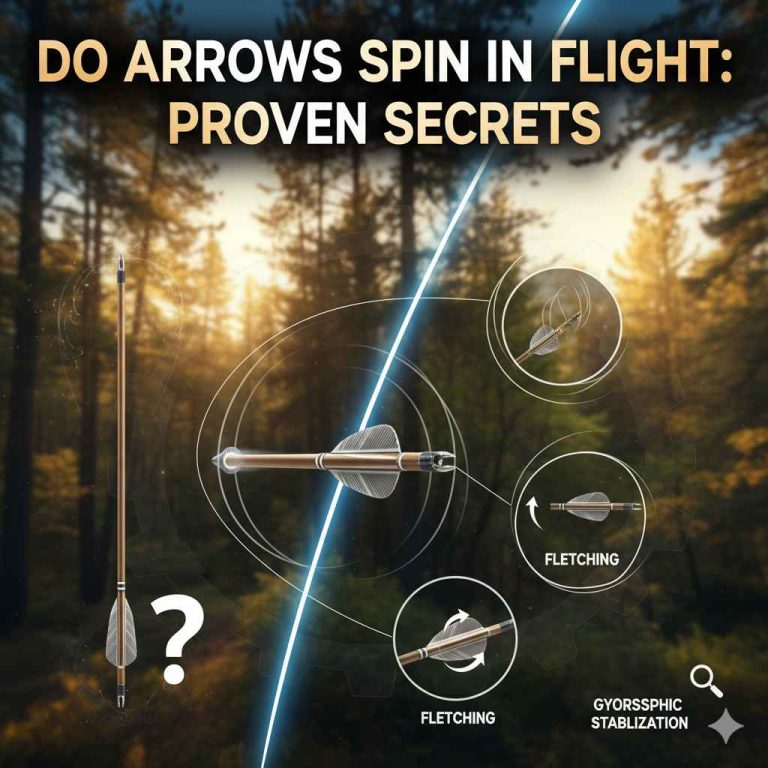
So, how does this initial bending turn into a stable spin that helps the arrow fly true? The key players here are the arrow’s fletchings (the vanes or feathers at the back) and the physics of rotation.
The Role of Fletchings
Fletchings are far more than just decorative. They are precisely angled to catch the air and act like tiny wings or sails. As the arrow spins, these fletchings create drag. This drag is not just about slowing the arrow down; it’s about steering it.
Imagine a spinning top. When it spins straight and fast, it stays upright. If it starts to wobble, the spin helps it correct itself. The arrow’s fletchings work in a similar fashion. The spin imparts stability, and the fletchings use the air to keep that stability directed towards the target. They constantly adjust to any slight deviations, using the air resistance to guide the arrow.
Aerodynamics at Play
The spin of the arrow is critical for its aerodynamic stability. In physics, a spinning object moving through a fluid (like air) is much more stable than a non-spinning one. This is a principle seen in many applications, from baseballs and footballs to bullets.
For an arrow, this spin:
- Reduces Wobble: It smooths out the arrow’s flight path, turning a shaky trajectory into a straight line.
- Maintains Alignment: It helps the arrow stay aligned with its direction of travel, preventing it from tumbling or veering off course.
- Improves Accuracy: By reducing aerodynamic drag and ensuring a true flight, the spin directly contributes to hitting your intended target more consistently.
External resources like NASA’s Applied Information Systems pages offer insights into aerodynamic principles that explain why spin is so important for stabilizing projectiles. Even though they focus on spacecraft, the core physics of air resistance and stability are the same.
Do ALL Arrows Spin? What Makes an Arrow Spin?
This is a great question for anyone looking to understand arrow flight. Not all arrows spin in exactly the same way, and the amount and effectiveness of spin depend on a few key factors related to how the arrow is made and how it’s shot.
Factors Influencing Arrow Spin:
- Fletching Type and Arrangement: The material (feathers or plastic vanes), their size, shape, and how they are attached to the arrow shaft are designed to impart spin.
- Arrow Spine (Stiffness): The stiffness of the arrow shaft plays a major role in how much it will bend during the archer’s paradox. A stiffer arrow bends less, while a more flexible arrow bends more.
- Bow Tuning: The way your bow is set up – including the arrow rest, nocking point, and draw weight – significantly impacts how the arrow flexes and thus how it spins.
- Release Technique: A clean, smooth release from the archer is crucial. A jerky release can disrupt the natural bending and spinning process.
Fletching Alignment: The Key to Spin
The most direct way fletchings contribute to spin is through their helical or offset alignment.
- Helical Fletching: These fletchings are slightly twisted around the arrow shaft. As the arrow moves forward, this twist forces the air against the fletching at an angle, which generates a rotational force.
- Offset Fletching: This means the fletching is attached with a slight angle, but not a full twist. Similar to helical, this angled attachment causes air to push against it and induce a spin.
Even straight-fletched arrows can develop some degree of spin from the initial bending of the archer’s paradox. However, helical and offset fletchings are intentionally designed to maximize this stabilizing spin, making them very popular for modern archery.
The Importance of Matching Arrows to Your Bow
The “spine” of an arrow refers to its stiffness. When you draw a bow, the arrow needs to bend around the riser. The amount of bend needed depends on the bow’s draw weight and the distance from the arrow rest to the center of the bow.
Arrows are rated by their spine value; a lower spine number means a stiffer arrow, and a higher spine number means a more flexible arrow. If an arrow is too stiff, it won’t bend enough to clear the riser, leading to inconsistent or poor flight. If it’s too flexible, it might bend excessively, making it harder to control and stabilize.
| Arrow Spine Category | Typical Behavior | Best For |
|---|---|---|
| Too Stiff (Low Spine) | Bends insufficiently, can hit riser. | Not suitable, leads to poor flight. |
| Correct Spine | Bends appropriately around riser, oscillates efficiently. | Consistent, accurate flight. Optimal spin. |
| Too Flexible (High Spine) | Bends excessively, can “porpoise” or fishtail. | May require heavier arrow points (inserts) to stiffen. |
Choosing the right arrow spine for your bow is critical. Archery shops and online resources often have “arrow spine charts” or calculators to help you find the right match. For instance, reputable archery equipment sites often provide detailed guides on arrow selection and spine matching.
What About Fixed-Blade Broadheads?
A common advanced question is about fixed-blade broadheads, often used for hunting. These have fixed blades that don’t move. For fixed-blade broadheads to fly accurately, the arrow must spin well and fly true, as these broadheads tend to be more sensitive to flight imperfections than mechanical (expanding) broadheads. If your arrows are spinning well and flying straight, even fixed blades will perform much better. This highlights the importance of proper arrow setup and bow tuning for hunters. For more on hunting equipment, the U.S. Fish and Wildlife Service often has conservation and ethical hunting guidelines that touch upon equipment effectiveness.
Troubleshooting Common Arrow Flight Issues: The Spin Factor
If your arrows aren’t flying straight, the first thing to consider is the spin – or lack thereof. Many flight problems can be traced back to issues that prevent the arrow from spinning effectively or stabilizing after it bends.
Signs of Poor Arrow Spin or Flight:
- “Fletching Tear” or “Fish Tail”: The arrow wobbles significantly as it flies, especially noticeable in slow-motion footage. It looks like the tail is being “towed” behind the rest of the arrow.
- Inconsistent Grouping: Your arrows land in a scattered pattern rather than tight groups, even with good form.
- Arrows Hitting Left/Right: Often, a persistent left or right miss can be due to how the arrow is flexing around the riser and not stabilizing its spin.
- Arrow Contacting the Bow: You might hear or see the arrow brushing against the bow’s riser or cables as it leaves. This is a clear sign of the archer’s paradox not working correctly.
Common Causes and Solutions for Spin Issues:
Here’s a look at what might be going wrong and how to fix it:
| Problem Area | Potential Cause | Recommended Action |
|---|---|---|
| Rest Setup | Arrow rest is not centered properly, or the arrow is not sitting on the rest correctly. |
|
| Nocking Point | Incorrect nocking point on the string can cause the arrow to sit too high or too low. |
|
| Arrow Spine | Arrow is too stiff or too flexible for your bow. |
|
| Fletching Damage | Bent, torn, or missing fletchings disrupt airflow and spin. |
|
| Bow Cam Timing (Compound Bows) | Uneven power draw from the cams can affect release consistency. |
|
| Archer’s Release | A poor release technique can impart unwanted torque. |
|
Paper Tuning: A Beginner’s Best Friend
A fantastic way to check your arrow flight and spin is through paper tuning. This process involves shooting an arrow through a sheet of paper held a few yards in front of the archer.
How to Paper Tune:
- Set up a large sheet of cardboard with a piece of paper taped to it, a few feet wide.
- Position yourself about 3-5 yards from the paper.
- Hold the paper by its edges, or have someone else hold it. Ensure it’s taut.
- Shoot an arrow at the center of the paper.
- Examine the tear the arrow makes in the paper:
- Clean Hole: Perfect shot! The arrow flew straight and true, with optimal flex and spin.
- Tail Left Tear (Right-handed archer): Arrow likely too stiff, not bending enough.
- Tail Right Tear (Right-handed archer): Arrow likely too flexible, bending too much.
- Tear Above or Below Center: Often related to nocking point adjustment or consistent release.
- Make small adjustments to your arrow rest (left/right) for horizontal tears or nocking point (up/down) for vertical tears. Re-paper tune after each adjustment.
Paper tuning is a straightforward method to diagnose and correct issues that affect your arrow’s initial flight and subsequent spin. The Archer’s Advantage, for example, provides detailed instructions and visuals on this process.

The Impact of Spin on Accuracy and Distance
Understanding that arrows spin is more than just a fun fact; it directly impacts your ability to shoot accurately and consistently, especially over longer distances.
Accuracy Benefits
As we’ve discussed, the spin imparted on an arrow is a primary stabilizing force. An arrow that spins consistently will fly more predictably, meaning it requires less compensation for air resistance or minor inconsistencies in its path.
For beginners, focusing on developing a clean release that encourages natural arrow flex and spin can lead to much tighter arrow groups on the target. Instead of fighting seemingly wild shots, you’ll start to see your arrows striking closer and closer to your aiming point, fostering confidence and enjoyment.
Distance and Trajectory
A well-stabilized arrow, thanks to proper spin, will maintain its trajectory more effectively over distance. An arrow that wobbles uncontrollably will experience more air resistance, slowing it down faster and causing it to drop more sharply than expected.
The consistent spin helps the arrow cut through the air more cleanly. This allows it to retain more of its energy as it travels to the target, ensuring a more powerful and accurate impact. The more consistent the spin, the less the arrow is affected by wind or other environmental factors, allowing for more predictable long-range shooting.
Why Different Arrows Behave Differently
You might notice that different types of arrows – even from the same bow – can fly slightly differently. This is often related to subtle variations in spine, fletching size, weight, and how they interact with the air and your bow.
For example, heavier arrows might fly a bit slower but are often more stable in wind due to their momentum. Lighter arrows fly faster but can be more susceptible to being pushed by wind. The spin plays a role in all these scenarios, but the arrow’s mass and aerodynamic profile also contribute significantly to how it ultimately performs, especially at longer ranges. For a deeper dive into arrow dynamics, resources like the University of Toronto’s Physics Department might offer relevant principles for projectile motion.
Conclusion: Embrace the Spin for Better Archery
So, do arrows spin? Absolutely! And it’s not just a curious phenomenon; it’s a fundamental aspect of how an arrow achieves stable, accurate flight. This spin, born from the archer’s paradox and amplified by meticulously designed fletchings, is your secret weapon for hitting the bullseye.
From understanding how your arrow flexes around the bow riser to ensuring your fletchings are in good condition and your bow is properly tuned, every element plays a part in achieving that perfect, stabilizing spin. Don’t be discouraged by initial inconsistencies; instead