Bow Efficiency Calculator
Bow efficiency is the share of stored bow energy that reaches the arrow, and for a quick estimate you can compare arrow kinetic energy to draw weight, draw length, and arrow mass. Skip it, and a bow can feel dead, loud, or underperforming while the real issue is setup or expectation. This guide shows a simple bow efficiency calculator method, then explains what normal numbers look like for compound bows, recurves, and longbows.
How is this calculated?
Press Calculate to see the math with your numbers.
What bow efficiency means
Bow efficiency is the percentage of stored energy that reaches the arrow as usable energy. That is separate from raw speed. A bow can shoot fast because of a light arrow or a long draw, yet still waste more energy than a better-tuned setup of the same bow type.
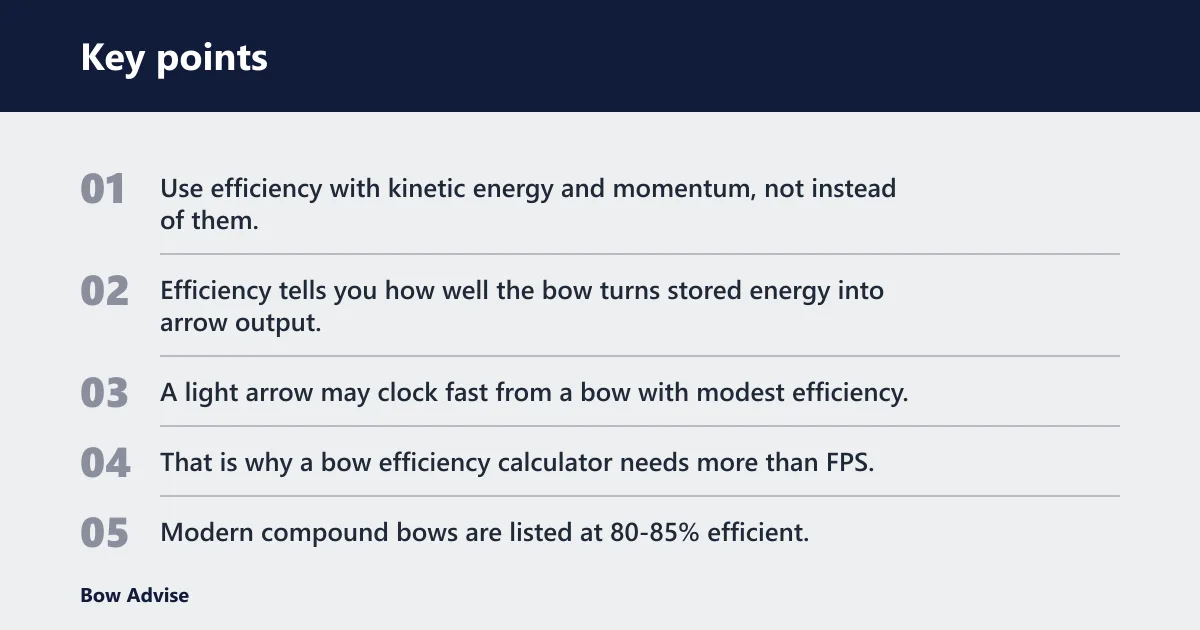
Use efficiency with kinetic energy and momentum, not instead of them. Speed helps with trajectory. Kinetic energy helps with impact energy. Momentum helps with penetration. Efficiency tells you how well the bow turns stored energy into arrow output.
Efficiency vs speed
Speed alone can mislead. A light arrow may clock fast from a bow with modest efficiency, while a heavier arrow may show lower speed even though the bow is transferring energy well. That is why a bow efficiency calculator needs more than FPS.
Bow type matters too. Modern compound bows are listed at 80-85% efficient. Recurve bows are listed at 65-75% efficient. Traditional longbows are listed at 50-65% efficient. Those bands are normal, not a verdict on whether a bow is “good.”
Efficiency, kinetic energy, and momentum
Kinetic energy is usually expressed in foot-pounds or joules, and momentum is often shown as slug-ft/s in some tools. A hunting setup can have fair efficiency but still be weak in impact energy if the arrow is too light. It can also be efficient but too slow for a clean sight picture at distance.
That is why a real estimate should include all three. Efficiency explains the transfer. Kinetic energy and momentum explain what the arrow brings downrange.
Why bow type changes the number
Compound bows use cams and cables to store and release energy in a more controlled way, so they usually land in a higher efficiency band. Recurves and longbows lose more energy to limb motion, hand shock, string vibration, and setup sensitivity. The same arrow does not behave the same way across those designs.
How do you calculate bow efficiency?
To figure efficiency, you need a chronograph reading, plus the setup data that shaped it. A practical back-calculation compares measured arrow speed to draw weight, draw length, and arrow mass, then checks whether the result fits the bow type. Without speed, you can guess only roughly; with speed, you can judge setup quality much better.
What numbers you need
Start with these inputs:
- Draw weight in pounds
- Draw length in inches
- Arrow mass in grains
- Measured arrow speed in FPS
The IBO standard uses 70 pounds, 30 inches, and a 350-grain arrow. That baseline gives a common comparison point, but real bows often differ from it in several ways at once.
Back-calculate from chronograph speed
Use the chronograph as the anchor. If the measured FPS is low for a bow that should be quick on paper, look first at setup and arrow mass before blaming the bow. If the speed is high but the bow feels harsh, look at energy transfer, brace height, and tune.
- Record draw weight, draw length, arrow mass, and chronograph speed.
- Compare the setup to the IBO base of 70 lbs, 30 inches, and 350 grains.
- Check whether the speed fits the bow type’s normal efficiency band.
- Look for likely causes of low apparent efficiency, such as extra accessory weight or tune problems.
How to read the result
If a compound lands near the upper part of its normal band, the setup is usually efficient enough for normal hunting and target use. If a recurve or longbow sits well below its normal band, the issue may be string setup, brace height, arrow spine, or simply the limits of that bow design.
A common first-timer mistake is judging efficiency from a single fast shot. Suppose a 70-pound compound with a 30-inch draw and a 350-grain arrow reads strong on the chronograph, but the string has extra accessories and the timing is off. The FPS may still look acceptable while the real efficiency is lower than it should be.
IBO speed standard explained
The IBO standard uses 70 pounds, 30 inches, and a 350-grain arrow. That makes speed comparisons easier because it gives everyone the same baseline. It does not mean your hunting bow should be set up exactly that way.
70 lb, 30 inches, 350 grains
Those three numbers matter because each one changes speed. Higher draw weight generally increases speed. More draw length usually increases speed as well. Heavier arrows reduce speed. The standard exists so manufacturers and readers can compare bows on common ground.
Why the standard exists
Without a shared baseline, speed claims are hard to compare. A 30-inch draw can produce more speed than a shorter draw, and a 350-grain arrow will fly faster than a heavier hunting arrow from the same bow. The standard reduces that noise.
How real setups differ from IBO
Most hunting setups are not IBO perfect. Accessory weight, actual arrow mass, peep sight, stabilizer length, and draw length all change the result. One competitor notes that each 1 inch of draw length change is about 10 fps, and another notes every 3 grains of arrow weight changes speed by about 1 fps. Those are rules of thumb, not a full replacement for a chronograph.
Bow efficiency lookup table
This table gives a text-only lookup for common setups. Use it to compare your reading against the bow type, then check the diagnosis notes before changing parts. The goal is not a single exact number. It is a realistic band and a likely cause when the band looks wrong.
| Bow type | Common efficiency band | Example setup | Likely diagnosis notes |
|---|---|---|---|
| Compound | 80-85% | 70 lbs, 30-inch draw, 350-grain arrow, clean timing | Normal if speed matches the setup. Lower than expected if cams are out of time, string accessories are heavy, or brace height is off. |
| Compound | 75-80% | 60 lbs, shorter draw, heavier hunting arrow | Often still acceptable. Check for added mass on the string, poor arrow spine, or a noisy shot that points to tune loss. |
| Recurve | 65-75% | 40-50 lbs, matched arrow spine, clean release | Normal for a well-set recurve. Lower readings often point to draw-length loss, limb design limits, or friction from poor string fit. |
| Recurve | 60-65% | Same bow with very light arrows | Light arrows can lift speed but not always efficiency. If the bow is harsh or noisy, arrow mass may be too low for the setup. |
| Traditional longbow | 50-65% | Moderate draw weight, heavier arrow, simple string | Normal range is lower than a compound or recurve. If the number is much lower, check brace height, string condition, and nock fit. |
| Traditional longbow | Below 50% | Over-light arrow or poor tune | Likely setup loss, not just bow design. Weak spine, excessive friction, or a bad string match can drag down the result. |
How do draw weight and draw length change efficiency?
Draw weight and draw length both change the amount of stored energy available to the arrow. More stored energy usually means more speed, but efficiency is the transfer rate, not the raw amount. That is why two bows can shoot the same FPS and still have different efficiency stories.
Draw weight and stored energy
More draw weight generally increases stored energy. If the bow is tuned well, more of that energy can move into the arrow. If the setup is poor, some of the extra energy is lost to vibration, timing error, or limb movement that does not help the arrow.
Draw length and speed changes
Longer draw length usually adds speed because the archer stores more energy. One competitor’s rule of thumb is about 10 fps for each inch of draw-length change. That helps with rough estimates, but it does not replace an actual chronograph reading.
Picture a 28-inch draw moving to 29 inches on the same compound. The arrow may pick up speed, but that does not automatically mean the bow is more efficient. It may simply be storing more energy because the archer is drawing farther.
Why 30 inches matters in IBO numbers
The IBO base draw length is 30 inches. That matters because many published speed numbers assume it. A shorter draw usually reads slower than the listed speed, and a longer draw often reads faster. If you do not account for that, efficiency estimates will drift.
How arrow weight changes efficiency
Arrow weight changes both speed and how the bow feels at release. Light arrows usually produce higher FPS. Heavier arrows usually reduce speed, but they can still be a better choice if the goal is a quieter shot and better hunting energy. Efficiency is not the same thing as “fastest arrow possible.”
Light arrows and speed gain
A light arrow can make a bow look fast on the chronograph. That does not prove the bow is more efficient. It may only show that the arrow is easy to move. Too-light arrows can also increase noise and harshness on some bows.
Heavier hunting arrows and speed loss
Heavier arrows reduce speed, and one common rule of thumb says every 3 grains changes speed by about 1 fps. That means a hunting arrow built 30 grains heavier than a target arrow may give up noticeable speed. The tradeoff is often stronger momentum and a steadier shot.
Suppose a bow shoots a 350-grain arrow cleanly, then the archer switches to a much heavier hunting shaft and sees a speed drop. That drop does not automatically mean the bow got less efficient. The extra mass alone can explain part of it.
When slower arrows still perform well
For hunting, slower is not always worse. Kinetic energy and momentum may still sit in a useful range for the game being pursued, even if the speed looks modest. Judge the setup by the full picture: efficiency, energy, momentum, and arrow construction.
What lowers apparent efficiency?
Some problems make a bow look less efficient than it should be. Others truly waste energy. The difference matters. A chronograph can reveal the symptom, but the setup details explain the cause.
Brace height and string accessories
Brace height, peeps, silencers, D-loops, and stabilizer weight can all affect speed. Extra accessory weight on the string often slows the arrow and can blur the simple efficiency estimate. The effect is not identical on every bow, so compare before and after on the same setup.
Cam timing and tune problems
On compounds, poor cam timing can lower apparent efficiency and make the bow feel rough. That is one reason a fast bow and an efficient bow are not the same thing. A bow may still post decent FPS while throwing energy into noise, vibration, or poor let-off timing.
Arrow spine, nock fit, and friction
Bad arrow spine can create poor launch behavior. Loose or tight nock fit can add friction or instability. On recurves and longbows, string fit and arrow shelf contact matter even more. Any of those can reduce the energy that reaches the arrow cleanly.
A common setup issue is a recurve that reads slower than expected with a heavy hunting shaft. If the spine is too weak, the bow can lose speed and consistency at the same time. The fix is often in the arrow match, not the limbs.
Frequently asked questions
How is efficiency calculated?
Efficiency is calculated as transferred arrow energy divided by stored bow energy, then shown as a percentage. For a field estimate, compare the arrow’s kinetic energy from the chronograph to the bow’s setup data: draw weight, draw length, and arrow mass. The result should be checked against the bow type’s normal band.
What is bow efficiency on a compound bow?
On a compound bow, efficiency is how much of the stored energy reaches the arrow after the cams and cables do their work. Modern compound bows are listed at 80-85% efficient. If the reading sits well below that band, check timing, string accessories, brace height, and arrow match before blaming the bow itself.
What is a good bow efficiency percentage?
A good bow efficiency percentage depends on bow type. A compound is usually strong in the 80-85% range, a recurve is commonly 65-75%, and a traditional longbow is often 50-65%. The right number is the one that fits the design and the setup, not the highest number on paper.
How do draw weight and draw length affect efficiency?
Higher draw weight and longer draw length usually raise stored energy, which can increase speed if the bow transfers that energy well. The IBO standard uses 70 pounds and 30 inches, so lower settings often read slower. More stored energy does not guarantee better efficiency if the setup wastes part of it.
Can I estimate bow efficiency without a chronograph?
You can make a rough guess without a chronograph, but it will be weak. The bow type and setup may suggest a likely band, yet you cannot back-calculate a serious estimate without speed. A chronograph is the cleanest way to separate a fast setup from an efficient one.