Arrow Length Vs Draw Length Compound Bow: Ultimate Guide Explained
Choosing the right arrow length for your compound bow isn’t just about following a chart or copying what someone else uses. It’s about safety, accuracy, and personal comfort. For many archers, new and experienced, understanding the relationship between arrow length and draw length can feel confusing. But getting this balance correct is the foundation for better shooting and a more enjoyable archery experience.
This guide will break down what matters, what mistakes to avoid, and how to confidently select the correct arrow length for your draw length. We’ll also look at the science behind the measurements, the impact on performance, and give practical examples so you won’t be left guessing.
Whether you’re a hobbyist or aiming for competition, these insights will help you make smarter decisions for your compound bow setup.


Understanding Draw Length
Draw length is the distance from the nocking point (where the arrow attaches to the string) to the grip’s deepest part, plus 1. 75 inches. For compound bows, this measurement is critical because the bow’s cams and limbs are designed to operate best at a specific draw length.
Why Draw Length Matters
- Accuracy: If your draw length is too short or too long, your anchor point changes, making it difficult to shoot consistently.
- Comfort: A proper draw length reduces muscle strain and helps you hold your aim steady.
- Safety: Drawing a bow past its intended length can damage the bow or cause an arrow to fall off the rest.
How To Measure Your Draw Length
One common way is to measure your wingspan (fingertip to fingertip) and divide by 2. 5. For example, if your wingspan is 70 inches, your estimated draw length is 28 inches. However, the most reliable method is to visit a pro shop, where they can measure you with proper equipment.
Pro Tip
Always check the manufacturer’s specs for your bow. Some compound bows have adjustable draw lengths, while others are fixed. Never set your draw length longer than your natural reach.
Arrow Length: What It Means And Why It Matters
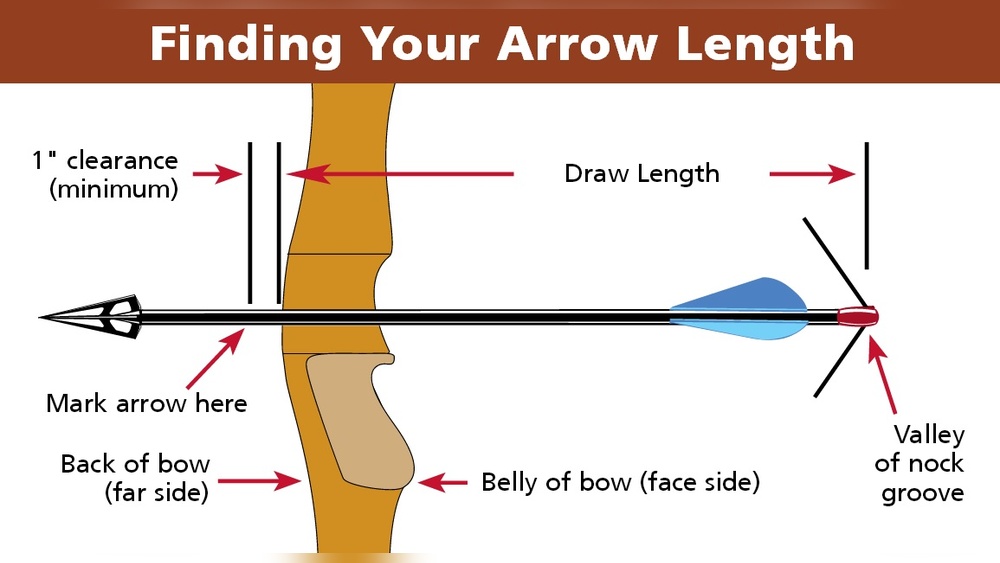
Arrow length is not the same as draw length. It’s measured from the nock groove (the slot where the string sits) to the end of the shaft, not including the point or broadhead.
The Purpose Of Correct Arrow Length
- Safety: An arrow that is too short can slip off the rest and be shot into your hand.
- Performance: Too long, and the arrow may be heavier than needed, losing speed and flattening your trajectory.
- Tuning: The right length makes tuning your bow easier and your shots more predictable.
How To Measure Arrow Length
Draw the bow with an extra-long arrow (at least 3 inches longer than your estimated need). Have a helper mark the shaft where it extends past the riser. Add about 1 inch to the draw length to get your ideal arrow length.
Arrow Length Vs Draw Length: The Key Relationship
The ideal arrow length is usually 1 to 2 inches longer than your draw length. This gives you safety margin and ensures the arrow tip stays in front of the riser at full draw.
Here’s a quick comparison for clarity:
| Draw Length (inches) | Recommended Arrow Length (inches) |
|---|---|
| 24 | 25, 26 |
| 26 | 27, 28 |
| 28 | 29, 30 |
| 30 | 31, 32 |
Two Key Insights Most Beginners Miss
- The arrow length you need may change if you use different arrow rests or broadheads. For example, a drop-away rest sits farther back than a whisker biscuit, so you might need a slightly longer arrow.
- Modern compound bows with aggressive cams might require a bit more clearance for broadheads. Always test with your actual setup before cutting arrows.
How Arrow Length Affects Performance
Arrow length is not just about safety, it directly influences how your compound bow performs.
Speed And Kinetic Energy
Shorter arrows are lighter (assuming same material and spine), so they fly faster. However, they must not be so short that they become dangerous. Longer arrows are heavier and slower but can offer more stability in flight, especially at longer distances.
Arrow Spine And Stability
The arrow spine (stiffness) must match both your draw length and arrow length. A longer arrow is less stiff, which can cause it to flex too much when shot from a powerful compound bow. This can hurt accuracy and even damage the arrow.
Example
If you shoot a 70-pound draw weight with a 30-inch draw length, a 28-inch arrow might be too weak (flexible), causing erratic flight. A 30-inch arrow with the correct spine rating will handle the energy better.
Credit: www.youtube.com
Choosing The Right Arrow Length: Step-by-step Guide
Follow these steps to select the ideal arrow length for your compound bow:
- Measure Your Draw Length: Use the wingspan method or get measured at a pro shop.
- Decide on Arrow Rest and Point Type: Choose your rest and whether you’ll use field points or broadheads.
- Test with a Full-Length Arrow: Draw a long arrow and mark where it passes the riser.
- Add Margin for Safety: Add at least 1 inch past the rest or riser.
- Check Manufacturer’s Recommendations: Some arrows have minimum cut lengths based on their spine rating.
- Order or Cut Arrows: Cut to length, then assemble with nocks and points.
Pro Tip: Always err on the side of a slightly longer arrow if unsure. You can shorten an arrow, but you can’t make it longer once it’s cut.
Common Mistakes When Matching Arrow And Draw Length
Cutting Arrows Too Short
This is one of the most dangerous mistakes. If your arrow is too short, you could draw the tip behind the riser. At full draw, it can slip off the rest, causing injury.
Ignoring Arrow Spine
Some archers pick an arrow based on length but ignore spine rating. A long, weak arrow will flex too much with a high-poundage bow, causing “fish-tailing” in flight.
Not Factoring In Broadheads
Broadheads are often longer than field points. If you cut arrows to just clear the riser with field points, you may find your broadheads dangerously close to your hand.
Changing Equipment Without Rechecking Length
Switching from a whisker biscuit to a drop-away rest, or changing your bow’s draw length, can change your ideal arrow length. Always measure again when you make a change.
Arrow Length, Draw Length, And Accuracy
Consistency Is Key
Consistent anchor points and draw length lead to tighter groups. An arrow that fits your draw length allows you to repeat your form every shot.
Effects On Trajectory
A too-long arrow adds weight, reducing speed and flattening your trajectory. This can make aiming at longer distances harder, especially for hunting. But a little extra length (1-2 inches) is usually a good trade-off for safety and versatility.
Tuning Your Bow
Proper arrow length makes bow tuning easier. Paper tuning, walk-back tuning, and bare shaft tests all depend on consistent arrow behavior. If your arrows are too long or too short, tuning becomes frustrating.
How Arrow Length And Draw Length Affect Hunting And Target Archery
Hunting
Hunters often use slightly longer arrows for safety and to accommodate broadheads. A 1. 5 to 2-inch margin is common.
- Example: If your draw length is 29 inches, a 30.5 or 31-inch arrow is a safe choice.
Target Archery
Target shooters sometimes use slightly shorter arrows for increased speed and a flatter trajectory. However, they never go shorter than the safety margin.
- Example: For a 28-inch draw length, a 29-inch arrow is typical.
Pro Tip
If you plan to shoot both field points and broadheads, always cut your arrows to match the broadheads. Safety comes first.
How To Adjust Arrow Length For Different Rests And Setups
The type of arrow rest can affect the ideal arrow length. Here’s a simple comparison:
| Arrow Rest Type | Arrow Length Needed | Notes |
|---|---|---|
| Whisker Biscuit | Draw Length + 1, 1.5 in. | Very secure, standard margin works |
| Drop-Away | Draw Length + 1.5, 2 in. | Rest sits farther back, needs extra clearance |
| Prong-Style | Draw Length + 1, 2 in. | Depends on rest position |
Switching between these rests? Measure again before cutting new arrows.
Arrow Length And Compound Bow Draw Weight
Arrow length and draw weight are connected by the arrow spine rating. As draw weight increases, the arrow needs to be stiffer. A longer arrow is less stiff, so you may need to buy arrows with a lower (stiffer) spine number.
Example
If you shoot a 60-pound bow with a 29-inch draw length, a 30-inch arrow needs a spine rating of at least 340 (stiffer) for safe and accurate shooting. Always check the arrow manufacturer’s chart.

Credit: www.outdoorlife.com
Real-world Scenarios: Making Adjustments
In my experience, the most common issue is archers switching bows and assuming their old arrows will still work. For example, when I moved from a 28-inch to a 29. 5-inch draw length, my arrows suddenly became too short for safe use.
I had to buy new shafts and cut them to the new length, adding about 1. 5 inches to my previous setup.
Another common scenario is when someone changes from field points to fixed-blade broadheads before hunting season. If their arrows were cut close with field points, the new broadheads sometimes sit behind the riser at full draw, an unsafe situation that’s easy to overlook.
Arrow Length, Draw Length, And Youth Archers
For young archers, it’s smart to buy slightly longer arrows than needed. As they grow and their draw length increases, the same arrows can be used safely for a longer period.
- Example: If a child’s draw length is 22 inches, consider using 24-inch arrows. As they grow, you can cut them down if needed.
When To Seek Professional Help
If you’re new to archery or unsure about measurements, visit a reputable pro shop. They can measure your draw length, recommend the right arrows, and even help with tuning. Online calculators can help, but nothing replaces hands-on expertise.
You can learn more about arrow length and draw length from the Wikipedia Arrow Article, which covers the technical aspects in greater detail.
Quick Reference: Arrow Length For Common Draw Lengths
Here’s a reference for typical setups (for compound bows):
| Draw Length (in.) | Arrow Length (in.) | Notes |
|---|---|---|
| 24, 25 | 25, 26.5 | Youth/Small Frame |
| 26, 27 | 27, 28.5 | Average Adult Female/Teen |
| 28, 29 | 29, 30.5 | Average Adult Male |
| 30, 31 | 31, 32.5 | Tall/Large Frame |
These are guidelines, always measure your specific setup before cutting arrows.

Credit: www.outdoorlife.com
Frequently Asked Questions
How Does Arrow Length Affect Flight And Accuracy?
Longer arrows are heavier, which can make them more stable in flight but slower. Shorter arrows are faster but can be less forgiving if the spine is too weak. For the best accuracy, match your arrow length and spine to your draw length and bow weight.
Can I Use The Same Arrows If I Change My Draw Length?
If your draw length increases, your arrows may become too short for safe shooting. It’s important to check arrow length with your new setup. If you decrease your draw length, longer arrows are safe but may be heavier than needed.
What Happens If My Arrow Is Too Long?
An arrow that’s too long is heavier, which reduces speed and flattens trajectory. However, it’s safer than being too short. Some archers use longer arrows to increase stability or for tuning reasons, especially with high-poundage bows.
How Do I Know If My Arrow Spine Matches My Draw Length And Arrow Length?
Check the arrow manufacturer’s spine chart. Input your draw weight, arrow length, and point weight. The chart will show the correct spine rating. If you’re between sizes, choose the stiffer option for safety.
Is There A Standard Arrow Length For Compound Bows?
There’s no universal standard; arrow length depends on your personal draw length, arrow rest, and tip type. Most adult compound bow users have arrow lengths between 27 and 31 inches, but always measure for your specific needs.
Matching your arrow length to your draw length is more than a technical detail, it’s a foundation for safe, enjoyable archery. Taking the time to measure, test, and adjust for your equipment and shooting style pays off with better accuracy, less frustration, and safer shooting. Always double-check your setup, especially when making changes. If in doubt, seek help from a pro shop or experienced archer. With the right knowledge and attention, you’ll find the perfect balance between arrow length and draw length for your compound bow.