Bow Let-Off Calculator: Holding Weight for Compound Bows
A bow let-off calculator uses this formula: let-off = 100 × (peak draw weight − holding weight) ÷ peak draw weight; for example, 60 lb peak and 12 lb holding weight equals 80% let-off. If you know the peak number and the valley number, the math is direct. A wrong holding-weight reading hides real draw effort and can skew tuning, stability, and shot timing. This guide shows how to calculate let-off, estimate holding weight, and verify whether your bow matches its spec at your true anchor point.
How is this calculated?
Press Calculate to see the math with your numbers.
What bow let-off means
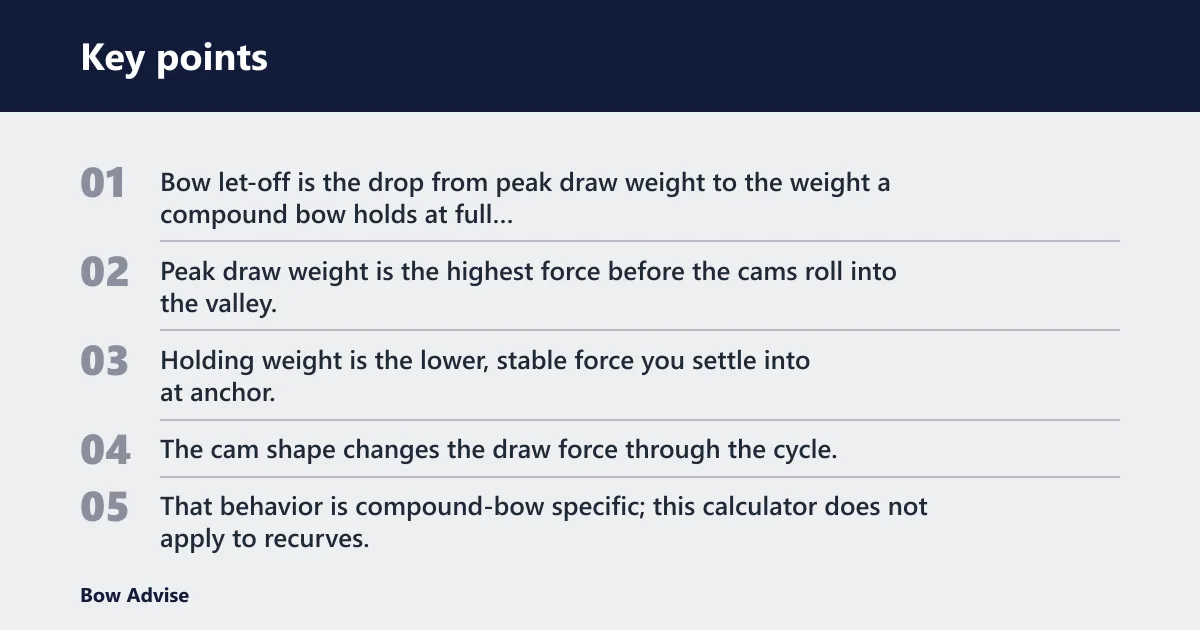


Bow let-off is the drop from peak draw weight to the weight a compound bow holds at full draw. Peak draw weight is the highest force before the cams roll into the valley. Holding weight is the lower, stable force you settle into at anchor.
Compound bow cams create that drop. The cam shape changes the draw force through the cycle, so the bow feels heavier on the way back and lighter at full draw. That behavior is compound-bow specific; this calculator does not apply to recurves.
Peak draw weight vs. holding weight
Peak draw weight is measured during the draw stroke before cam rollover. Holding weight is measured after the cam settles in the valley. The difference between them is what a shooter feels when aiming, settling pins, or holding on a target face.
Higher let-off means a lighter hold at full draw. Lower let-off means a heavier hold. More let-off reduces the force needed to stay at anchor, while less let-off leaves more weight on the wall.
Common let-off ranges and what they feel like
For most compound bowhunters, 80–85% is the practical sweet spot. A 60 lb bow at 80% let-off holds 12 lbs, which is a good reference point for the math and for scale checks. The tool includes let-off options from 60% to 90%.
Low-let-off setups, often discussed in the 60–75% range, hold more weight at full draw. Higher values reduce full-draw holding weight further. That can help with steadiness for some shooters, but it also changes how the bow feels at anchor.
A bow let-off calculator needs two real readings: peak weight and holding weight. From those, it can return let-off percentage. It can also work backward to estimate peak weight needed or to check whether an advertised spec matches the bow’s measured behavior.
The core holding-weight formula is holding weight = peak weight × (1 − let-off ÷ 100). The reverse check can be calculated as let-off% = (1 − holding ÷ peak) × 100. Those two formulas let you move in either direction and verify the numbers.
The holding-weight formula
Use the formula when you know the bow’s peak draw weight and the advertised or measured let-off. Example: 70 lb peak at 85% let-off gives 10.5 lb holding weight. That is a simple calculation, but it only stays useful if peak weight is measured correctly.
The let-off back-calculation formula
Use the back-calculation when you have scale readings from a real draw. If peak is 64 lb and valley is 12 lb, then let-off is (1 − 12 ÷ 64) × 100 = 81.25%. That measured result can sit a little above or below a catalog claim.
What inputs the calculator needs
- Peak draw weight from the draw stroke.
- Holding weight at the valley, at your true anchor point.
- The let-off percentage if you want holding weight only.
- Measured scale readings if you want actual let-off instead of the advertised number.
Many archery calculator pages separate these tasks. Rcherz has a dedicated Let Off Calculator under its archery calculators section, asks for measured maximum force and measured end force, and notes the function is available only to logged-in users. Archerycalculators.com also lists Bow Let-Off Calculator among its bow setup tools.
Measure peak and valley weight correctly
Use a bow scale, not a guess. A digital peak-hold model can capture the highest force and the lower valley reading in one draw. That matters because the peak happens just before rollover, while the valley is the stable number after the cam settles at anchor.
Read peak weight during the draw stroke, before the cam rolls over. Then settle into the valley and note the stable holding weight. If the scale bounces, pauses, or drifts, repeat the draw until the reading is steady enough to trust.
Using a bow scale
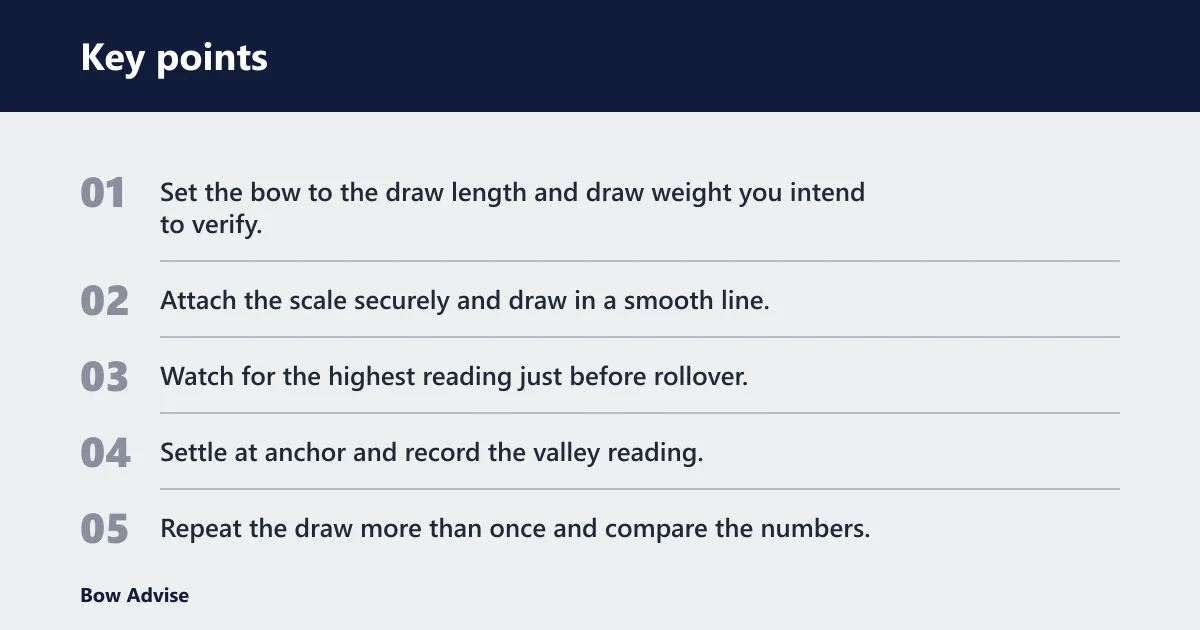
- Set the bow to the draw length and draw weight you intend to verify.
- Attach the scale securely and draw in a smooth line.
- Watch for the highest reading just before rollover.
- Settle at anchor and record the valley reading.
- Repeat the draw more than once and compare the numbers.
Reading the peak before cam rollover
The peak reading is not the number you hold at full draw. It is the top of the curve, just before the cams rotate past the heavy part of the stroke. If the scale is too slow or the draw is jerky, the peak can read low or high.
Suppose a shooter sees 62 lb on the scale, but the true peak is reached for only a moment near 64 lb before rollover. The lower number can make the bow look like it has more let-off than it really does.
Finding the stable valley at anchor
The valley reading should settle after the cam rolls into the back wall. Hold at your normal anchor, not a stretched or short position. If the number keeps sliding, the bow may still be settling, or the anchor may not match the normal shot position.
A common first-timer mistake is reading the valley before the bow is fully seated against the wall. That usually makes holding weight look too high or too low, depending on where the scale is caught in the motion.
Does anchor point change your reading?
Yes. A true anchor point changes how the bow loads into the valley, so it changes the number a scale records. If the anchor is shorter, longer, or slightly rotated from the normal shot position, both peak and valley readings can shift. That can make a healthy bow look out of spec.
Over-draw is another common error. If the archer pulls past the actual anchor or shortens the draw length, the scale can show a different peak and a different valley. The result is a measured let-off that does not match the bow’s real setup.
Why the true anchor matters
A bow is only “at” full draw when it is in the same position it occupies during a real shot. Chin height, release position, and wrist angle all affect whether the string stops where it should. A small change can alter the valley reading enough to confuse the math.
Over-draw and shortened draw length errors
If the draw goes past the normal wall, the peak can rise or the valley can shift. If the draw stops short, the holding weight may read lighter than expected. In both cases, the calculator is fine; the measurement is the problem.
How to repeat a clean measurement
Use the same stance, same anchor, and same draw path for each test. A common rule of thumb is to take at least three draws and compare them. If one reading is clearly off, discard it and repeat instead of averaging a bad number into the result.
Picture a bow set for a 30-inch draw. If the shooter stops at 29.5 inches on one draw and then reaches 30 inches on the next, the valley will not match. The bow did not change; the measurement point did.
Does limb bolt adjustment change bow let-off?
Limb bolt adjustment changes peak draw weight, but it does not materially change the let-off percentage. The cams still create the same general peak-and-valley pattern. What changes is the weight that sits on top of that pattern, so holding weight moves with peak weight.
If the limb bolts lower peak draw weight, the holding weight drops too. If the limb bolts raise peak draw weight, holding weight rises too. The percentage may stay close to the original cam design, but the actual pounds in hand will change.
What limb bolts do change
Limb bolts alter overall draw weight and limb preload. That changes how much force the bow stores and releases. It also changes the peak number you see on the scale, which is why a let-off calculator needs fresh readings after a weight adjustment.
What they do not change
Limb bolts do not re-cut the cam profile. They do not turn an 80% let-off bow into a 60% let-off bow. The bow may feel different because the draw weight changed, but the underlying cam behavior remains the same.
Let-off validation table
This table gives ten checkable scenarios. It pairs peak weight, holding weight, calculated let-off, a hunting or target reality check, and the most likely failure case. Use it to compare an advertised number with a scale reading at a real anchor point.
| Peak weight | Holding weight | Calculated let-off | Realistic use check | Failure-case note |
|---|---|---|---|---|
| 60 lb | 12 lb | 80% | Realistic for hunting | Clean baseline; matches the formula example |
| 70 lb | 14 lb | 80% | Realistic for hunting | Check that the peak was read just before rollover |
| 70 lb | 17.5 lb | 75% | Realistic for target use | Wrong anchor can make holding weight look higher |
| 60 lb | 21 lb | 65% | Realistic for target use | Over-draw may push peak higher than intended |
| 65 lb | 13 lb | 80% | Realistic for hunting | Inconsistent scale readings can move the result by a point or two |
| 62 lb | 9.3 lb | 85% | Realistic for hunting | Valley may be read before the bow fully settles |
| 58 lb | 11.6 lb | 80% | Realistic for hunting | Limb bolt change lowered both numbers, not the let-off percentage |
| 72 lb | 21.6 lb | 70% | Realistic for target use | Short draw length can distort the valley reading |
| 68 lb | 27.2 lb | 60% | Realistic for target use | Measure again if the scale bounce was heavy |
| 64 lb | 6.4 lb | 90% | Less common for hunting, more comfortable for some target setups | Advertised let-off may be higher than measured let-off tolerance |
Advertised let-off is a spec, not a guarantee. Small tolerance differences are normal, so a measured result a little above or below the brochure number is not unusual. What matters is whether the bow is close enough to the cam’s expected valley behavior for the setup and use case.
Frequently asked questions
What is bow let off?
Bow let-off is the percentage reduction from peak draw weight to holding weight on a compound bow. The higher the let-off, the lighter the bow holds at full draw. That is why the same peak weight can feel very different at anchor.
What does the let off on a bow mean?
It means how much of the peak draw weight has “let off” by the time the bow reaches the valley. A higher percentage leaves less force on the wall. A lower percentage leaves more force in the holding hand and usually feels firmer at full draw.
How do I calculate holding weight from peak draw weight and let-off?
Use holding weight = peak weight × (1 − let-off ÷ 100). If peak weight is 60 lb and let-off is 80%, the holding weight is 12 lb. This is the fastest way to estimate what the bow should hold before you put it on a scale.
How do I find my bow’s actual let-off with a scale?
Measure peak weight during the draw stroke, then record the stable valley at your true anchor point. Use let-off% = (1 − holding ÷ peak) × 100. Repeat the draw several times, because a single bad reading can hide the real cam behavior.
What bow has the most let off?
There is no single answer without the exact model and cam system. Many compound bows are sold in ranges that include 60% to 90% let-off options, but the only reliable way to compare bows is by their measured peak and valley readings, not by label alone.
Is high let-off better for hunting or target shooting?
High let-off is often a good fit for hunting because it lowers holding weight and can reduce fatigue at full draw. Target shooters may prefer lower let-off if they want more weight on the wall. The better choice depends on how steady the bow feels at anchor.