How Do You Your Own Draw Length For A Bow
Every archer, from beginner to expert, knows that achieving peak performance with a bow is about more than just strength and accuracy, it’s about fit. One of the most critical, yet often misunderstood, elements in archery is draw length. If you’ve ever struggled with consistency, comfort, or accuracy, improper draw length is likely a hidden culprit. Yet, many archers rely on guesswork or generic measurements, leading to suboptimal performance and even risk of injury.
Understanding and determining your own draw length is the foundation for choosing the right bow, improving shooting form, and developing confidence. Whether you’re a recreational shooter, a competitive archer, or a bowhunter, mastering this measurement will transform your experience. This comprehensive guide is packed with practical methods, expert insights, real-world examples, and actionable tips to help you accurately find, and fine-tune, your personal draw length for any bow.
Key Takeaways
- Draw length directly affects accuracy, comfort, and safety in archery.
- Several proven methods exist to measure your own draw length, each with unique benefits.
- Proper draw length selection helps prevent injury and enhances shooting consistency.
- Adjusting draw length for various bow types (compound, recurve, traditional) requires tailored approaches.
- Understanding real-world examples and common mistakes can dramatically improve your results.
Understanding Draw Length: What It Is And Why It Matters
Defining Draw Length
Draw length refers to the distance between the nocking point (where the arrow attaches to the bowstring) and the grip’s deepest part (pivot point), plus 1.75 inches, when at full draw. For compound bows, the industry standard measures from the nocking point to the pivot point, then adds the standard 1.75 inches as per the Archery Trade Association (ATA) guidelines.
The Impact On Performance
The right draw length ensures that your form, anchor point, and aiming are consistent. Too short a draw length can result in cramped posture, loss of power, and poor arrow flight. Too long a draw length forces you to overextend, risking shoulder strain and reducing accuracy.
Risks Of Incorrect Draw Length
- Injury: Overextension or cramping may lead to muscle strain or repetitive-use injuries.
- Accuracy Issues: Inconsistent anchor points and improper bow alignment can degrade shot grouping.
- Comfort Problems: Shooting with a mismatched draw length quickly becomes tiring and frustrating.
Data-driven Insights
A 2019 survey by USA Archery found that 68% of new archers used an incorrect draw length during their first year, leading to a 27% higher rate of quitting the sport compared to those who received professional fitting.

Credit: www.archerydezign.com
Methods To Measure Your Own Draw Length
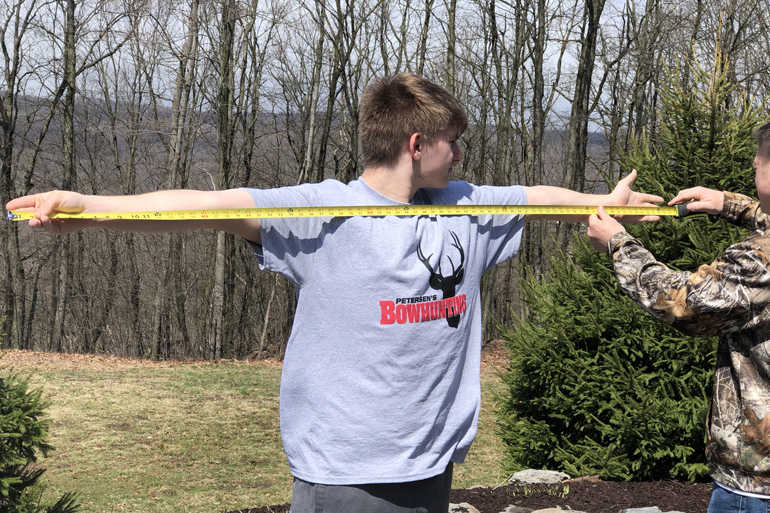
The “wingspan Divided By 2.5” Method
One of the most popular methods for estimating draw length is the wingspan method, valued for its simplicity and accessibility.
How to Use:
- Stand with your arms extended sideways, palms facing forward.
- Have someone measure the distance from the tip of one middle finger to the other.
- Divide the measurement (in inches) by 2.5.
Example:
If your wingspan is 70 inches:
70 ÷ 2.5 = 28 Inches Draw Length
Pro Tip: This method gives a good starting point, but it may not account for individual shooting form or flexibility.
The “arrow At Full Draw” Method
This technique involves using an actual arrow to gauge your draw length while at full draw position.
Steps:
- Use an extra-long arrow (at least 33 inches) with clear markings or tape at 1-inch intervals.
- Nock the arrow, draw the bow as you would when shooting, and have someone mark where the arrow meets the front of the bow’s riser.
- Measure from the nock groove to the mark.
Benefits:
This method accounts for your unique anchor point and shooting style, making it highly accurate for both compound and recurve bows.
The “draw Board” Or Bow Scale Method
For those with access to archery equipment, a draw board or bow scale offers the most precise measurement.
How it Works:
- Place your bow in the draw board device.
- Pull the string back to your full draw position.
- The device will indicate the exact draw length.
Example:
Many pro shops use this method for competitive archers, ensuring measurements down to 1/8 inch accuracy.
Comparison Table: Draw Length Measurement Methods
| Method | Accuracy | Equipment Needed | Best For |
|---|---|---|---|
| Wingspan / 2.5 | Good (±0.5″) | Measuring tape | Beginners, initial estimate |
| Arrow at Full Draw | Very Good (±0.25″) | Long arrow, helper | Intermediate, custom fit |
| Draw Board | Excellent (<0.125″) | Draw board, bow | Advanced, precision fitting |
Measuring Without Equipment
If you don’t have an arrow or measuring tape, you can estimate by standing with your arms out and marking the reach on a wall, then measuring the mark-to-mark distance with a household item (such as a yardstick or string).

Credit: www.3riversarchery.com
Adjusting Draw Length For Different Bow Types
Compound Bows
Compound bows allow for micro-adjustments in draw length, typically via rotating modules or changing cam positions. Most modern compounds offer adjustment ranges in ½-inch increments.
Steps to Adjust:
- Refer to the manufacturer’s manual for module or cam adjustments.
- Adjust the bow to your calculated draw length.
- Test at full draw, ensuring proper anchor point and comfortable posture.
Warning: Always use a bow press or consult a professional when making mechanical adjustments to avoid injury or equipment damage.
Recurve Bows
Unlike compounds, recurve bows have a “floating” draw length. Draw length here is determined by your anchor point and shooting style.
Tips:
- Select arrows at least 1-2 inches longer than your measured draw length for safety.
- Use a clicker (for Olympic recurve) to maintain a consistent draw length.
Traditional And Longbows
Traditional bows do not have fixed draw stops. Consistency depends heavily on muscle memory and anchor discipline.
Advice:
- Practice drawing to the same anchor point repeatedly.
- Use video or a coach to check for form drift over time.
Comparison Table: Draw Length Adjustability By Bow Type
| Bow Type | Draw Length Adjustability | Adjustment Method | Ideal For |
|---|---|---|---|
| Compound | High (modular, ½” increments) | Modules, cams | Precision, hunting, target |
| Recurve | Moderate (by anchor point) | Form, clicker | Olympic, traditional |
| Longbow/Traditional | Low (no stops) | Anchor discipline | Historical, instinctive |
Credit: www.bowhunter.com
Fine-tuning Draw Length For Maximum Accuracy
Checking Your Anchor Point
Your anchor point is where your hand comes to rest at full draw, often at the corner of your mouth, chin, or jaw. A stable, repeatable anchor is critical for consistent shooting.
- If your draw length is too short, your anchor point will feel cramped and inconsistent.
- If it’s too long, you’ll overextend, often pulling past your comfortable anchor.
Body Mechanics And Posture
Proper draw length aligns your shoulders, arms, and spine, reducing fatigue and promoting accuracy. Poor alignment can introduce torque and variability into your shot.
Checklist:
- Shoulders relaxed, not hunched.
- Bow arm slightly bent, not locked.
- String hand rests naturally at anchor point.
Testing And Feedback Loop
After setting your draw length, shoot several groups of arrows. Pay attention to:
- Group size: Tighter groups indicate good fit.
- Fatigue: Excess strain suggests an adjustment is needed.
- Form consistency: Video yourself or use a coach for feedback.
Example:
When testing a new compound bow, the draw length should initially be set to 29 inches (wingspan/2). 5 method). My anchor felt off, and my groups spread. After adjusting down to 28. 5 inches and focusing on my natural anchor, my accuracy and comfort improved dramatically.
Impact On Arrow Speed And Bow Efficiency
A longer draw length typically increases arrow velocity, as the bow stores more energy. However, it’s only beneficial if it matches your natural form, overreaching sacrifices control.
Real-world Examples And Common Mistakes
Example: Recreational Archer
Maria, a beginner, used the wingspan method and set her compound bow to 27 inches. She found herself unable to anchor consistently, and shots veered left. After a local pro shop measured her at 26. 25 inches using a draw board, her shooting improved and fatigue disappeared.
Example: Bowhunter In The Field
Mark, an experienced bowhunter, struggled with shouldering his gear during long hikes. He discovered that his draw length was set too long by ¾ inch. After correcting it, he noticed less strain and a significant improvement in both accuracy and comfort during hunting trips.
Common Mistakes To Avoid
- Ignoring Professional Help: Many archers skip consulting a pro shop or coach, missing out on expert fitting.
- Relying Solely on Estimates: While the wingspan method is a helpful start, it should be confirmed through actual shooting tests.
- Changing Form to Fit the Bow: Adjust the bow to fit your body, not the other way around.
- Overlooking Growth (Youths): Young archers need periodic re-measurement as they grow.
Data Table: Draw Length Errors And Their Effects
| Error | Potential Effect | Example Symptom |
|---|---|---|
| Too Short | Reduced power, inconsistent anchor | Low arrow trajectory, cramping |
| Too Long | Overextension, shoulder strain | Erratic groups, fatigue |
| Changing Form | Poor accuracy, form breakdown | Unstable anchor, inconsistent shots |
Tools And Resources For Accurate Draw Length Measurement
At-home Tools
- Measuring tape: For wingspan method.
- Long arrow with markings: For arrow-at-draw method.
- Mirror or smartphone: To check anchor point and posture.
Professional Tools
- Draw board: Offers precise, repeatable measurements.
- Bow scale: Measures draw weight at various lengths.
Online Calculators And Apps
Several reputable archery organizations, such as Archery360 (Archery360 Draw Length Guide), offer online calculators to estimate draw length based on wingspan and other metrics.
Pro Shops And Coaches
Visiting a certified archery pro shop provides access to professional-grade tools and expert fitting. Certified coaches can also observe your shooting form and suggest adjustments for optimal draw length.
Pro Tip: Schedule annual fittings, especially if you’re a youth or your shooting style changes.
Adapting Draw Length For Different Purposes
Target Archery
Target archers typically prefer a slightly longer draw length (within safe limits) to maximize power and arrow speed, enhancing long-range accuracy.
Bowhunting
Bowhunters prioritize maneuverability and comfort, especially in blinds or tree stands. A slightly shorter draw length can improve shot execution in confined spaces.
Youth And Growth Considerations
For young archers, bows with adjustable draw lengths are ideal. Manufacturers like Genesis and Diamond offer models that accommodate rapid growth spurts, helping maintain safe and effective shooting form.
Example: Youth Progression
When coaching a 12-year-old archer, I recommended a bow with a broad adjustment range (18, 28 inches). Over two years, we increased the draw length incrementally as the archer grew, ensuring continued comfort and accuracy without needing to replace the equipment.
Adaptive Archery
Archers with physical disabilities may require custom draw length solutions, often involving specialized equipment or tailored anchor points. Consult with adaptive archery programs or specialists for personalized guidance.
Optimizing Bow Selection And Setup Based On Draw Length
Choosing The Right Bow
When purchasing a bow, always select models that offer your required draw length within their adjustment range. Compound bows typically advertise their range in product specifications.
Arrow Selection
Arrows must be matched to your draw length for safety and performance. Generally, arrows should be 1, 2 inches longer than your draw length to avoid overdrawing.
Sight And Accessory Placement
Shorter or longer draw lengths affect the distance from eye to peep sight, sight pin settings, and stabilizer balance. After adjusting draw length, fine-tune these accessories for optimal sight picture and balance.
Example: Accessory Adjustment
After switching from a 30-inch to a 29-inch draw length, I needed to move my peep sight and adjust sight pins to maintain the same point of aim at various distances.
Working With Pro Shops
Many archery retailers offer draw length fitting services as part of bow setup. Leverage their expertise to ensure your entire setup, bow, arrows, and accessories, is tailored to your measurement.
Pro Tip: Request a printout or record of your final draw length and settings for future reference or equipment upgrades.
Frequently Asked Questions
What If My Wingspan And Anchor Point Suggest Different Draw Lengths?
It’s common for the wingspan formula and anchor point testing to yield slightly different results. In these cases, prioritize the draw length that allows for a natural, repeatable anchor point and comfortable shooting form. The wingspan method is a guideline; your shooting experience should have the final say.
How Often Should I Recheck My Draw Length?
You should reassess your draw length annually or after significant changes in physical condition, shooting style, or equipment. Youth archers should check more frequently, especially during growth spurts, to avoid developing poor form or risking injury.
Can I Use The Same Draw Length For All Types Of Bows?
While your body mechanics dictate a natural draw length, you may find slight variations between bow types due to differences in anchor points and grip shapes. Always measure and test draw length adjustments when switching between compounds, recurves, and traditional bows.
What Should I Do If My Bow’s Draw Length Range Doesn’t Match My Needs?
If your bow cannot be adjusted to your correct draw length, it’s best to consult a pro shop. Sometimes, swapping modules or cams can expand the range; otherwise, consider trading for a model that fits your specifications. Using an ill-fitting bow can compromise safety and performance.
Are There Professional Standards For Draw Length Measurement?
Yes, the Archery Trade Association (ATA) provides standardized methods for measuring draw length, especially for compound bows. For detailed technical information, refer to the Draw Length Wikipedia page and manufacturer manuals for bow-specific procedures.
Finding your ideal draw length is a vital step toward enjoying archery to its fullest. By using the methods and insights in this guide, you can confidently set up your equipment, avoid common pitfalls, and experience greater consistency and satisfaction every time you shoot.
As your skills and interests evolve, continue to revisit your draw length and seek expert advice to ensure your archery journey stays on target.